

This article gives you a scripture-centered bank of accountability questions for men, organized by category, plus the meeting rhythm that makes them work. Pick three questions before your next check-in and protect a weekly or biweekly time slot for using them. Men who pair honest questions with a consistent cadence report a clearer conscience, deeper honesty with the men around them, and real traction in their walk with Christ.
TL;DR:
- Effective accountability groups consist of three to five men meeting weekly or biweekly to ensure honesty and prevent members from hiding or the group from losing focus.
- Questions should cover key areas such as spiritual growth, thought life, marriage, work integrity, and leadership, with specific prompts like examining lust or financial honesty.
- A structured, Scripture-centered format with confidentiality and a "go-first" norm promotes genuine vulnerability and ongoing trust.
- Red flags for accountability partners include gossip, repeated cancellations, or vague confidentiality, emphasizing the importance of trust and transparency.
- Vetted groups like ISI Brotherhood offer ready-made cohorts that incorporate these principles, saving months of self-organization and focusing on character and calling.
Table of Contents
- Accountability Questions for Men, Organized by Category
- How to Run an Effective Accountability Check-In
- How to Choose an Accountability Partner or Group
- How ISI Brotherhood Models This in Practice
- A Brief Word From Derek
- ISI Brotherhood: A Vetted Option If You'd Rather Not Build This Alone
- Resources for Further Study
- Sources
- FAQ
Accountability Questions for Men, Organized by Category
Random questions in a random meeting produce random results. What actually changes a man is a short list of pointed questions, asked in the same categories, on a rhythm he can't quietly skip. Below are six categories that cover the ground where most men either grow or quietly stall out. Each one opens with a Scripture anchor and a one-line goal, then gives you questions ready to use verbatim.
Spiritual life: Scripture and prayer
Goal: Keep first things first before anything else gets discussed.
Galatians 6:2 tells believers to "carry each other's burdens," and that starts with knowing whether a brother is even in the fight spiritually. James 5:16 adds the promise behind the discomfort: confession and prayer for one another lead to healing.
- Did you spend unhurried time in Scripture this week, or did it get squeezed out?
- When you prayed, was it mostly requests, or did you also listen?
- What is God currently teaching you, and how are you applying it?
- Is there a sin you're avoiding naming, even here?
- Did you worship in community this week, and why or why not?
- What's one verse that confronted you this week?
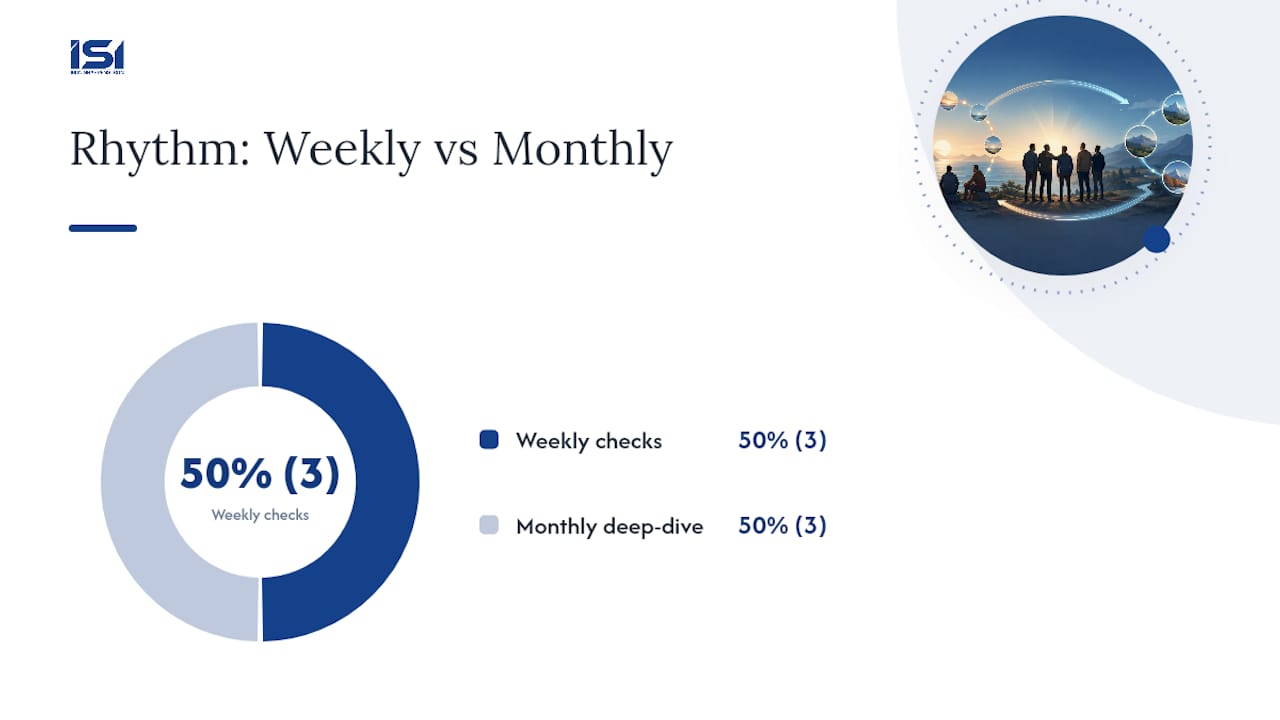
Questions 1, 2, and 5 work well as weekly quick checks. Questions 3, 4, and 6 are better suited to a monthly deep-dive conversation where you have more time to sit with the answer.
Marriage, parenting, and friendship
Goal: Measure whether your closest relationships are getting your best energy or your leftovers.
- Did your wife feel pursued or managed this week?
- When did you last have an unhurried conversation with your kids, not about logistics?
- Are you carrying resentment toward your spouse you haven't voiced?
- Who did you check in on this week besides your own household?
- Is there a friendship you've let go cold that you need to revive?
- Did your family see you angry more than they saw you patient?
- What did you sacrifice this week for your family, and what did you protect instead?
Questions 1, 3, and 6 belong in weekly rhythm. The friendship and sacrifice questions do better as monthly reflection, since they take longer to answer honestly. A structured guide to marriage and intimacy can help if the marriage questions keep surfacing the same pattern.
Thought life and purity
Goal: Surface what happens in private before it becomes public.
- Did you look at anything this week you'd be ashamed for your wife or pastor to see?
- Where were you alone with your phone or laptop, and what did you do with that privacy?
- Did lust show up in a daydream, a joke, or a second glance you indulged?
- Are you using work travel, late nights, or stress as an excuse for compromise?
- What safeguard did you actually use this week, not just say you'd use?
This category is a weekly non-negotiable. Waiting a month to ask it gives a struggling man four extra weeks to hide.
Work, finances, and integrity
Goal: Test whether your business ethics match your Sunday convictions.
- Did you tell a client, employee, or partner anything you knew was misleading?
- Are your finances (business or personal) something you'd let this group audit right now?
- Did you cut a corner this week because it was profitable, not because it was right?
- Are you giving generously, or have you quietly stopped?
- Did you treat an employee or vendor with the same respect you'd want from a boss?
- Is there a debt or financial decision you're hiding from your spouse?
Leadership and character
Goal: Ask whether you're leading from conviction or from convenience.
- Did you make a decision this week out of fear of what people would think?
- Where did you take credit that belonged to someone else?
- Did you apologize for something you got wrong, or did you let it slide?
- Are you leading your team, church, or family the same way in private as in public?
Mission and service
Goal: Check whether your faith is producing fruit outside your own household.
- Who did you serve this week who couldn't do anything for you in return?
- Did you share your faith, even briefly, with someone who doesn't know Christ?
- Are you using your business or platform for anything beyond your own gain?
A biblical accountability group typically runs 3 to 5 men on a consistent, recurring rhythm, meeting weekly or biweekly, built around prayer and Scripture-centered honesty rather than a loose support-group format. That size matters more than most men assume. Below four men, you lose enough voices that one bad week can derail the whole group. Above five, someone always has a reason not to talk.
How to Run an Effective Accountability Check-In
The questions above only work inside a structure that protects honesty. Without one, even great questions turn into small talk with a Bible verse tacked on.
Group size and cadence: Stick to 3 to 5 men, meeting weekly or biweekly for 30 to 60 minutes. Larger groups feel productive but quietly let men hide in the crowd.
A simple meeting template:
- Open with a short Scripture reading, two minutes, no lecture.
- Answer three prioritized questions from your categories, chosen ahead of time.
- Share one win and one struggle from the week, briefly.
- Voice specific prayer requests, not vague ones like "pray for my week."
- Name one commitment for the next seven days, out loud, to the group.
This kind of focused format keeps meetings from sprawling into an hour of catching up with no actual accountability happening.
Four rules keep the whole thing from collapsing. Make confidentiality clear from day one, out loud, not assumed. Adopt a "go-first" norm where the most seasoned man in the room answers honestly before asking anyone else to. Protect the rhythm: this is not a meeting you casually cancel because work got busy. And insist on short, direct answers instead of long explanations that dodge the actual question.
Confidentiality, honesty, and a protected cadence are the three non-negotiables that separate real accountability from a friendly chat that only happens to mention God.
Pro Tip: Watch for "polished answers." A man who always says "good week, no struggles" is usually the one carrying the most. Ask a specific follow-up instead of moving on.
For busy men, a 30-minute video call works fine if the questions are chosen in advance. Rotate who facilitates each week so it's never one man's job to carry the whole group, and use a shared checklist, even a simple shared document, to track commitments from one meeting to the next. Structure like the one outlined in ISI Brotherhood's guide to building a men's accountability group shows how this looks in practice over several months, not just one good meeting.
How to Choose an Accountability Partner or Group
The wrong partner will nod along and change nothing. The right one will make you uncomfortable in the first month, on purpose.
Look for a mature Christian faith that shows up in ordinary decisions, not just Sunday statements. Look for humility, the kind that admits fault before being confronted. Look for the courage to actually say the hard thing out loud instead of hinting at it. Look for a track record of confidentiality with other people's business. Look for Scripture-centered conviction rather than a man who leads with his own opinions dressed up as biblical wisdom.
Red flags show up fast if you're watching. Gossip about other men in the group is the clearest one. Vague or unspoken confidentiality expectations are another. Repeated no-shows or canceled meetings signal the group isn't actually a priority for that man. And moralism, correction without grace, turns accountability into judgment instead of growth. Effective accountability depends on authentic friendship and trust built before the hard questions start, not accountability imposed on a stranger.
Before inviting someone in, ask three things directly:
- Will you tell me the truth even when it costs you the friendship?
- Can I trust you with something I haven't told my spouse?
- Are you willing to go first when the questions get uncomfortable?
If you want more structure than a peer-led group naturally provides, a church-led group or a vetted mastermind cohort adds facilitation, consistent format, and outside accountability for the group itself. A businessman-focused accountability structure tends to fit leaders whose schedules make an informal, self-organized group hard to sustain.
How ISI Brotherhood Models This in Practice
Members are placed into a small Personal Board of Advisors, typically the same size range recommended above, that meets on a regular cadence and works through five specific areas: personal, spiritual, relational, professional, and financial.
- Confidentiality is made clear from day one, not assumed or left to interpretation.
- The rhythm is protected. Meetings aren't casually rescheduled around convenience.
- A facilitator norm keeps the group asking real questions instead of drifting into generic encouragement.
- The five-area structure maps closely onto the categories in the question bank above.
For a practical breakdown of how this works over 30, 60, and 90 days, ISI's leadership accountability framework walks through the specifics.
A Brief Word From Derek
My own rhythm is simple: a weekly check-in with one other man, Scripture first, then the hard questions. It's not complicated, and it's not always comfortable. If you don't have this yet, invite one brother this week and protect that time on your calendar before anything else claims it.
— Derek
ISI Brotherhood: A Vetted Option If You'd Rather Not Build This Alone
Building an accountability group from scratch takes months of trial and error, mostly figuring out who will actually show up and tell you the truth. ISI Brotherhood skips that guesswork by placing you directly into a small mastermind cohort of vetted Christian business owners and leaders, already structured around weekly meetings, a Personal Board of Advisors, and the five areas of growth this article walks through.
Members get more than a weekly meeting. There is a year-round online community, leadership events both virtual and in-person, and a full library of teaching, including reflections like What a Privilege It Is to Be the Patriarch, that dig into the same questions of character and calling covered here. Your Personal Board applies the exact rhythm outlined above: get the right men in the room, protect the rhythm, and make confidentiality clear before anything deep gets said. If a DIY group feels like one more thing to manage on top of running a business, learn more about joining an ISI mastermind and see whether a Personal Board fits where you are right now.
Resources for Further Study
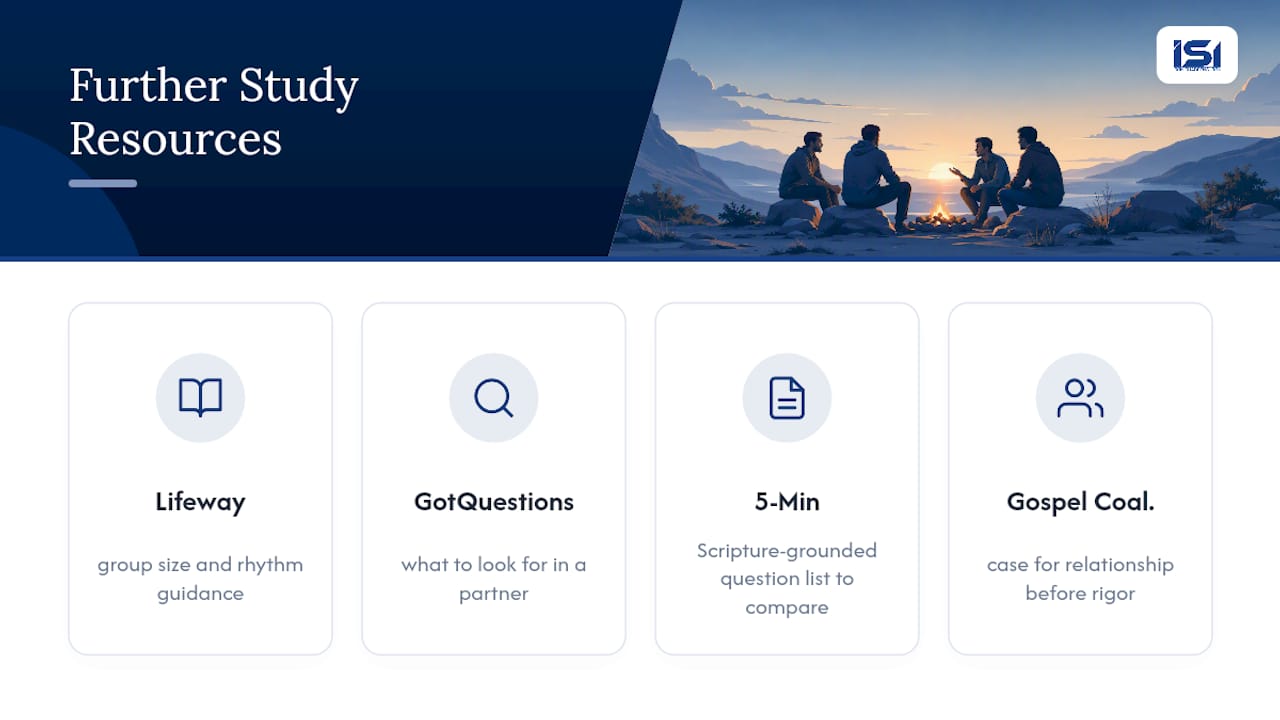
A few ministry resources go deeper on specific pieces of this topic. Lifeway's guide to accountability group success covers group size and rhythm in more detail. GotQuestions breaks down what to look for in a partner. 5 Minute Discipleship offers a separate list of Scripture-grounded questions worth comparing against this one. Eternal Perspective Ministries traces meeting formats back to historical practice, including Wesley's early Methodist bands. The Gospel Coalition makes the case for relationship before rigor.
Sources
- The resolution for men: keys for accountability group success (Lifeway)
- What should I look for in an accountability partner? | GotQuestions
- 21 accountability questions for Christians (5 Minute Discipleship)
- What makes a good accountability partner? (The Gospel Coalition)
FAQ
What are some good accountability questions?
Strong questions are specific and hard to dodge, covering Scripture and prayer, thought life, marriage and family, and work integrity, such as "Did you look at anything this week you'd be ashamed for your wife to see?" rather than a vague "How's your walk with God?"
What are the five P's men use for accountability?
Definitions vary by ministry and there's no single agreed-upon list. Rather than force a version that isn't well established, focus on the five areas ISI Brotherhood uses instead: personal, spiritual, relational, professional, and financial.
What does the Bible say about men being accountable?
Galatians 6:2 calls believers to carry one another's burdens, and James 5:16 links confessing sin to one another with prayer and healing, both pointing to accountability as a relational and spiritual discipline, not just a self-improvement habit.
What were John Wesley's 22 questions?
Wesley and the early Methodist "holy clubs" used a set of probing self-examination questions covering pride, honesty, temptation, and daily devotion, and versions of this list are still referenced by ministries like Eternal Perspective Ministries as a model for modern accountability groups.
How many men should be in an accountability group?
Most ministry guidance recommends 3 to 5 men meeting weekly or biweekly, a size small enough that no one can hide and large enough to sustain the group if one man misses a week.