

If you're a Christian founder or executive asking whether you need a Personal Board of Advisors or a formal board of directors, the answer is almost always the same: if you're seeking spiritual accountability, peer wisdom, and relational growth, you need a Personal Board. If your company has shareholders, investors, or legal governance requirements, you need a board of directors. Many leaders eventually need both, but they serve entirely different purposes.
A Personal Board of Advisors is a faith-based mastermind cohort — a small circle of trusted peers who speak into your life across personal, spiritual, relational, professional, and financial dimensions. A board of directors is a formal governance body with fiduciary duties, legal authority, and accountability to stakeholders. Confusing the two is one of the most common and costly mistakes Christian business owners make. Iron Sharpens Iron (ISI) exists precisely to help men build the first kind — and to do it with biblical intentionality.
Table of Contents
- What is the difference between a Personal Board and a board of directors?
- How do these two structures compare across what matters most?
- Which structure should you choose?
- How do you start or join a Personal Board of Advisors?
- How does a Personal Board complement a formal board?
- What pitfalls and red flags should you watch for?
- Key Takeaways
- What ISI's placement model actually looks like
- Ready to build your Personal Board of Advisors?
- Useful sources and next steps
What is the difference between a Personal Board and a board of directors?
A Personal Board of Advisors, as used throughout this article, is a faith-centered mastermind cohort: a small group of Christian men who meet regularly to challenge, encourage, and hold one another accountable across five life areas — personal, spiritual, relational, professional, and financial. No equity changes hands. No legal paperwork is signed. The value is relational and spiritual, not contractual.
A board of directors is a formal corporate governance body elected or appointed to represent shareholders and stakeholders. Directors carry fiduciary duties — loyalty, care, and obedience to the company's legal obligations. They vote on major decisions, approve budgets, and can be held legally liable.

Primary purposes, side by side:
Personal Board of Advisors:
- Peer accountability and spiritual growth
- Honest counsel across all life domains, not just business
- Preventing isolation and burnout through trusted relationships
- Applying biblical wisdom to real decisions without presumption
Board of Directors:
- Fiduciary oversight and legal compliance
- Investor and stakeholder representation
- Strategic governance and executive accountability
- Regulatory and reporting obligations
ISI's model builds Personal Boards intentionally, placing each member into a small cohort where faith-rooted mentorship translates spiritual conviction into testable, practical strategies.
How do these two structures compare across what matters most?
| Dimension | Personal Board of Advisors | Board of Directors |
|---|---|---|
| Primary purpose | Personal, spiritual, and professional growth | Corporate governance and fiduciary oversight |
| Authority & legal status | No legal authority; purely advisory | Legal authority; fiduciary duties and liability |
| Membership & selection | Peers chosen for trust, diversity of perspective, and shared values | Elected or appointed by shareholders/stakeholders |
| Meeting cadence & format | Weekly or biweekly mastermind meetings; informal, relational | Quarterly formal meetings; minutes, resolutions, voting |
| Confidentiality & accountability | Confidentiality covenant; mutual peer accountability | Formal minutes, public filings, legal record |
| Compensation & time commitment | Typically volunteer or reciprocal; 1–2 hours per meeting | Directors often compensated; significant time and legal exposure |
| Outcomes & measures of success | Character growth, decision clarity, spiritual integrity | Company performance, compliance, shareholder value |
| When to use both | Always for personal growth; add formal board when investors or legal governance require it | Required when company structure, investors, or law demands it |
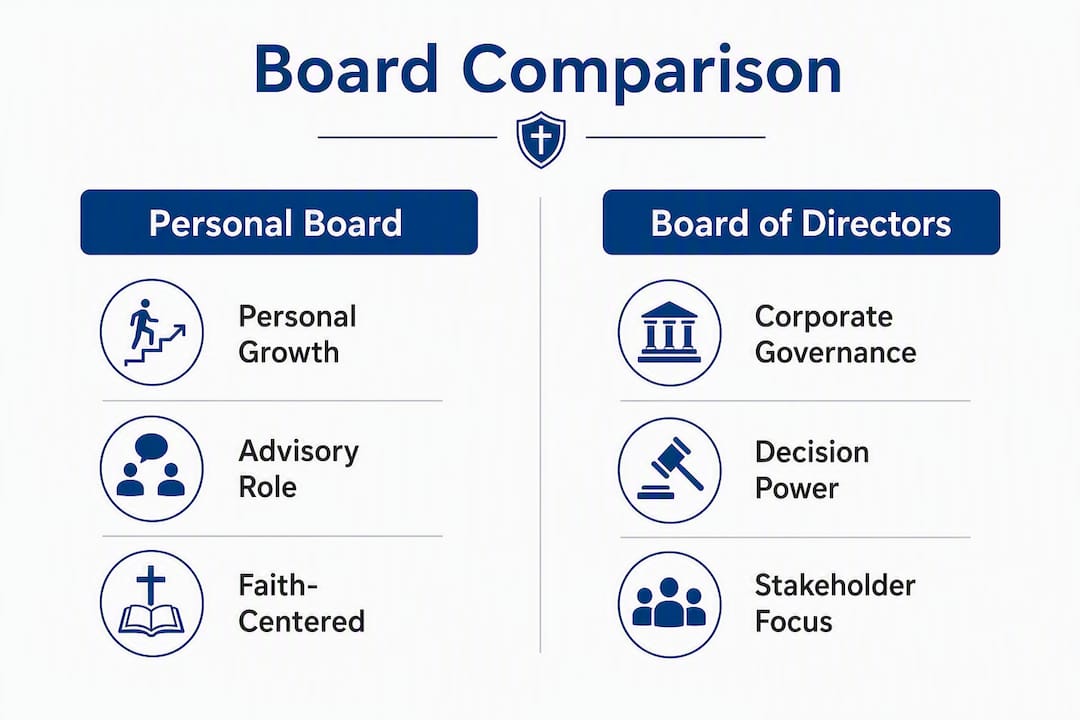
Three differences hit hardest for Christian founders. First, decision power: your Personal Board advises; your board of directors decides. Blurring that line creates confusion and potential liability. Second, fiduciary liability: directors can be sued; Personal Board members cannot. Third, spiritual and relational accountability: a board of directors will never pray with you over a hard call or ask how your marriage is holding up. A well-constructed personal advisory cohort reduces founder isolation and accelerates decision-making in ways formal governance simply cannot.
Which structure should you choose?
The decision usually comes down to where you are in the business and what kind of help you actually need.
You need a Personal Board of Advisors if:
- You're a solo founder or early-stage owner who needs honest peers, not a governance structure
- You want spiritual accountability woven into your professional development
- You're making decisions that affect your family, faith, and finances simultaneously
- You have a revenue level and specific decisions that justify peer counsel
You need a board of directors if:
- You've taken on investors or have shareholders expecting formal governance
- Your company's legal structure (C-corp, nonprofit) requires one
- You're preparing for a capital raise, acquisition, or public offering
Three short profiles:
Solo founder, under $200K ARR: A Personal Board is the right move. No investor requires a formal board yet, and what you need most is honest peers who will press you on your pricing, your priorities, and your prayer life. As a practical rule, paying for a peer group is worthwhile once you reach $200K in annual revenue and have specific decisions that justify the expense.
Scaling founder with outside investors: You likely need both. Your investors may require a formal board; your soul still needs a Personal Board where you can speak freely without legal exposure.
Mature company with shareholders and compliance obligations: A formal board is non-negotiable. A Personal Board remains valuable for the CEO's personal formation and for processing governance decisions before they reach the boardroom.
Pro Tip: In faith-based groups, the greatest risk is not conflict but consensus. When everyone shares the same theology and social circle, groupthink can masquerade as spiritual unity. Build in a Devil's Advocate seat from day one.
How do you start or join a Personal Board of Advisors?
Step-by-step checklist:
- Define your five seats using the five-seat archetype: Operator, Pattern-Matcher, Domain Expert, Emotional Anchor, and Devil's Advocate. More than seven members makes cadence hard to sustain.
- Recruit for trust and diversity of perspective, not just shared industry or theology.
- Set a meeting cadence: weekly or biweekly works best for mastermind-style accountability; monthly 60-minute calls work for lighter advisory relationships.
- Establish a confidentiality covenant before the first meeting (template below).
- Run two trial meetings before formalizing any commitments.
- Review the group's health at the six-month mark and adjust seats or cadence as needed.
Membership expectations:
- Show up prepared with a real challenge or decision to bring
- Reciprocate: give as much as you receive
- Honor the confidentiality covenant without exception
- Commit to the cadence; chronic absence breaks trust fast
Sample 60-minute Personal Board meeting agenda:
- 0–5 min: Opening and brief spiritual check-in (one word or verse each)
- 5–15 min: Round-robin wins and challenges (2 minutes per person)
- 15–45 min: Hot seat — one member presents a live decision or struggle; group asks questions, then offers input
- 45–55 min: Commitments — each member states one action before the next meeting
- 55–60 min: Prayer and close
Confidentiality covenant (adapt as needed): When conversations touch on governance, investor relations, or fiduciary obligations, consult qualified legal counsel — a Personal Board is not a substitute for professional legal advice.
How does a Personal Board complement a formal board?
Think of the two structures as operating on different planes. Your Personal Board works on you — your character, your clarity, your courage. Your board of directors works on the company — its compliance, its capital, its strategic direction. The two are not in competition; they feed each other.
In practice, your Personal Board is where you process a hard governance decision before it reaches the boardroom. You can speak freely, test your reasoning, and examine your motives without creating a legal record. What emerges is a sharper, more grounded version of you walking into that formal meeting.
Clear handoffs matter. Your Personal Board can recommend, challenge, and pray. It cannot vote, bind the company, or override directors. When a conversation in your mastermind touches on investor rights, shareholder agreements, or regulatory compliance, that conversation belongs with counsel or your formal board, not your peer group.
What pitfalls and red flags should you watch for?
Red flags in faith-based Personal Boards:
- Advisors acting as though they have decision-making authority over your business
- Mixing donor, investor, or vendor relationships with advisory roles without clear disclosure
- Lack of diversity in thought, background, or life stage — a room of identical perspectives is an echo chamber
- Spiritual pressure that substitutes Scripture for professional expertise ("God told me you should do X")
- No written expectations, leading to unspoken resentments about time and reciprocity
Mitigations:
- Put expectations in writing before the first meeting, including confidentiality and conflict-of-interest disclosures
- Rotate the hot seat so no single member dominates the group's attention
- Protect the Devil's Advocate seat — someone must be empowered to push back
- Revisit group health every six months; formalization often kills candor, so keep structure light
A specific note for faith communities: Scripture should inform your values and shape your character. It should not substitute for a lawyer's review of your partnership agreement or an accountant's read of your tax exposure. The most dangerous version of a faith-based Personal Board is one where "we prayed about it" becomes a reason to skip professional due diligence.
Key Takeaways
A Personal Board of Advisors builds the leader; a board of directors governs the company — and most Christian business owners need the first long before they need the second.
| Point | Details |
|---|---|
| Personal Board vs formal board | Personal Boards provide relational accountability and spiritual growth; boards of directors carry legal authority and fiduciary duties. |
| When to add a formal board | Add a board of directors when investors, shareholders, or your legal structure require formal governance. |
| Five-seat model | Build your Personal Board with five roles: Operator, Pattern-Matcher, Domain Expert, Emotional Anchor, and Devil's Advocate. |
| Legal caveat | Consult qualified legal counsel for any governance, fiduciary, or investor-relations questions — a Personal Board is not a substitute. |
| Isibrotherhood's model | ISI places members into faith-centered Personal Boards with weekly mastermind meetings, year-round community, and leadership events. |
What ISI's placement model actually looks like
The thing that separates a well-run Personal Board from a casual accountability group is intentional placement. At Isibrotherhood, every member is placed into a small mastermind cohort — a Personal Board of Advisors built around trust, shared faith, and complementary life experience. Weekly meetings follow a structured format that covers all five life areas: personal, spiritual, relational, professional, and financial. The year-round online community keeps the relationships active between meetings, and leadership events deepen the bonds formed in those small groups.
Christian business leaders consistently report that the most dangerous trap is leading alone — that isolation is where integrity erodes and burnout takes root. ISI's model is built around that reality. The placement process is designed to put you in a room with men who will tell you the truth, pray with you through the hard seasons, and hold you to the commitments you make.
Ready to build your Personal Board of Advisors?
Isibrotherhood offers something most business communities don't: a structured placement process that puts you into a Personal Board of Advisors built for your stage of life and business. You're not dropped into a generic group chat. You're matched with a small cohort of Christian men committed to the same five-area growth model, meeting weekly with a clear agenda and a confidentiality covenant that makes honest conversation possible.
Membership includes access to small-group mastermind cohorts, a member directory, virtual and in-person leadership events, and a full online platform. Membership tiers vary in time commitment and investment level, with premium mastermind cohorts at higher price points than community-only access. CEO-level mastermind groups typically cost between $7,000 and $60,000 per year, with most falling in the $12,000–$30,000 range. ISI's model is designed to offer peer accountability that matches this caliber, at a price point reflecting its faith-centered approach.
If you're ready to stop leading alone, see what membership looks like and take the first step toward your Personal Board.
Useful sources and next steps
For deeper reading on Personal Boards and mastermind structures, start with Felix Lenhard's guide to creating a Personal Board of Advisors and Vikas Malpani's solo founder network playbook, which covers the five-seat model and cost benchmarks in detail. For the faith-specific case for mentorship, Story Collaborative's piece on faith-driven entrepreneurship is worth your time.
For any questions touching on formal governance, fiduciary duties, or investor relations, consult a qualified attorney — this article is general information, not legal advice.
To learn more about ISI's placement model or request an informational call, visit Isibrotherhood.