

Mastermind fees are tax deductible when the group primarily maintains or improves skills you already use in your current business, per IRS Topic 513 and Treasury Regulation §1.162-5. Expect limits on meals (typically 50%) and travel allocation for retreats, plus closer IRS scrutiny on unusually large fees. Keep documentation and confirm the specifics with a CPA before you file.
TL;DR:
- Mastermind fees are deductible when the primary focus is on maintaining or improving skills used in your current business, not on gaining a new trade.
- Travel and retreat expenses are only deductible if the trip's main purpose is business, requiring detailed documentation of sessions and timing.
- Keeping thorough records, such as agendas, session notes, receipts, and a travel log, ensures deductions withstand IRS scrutiny.
- Fees paid to facilitators who act as consultants are more likely to be deductible when their work resembles professional strategy services rather than general education.
- Large, high-end mastermind fees require stronger evidence linking the expense to tangible business results to qualify for full deduction.
Table of Contents
- What IRS Rules Actually Govern Mastermind Fee Deductions?
- When Do Mastermind Fees Qualify for a Deduction?
- How Are Retreats, Travel, and Meals Treated for Tax Purposes?
- How Should You Document, Pay, and Report Mastermind Expenses?
- Documentation Checklist and Sample Records to Keep
- What About Masterminds That Mix Business and Personal Growth?
- Author Derek's Perspective: Treat It as a Disciplined Investment, Not a Write-Off
- How ISI Brotherhood Fits Into Your Professional Development Plan
- Where to Verify the Rules Yourself
- Sources
- FAQ
What IRS Rules Actually Govern Mastermind Fee Deductions?
The starting point is IRC §162, which allows a deduction for any "ordinary and necessary" expense of carrying on a trade or business. Ordinary means common in your line of work. Necessary means helpful and appropriate, not indispensable. A mastermind fee clears that bar the same way a coaching invoice or a conference ticket would, as long as it connects to the business you already run.
The sharper test comes from Treasury Regulation §1.162-5, which governs work-related education. It allows a deduction when the education maintains or improves skills used in your current trade or business. It blocks a deduction when the education qualifies you for a new trade or meets the minimum requirements of your current position. A mastermind built around scaling an existing business passes. A program that trains you into a brand new profession does not.
IRS Topic 513 applies this same standard to work-related education expenses generally, and Publication 463 governs the travel and meal costs that often ride along with a retreat-style mastermind.
The travel piece hinges on a "primary purpose" test: was the trip primarily business, with personal time incidental, or was business the side activity?
- IRC §162: ordinary and necessary standard for any business expense
- Treasury Reg §1.162-5: education must maintain or improve current skills
- IRS Topic 513: applies the education test specifically to courses, workshops, and similar programs
- Publication 463: governs travel, lodging, and meal allocation when the education happens away from home
Quick fact: Treasury Regulation §1.162-5 specifically disallows deductions for education that qualifies you for a new trade or business, even if it also happens to sharpen skills you already use.
When Do Mastermind Fees Qualify for a Deduction?
Run your mastermind through this checklist before you assume the fee is deductible:
- Business focus. Sessions center on strategy, pricing, marketing, client acquisition, or leadership inside your current business, not general self-improvement.
- Documented evidence. You have an agenda, session notes, and materials that tie topics to real business decisions.
- Facilitator structure. A coach-led group often looks more like consulting; a peer-led group often reads as professional development. Either can qualify, but the paper trail should match the format.
- Reasonable scale. The fee is proportionate to your business size and the value received.
Format matters more than most owners realize. A facilitator running structured curriculum with deliverables resembles a consulting engagement, and you should treat those invoices accordingly. A peer-driven group where members trade feedback functions more like continuing education. Both are legitimate, but how you label and record the expense should follow the actual structure of the meetings, not just the group's name.
Fee size draws attention on its own. Tax advisors who work with entrepreneurs note that high-end mastermind fees, sometimes running into the thousands per year, are deductible in principle but require proportionally stronger evidence connecting the cost to business results.
Pro Tip: Write one sentence after every session describing what you implemented because of it. Six months of those sentences is worth more in an audit than a stack of blank invoices.
How Are Retreats, Travel, and Meals Treated for Tax Purposes?
Mastermind retreats introduce a second layer of rules on top of the education test: allocation.
If a trip is primarily business, transportation to and from the destination is generally deductible in full. A three-day mastermind retreat where you attend every session and take one afternoon off to see the city still counts as primarily business. Flip that ratio, where business is the side activity and sightseeing dominates the trip, and the travel becomes largely personal and nondeductible.
- Lodging and meals get allocated between business days and personal days, so keep a simple log noting which nights were retreat nights.
- Meals are generally partly deductible under IRS rules, and that limit applies whether the meal happens at a mastermind retreat, a client dinner, or a solo work trip.
- Retreat registration fees are typically fully deductible when the content is business focused, separate from the travel allocation question.
- Publication 463 gives detailed examples of exactly this kind of mixed-purpose trip, and its allocation logic is the clearest reference point for retreat expenses.
Contemporaneous notes matter here more than memory. Write down which days were mastermind sessions versus personal time while the trip is still fresh, not months later when you are pulling receipts for your return.
How Should You Document, Pay, and Report Mastermind Expenses?
Good documentation is what separates a deduction that survives a review from one that does not. Keep the membership agreement or invoice, session agendas, contemporaneous notes on what was covered, receipts for related travel, and a simple worksheet allocating business versus personal days for any retreat.
Payment method matters too. Have your business bank account or business credit card pay the fee directly whenever possible. If you pay personally and get reimbursed, do it under an accountable plan, which requires a business connection, adequate accounting, and return of any excess advance. Preserve the bank and card statements either way.
Reporting depends on your structure:
- Sole proprietors and single-member LLCs report mastermind fees on Schedule C, typically under "other expenses" or a category you label consistently year over year.
- S-Corp owners generally have the corporation pay and deduct the fee directly as a business expense, or reimburse the owner under an accountable plan.
- If the facilitator functions more like a consultant delivering paid strategy work, treat those fees as professional or consulting services rather than generic education costs.
Pro Tip: Name your files consistently: "2026 Mastermind Invoice," "2026 Mastermind Agenda Q1," and so on. When your CPA asks for backup, you want to hand over a folder, not go digging.
Documentation Checklist and Sample Records to Keep
Build a simple file for each mastermind year with these items:
- Membership agreement or enrollment invoice
- Course outline, curriculum, or session agendas
- Session notes linking each topic to a specific business task or decision
- Receipts for the fee itself and any related travel
- A travel allocation worksheet for retreats, splitting business and personal days
- One piece of evidence showing a business outcome, such as a new client, a pricing change, or a revenue shift you can trace back to the group
If you get reimbursed by your own business, a short line like "Reimbursement for mastermind membership fee under accountable plan, [dates]" attached to the receipt is enough. Contemporaneous notes matter because memory fades fast, and an examiner trusts a note written the week of the session far more than a reconstruction written a year later. Keep everything for three to seven years, matching your standard tax record retention window.
What About Masterminds That Mix Business and Personal Growth?
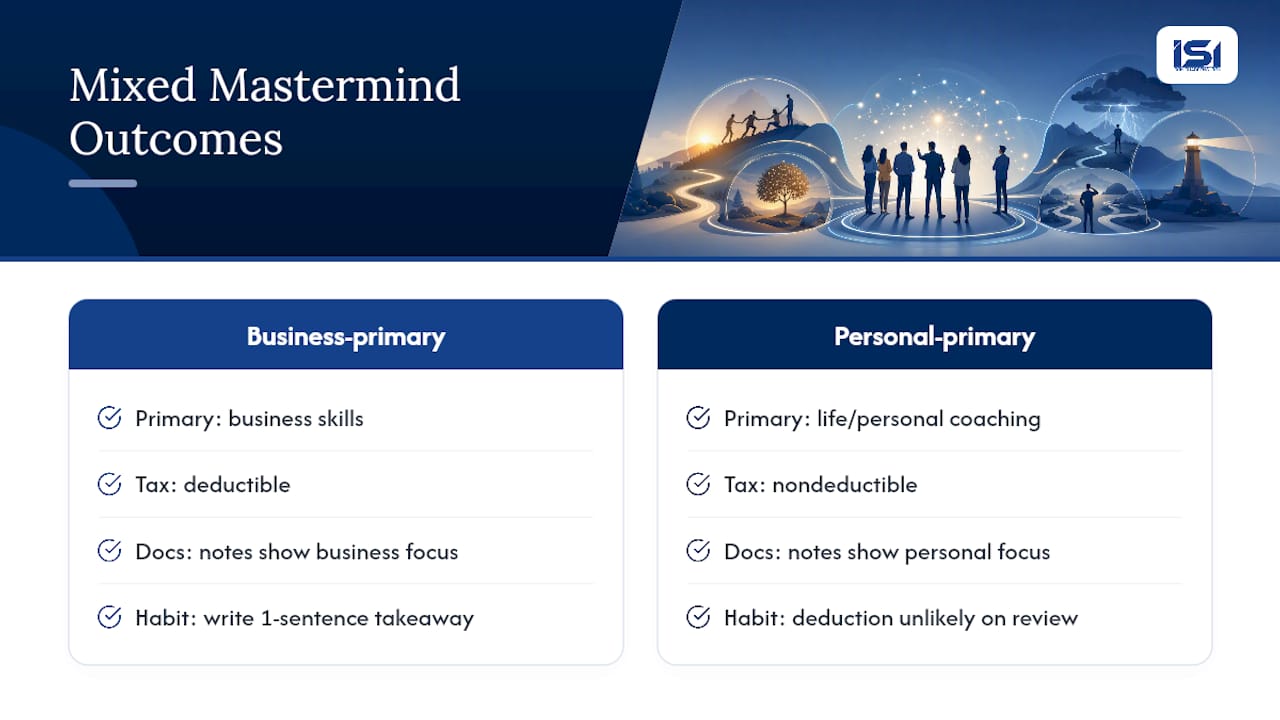
Most masterminds do not sit in a clean business-only lane, and that is where owners get nervous. A group built around leadership, faith, or personal accountability alongside business strategy is common, and the tax treatment depends on where the primary content actually lands.
The test is not whether personal growth ever comes up in conversation. It is whether the sessions primarily maintain or improve skills you use in your current business. A group that spends most of its time on pricing strategy, client retention, and operational decisions, with occasional discussion of character, discipline, or family life woven in, still passes the Treasury Regulation §1.162-5 test. A group that is fundamentally about general life coaching or personal transformation, with business mentioned only in passing, does not.
Documentation is what resolves the gray area. If your session notes consistently show business topics as the substance of each meeting, occasional personal or spiritual discussion does not disqualify the fee. If your notes lean almost entirely toward personal development language with no connection to business tasks, a reviewer has grounds to challenge the deduction. This is one more reason the habit of writing a one-sentence business takeaway after each session pays off. It creates a running record that the group's center of gravity is professional, even when the conversation touches on the whole person.
Author Derek's Perspective: Treat It as a Disciplined Investment, Not a Write-Off
I've watched too many owners join a group for the tax angle and skip the part that actually builds a business: showing up prepared, with real problems on the table. Get the right men in the room, protect the rhythm of your meetings, and make confidentiality clear from day one, and the documentation almost writes itself, because you are actually doing the work the deduction assumes. If your fee is unusual or large, run it by a CPA before you file. That call costs far less than an audit does.
— Derek
How ISI Brotherhood Fits Into Your Professional Development Plan
This mastermind group is designed for documented, business-focused participation. Members typically engage in small advisory groups, meet regularly in mastermind cohorts, and attend leadership events focused on business decisions.
That structure makes recordkeeping simple. Weekly meeting notes naturally show business topics discussed, an agenda ties each session to specific goals, and you can track outcomes, like a pricing change or a new client, against the KPIs you set with your group. If you want a mastermind with the ISI Community plan at $97 per month or the deeper ISI Mastermind plan at $650 per month, both give you the kind of consistent business content and documentation trail your CPA will want to see. Visit either page to compare what fits your stage of business and get your Personal Board of Advisors started this month.
Where to Verify the Rules Yourself
- IRS Topic 513: the education test for maintaining or improving job-related skills
- Treasury Regulation §1.162-5: the legal standard behind deductible education expenses
- IRS Publication 463: travel, lodging, and meal allocation rules for mixed-purpose trips
This article is general information, not a substitute for advice from a qualified financial advisor. Consult a qualified financial professional about your own circumstances before acting on anything here.
Sources
- Topic no. 513, Work-related education expenses
- Publication 463 (Travel, Gift, and Car Expenses)
- 26 CFR §1.162-5 — Expenses for education
FAQ
Are Mastermind Fees Tax Deductible for a Sole Proprietor?
Yes, mastermind fees are tax deductible for a sole proprietor when the group maintains or improves skills used in your current business, following the test in IRS Topic 513. Report the expense on Schedule C, and keep agendas, notes, and receipts showing the business connection.
What Is the Most Overlooked Tax Deduction for Entrepreneurs?
Work-related education, including mastermind fees, coaching tied to business skills, and industry-specific workshops, is one of the most overlooked deductions because owners assume it only applies to formal courses. Any program that maintains or improves skills in your current trade can qualify under Treasury Regulation §1.162-5, not just accredited education.
Are Financial Advisor Fees Deductible?
Financial advisor fees tied to managing your personal investments are generally not deductible as miscellaneous itemized expenses under current federal rules. Fees paid for business-specific financial consulting, distinct from personal wealth management, may qualify as an ordinary and necessary business expense under IRC §162, so ask your CPA to separate the two.
Is Coaching Tax Deductible the Same Way as a Mastermind?
Business coaching is generally treated the same way as mastermind fees: deductible when the coaching maintains or improves skills in your current business, and nondeductible when it's general life coaching or personal development. Tax professionals typically classify coach-led programs as consulting when the facilitator delivers structured strategy work, which affects how you categorize the expense.
What Does ISI Brotherhood Membership Cost?
ISI Community membership is $97 per month, and ISI Mastermind is $650 per month, both detailed on the ISI Community and ISI Mastermind pages. Both include documentation-friendly structures like weekly meetings and agendas that support a business-purpose deduction claim.