

Biblical decision making is choosing according to Scripture, prayerful wisdom, and faithful counsel — in that order, every time. When you face a hard choice, Scripture is the primary authority for settling moral questions and shaping your criteria before anything else enters the picture.
Here are some immediate steps you can take in the next few days:
- Identify the biblical question. Write down the decision and ask: does Scripture speak directly to this? Check Proverbs, the Gospels, and the epistles first.
- Pray for wisdom. James 1:5 promises that God gives wisdom generously to those who ask — not grudgingly, not conditionally.
- Name two advisors. Identify two people with spiritual maturity and relevant experience you can call this week.
- Set a decide-by date. Paralysis is not faithfulness. Give yourself a deadline that honors both urgency and prudence.
- Abide in Christ. John 15:5 makes the connection plain: apart from Him, you can do nothing of lasting value.
Biblical decision making requires balancing three ethical pillars: Scripture (normative commands), wisdom (contextual application), and existential concern — the state of your heart and your motives. Miss any one of them and the process breaks down.
Key Takeaways
Biblical decision making works when you prioritize Scripture first, pray with specific intent, seek counsel from godly advisors, and act with a plan to implement and evaluate.
| Point | Details |
|---|---|
| Scripture comes first | Check for direct commands before applying wisdom or seeking counsel on any decision. |
| Prayer is specific, not general | James 1:5 promises wisdom to those who ask; pray over the exact decision, not just the situation. |
| Counsel requires the right people | Advisors must share biblical convictions and have relevant experience to give useful input. |
| Implementation is part of the decision | Assign accountability, set metrics, and schedule a review before you announce the choice. |
| Isibrotherhood provides ongoing structure | A Personal Board of Advisors gives leaders standing counsel, accountability, and strategic clarity. |
Table of Contents
- A biblical step-by-step process you can follow right now
- How to classify your decision before you start
- How to look to the Word of God first in every decision
- How prayer and wise counsel work together
- Common mistakes and red flags to watch for
- How to implement and evaluate decisions well
- Your one-page decision checklist
- How leaders build a decision-ready advisory system
- How the Holy Spirit guides your decisions
- God's sovereignty and your responsibility in decision making
- Biblical examples of decision making you can model
- When a decision requires faith-led risk versus a clear command
- How to wait on God without drifting into passivity
- What one hard decision actually looked like
- Isibrotherhood helps you make decisions with trusted men beside you
- Sources
A biblical step-by-step process you can follow right now
Most decision-making frameworks stall because they are either too abstract or too long. The process below is built to move you from uncertainty to faithful action, whether you are choosing a business partner or navigating a personal crossroads.
- Clarify the decision. Write it in one sentence. Vague decisions produce vague answers.
- Search Scripture. Look for direct commands first, then principles. Use a concordance or a tool like YouVersion's Bible app to search by theme.
- Pray for wisdom. Ask specifically. James 1:5 is not a general prayer prompt — it is a promise tied to a specific request.
- Seek counsel. Bring the decision to two or three trusted advisors before you move. Proverbs 15:22 is direct: "Plans fail for lack of counsel, but with many advisers they succeed."
- Evaluate your options. List the realistic paths. For each one, ask: does this honor God, serve others, and align with your calling?
- Decide and act. Effective biblical decision making ends with mobilization, not just reflection. Choose and move.
- Implement with a plan. Communicate the decision, assign accountability, and set a timeline.
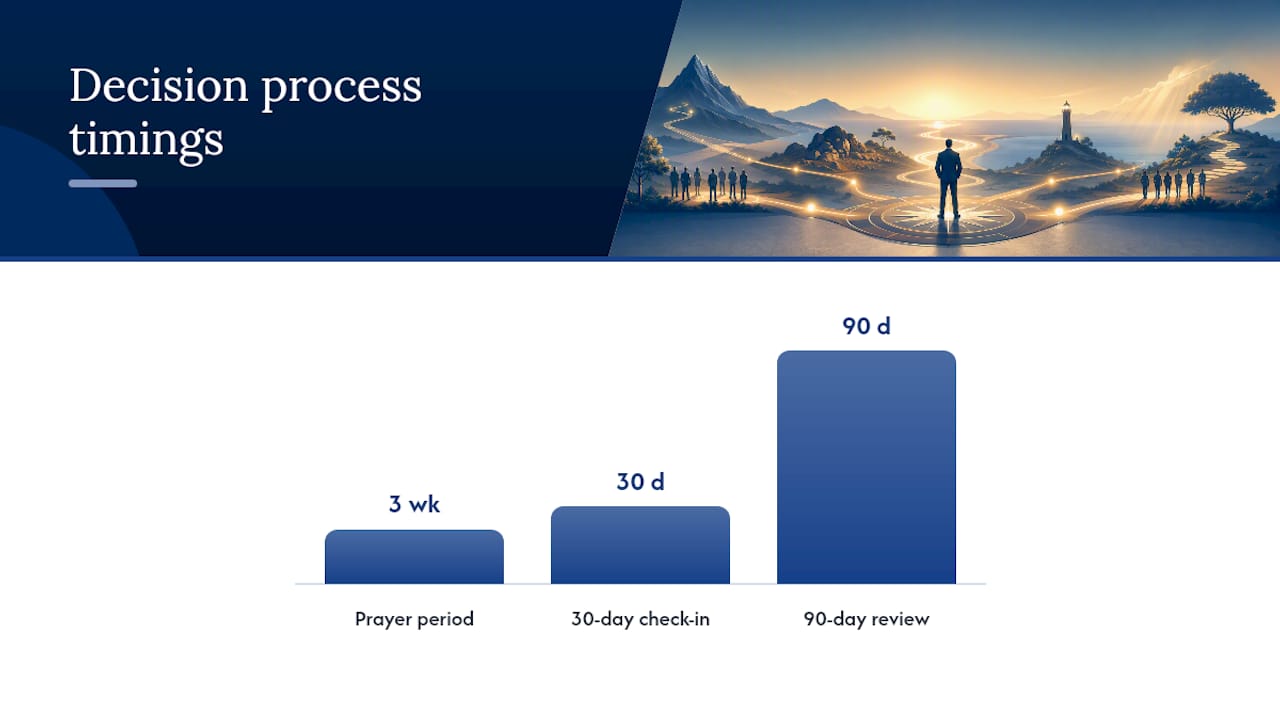
- Review and adjust. Schedule a 30-day check-in. What worked? What needs correction?
Applied scenario: A business owner is deciding whether to hire a COO. He clarifies the question (can the business sustain this role?), searches Scripture for stewardship principles, prays over three weeks, consults his pastor and a trusted peer, evaluates two candidates against biblical character criteria, makes the hire, communicates the vision to his team, and reviews the decision at 30 and 90 days.
Pro Tip: You have enough information to act when you have searched Scripture, prayed with sincerity, and received counsel from at least two godly advisors. Waiting beyond that point is often fear dressed up as prudence.
How to classify your decision before you start
Not every decision carries the same weight, and confusing the categories is one of the most common sources of paralysis. God guides through Scripture, prayer, conscience, and community rather than through private signs — but the type of decision shapes which of those channels does the most work.
Category 1: Commanded/moral decisions. Scripture speaks directly. There is no room for personal preference here.
- Should I be honest in this contract negotiation? (Proverbs 11:1; Ephesians 4:25)
- Should I forgive this business partner? (Matthew 18:21–22)
- Should I honor my commitments even when it costs me? (Psalm 15:4)
Category 2: Wisdom/indifferent matters. Scripture gives principles but not a specific answer. Which city to expand into, which vendor to hire, which strategy to pursue — these live in the space of Christian liberty and require wisdom, not a command.
When a decision mixes both types — say, a business expansion that involves both financial stewardship (wisdom) and a potential ethical compromise (command) — resolve the moral dimension first. A decision that violates a clear command is disqualified regardless of how wise the strategy looks.
How to look to the Word of God first in every decision
The phrase "Scripture first" sounds obvious until you are under pressure and reaching for your gut instead. Here is a practical filter for applying the Word before anything else.
Four steps for applying Scripture to a specific decision:
- Identify relevant passages. Search by theme (stewardship, leadership, integrity, relationships). Do not stop at one verse.
- Interpret in context. Read the surrounding chapter. A verse pulled from its narrative can mean the opposite of what it appears to say in isolation.
- Test against major doctrines. Does your interpretation align with the character of God, the gospel, and the witness of the broader church? If not, revisit it.
- Translate principle into criteria. Turn the biblical principle into a concrete test for your options. "God honors integrity" becomes: "Does this option require me to misrepresent anything to anyone?"
A common misuse worth naming: using an isolated verse as a sign. Flipping to a random passage and treating it as divine direction is not biblical guidance — it is a form of divination. Scripture is the primary authority for settling moral questions, not a Magic 8-Ball.
Selective proof-texting is equally dangerous. If you are only searching for verses that confirm what you already want to do, you are not consulting Scripture — you are recruiting it. The corrective practice is simple: ask a trusted advisor to challenge your interpretation before you act on it.
How prayer and wise counsel work together
When Scripture does not answer directly, prayer and counsel carry the weight. These are not optional supplements to the process — they are the process, according to James 1:5 and the Proverbs wisdom tradition.
Scripture emphasizes seeking God's wisdom through James 1:5 and wise counsel through Proverbs, and the two work together rather than in sequence. You pray to align your heart; you seek counsel to test your thinking.
Qualities to look for in advisors:
- Spiritual maturity — they walk with God consistently, not just in crisis
- Relevant experience — they have navigated something similar
- Commitment to your mission — they understand what you are building and why
- Willingness to challenge you — a yes-man is not a counselor
How to structure a counsel conversation:
- State the decision clearly in one sentence.
- Share what Scripture and prayer have surfaced so far.
- Ask for honest pushback, not just affirmation.
- Listen more than you talk.
Pro Tip: When advisors disagree, do not default to the one who agrees with you. Sit with the tension, pray over the conflicting counsel, and look for the principle underneath each position. The disagreement itself is often the most useful data.
Common mistakes and red flags to watch for
The most dangerous decisions are not the ones made in obvious rebellion — they are the ones made with sincere motives but flawed methods. Emotions are normal but unreliable as primary decision drivers; Scripture and counsel are the corrective.
Common mistakes:
- Seeking signs. Waiting for a feeling, an open door, or a coincidence before acting is not biblical discernment — it is superstition with a spiritual veneer.
- Over-relying on emotions. Peace and excitement are real, but they are not infallible. Fear can masquerade as wisdom; desire can masquerade as calling.
- Ignoring counsel. Proverbs 12:15 says the wise listen to advice. Bypassing advisors because you already know what you want is pride, not confidence.
- Moving from fear. Decisions made to avoid pain rather than pursue God's purposes tend to shrink your calling over time.
- Idol-driven goals. If the outcome you want has become non-negotiable regardless of what God shows you, it has become an idol.
Quick red-flag checklist:
- Am I avoiding counsel because I already know what they will say?
- Is my peace about this decision based on Scripture and prayer, or on the outcome I prefer?
- Would I make this same choice if the financial upside were removed?
- Am I moving quickly to avoid sitting with discomfort?
- Have I considered how this affects the people closest to me?
If a decision proves wrong, repentance is not failure — it is the process working. Practical, scripture-informed principles include honoring others and guarding motives, and both apply equally to course correction. Acknowledge the error, make it right where possible, and adjust with the same biblical process you used to decide in the first place.
How to implement and evaluate decisions well
A decision that never gets implemented is just a preference. The gap between choosing and executing is where most leadership decisions quietly die.
Implementation checklist:
- Communicate the vision clearly to everyone affected
- Match the decision to your current capacity — do not commit resources you do not have
- Assign specific accountability (who owns what, by when)
- Set measurable metrics so you know whether the decision is working
Sample timelines:
- Urgent decision (24–72 hours): Clarify the question, pray, call one trusted advisor, make the call, communicate it immediately.
- Standard leadership decision (1–2 weeks): Full eight-step process above, including two or three counsel conversations and a written options evaluation.
- Major strategic decision (30–90 days): Convene your advisory board, run a formal discernment process, build a communication and implementation plan before announcing.
Evaluation metrics to track:
- Did the decision align with the original biblical criteria?
- Are the people affected flourishing or struggling?
- What would you do differently with the same information?
When a decision needs a pivot, treat it as a learning moment, not a verdict on your faith. The goal of evaluation is not self-condemnation — it is mobilizing and evaluating outcomes so the next decision is wiser.
Your one-page decision checklist
Print this. Save it to your phone. Use it every time a significant decision is in front of you.
Before you decide, ask:
- Does Scripture forbid any of my options?
- Have I prayed specifically about this decision, not just generally?
- Have I consulted at least two godly advisors with relevant experience?
- Am I moving from faith or from fear?
- Who will be affected, and have I considered their interests honestly?
- Is my motive something I could state openly before God and my closest advisors?
- Have I given this decision appropriate time, or am I rushing to relieve discomfort?
- Do I have a plan for communicating and implementing this decision?
Decision template:
- Decision to make: _______________
- Decide-by date: _______________
- First action after deciding: _______________
- Who needs to be informed: _______________
Keep this checklist somewhere accessible. The biblical principles for solid decision making are not complicated — but they are easy to skip under pressure. The checklist is your circuit breaker.
How leaders build a decision-ready advisory system
Individual discernment is necessary but not sufficient for leaders. The higher your responsibility, the more you need a structured system of counsel — not just occasional advice, but a formal board that meets regularly and knows your mission.
Leaders who practice both vertical counsel (prayer, spiritual discipline) and horizontal counsel (trusted peers and advisors) avoid the "lone ranger" mentality that produces isolated, unchecked decisions. Vertical counsel aligns your heart with God's purposes. Horizontal counsel tests your thinking against people who know your context.
Recommended board structure:
| Board Type | Size | Meeting Cadence | Primary Role |
|---|---|---|---|
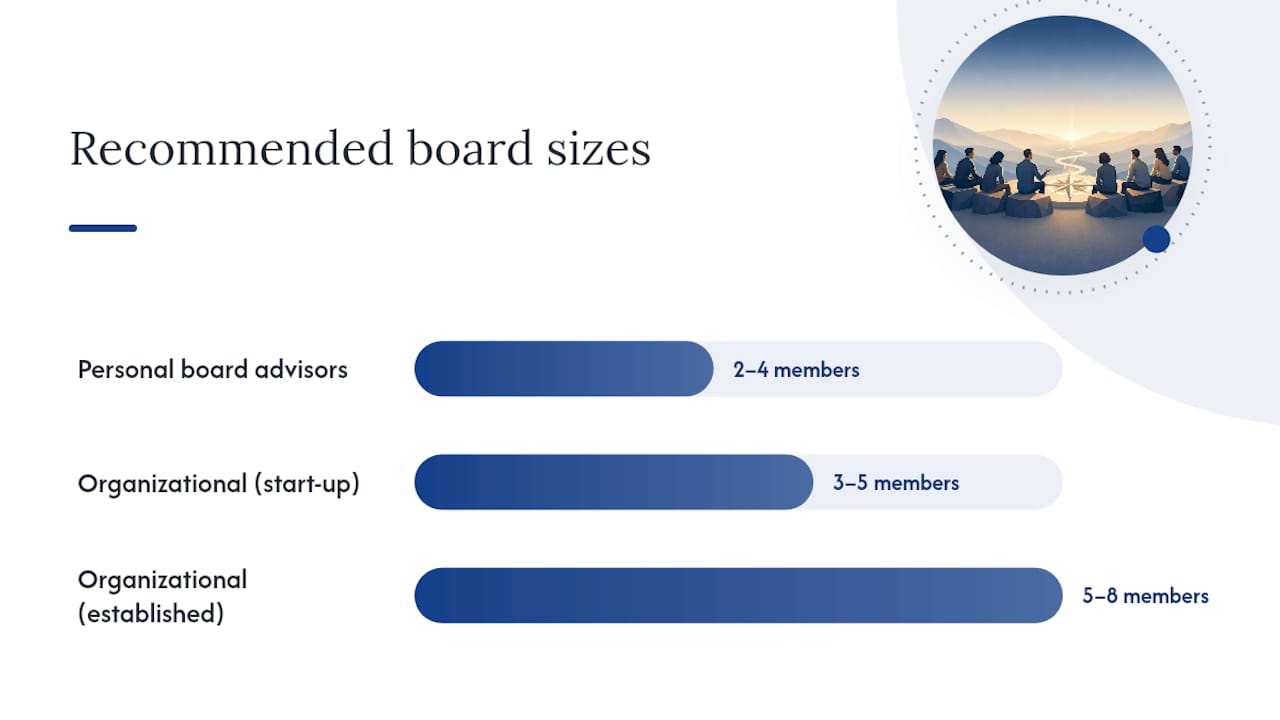
| Personal Board of Advisors | 2–4 members | Monthly or bi-monthly | Confidential counsel, personal accountability |
| Organizational Advisory Board | 3–5 (start-up) or 5–8 (established) | Bi-annually or quarterly | Organizational oversight, financial accountability |
Advisory boards provide outside perspective, financial oversight, and accountability, and the recommended size scales with organizational stage: roughly three members for start-ups, five to eight for established organizations, with at least bi-annual meetings.
Advisory board agenda template (60 minutes):
- Open in prayer and Scripture (10 min)
- Leader update: current decisions and challenges (15 min)
- Board input and pushback (20 min)
- Action items and accountability (10 min)
- Close in prayer (5 min)
Case example: A founder facing a major hire brings the decision to his personal board before making an offer. The board surfaces a character concern the founder had rationalized away, recommends a reference check with a specific question, and prays over the decision together. The founder delays the hire by two weeks, runs the check, and receives information that changes the outcome. The board did not make the decision — but it made the decision better.
Pro Tip: Build your board before you need it. Biblical leaders build foundations — consistent prayer, Bible study, and counsel — before critical moments arrive, so they can respond wisely under pressure rather than scrambling for perspective in a crisis.
For practical guidance on leading like Christ in your advisory relationships, the principles of servant leadership and accountability apply directly to how you structure and use your board.
How the Holy Spirit guides your decisions
The Holy Spirit is not a tiebreaker you invoke when Scripture and counsel have failed to produce clarity. He is active throughout the entire process — convicting, illuminating, and confirming.
John 16:13 describes the Spirit as one who "guides you into all truth." That guidance typically works through the ordinary means: Scripture coming alive in a specific way, a persistent sense of conviction that survives prayer and counsel, or a settled peace that is distinct from mere preference. The Spirit rarely bypasses the process — He works through it.
Practically, this means paying attention to what persists. Impressions that fade under prayer are usually emotion. Convictions that deepen through Scripture study and counsel carry more weight. The Spirit's guidance tends to align with the character of God revealed in Scripture, not contradict it.
God's sovereignty and your responsibility in decision making
One of the most freeing truths in Christian decision making is also one of the most misunderstood: God's sovereignty does not eliminate your responsibility to choose wisely — it underwrites it.
Proverbs 16:9 captures the tension directly: "In their hearts humans plan their course, but the Lord establishes their steps." You plan. God establishes. Both are true simultaneously. The sovereignty of God is not a reason to be passive; it is the reason you can act without being paralyzed by the fear of making a mistake that God cannot redeem.
This also means that a wrong decision, made with sincere process and genuine repentance, is not outside God's reach. His sovereignty is not threatened by your imperfect judgment. What He asks is faithfulness to the process — Scripture, prayer, counsel, action — not a guarantee of perfect outcomes.
Biblical examples of decision making you can model
Scripture is not short on decision-making case studies. Three stand out for their practical lessons.
Moses (Exodus 18): Facing an unsustainable workload, Moses received counsel from his father-in-law Jethro to delegate authority. He did not treat the advice as a threat to his calling — he acted on it. The lesson: wise counsel often comes from outside your immediate circle, and humility to receive it is itself a form of leadership.
David (1 Samuel 23): Before engaging enemies at Keilah, David "inquired of the Lord" twice — once to confirm the mission and once to test whether the people he was protecting would betray him. He did not assume the first answer covered every dimension of the decision. The lesson: major decisions often require multiple rounds of prayer and discernment, not a single green light.
Jesus (Luke 6:12–13): Before choosing the twelve apostles, Jesus spent the entire night in prayer. The most consequential leadership decision in human history was preceded by extended, solitary communion with the Father. The lesson: the weight of a decision should determine the depth of your prayer, not just the length of your checklist.
When a decision requires faith-led risk versus a clear command
Some decisions are not about discernment at all — they are about obedience. When Scripture speaks clearly, the only question is whether you will comply. Launching a business, hiring a team member, or entering a new market are wisdom decisions. Lying to a client, breaking a covenant, or exploiting a worker are not.
The confusion happens when leaders frame a clear command as a wisdom question to create room for the answer they want. "Is it always wrong to misrepresent this?" is not a discernment question — it is a rationalization. Recognizing that distinction protects you from using the language of faith to justify disobedience.
Faith-led risk, by contrast, is stepping into uncertainty with a clear conscience, having done the biblical work. Abraham leaving Ur, Peter stepping out of the boat, Paul entering Macedonia after a vision — these were not reckless moves. They were obedient responses to clear direction, taken at personal cost. The risk was real; the obedience was the point.
How to wait on God without drifting into passivity
Waiting on God is one of the most misapplied concepts in Christian decision making. It is not the same as doing nothing. Isaiah 40:31 promises renewed strength to those who wait on the Lord — but the Hebrew word for "wait" carries the sense of expectant, active hope, not passive delay.
Productive waiting looks like this: you have done the biblical work (Scripture, prayer, counsel), you have no clear direction yet, and you are continuing to steward your current responsibilities faithfully while remaining attentive. You are not stalling. You are not avoiding. You are holding the question open before God while you keep moving in what is already clear.
A practical boundary: if you have been in the waiting posture for more than 30 days on a decision that requires action, bring it back to your advisors. Sometimes what feels like waiting on God is actually waiting for certainty that God never promised. Faithful action under uncertainty, grounded in the process, is often the answer itself.
For practical support on following Jesus through seasons of uncertainty, resources on prayer and abiding in Christ can help you stay grounded when the path forward is not yet clear.
What one hard decision actually looked like
There was a season when a decision about a key business partnership sat on my desk for six weeks. The financials made sense. The strategy made sense. But something in the counsel conversations kept surfacing a character question I kept rationalizing away.
I went back to Scripture — specifically Proverbs 13:20: "Walk with the wise and become wise, for a companion of fools suffers harm." I prayed over it for two weeks. I brought it to my personal board, and one member asked a question I had been avoiding: "Would you want this person in your life if the money were not involved?" The answer was no.
I walked away from the partnership. The short-term cost was real. But the decision aligned with the process — Scripture, prayer, counsel, honest motive-checking — and that alignment produced a peace that the financial upside never could have. The lesson is not that walking away is always right. It is that the process surfaces what the spreadsheet cannot.
Isibrotherhood helps you make decisions with trusted men beside you
The hardest part of biblical decision making is not knowing the steps — it is having the right people around you when the pressure is real.
Isibrotherhood places Christian business owners, executives, and entrepreneurs into a Personal Board of Advisors: a small, trusted group of men who meet regularly to challenge, encourage, and hold each other accountable across five areas of life — personal, spiritual, relational, professional, and financial. For leaders who want to stop making major decisions alone, this is the structure that makes the difference.
What members gain for their decision making:
- A standing group of godly advisors who know your context and your calling
- Weekly accountability that keeps your motives and methods honest
- Strategic clarity from peers who have navigated similar crossroads
Apply for membership at Isibrotherhood and find out how a Personal Board of Advisors can change how you lead.
Sources
- Leadership and Ethical Responsibility — three aspects of every decision (WEA / Thomas Schirrmacher)
- Three principles for biblical decision-making — International Leadership Institute (ILI)
- An abundance of counselors — Nav Missional Enterprise
- Discipleship
- Triune Decision-Making: How God Guides Tough Choices — Desiring God
- Gotquestions
- 10 Biblical Principles For Decision Making — Watermark Community Church
- Integrity Idea 064: Seek Horizontal Counsel — Integriosity