

Biblical leadership centers on servant authority, humble wisdom, and Spirit-dependent stewardship. The eight core principles Scripture returns to again and again are servant leadership, wisdom, humility, integrity, love and compassion, stewardship, disciple-making, prayer and dependence on God, and accountability through mentoring. Start this week by choosing one principle, writing its key verse on a card, and applying one concrete action in your next meeting or decision.
These are not motivational concepts with a Bible verse bolted on. They are a formation system, one that reshapes how you exercise authority, allocate resources, develop people, and stay accountable. The difference between a leader who quotes Scripture and a leader who is shaped by it shows up in the hard moments: a difficult hire, a financial shortfall, a team member who needs correction.

Key Takeaways
Biblical leadership is not a set of techniques to apply — it is a formation process that requires Scripture, community, and sustained accountability to produce lasting character.
| Point | Details |
|---|---|
| Servant authority is the foundation | Every other principle flows from the posture that leadership exists to serve, not to accumulate power. |
| Inner life precedes outer systems | Prayer, Scripture, and humility must be genuine before governance structures can hold. |
| Formation requires community | Principles practiced in isolation calcify into performance; peer accountability produces real character. |
| Stewardship reframes success | Money, people, and influence are entrusted, not owned — measure outcomes accordingly. |
| Isibrotherhood accelerates formation | A Personal Board of Advisors puts these principles into live practice through structured peer accountability. |
Table of Contents
- What are the core biblical leadership principles?
- How do you develop these principles in your life and organization?
- Why biblical leadership is different from secular models
- What I've learned about leading from Scripture
- How Isibrotherhood helps leaders live these principles
- Further reading and primary sources
- Sources
What are the core biblical leadership principles?
The eight principles below come from the same scriptural thread that runs from Proverbs through the Gospels into Paul's letters. Each one carries a key verse and two practical actions you can put into your calendar this week.
-
Servant leadership. Authority in Scripture flows downward, not upward. Jesus redefined greatness as service in Mark 10:43–45, and that inversion is not rhetorical — it is structural. A leader who serves creates psychological safety, earns trust, and models the culture the whole organization follows.
- Before your next team meeting, ask each person: "What's one obstacle I can remove for you this week?"
- Evaluate your calendar: does it reflect time invested in your team's growth, or only in your own output?
-
Wisdom and seeking counsel. Proverbs 11:14 says plans fail without counsel, but they succeed with many advisors. Leadership wisdom from Proverbs consistently surfaces this: the wise leader is not the smartest person in the room — they are the one most willing to listen.
- Build a standing "counsel checkpoint" into every major decision: who are the three people you will consult before committing?
- Read one chapter of Proverbs each morning for 30 days and note every verse that touches a current leadership challenge.
-
Humility. Philippians 2:3–4 calls leaders to consider others more significant than themselves. That is not low self-esteem; it is a deliberate posture that keeps ego from distorting judgment. The twelve scriptural marks of Christian leadership formation place humility first, ahead of skill and capability, for exactly this reason.
- After a win, publicly credit the team members whose work made it possible — by name.
- When you are wrong, say so plainly and quickly, without softening it with "but."
-
Integrity. Proverbs 10:9 puts it plainly: "Whoever walks in integrity walks securely." Integrity is not just honesty in speech; it is alignment between private conviction and public behavior. Christian business leaders who protect their reputation do so not as a brand strategy but because their word is their witness.
- Conduct a monthly personal inventory: where did your actions last month diverge from your stated values?
- Establish one non-negotiable ethical boundary in your business in writing, shared with your team.
-
Love and compassion. John 13:34–35 makes love the distinguishing mark of Christ's followers, and that mark shows up in leadership through how you treat people under pressure. Compassion is not softness — it is the willingness to see the person behind the performance metric. The shepherd model of Christian leadership frames this as feeding, protecting, correcting, and modeling godliness, all at once.
- When a team member underperforms, lead the conversation with curiosity before correction.
- Create a simple check-in practice: one question per week that invites your team to share what is hard right now.
-
Stewardship and missional purpose. Everything a leader manages — money, people, time, influence — belongs to God. Biblical business leadership reframes success as faithful stewardship rather than personal accumulation, and calls leaders to set goals that serve people and communities, not just shareholders. Matthew 25:14–30 (the parable of the talents) makes the stakes clear: stewardship is not optional, and passivity is its own form of failure.
- Write a one-paragraph stewardship statement for your organization: what has been entrusted to you, and for whose benefit?
- Review your budget quarterly through a stewardship lens: does spending reflect kingdom priorities?
-
Disciple-making and development. Matthew 28:19–20 is not just a missionary mandate — it is a leadership model. The leader's job is to reproduce what they know in others. Twelve biblical principles for building a business include multi-generation planning precisely because biblical leaders think beyond their own tenure.
- Identify one person in your organization you are actively developing. Schedule a monthly one-on-one with a growth agenda, not just a task review.
- Ask yourself: if I left tomorrow, who would carry the values forward?
-
Prayer and dependence on God. Proverbs 3:5–6 is the antidote to the self-sufficient leader. Prayer is not a ritual opener for meetings — it is the posture that keeps a leader from confusing their own ambition with God's direction. Leaders who pray before major decisions report a qualitatively different relationship to outcomes: less anxiety, more clarity, and greater willingness to change course.
- Block 15 minutes before your first meeting each day for Scripture and prayer, specifically naming the decisions you face.
- Before any significant hire or strategic pivot, bring the decision to a trusted group for prayer, not just analysis.
-
Accountability and mentoring. Proverbs 27:17 — "As iron sharpens iron, so one person sharpens another" — is the biblical case for peer accountability. A leader without accountability is a leader without a mirror. Titus 1 and 1 Timothy 3 both tie leadership qualification to character that has been tested and observed by others over time.
- Join or form an accountability group of three to five peers who will ask hard questions about your character, not just your results.
- Meet with a mentor quarterly with a prepared list of decisions and failures from the previous 90 days.
How do you develop these principles in your life and organization?
Knowing the principles is the easy part. The harder work is building the rhythms and systems that make them durable under pressure. Formation precedes reliable organizational outcomes — leaders who implement biblical values mechanically, without an ongoing inner life with God, tend to see those values erode the moment the culture is tested.
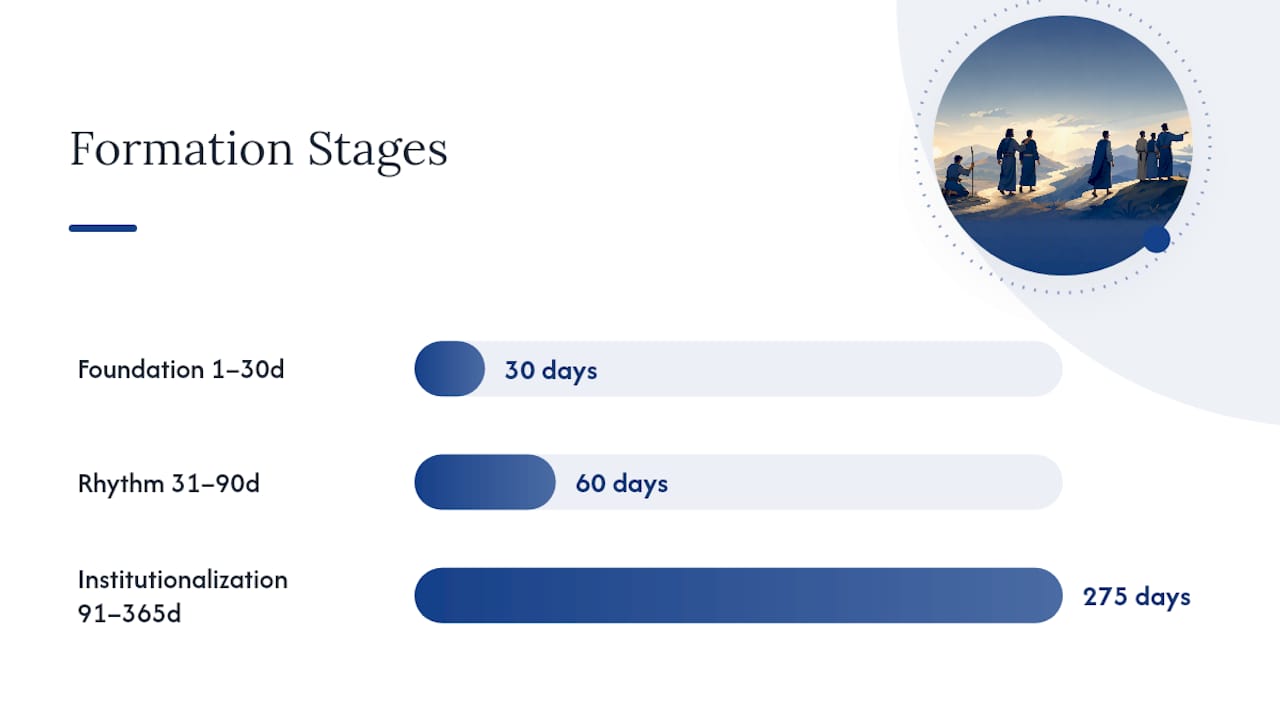
A 30/90/365-day formation plan:
- Days 1–30 (Foundation): Choose two principles from the list above. Write their key verses somewhere visible. Practice one concrete action per principle each week. Start a simple journal: one sentence per day on where you saw the principle tested.
- Days 31–90 (Rhythm): Add a weekly accountability conversation with one trusted peer. Bring one real decision from the week and ask for honest feedback. Begin a monthly personal inventory (integrity check, stewardship review, team development audit).
- Days 91–365 (Institutionalization): Translate your personal values into organizational systems. Write a leadership covenant for your team. Build governance systems that reward kingdom values — hiring criteria, performance reviews, and meeting rhythms that reflect the principles, not just the profit targets.
A sample weekly rhythm leaders can copy:
- Monday morning: 15 minutes of Scripture and prayer, naming the week's key decisions
- Tuesday or Wednesday: One development conversation with a direct report (growth-focused, not task-focused)
- Thursday: A brief integrity check: where did I lead well this week, and where did I miss?
- Friday: Five minutes of gratitude and stewardship reflection — what was entrusted to me this week, and how did I manage it?
- Weekly or biweekly: Accountability call or meeting with a peer group
Reflection questions for honest self-evaluation:
- Am I leading from a place of genuine inner life with God, or performing biblical leadership for an audience?
- Where did my decisions last week reflect my own ambition more than servant authority?
- Who am I actively developing, and what evidence do I have of their growth?
- What would my team say about my integrity if I were not in the room?
Pro Tip: The leaders who sustain biblical formation long-term are not the ones with the most discipline — they are the ones embedded in a community that holds them accountable. Principles practiced in isolation tend to calcify into performance; principles practiced in community tend to produce genuine character.
Why biblical leadership is different from secular models
The distinction is not cosmetic. Christian leadership is not secular leadership with a devotional added to the agenda. The theological case for what makes Christian leadership distinctly Christian centers on the active role of the Holy Spirit in leader-follower dynamics, specifically four Spirit-initiated synergies: conviction-confession, conversion-repentance, consecration-obedience, and confirmation-perseverance. Secular leadership models have no equivalent mechanism. They can teach behavior change; they cannot produce heart change.
Common misconceptions — and the corrective:
- "Servant leadership is just a management style." Secular servant leadership is a technique for improving engagement. Biblical servant leadership is a theological posture rooted in consecration and obedience to Christ. The motive is different, and the motive is what sustains it when serving is costly.
- "Biblical principles are a toolkit for efficiency." Using Scripture as a productivity framework misses the point entirely. These principles are formative, not instrumental. They are meant to change the leader, not just improve the output.
- "Humility means being passive or indecisive." Philippians 2 describes Christ's humility as an act of deliberate, powerful self-giving — not weakness. Biblical humility is compatible with decisive, courageous leadership.
- "Prayer is a warm-up ritual." Prayer is the mechanism of dependence. A leader who prays before decisions is structurally different from one who does not, because they are acknowledging that outcomes are not entirely theirs to control.
A checklist for evaluating whether a practice is truly biblical:
| Evaluation Question | What to Look For |
|---|---|
| Is it Scripture-tested? | Can you trace it to a specific biblical text, not just a general principle? |
| Is it Spirit-led? | Does it require dependence on God, or can it run on human effort alone? |
| Does it form disciples? | Does it develop others toward Christlikeness, or only toward performance? |
| Does it steward well? | Does it treat people, money, and influence as entrusted, not owned? |
| Does it survive pressure? | Would this practice hold up when it is costly, not just convenient? |
Formation work — discipleship, spiritual practices, peer accountability — is what makes these principles durable. Without it, even the most well-designed organizational systems eventually drift toward whatever the leader's unexamined character defaults to.
What I've learned about leading from Scripture
There is a version of biblical leadership that looks good on a slide deck and falls apart in a hard conversation. The principles in this guide are not new — they have been tested across centuries of pastoral and organizational leadership. What I keep coming back to is this: the leaders who actually embody these principles are almost never the ones who studied them the hardest. They are the ones who stayed in community long enough for the principles to be tested, challenged, and refined by other men who cared enough to tell the truth.
The single change worth trying this week is not a new habit or a new system. It is one honest conversation with one person who knows you well enough to ask the hard question. That is where formation actually happens.
How Isibrotherhood helps leaders live these principles
Reading about servant leadership and actually practicing it under pressure are two different things. Isibrotherhood exists for the gap between them.
Every Isibrotherhood member is placed into a Personal Board of Advisors, a small cohort of Christian men who meet regularly to challenge and encourage one another across five areas: personal, spiritual, relational, professional, and financial. This is not a networking group or a Bible study. It is a structured accountability environment where the principles in this guide get tested against real decisions, real failures, and real growth.
- Formation, not just information: Weekly mastermind meetings keep biblical values connected to live business decisions.
- Peer accountability: A trusted group that asks hard questions about character, not just results.
- Long-term development: Year-round community, leadership events, and resources that support the 365-day formation arc.
If you are ready to move from knowing these principles to being shaped by them, explore Isibrotherhood membership and take the next step.
Further reading and primary sources
These sources ground the principles in this guide and are worth returning to for deeper study.
- What is "Christian" About Christian Leadership? — A theological paper on the Holy Spirit's role in leader-follower dynamics; essential for understanding why biblical leadership is structurally different from secular models.
- Biblical Leadership Foundations – Stephen Judd — A practical framework of twelve scriptural marks for Christian leadership formation, with emphasis on character before capability.
- Gotquestions — A clear pastoral summary of the shepherd model, grounded in John 10 and applicable to both organizational and pastoral contexts.
- Bibleconclusions — Practical application of Scripture to business authority, stewardship, and decision-making, with specific governance examples.
- 12 biblical principles on which to build a business – Biblical Leadership — A concise, copyable list of scripture-rooted principles for business leaders, including multi-generation planning and excellence as worship.
- What makes a good Christian business leader? – CCU — An eight-point practical checklist for workplace behavior tied to scriptural motives, useful for delegation, ethics, and personal inventory.