

Yes. A small, structured accountability group is one of the fastest, lowest-cost ways for entrepreneurs to boost follow-through and make sharper decisions. The first move is simple: attend one trial meeting of an existing group, or invite three to five peers and agree on a written format before your first real session.
TL;DR:
- Groups of three to six entrepreneurs provide diverse feedback and accountability that significantly improve strategic clarity and follow-through compared to working alone.
- Weekly meetings, lasting 60 to 75 minutes, are most effective when structured around quick check-ins, hot seat problem-solving, and clear commitments.
- Starting a group with a trial meeting, a written social contract, and regular reviews helps prevent dropout and ensures long-term cohesion.
- Face-to-face or online faith-based groups like ISI Brotherhood incorporate spiritual and personal growth alongside business support, adding a wider life focus.
- Combining peer groups with individual coaching offers the broadest range of perspectives and accountability, especially for complex or long-term goals.
Table of Contents
- What is a business accountability group, and why does it work?
- What benefits do business owners actually get from these groups?
- What formats and meeting cadences actually work?
- How do you find or join a group that's actually worth your time?
- How do you start and run a group that doesn't fall apart by month two?
- How does ISI Brotherhood structure this, and what should you look for?
- A short reflection on discipline and the men who show up
- How ISI Brotherhood fits into your next step
- Sources
What is a business accountability group, and why does it work?
A business accountability group is a small circle of entrepreneurs, typically 3 to 8 members, who meet on a set schedule to report on goals, work through problems out loud, and hold one another to what they said they'd do. That's a different animal than corporate accountability, which usually means legal duties, audits, and disclosure obligations owed to regulators or shareholders. Peer accountability has no enforcement mechanism beyond the social kind, and that turns out to be plenty.
The mechanism is straightforward psychology. Saying a goal out loud to people who will ask about it next month changes how seriously you treat it. Behavioral research on peer support and goal attainment backs this up across health, fitness, and task performance, and the same dynamic transfers cleanly to business.
- Public commitment raises the cost of quitting quietly.
- Peer questions surface blind spots a solo operator won't catch.
- Scheduled check-ins turn vague intentions into dated deadlines.
The signal to watch: groups of 3 to 8 members produce better strategic clarity and follow-through than entrepreneurs working alone, largely because someone else is watching the scoreboard with you.
What benefits do business owners actually get from these groups?
The upside isn't motivation in the abstract. It's execution. Entrepreneurs who join a well-run group report faster decisions, because they're no longer stuck weighing options in their own head for three weeks straight. They also get a check against groupthink, since a room full of people from different industries won't rubber-stamp a bad idea the way an internal team sometimes will.
- Faster follow-through on commitments you've already decided to make.
- Decisions tested by people with no stake in flattering you.
- Exposure to problems you haven't hit yet, solved by someone who already has.
- Lower isolation, which matters more than most owners admit.
Reporting to peers shifts internal motivation and creates the kind of structured pressure that keeps leaders focused, according to Forbes reporting on CEO networks. Peer groups also guard against groupthink by pulling in diverse, experience-driven feedback that a one-on-one coaching relationship can't replicate on its own.
So when do you pick a peer group over a coach or a formal advisory board? Coaching works when you need one expert's undivided attention on a narrow problem. A peer group works better when you need range, when five different perspectives from five different battles beat one expert's single lens.
Pro Tip: Don't treat a peer group and a coach as either/or. The strongest operators use both. The group catches what a single coach can't see.
What formats and meeting cadences actually work?
Three formats cover almost every version of this that works. Each has real tradeoffs.
- Accountability partners (2 people). Fastest to set up, lightest on scheduling friction, but you lose the diversity of feedback a bigger room provides.
- Small peer groups (3 to 6 people). The sweet spot for most entrepreneurs. Enough voices for real feedback, small enough that everyone talks every session.
- Masterminds with a hot seat (5 to 7 people). One member gets the group's full attention each meeting while others rotate through. Best for owners wrestling with a specific, meaty problem.
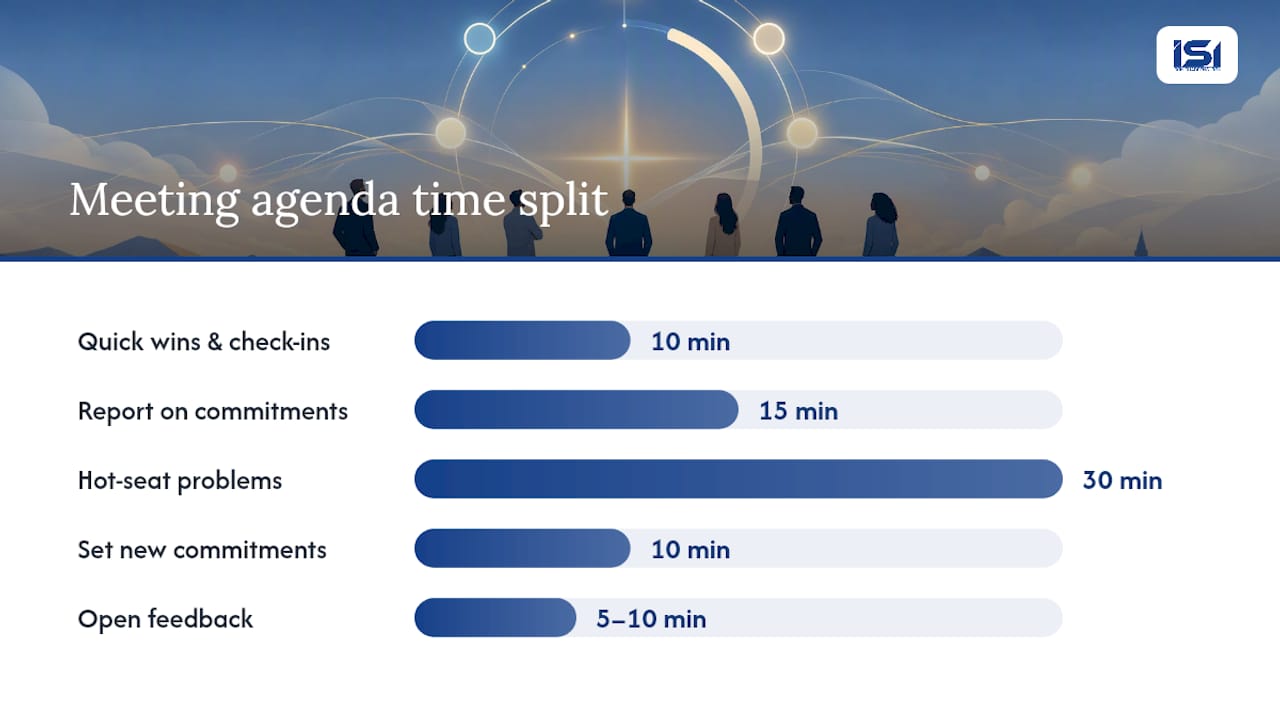
Weekly meetings suit fast-moving goals like sales targets or product launches. Biweekly works fine for slower initiatives like a hiring overhaul or a market entry. A tight 60 to 75 minute agenda beats a loose two-hour ramble every time: 10 minutes of check-ins, 30 minutes of reporting and hot seat, 15 minutes of problem-solving, 10 minutes locking next commitments.
How do you find or join a group that's actually worth your time?
Start where entrepreneurs already gather. Industry associations, LinkedIn groups built around your niche, referrals from other founders, and your existing network of vendors and clients are all faster paths than a cold search. A referral from someone whose judgment you trust beats a random group you found through an ad, every time.
Before you commit to anything, run a checklist:
- Attend a trial meeting. Vetting members through a trial session is one of the strongest predictors of whether a group lasts.
- Match commitment levels. A group full of owners who treat meetings as optional will drag you down to their standard.
- Confirm confidentiality up front. If nobody mentions it unprompted, that's your answer.
- Ask about attendance policy. Groups with no consequence for chronic no shows tend to unravel within months.
Watch for red flags: a facilitator who dominates every session, members who are direct competitors with no real trust between them, or a group that's more social hour than working meeting. Our guide to finding a mastermind group walks through additional vetting questions worth asking before you say yes.
Pro Tip: If a group can't clearly explain its own format in under two minutes, that's a preview of how unfocused the actual meetings will be.
How do you start and run a group that doesn't fall apart by month two?
Most informal groups die inside 60 days without written structure and a lightweight way to stay accountable between sessions. Here's the sequence that avoids that.
- Get the right men in the room. Recruit 3 to 6 people at a comparable stage and commitment level, not just whoever's available.
- Run a trial meeting before anyone commits. One test session tells you more than a dozen phone calls.
- Write the social contract. Cover the group's purpose, meeting cadence, who facilitates, attendance expectations, confidentiality, and when the group renews or disbands.
- Lock the agenda early. Protect the rhythm from the start, because a group that reschedules constantly in month one rarely survives month three.
- Add lightweight accountability between meetings. A shared Slack channel, a simple commitment board, or a daily check-in text keeps momentum alive without adding a second meeting.
- Schedule 30 and 90 day reviews. Ask honestly whether the format, the members, and the commitments are still working.
A sample 60 to 75 minute agenda: 10 minutes of quick wins and check-ins, 15 minutes reporting on last session's commitments, 30 minutes on one or two hot seat problems, 10 minutes setting new commitments with dates attached, 5 to 10 minutes of open feedback.
Dropouts and dominant members are the two failure modes worth planning for before they happen. If someone stops showing up, address it directly at the next 30 day review rather than letting it fester unspoken. If one member is eating half the airtime every session, the facilitator needs a standing rule: hot seat time is timed, no exceptions, and everyone gets equal minutes across a quarter.
Pro Tip: Build an end date into the group from day one, six to twelve months out, with a scheduled renewal decision. It sounds counterintuitive, but a group with no exit ramp tends to calcify into a social ritual instead of a working session.
How does ISI Brotherhood structure this, and what should you look for?
ISI Brotherhood runs this exact model at scale, through what it calls a Personal Board of Advisors: a small, trusted circle of Christian men who meet weekly to challenge and support each other across five areas of life, personal, spiritual, relational, professional, and financial. That's a wider lens than most secular accountability groups, which tend to stop at the professional layer.
Members get more than the weekly mastermind meeting itself:
- A year-round online community for support between sessions.
- Access to a member directory for finding compatible peers.
- Leadership events, both virtual and in-person.
- Involvement with the ISI Brotherhood Foundation.
If you're weighing a faith-based mastermind against a general peer group, the real question is fit, not superiority. A general group might serve you fine if you're purely optimizing for business metrics. A faith-integrated model like ISI Brotherhood's approach matters more if you want the group asking about your marriage and your character with the same seriousness it asks about your revenue.
A short reflection on discipline and the men who show up
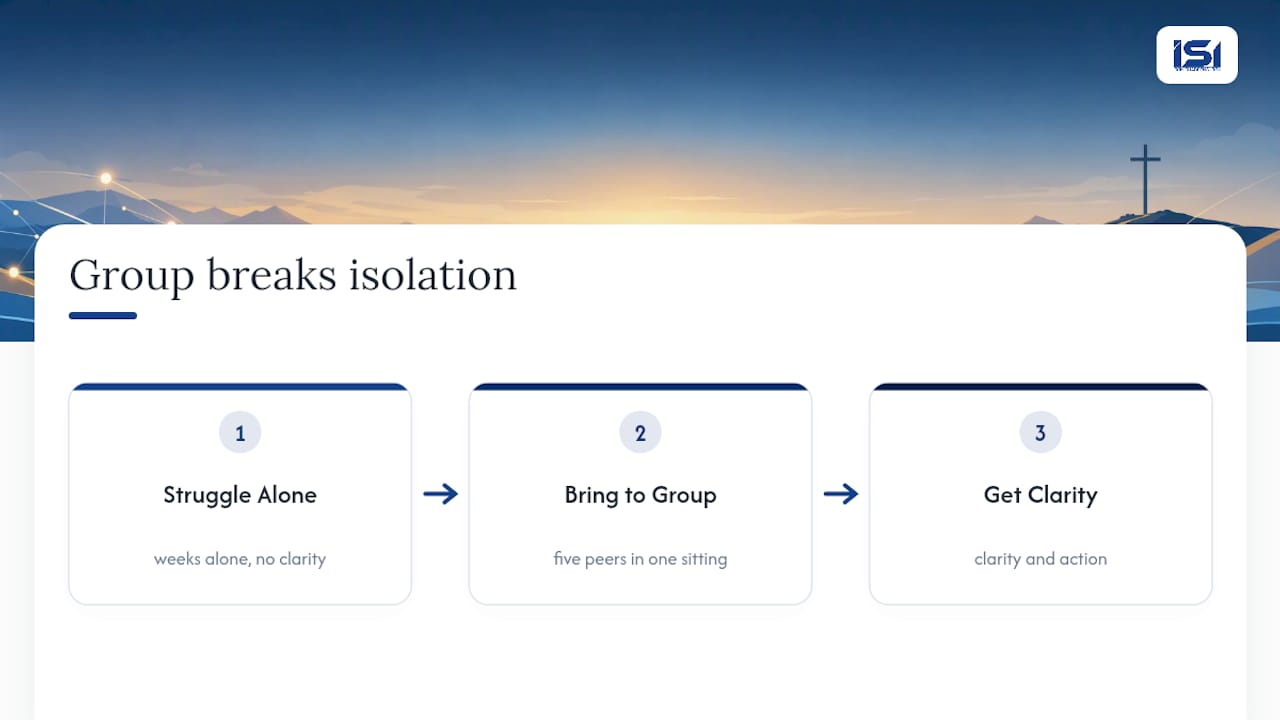
Discipline is rarely the problem. Isolation is. I've seen the pattern enough times to trust it: an owner white-knuckles a decision alone for weeks, brings it to a group of five other men in one sitting, and walks out with clarity he couldn't manufacture by himself. One member I know of stopped a bad hire cold because three peers, independently, all flagged the same red flag he'd talked himself past.
If you're skeptical this works, don't take my word for it. Commit to the format for 90 days and let the results argue for themselves.
— Derek
How ISI Brotherhood fits into your next step
Everything in this playbook, the social contract, the vetted members, the weekly rhythm, is what ISI Brotherhood already runs for Christian business owners, and it does it with a faith foundation most peer groups never build in. Instead of assembling your own group from scratch and hoping the format holds, you join a Personal Board of Advisors that's already structured, already vetted, and already built to last past the 60-day drop-off point that kills so many informal groups.
Make confidentiality clear from day one, and ISI Brotherhood does exactly that as a baseline expectation for every member, not an afterthought added after trust breaks. If you want to see whether this model fits how you lead, read how ISI builds trust inside its mastermind groups and then check whether a mastermind group is right for you to take the next step toward joining an introductory session.
Sources
- Accountability groups: The symbiotic support business owners need for the long haul — Forbes
- How accountability teams enhance leadership effectiveness — Entrepreneur