

Yes, you can faithfully practice business tithing. The most sustainable baseline is to tithe from net profit or your owner's draw rather than gross revenue, and to treat most of that giving as a personal charitable contribution for tax purposes, not a business expense. The calculation and tax mechanics differ by entity type, and both matter more than most owners realize before they write the first check.
TL;DR:
- Tithing from net profit or owner’s draw aligns better with biblical principles and scales naturally with business performance.
- Charitable contributions are generally a personal deduction and require proper documentation; deductibility depends on entity type and itemization.
- Using a separate giving account and formal documentation helps manage tithes, but never let donations interfere with payroll or vendor obligations.
- Tithing on gross revenue can threaten financial stability in low-margin businesses and should be avoided unless carefully planned.
- Establishing clear policies and accountability systems encourages consistent giving and reduces the risk of misclassification or audit issues.
Table of Contents
- How Business Owners Commonly Calculate a Business Tithe
- Tax and Accounting Rules That Affect Business Tithing
- Practical Methods to Manage and Pay a Business Tithe
- Biblical Foundation and Stewardship Principles for Business Tithing
- Common Pitfalls and How to Avoid Them
- A Step-by-Step Plan to Start Business Tithing This Fiscal Year
- Examples of Successful Business Tithing Practices
- How to Communicate Your Business Tithe to Stakeholders and Customers
- Legal Considerations and Compliance Issues in Business Tithing
- Publisher Perspective: How ISI Brotherhood Approaches Business Giving and Accountability
- An Adjacent Path: Steward Your Giving Inside a Trusted Group of Men
- Sources
How Business Owners Commonly Calculate a Business Tithe
There are two dominant approaches, and they produce very different numbers for the same company.
A gross-revenue tithe takes 10% off total sales before any expenses come out. A net-profit tithe, sometimes called the firstfruits approach, takes 10% of what's left after paying vendors, payroll, and overhead. Consider a consulting firm bringing in significant revenue with substantial operating costs. A gross tithe demands a large amount, while a net-profit tithe on the remaining profit is much smaller. That gap can be the difference between a thriving business and one gasping for cash by the fourth quarter — learn how to effectively measure website ROI to ensure your financial capacity before committing to a tithe.
Most ministry resources, including guidance from Crown Financial Ministries, point owners toward the net-profit model. The logic is straightforward:
- Gross-revenue tithing ignores debt service, payroll obligations, and thin margins common in retail, construction, and service businesses.
- Net-profit tithing mirrors the biblical firstfruits principle: give from the increase, not from the seed you need to plant next season.
- A net-based model scales naturally. Slow months produce smaller gifts; strong months produce larger ones, without forcing a business into a cash crunch.
Firstfruits, as CRU Foundation frames it in the context of business giving, is about honoring God with the increase your labor produces. That reframes the tithe less as a tax on revenue and more as a response to profit.
Tax and Accounting Rules That Affect Business Tithing
This is where good intentions run into IRS realities, and where a lot of owners get tripped up.
The core rule: charitable giving is almost always a personal deduction, not a business one. The IRS makes clear that donations from pass-through entities flow to the owner's individual return and land on Schedule A, and only if you itemize. With the standard deduction generally high enough that many filers do not itemize, a lot of business owners tithe without receiving a direct tax benefit. That's not a reason to stop. It's a reason to plan.
Treatment breaks down by structure:
- C-corporations can deduct charitable contributions directly on Form 1120, but the deduction is capped at 10% of taxable income, with a 1% floor now in place for 2026 under rules described by LegalClarity.
- Pass-through owners (S-corps, partnerships, most LLCs) see contributions flow through to their personal return, where they only help if the owner itemizes on Schedule A.
- Sole proprietors cannot deduct tithes on Schedule C at all. Payments should be treated as a personal draw or contribution, never as a business expense.
That last point connects to 26 U.S. Code §162, which explicitly excludes charitable contributions from ordinary and necessary trade-or-business deductions. Charitable giving lives under a different section of the tax code entirely, with its own rules.
Documentation matters just as much as classification. The IRS requires bank records for every gift and a written acknowledgment from the charity for any contribution of $250 or more. Skip that paperwork, and even a legitimate gift can become a problem in an audit.

Practical Methods to Manage and Pay a Business Tithe
Once you've settled on net profit as your base, the mechanics come down to timing and bookkeeping discipline.
- Open a separate giving account. Transfer your tithe percentage monthly, right after you close the books, so the money is set aside before it gets absorbed into general operating cash.
- Route it through an owner's draw. For sole proprietors and most pass-through entities, pull the funds as a draw, then give personally. This keeps the transaction clean for tax purposes and avoids misclassification later.
- Consider a donor-advised fund for bunching. If you're near the itemizing threshold some years and not others, concentrating several years of giving into one tax year through a donor-advised fund can push you over the line where itemizing actually pays off.
A few operational cautions matter here:
- Never let a giving commitment interfere with payroll or vendor obligations. Employees and creditors come before the offering plate, both practically and, many would argue, biblically.
- Noncash gifts (equipment, inventory, even equity) require careful valuation and often legal counsel before you commit.
- Some growing companies set aside a slice of equity for long-term kingdom impact, an advanced move CRU Foundation notes should only happen with tax and legal counsel involved from the start.
Biblical Foundation and Stewardship Principles for Business Tithing
The firstfruits principle runs through Scripture as an instruction to give from the first and best of the increase, not the leftovers. It's less a formula than a posture. Malachi's challenge to bring the whole tithe, and Paul's instruction in 2 Corinthians about giving cheerfully rather than under compulsion, both point toward the heart behind the check as much as the number on it.
Ministries generally interpret this in practice through a few consistent principles:
- Give with a cheerful, willing posture rather than resentment or obligation.
- Honor creditors and employees as part of faithful stewardship, not as competing priorities.
- Plan ahead so generosity doesn't become reactive or erratic.
Business becomes a form of worship when the numbers and the heart line up. That's a theme worth exploring further in Kingdom Entrepreneurship, which frames the whole enterprise as ministry, not just the giving line item.
Common Pitfalls and How to Avoid Them
The most frequent mistake is recording tithes as a Schedule C business expense. It's not deductible there, and if the IRS catches it, you're looking at back taxes and possibly penalties. If you've done this in past years, work with your accountant to amend returns and reclassify those payments as personal contributions going forward.
The second pitfall is tithing on gross revenue in a low-margin business. A construction company running 8% net margins that tithes 10% of gross is effectively giving away more than its entire profit. That's not sustainable generosity. It's slow financial suicide dressed up as faith.
- Missing a $250+ acknowledgment letter is fixable: contact the charity and request a retroactive letter before filing.
- Routing personal tithes through business accounts without proper documentation creates real audit exposure and can look like disguised compensation.
Pro Tip: Keep a dedicated folder, digital or physical, with every acknowledgment letter and bank record tied to your giving. When tax season arrives, you want five minutes of filing, not five hours of reconstruction.
A Step-by-Step Plan to Start Business Tithing This Fiscal Year
- Decide your base. Choose net profit or owner's draw as your calculation method, and write the decision down with the percentage and frequency.
- Create a bookkeeping category. Set up a dedicated line item in your accounting software and a transfer schedule, monthly is easiest to track.
- Build your documentation system. Set up a folder or digital tracker for acknowledgment letters and bank records before your first gift goes out.
- Open a giving account. Route transfers there automatically so the money is separated before it can get spent elsewhere.
- Schedule an annual review. Sit down with your accountant and, ideally, a ministry partner or mentor once a year to revisit the base, the amount, and whether the plan still fits your business's reality.
Examples of Successful Business Tithing Practices
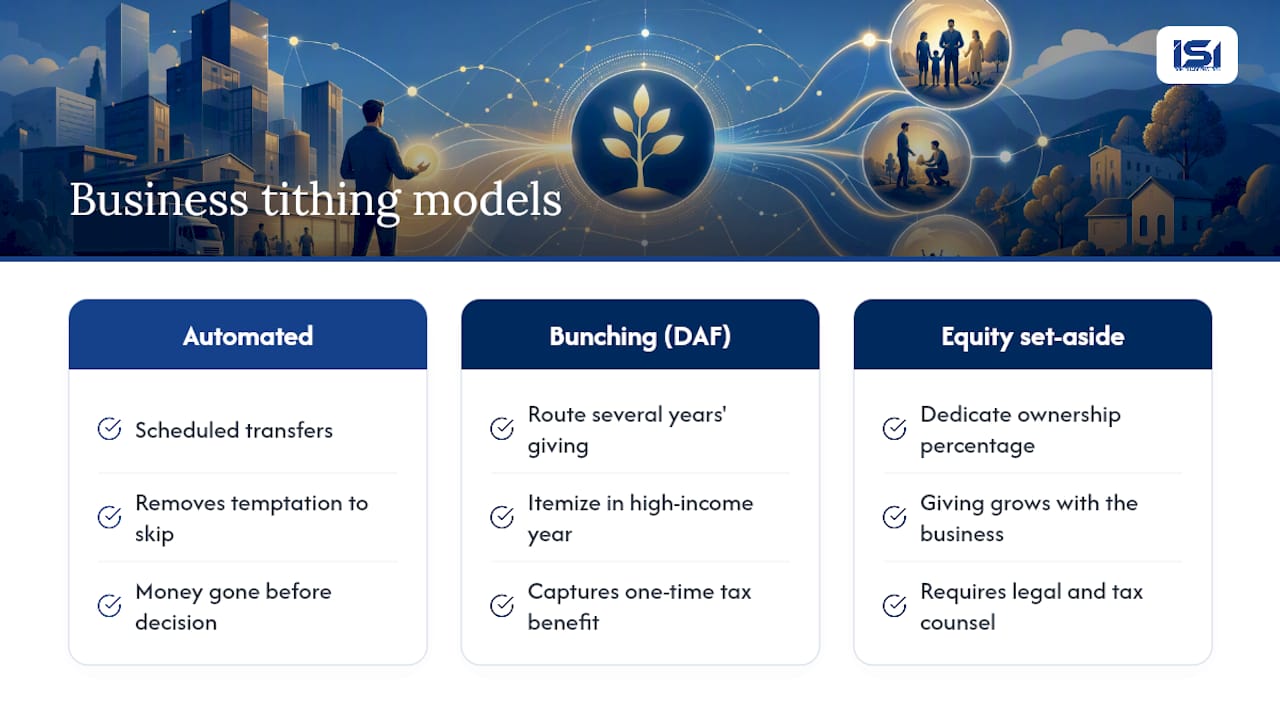
The owner reported that automating the transfer removed the temptation to skip a quarter during a cash crunch, because the money was already gone before he could second-guess it.
Other businesses lean toward bunching. A marketing agency owner who rarely itemizes due to a high standard deduction threshold instead routes several years of giving through a donor-advised fund in a single high-income year, timing it around a major client contract or a one-time asset sale. That single year of itemizing captures a tax benefit that would otherwise disappear entirely.
Larger, more mature companies sometimes move toward equity set-asides, dedicating a small percentage of ownership to a foundation or donor-advised structure so that as the business grows, the giving capacity grows automatically without requiring a new decision every year. This is the most complex model on the spectrum and, as noted earlier, it requires legal and tax counsel before implementation.
What ties these examples together isn't the mechanism. It's consistency. Every business owner who sustains tithing over a decade or more has built a system that doesn't depend on willpower in a hard month.
How to Communicate Your Business Tithe to Stakeholders and Customers
Transparency builds trust, but oversharing can turn generosity into a marketing gimmick, and customers notice the difference. If you're a sole proprietor or small pass-through entity, your tithe is largely a private matter between you, your family, and your church; there's rarely a need to broadcast it.
For businesses with partners, investors, or employees, the calculation changes. Partners and co-owners need to agree on the giving policy in writing before money moves, since a unilateral decision to tithe company profits without partner buy-in can create real conflict, even legal exposure, in a multi-owner entity. Employees benefit from knowing the company has a giving culture, especially if it ties into volunteer time or matching programs, but detailed dollar figures rarely need to leave the leadership team.
Customers respond well to giving that feels authentic and connected to mission, poorly to giving that feels like a marketing checkbox. The former feels like conviction. The latter can feel like a sales tactic, even when the giving is completely genuine.
Legal Considerations and Compliance Issues in Business Tithing
The biggest legal risk isn't the giving itself. It's misclassification. Treating a personal charitable contribution as a business expense on Schedule C, or routing tithes through business accounts without proper documentation, can trigger IRS scrutiny and reclassification as owner compensation or a taxable distribution.
Multi-owner entities carry an additional layer of risk. If you run an S-corp or partnership, unilaterally directing company funds toward charitable giving without partner or shareholder agreement can expose you to breach of fiduciary duty claims, even when your motives are entirely sincere. Get the giving policy in writing, approved by anyone with an ownership stake, before the first transfer happens.
Exceeding the ceiling doesn't make the gift illegal, but it does mean the excess doesn't produce a current-year tax benefit, and needs to be tracked for potential carryforward under the applicable rules.
Publisher Perspective: How ISI Brotherhood Approaches Business Giving and Accountability
Financial faithfulness rarely survives on willpower alone. Most owners who abandon a giving plan don't do it out of greed. They do it because nobody was asking the hard question in month seven, when cash got tight and the tithe felt optional. Peer accountability changes that. A small group that asks direct financial questions, not just "how's business," but "did you tithe this quarter" creates a rhythm that outlasts a single motivated Monday morning.
Protect the rhythm. That's the real discipline behind sustained generosity, and it's easier to protect inside a group of men who will actually ask.
— Derek
An Adjacent Path: Steward Your Giving Inside a Trusted Group of Men
Tax software and a good accountant handle the mechanics of business tithing. Neither one asks you, every week, whether you actually followed through. That's the gap a Christian business mastermind fills, and it's a different kind of support than the calculation and compliance guidance above.

Membership includes weekly mastermind meetings, biblical coaching, a year-round online community, and practical resources across the financial, professional, and spiritual areas of a leader's life. If you've read this far because you want your giving plan to actually stick past the first hard quarter, get the right men in the room and see how a group built for accountability makes generosity sustainable. Explore what it means to lead with legacy in mind and consider joining a mastermind cohort built for exactly this kind of faithfulness.
Sources
For deeper detail, consult IRS Publication 334, IRS Topic 506 on charitable contributions, 26 U.S. Code §162, and Crown Financial Ministries' business tithing resource. Always confirm specifics with a qualified tax advisor before filing.
- IRS — Income and expenses: what can you deduct?
- 26 U.S. Code §162 — Trade or business expenses (excludes charitable contributions)
- How to Tithe as a Business Owner: Tax Deduction Rules - LegalClarity