

If you want Scripture to shape how you lead, join or launch a short businessmen Bible study, six to eight weeks, four to eight men, one recurring hour. That is the whole decision tree. Everything else is logistics.
Three resources get you moving this week. Faith Driven Entrepreneur offers roughly sixteen short topical reading plans, each about a week long, built for men who read in gaps between meetings. InterVarsity's God & Business is a slower, book-based small-group study that digs into vocation rather than quick hits. And Isibrotherhood's small-group model places you in a standing mastermind rather than a study that ends.
Before your first meeting:
- Pick one plan (topical for speed, book-based for depth)
- Invite four to eight men personally, not by mass email
- Lock a recurring day and time on everyone's calendar now
- Send week one's passage and one prep question 48 hours out
Key Takeaways
A businessmen Bible study works best as a short, accountability-heavy pilot that leads into a standing structure like a Personal Board of Advisors.
| Point | Details |
|---|---|
| Start short | Commit to a short period with a small group before considering a longer format. |
| Choose the right plan | Use topical plans for speed and flexibility, book-based studies like God & Business for depth. |
| Name the action | Replace vague prayer requests with one specific business task due before the next meeting. |
| Protect the clock | Start and end on time and state confidentiality norms in week one, not later. |
| Plan for what's next | Move a successful study into a standing accountability group before momentum fades. |
Table of Contents
- Ready-To-Run Bible Studies for Business Leaders
- How Do You Actually Lead a Business Bible Study?
- Which Bible Passages Fit Business and Leadership Decisions?
- Sample 8-Week Bible Study Plan You Can Copy
- What Keeps Businessmen Applying Scripture Long Term?
- Making Room for Prayer and Worship in a Business Setting
- Do Businessmen Actually Change After Joining a Bible Study?
- Books, Podcasts, and Mentors Worth Adding to Your Study
- Ready to Move From Study to Standing Accountability?
- A Businessmen Bible Study for Business Leaders
- Frequently Asked Questions
- Sources
Ready-To-Run Bible Studies for Business Leaders
You don't need to build a curriculum from scratch. Two established options cover most of what a busy leader needs, and knowing which one fits your group saves you weeks of trial and error.
Faith Driven Entrepreneur's reading plans work best when your group has momentum but not much runway. Each of the roughly sixteen topical plans runs about a week, so a group can move through risk, calling, and stewardship in a single quarter without committing to a semester-long program. If your men are the type who skip a meeting during a launch or a close, this format forgives that. Nobody loses the thread because each week stands on its own.
InterVarsity's God & Business study takes the opposite approach. It's a multi-week, book-based curriculum that treats work itself as a theological question worth sitting with. This suits a group that already trusts each other and wants to wrestle with something harder than a weekly devotional.
Here's how to map the choice to your actual problem:
- Leading a team through a hard decision? Start with a leadership-themed topical plan.
- Wrestling with whether your calling is even legitimate ministry? Go with God & Business.
- Managing a cash crunch or growth risk? Choose a stewardship or risk-focused topical week.
- Want something that outlasts the initial six weeks? Pair either plan with a standing accountability structure once the study ends.
How Do You Actually Lead a Business Bible Study?
Most groups die in the first three weeks because nobody planned the boring parts. Group size, frequency, and meeting length matter more than which book you pick.
Keep the group at four to eight men. Smaller than four and one absence guts the discussion. Larger than eight and quieter men stop talking. Meet weekly, not biweekly. Momentum in a men's group depends on consistency, and gaps let work emergencies win. Commit to six to ten weeks up front. Short-term commitments maximize signups and follow-through among men who are already stretched, and you can always extend once the group proves itself.
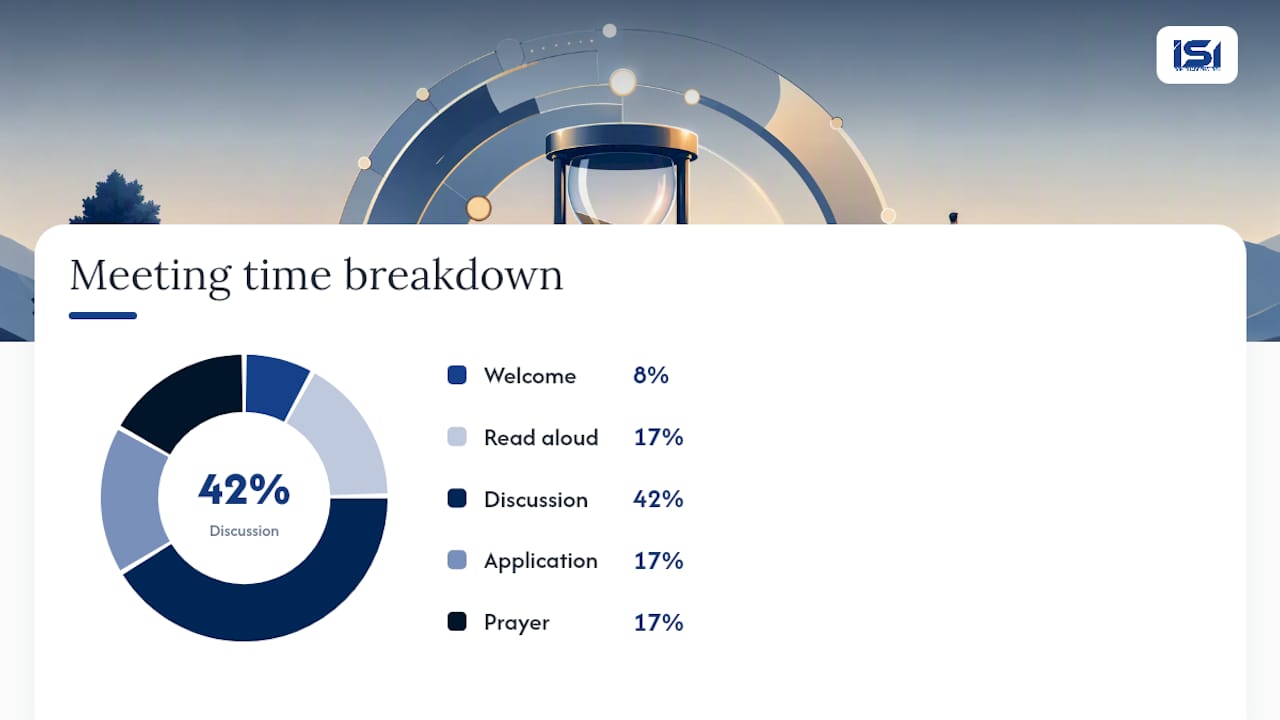
A sixty-minute meeting breaks down like this:
- Welcome and quick check-in, five minutes
- Read the passage aloud, ten minutes
- Guided discussion using two or three prepared questions, twenty-five minutes
- Application and a named accountability action, ten minutes
- Prayer, ten minutes
That accountability step is the one most groups skip, and it's the one that drives actual follow-through. "Pray about your finances" produces nothing. "Call your CFO by Friday about the Q2 numbers" produces a report next week.
Prep checklist for the leader: read the passage twice before the meeting, send it and one question 48 hours ahead, write two backup questions in case the first one falls flat, and know which member tends to dominate so you can redirect early.
Confidentiality needs to be stated out loud in week one, not assumed. Business details shared in a group like this can be sensitive, competitive, or simply embarrassing. Say plainly that what's discussed stays in the room.
Pro Tip: Starting and ending on time signals professional respect to men who run their own calendars for a living. A study that runs long every week quietly trains people to skip it.
Which Bible Passages Fit Business and Leadership Decisions?
You don't need forty passages. You need five that map cleanly onto decisions your group actually faces, with a question sharp enough to move past small talk.
- Proverbs 16:3. Solomon's charge to commit your work to the Lord frames planning as an act of surrender, not control. The practical version of this verse isn't passive. It means building the actual budget, naming the variables you can't control, and then holding the plan loosely enough that God can redirect it.
- Proverbs 21:5. Steady, diligent planning outperforms hasty moves, a useful check for founders who mistake speed for progress.
- Genesis 41 (Joseph). Joseph's grain strategy in Egypt reads like a case study in forecasting and stewardship under pressure, part of a broader biblical theology of entrepreneurship that treats enterprise as legitimate vocation.
- Matthew 20. The parable of the workers challenges how leaders think about fairness, wages, and what employees are actually owed.
- Luke 19 (the minas). A direct picture of stewardship and the risk of playing it too safe with what you've been given.
Faith Driven Entrepreneur's own reading data shows most of their plans run about one week each, which tells you something: a single well-chosen passage, studied deeply for one session, beats a rushed tour through five.
Build your own week around three moves: pick one passage, write one business-specific question, and assign one accountability challenge tied to a real decision on someone's desk.
Sample 8-Week Bible Study Plan You Can Copy
This is a full curriculum, not a sketch. Adapt the order, but keep the arc.
- Week 1: Introductions and expectations. No deep text yet. Set confidentiality norms, share why each man joined, agree on the schedule.
- Week 2: Calling and vocation. Read Genesis 2:15. Ask: does your work feel like a calling or a cage right now? Action: write one sentence naming your business's purpose.
- Week 3: Planning and surrender. Read Proverbs 16:3. Ask: where are you gripping a plan too tightly? Action: name one uncontrollable variable in your current strategy.
- Week 4: Stewardship and risk. Read Luke 19:12-26. Ask: are you playing too safe with resources entrusted to you? Action: identify one risk you've been avoiding.
- Week 5: Integrity under pressure. Read Proverbs 11:3. Ask: where have you cut a corner this quarter? Action: name it to the group.
- Week 6: Leading people well. Read Matthew 20:1-16. Ask: how do your team's incentives reflect your values? Action: review one compensation or recognition decision.
- Week 7: Diligence over hustle. Read Proverbs 21:5. Ask: what's one area where speed is costing you quality? Action: slow one process down this week.
- Week 8: Commissioning and next steps. No new passage. Review what changed, decide whether to extend, and pair off for ongoing accountability.
Open every session with a two-minute win-and-struggle check-in. Close every session by naming the accountability action out loud, not just thinking it.
What Keeps Businessmen Applying Scripture Long Term?
An eight-week study builds momentum. Without a structure to catch that momentum, it fades by month three. This is exactly the gap Isibrotherhood built its model to close.
Isibrotherhood organizes members into Personal Boards of Advisors, small, trusted cohorts that meet regularly across five areas: personal, spiritual, relational, professional, and financial. It's the natural next step after a short study proves the group works.
Sustaining rhythms that actually stick:
- Weekly check-ins on one specific goal, not a general "how's it going"
- Monthly review of business and personal goals side by side
- A designated prayer partner for the weeks the full group can't meet
- A stated confidentiality norm, repeated, not just assumed
Watch for the signal that a study should evolve into a standing group: when men start bringing real business problems to week six instead of surface-level updates, the trust is already there. Don't let the calendar end it.
Pro Tip: If your eight-week study group doesn't want to disband, don't force a new format on them. Simply extend the cadence and let someone volunteer to track goals month to month.
Making Room for Prayer and Worship in a Business Setting
Executives are often more comfortable analyzing a passage than praying out loud, and a good facilitator plans for that instead of hoping it resolves itself.

Keep prayer time structured rather than open-ended for the first few weeks. A round of one-sentence prayer requests tied to the week's accountability action works better than an open floor, especially with men who've never prayed aloud in a group. Rotate who closes in prayer so it isn't always the same voice, and it isn't always the leader.
Worship doesn't need a worship band. A single hymn or song played quietly for sixty seconds before scripture reading resets the room from meeting mode to something slower. Some groups read a short psalm aloud together instead, which works well with men who feel awkward singing but want a shared spoken moment.
The goal isn't performance. It's making space for men who spend fifty weeks a year solving problems to sit still for ten minutes and let something other than their own competence carry the room. That's harder for high performers than it sounds, and it's usually the part of the meeting they remember longest.
Do Businessmen Actually Change After Joining a Bible Study?
The honest answer is: the ones who stay consistent do, and the ones who treat it as optional don't.
What tends to shift first isn't theology. It's decision-making speed and how a leader handles pressure. A man who spends eight weeks studying Proverbs 16:3 alongside peers who ask hard questions starts running his budget decisions through a different filter, not because the verse changed but because someone in the room will ask about it next week. That's the actual mechanism behind these groups. Accountability changes behavior faster than private conviction does.
The second shift is relational. Founders and executives are often isolated by design, careful about what they share with employees, investors, or even spouses. A small group built on the same faith commitment and similar business pressure becomes one of the few rooms where a man can say "I'm scared this quarter" without managing anyone's perception of him. That alone keeps some men coming back long after the original curriculum ends.
Books, Podcasts, and Mentors Worth Adding to Your Study
A weekly study covers Scripture. It doesn't cover everything a growing leader needs between sessions, which is where a short reading list and a few trusted voices fill the gap.
For books, look for titles that treat vocation and calling seriously rather than repackaging generic leadership advice with Bible verses stapled on. For podcasts, seek out Christian entrepreneur and CEO shows that interview working founders about specific decisions, not just principles. Short video content also has a place here. A scripture teaching series can work well as pre-session material, giving your group ten minutes of context before you even open the passage together.
Mentorship is the piece most men skip because it feels harder to arrange than a podcast subscription. A weekly study gives you peers. A Personal Board gives you structured peer accountability. What often remains missing is a single mentor further down the road who has already made the mistakes you're about to make. Ask around your own group. Someone usually knows a candidate who'd say yes if asked directly.
Ready to Move From Study to Standing Accountability?
A six to eight-week study proves whether Scripture and business decisions belong in the same room together for your group. Most men who run one well don't want it to end. That's the moment to consider a standing structure built for exactly this.
Isibrotherhood's Personal Boards of Advisors take the accountability rhythm your study group just built and make it permanent, covering personal, spiritual, relational, professional, and financial growth in one recurring meeting. Members get weekly mastermind sessions, a year-round community, and leadership events instead of a curriculum with an end date. If your group's momentum after week eight has you wondering what comes next, Isibrotherhood is built for exactly that question.
A Businessmen Bible Study for Business Leaders
The conventional advice on this topic treats Bible study like a spiritual discipline separate from work, something you do before the workday starts and then set aside. That framing undersells what's actually useful here. The studies that change how men lead are the ones that put a real business decision on the table in the same session as the passage, not next to it.
Most groups also overweight the choice of curriculum and underweight the accountability structure around it. A mediocre reading plan with a leader who asks hard follow-up questions beats an excellent book study where nobody names a concrete action. If you're choosing where to spend your planning energy, spend it there first.
The other miss is treating an eight-week study as the finish line. It's a pilot. The men who get the most out of Scripture applied to business are the ones who move from a short study into something standing, a Personal Board, a recurring mastermind, a pair of accountability partners who don't let the calendar decide when the conversation ends.
Frequently Asked Questions
How long should a businessmen Bible study run? Six to eight weeks is the sweet spot for a first group. Shorter commitments get more signups and higher completion from busy leaders, and you can extend once the group has proven it works.
What's the ideal group size? Four to eight men. Fewer than four and one absence stalls the discussion. More than eight and quieter members stop contributing.
Do we need a trained facilitator? No formal training is required, but the leader should prep the passage twice beforehand, send pre-read material 48 hours out, and have two backup questions ready if the first one falls flat.
How do we handle confidentiality around sensitive business details? State the norm explicitly in week one. Don't assume it. Business struggles shared in the group should stay in the room, full stop.
What happens after the study ends? Groups that built real trust often move into a standing structure, like a Personal Board of Advisors, rather than disbanding. That's the model Isibrotherhood uses for ongoing accountability across professional, spiritual, and personal growth.