

About half of all CEOs say they feel lonely in the role, and most say it hurts how they lead. The cause is rarely a lack of people around you. It's the weight of decisions you cannot share, the confidentiality that walls you off from your own team, and the social distance that comes with the title. The fastest fix isn't a vacation or a night out. It's building a small, trusted circle, a Personal Board of Advisors, who understand exactly what you're carrying.
TL;DR:
- Building a trusted Personal Board of Advisors with individuals outside your company helps reduce role-based isolation and improves decision-making clarity.
- Establishing confidentiality and a regular meeting rhythm is critical for turning peer groups into truly supportive spaces where CEOs can share vulnerabilities.
- Seeking support through coaching, therapy, or peer groups can prevent chronic loneliness from translating into physical health issues and organizational blind spots.
- Starting the process involves a few key actions: identifying potential advisors, scheduling exploratory calls, and setting boundaries for daily disconnection.
- Long-term, unaddressed loneliness can lead to serious mental health risks and a gap between the leader's authentic self and their perceived role, making early intervention essential.
Table of Contents
- Why CEO Loneliness Happens: Role Mechanics and Common Triggers
- How Loneliness Affects Leaders and the Companies They Run
- Evidence-Backed Strategies to Reduce CEO Loneliness
- How to Build a Confidential Personal Board of Advisors
- Your First 30 Days: A Practical Checklist
- The Long-Term Cost of Carrying Loneliness Alone
- A Founder's Honest Take on Leading Through Loneliness
- A Faith-Forward Option Worth Considering
- Sources
- FAQ
Why CEO Loneliness Happens: Role Mechanics and Common Triggers
CEO loneliness isn't a personality flaw. It's built into the architecture of the job. You're paid to project certainty even when you're guessing, and that overvisibility means every hallway conversation gets filtered before it reaches you. Role pressures documented in leadership research create a structural bind that has little to do with how many friends you have.
- Overvisibility: your mood, your posture, your offhand comment gets read as a signal by everyone watching.
- Concealed uncertainty: you're expected to have answers, so you learn to hide the doubt.
- Information asymmetry: you know things (layoffs, valuations, board conflicts) that no one else in the building can know yet.
- Social distance: friendships with direct reports get complicated the moment you can fire them.
These pressures show up hardest during specific moments: a sensitive personnel decision, a major pivot nobody's approved yet, an acquisition still under wraps. That's situational loneliness, tied to a season. Left unaddressed across years, it hardens into something more chronic, a baseline isolation that follows you even when the crisis passes.
How Loneliness Affects Leaders and the Companies They Run
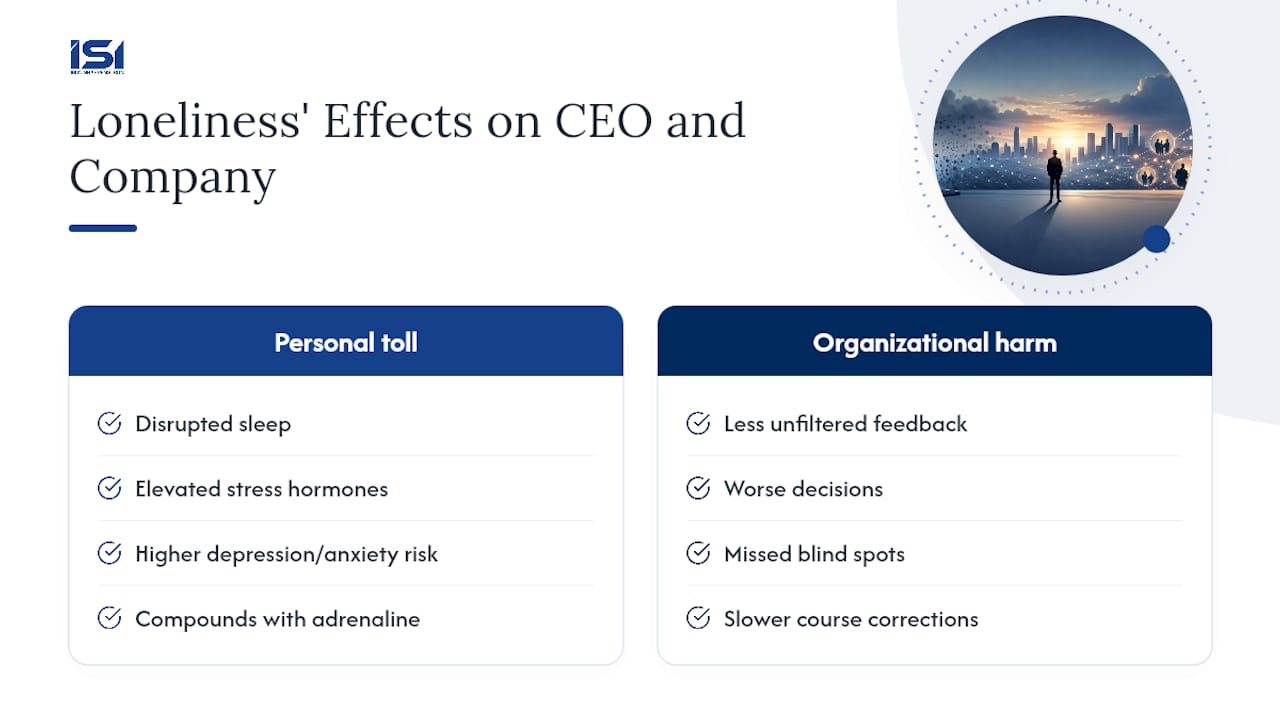
Loneliness doesn't stay in your head. It shows up in your body first, disrupting sleep, elevating stress hormones, and raising your risk for depression and anxiety over time. For a CEO, that physical toll compounds fast because the job already runs on adrenaline and short recovery windows.
The organizational damage is just as real. Isolated leaders get less unfiltered feedback, and thinner feedback means worse decisions, missed blind spots, and slower course corrections. Teams sense when a CEO has stopped hearing hard truths, and that silence tends to spread down the org chart.
Many CEOs report feeling lonely in the role, and a significant share of them say it actively hinders their performance, according to Harvard Business Review. That's not a soft-skills footnote. It's a performance problem hiding in plain sight.
Evidence-Backed Strategies to Reduce CEO Loneliness
Not every fix requires the same investment, and knowing which tool solves which problem saves you time.
- Peer groups and Personal Boards of Advisors. Nothing else replicates the specific relief of talking to someone who has actually made a call like yours. Research on senior leaders and belonging points to peer relationships as the antidote role-based isolation actually responds to.
- Executive coaching. A coach helps you sharpen decisions and behavior in real time. Stanford's David Larcker found coaching and peer networks are the remedies CEOs reach for most often.
- Therapy. A licensed therapist addresses what coaching won't touch: grief, anxiety, marriage strain, the parts of you that exist outside the P&L.
- Protective daily habits. Exercise, sleep discipline, and hobbies unrelated to work show up repeatedly among leaders who report lower loneliness, according to research from HEC Montreal.
Coaching sharpens your performance. Therapy heals what performance can't touch. A peer group gives you both a mirror and a gut check, which is why one exploratory study of CEOs found every single interviewee relied on a trusted sparring partner to cope.
Pro Tip: If you only have thirty minutes this week, don't spend it researching coaches. Spend it texting three people who've run something before and asking if they'd consider meeting monthly.
How to Build a Confidential Personal Board of Advisors
A Personal Board of Advisors only works if you build it with intention, not convenience. Here's the blueprint.
Get the right men in the room. Don't default to your existing friend group. Look for people who aren't your competitors, who bring different functional expertise, and who have actually carried CEO-level weight themselves. Character matters more than resume.
Set the structure before the first meeting. Four to seven members is the sweet spot, small enough for real trust, large enough for varied perspective. Meet monthly or biweekly. Protect the rhythm from day one, because a group that meets "whenever" quietly dissolves within a year.
Make confidentiality clear from day one. State it out loud in the first session: what's said in the room stays in the room. That single sentence is what turns a friendly gathering into a place people will actually tell the truth.
Personal Board of Advisors models run on this logic: small cohorts of Christian business leaders, structured meeting agendas, and confidentiality built into the group's founding norms rather than added later.
| Element | What it looks like |
|---|---|
| Cohort size | 4 to 7 members |
| Cadence | Monthly or biweekly |
| Agenda | Wins, hot seat decision, feedback, commitments |
| Confidentiality | Stated explicitly at the first meeting |
Your First 30 Days: A Practical Checklist
You don't need a strategic plan to start. You need three phone calls and one boundary.
- This week: write down three names of people who could sit on your board, people outside your company with real decision-making experience.
- This week: schedule one 45-minute exploratory call with the strongest name on that list.
- This week: set one daily disconnection window, even 20 minutes, where your phone stays in another room.
- This month: lock the date for your first group meeting, even if the group is only two people so far.
- This month: book a single coaching session or therapy consult to see if either fits your situation.
- Ongoing: track three things weekly, your mood, your confidence in recent decisions, and how often someone gave you feedback you didn't want to hear.
The Long-Term Cost of Carrying Loneliness Alone
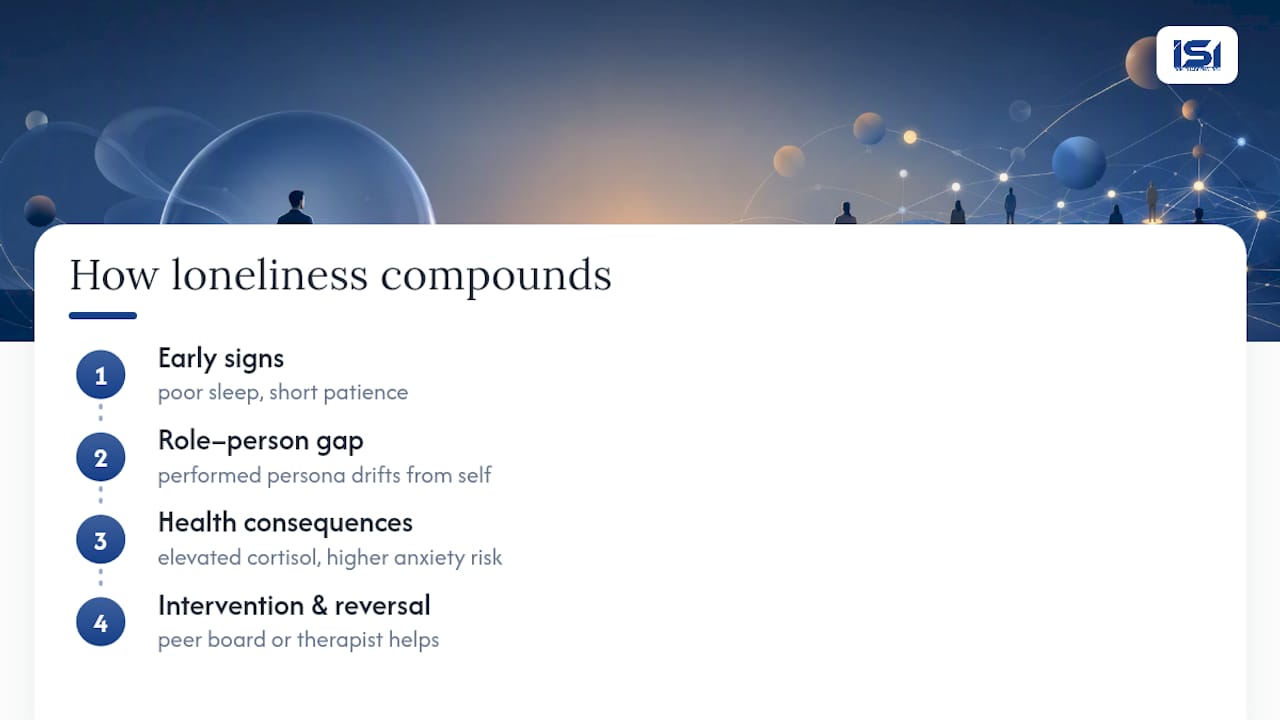
Loneliness that goes unaddressed for years doesn't plateau. It compounds. What starts as a bad quarter of poor sleep and short patience can calcify into chronic anxiety, a strained marriage, or a slow slide toward depression that a leader learns to mask well enough that even his own family misses it.
The research on leader loneliness draws a distinction worth sitting with: a role versus person conflict, where the persona you perform at work drifts further and further from who you actually are. That gap is where the real damage lives. It's not the isolation itself that breaks leaders. It's the years spent pretending the isolation isn't there.
The physical risks are documented too, elevated cortisol, disrupted sleep architecture, and a measurably higher likelihood of clinical anxiety or depression among leaders who report chronic loneliness. None of that resolves itself. It requires an actual intervention, whether that's a peer board, a therapist, or both, and the leaders who wait until crisis forces their hand tend to pay a steeper price than those who build support structures early. The good news: every study on this topic agrees the trajectory is reversible once real support enters the picture.
A Founder's Honest Take on Leading Through Loneliness
Most CEOs resist help because asking feels like admitting the mask has cracked. That instinct is backwards. Vulnerability with the right four or five men isn't weakness, its strategy. One leader I've heard described through ISI's own community carried a major restructuring decision alone for months, convinced no one would understand the stakes, until a Personal Board session forced him to say it out loud. The clarity came from being heard, not from being told what to do.
— Derek
A Faith-Forward Option Worth Considering
If you've read this far, you already know the fix isn't a mystery, it's a room full of the right men, meeting on a rhythm you protect. A faith-forward model built around exactly that: Personal Boards of Advisors, regular mastermind meetings, and events that bring Christian business owners and executives into rooms where confidentiality is set from the first handshake, not negotiated later.
A secular peer group can absolutely deliver candid feedback and structure. What a faith-focused brotherhood adds is a shared foundation, biblical wisdom sitting alongside the business conversation, so the hot seat isn't just about revenue and org charts but also about the marriage, the faith, and the man behind the title. That combination is why leaders describe it less like networking and more like finally being known. If your loneliness has a spiritual weight to it, that's worth hearing directly, When God Goes Silent speaks straight to leaders in that exact season. Explore ISI Brotherhood's Personal Board model and find out if a cohort is forming near you.
Sources
- CEOs often feel lonely. Here’s how they can cope — Harvard Business Review
- Lonely at the top: How senior leaders navigate the need to belong (SAGE / Journal article)
- David Larcker: 'Lonely at the Top' resonates for most CEOs — Stanford Graduate School of Business
FAQ
What Personality Type Do Most CEOs Have?
There's no single CEO personality type, though many studies note a strong presence of conscientiousness and drive toward achievement, traits that also make asking for help feel unnatural.
What Is CEO Syndrome?
"CEO syndrome" isn't a clinical diagnosis, it's shorthand people use for the cluster of chronic stress, isolation, and decision fatigue that builds up from carrying top-level responsibility without adequate support.
Are Most CEOs Introverts or Extroverts?
CEOs skew toward extroversion more than the general population, but that trait doesn't prevent loneliness, since the isolation of the role is structural rather than social.
At What Age Does Loneliness Peak?
Loneliness tends to spike during major life transitions, and for executives that often lines up with periods of intense responsibility, though individual circumstances vary widely.
How Common Is Loneliness Among CEOs?
Roughly half of CEOs report feeling lonely in the role, and many say it measurably hinders their performance, according to Harvard Business Review.