

If you're a Christian business leader ready to choose a mastermind, start by targeting small, covenant-style groups that place you into a Personal Board of Advisors, not open-enrollment programs built for scale. Look for a group that pairs weekly accountability with real spiritual formation. Business owners in a season of growth or transition gain the most. Your next move is simple: research two or three faith-aligned programs this week and request an interview with each.
TL;DR:
- Small, covenant-style groups with five to eight men and a Personal Board of Advisors format foster deeper accountability and trust than large open forums.
- Candidates should be committed to weekly meetings for at least a year, ready for both spiritual and business growth, and able to handle accountability.
- Evaluating groups involves asking consistent questions about theology, confidentiality enforcement, meeting structure, and member vetting, rather than relying on marketing hype.
- Membership typically includes weekly meetings, an online community, occasional retreats, and resources across personal, spiritual, and professional growth areas.
- Watch out for programs with no application process, vague answers, or heavy pricing pressure, which signal weak culture and poor fit.
Table of Contents
- What Kind of Man Actually Benefits From a Faith-Based Mastermind?
- What Selection Criteria Actually Separate Good Masterminds From Mediocre Ones?
- How Do You Actually Vet and Join the Right Mastermind?
- What Should You Realistically Expect Once You Join?
- What Questions Should You Ask Before You Commit?
- Why Iron Sharpens Iron Fits This Selection Framework
- Understanding Faith Alignment and Denominational Fit
- How Do You Judge the Culture Before You're Fully In?
- What Red Flags Should Send You Looking Elsewhere?
- From Performance to Stewardship: A Closer Look
- Ready to Sample Iron Sharpens Iron?
- Sources
What Kind of Man Actually Benefits From a Faith-Based Mastermind?
Not every leader is ready for this level of accountability, and that's worth admitting before you apply anywhere. A faith-based mastermind works best for men who already sense a gap between what their business demands and what their soul can sustain.
You're likely a strong fit if you recognize yourself in a few of these:
- You run a business, lead a team, or carry executive responsibility, and decisions rest on your shoulders more often than you'd like.
- You want biblical accountability, not just networking, and you're willing to let other men speak into your blind spots.
- You can commit to a weekly or near-weekly meeting rhythm for at least a year, not just a season.
- You're at a stage, whether growth, plateau, or crisis, where isolation has become a real cost.
If your calendar can't absorb a recurring weekly commitment, or if you're looking for pure business tactics without the spiritual layer, a faith-based mastermind will frustrate you. Mentoring that integrates Scripture with business decisions only works when the member shows up ready for both halves of the conversation.
What Selection Criteria Actually Separate Good Masterminds From Mediocre Ones?
Marketing pages all sound similar. The differences that matter show up in five practical areas, and you can evaluate every program you're considering against them.
- Group size and structure. A Personal Board of Advisors model, typically five to eight men, produces far deeper accountability than a forum of fifty. Smaller groups force real disclosure; larger ones tend toward polite networking.
- Meeting cadence and format. Weekly meetings build momentum that monthly calls cannot. Ask whether sessions happen virtually, in person, or in a hybrid rhythm, and how often the group gathers for larger events.
- Facilitator role. Some masterminds run peer-led with a light-touch host; others have a trained facilitator providing theological and business oversight. Neither is automatically better, but you need to know which one you're joining.
- Confidentiality and enforcement. Ask how the group actually handles a broken confidence or a member who stops showing up. Written expectations mean little without enforcement.
- Cost shape and commitment length. Programs vary from month-to-month billing to annual commitments. The FORGE, one example of an application-based Christian mastermind, publishes a monthly fee of $179, which gives you a useful benchmark when comparing quotes.
Pro Tip: Ask every program the same five questions above, in the same order, and write down the answers side by side. The comparison will surface differences that a glossy landing page never will.
The Personal Board of Advisors framework works because it borrows structure from executive coaching while keeping the intimacy of a small group. That combination is worth prioritizing over sheer program size.
How Do You Actually Vet and Join the Right Mastermind?
Choosing well takes a sequence, not a gut decision after one podcast episode. Here's the order that keeps you from signing up for the wrong room.
- Research broadly first. Listen to a few episodes of each program's podcast, read sample blog content, and request a syllabus if one exists. Programs built on biblical formation paired with practical business training usually publish this material willingly.
- Vet the theology and the leader. Request a written theology statement, check the facilitator's background, and ask for alumni references you can actually call.
- Prepare for the interview. Most serious programs use an application and interview process to protect the group's chemistry, not to gatekeep for its own sake. Expect questions about your business stage, your walk with Christ, and your capacity for weekly commitment. Answer honestly about where you're struggling; vague answers read as guarded, not humble.
- Run a 90-day trial with measurable goals. Pair one spiritual discipline (weekly Scripture reading, prayer accountability) with one business KPI (revenue target, hiring milestone). Tracking both together tells you whether the group is producing real fruit or just good conversation.
- Decide with your own council. Before you commit past the trial, talk it over with your spouse, pastor, or a trusted friend outside the group.
For more on locating programs worth this level of scrutiny, see this guide on finding a mastermind group.
What Should You Realistically Expect Once You Join?
Membership in a serious faith-based mastermind usually includes a consistent bundle of components, and knowing them ahead of time keeps you from either under-committing or over-promising to yourself.
- Weekly mastermind meetings where five to eight men walk through business and life updates with real follow-up.
- A member directory or year-round online community for contact between sessions.
- Leadership events, virtual or in-person, layered on top of the weekly rhythm a few times a year.
- Resources for growth across personal, spiritual, relational, professional, and financial areas, not just revenue tactics.
Expect one to two hours weekly for the core meeting, plus occasional retreats that run a full day or weekend. Pricing shapes vary from simple monthly billing to annual commitments with a lower effective rate. Watch for minimum enrollment periods; a six or twelve month floor is common and reasonable, but you should know it before you sign.
Members who stick with a well-run group for a full year typically report the same handful of outcomes: sharper accountability, a stewardship mindset that replaces performance anxiety, and relational depth they didn't have with business peers. Structures like a Christian accountability group exist specifically to produce that shift.
What Questions Should You Ask Before You Commit?
Bring this list to your first call or interview. A confident program will answer every one of these without hesitation.
- How is Scripture actually integrated into a typical meeting, not just mentioned?
- What denomination or theological tradition shapes the group's teaching?
- How are members vetted, and what's the typical business stage or industry mix?
- What's the group size, and how many men are in a single cohort?
- How is confidentiality enforced when someone breaks it?
- What happens when a member misses meetings repeatedly?
- How are conflicts between members handled?
- What measurable outcomes have past members reported?
- Can I speak with an alumni member directly?
- What's the refund or pause policy if life circumstances change?
- Is there a trial period before a longer commitment?
- What does the meeting structure and facilitation style actually look like week to week?
Why Iron Sharpens Iron Fits This Selection Framework
Iron Sharpens Iron (ISI) was built around the exact model this article recommends: a small, covenant-style Personal Board of Advisors rather than a large networking pool. Every member gets placed into a group of Christian men who meet weekly and speak into five specific areas of life, personal, spiritual, relational, professional, and financial, instead of business metrics alone.
Here's what that structure includes in practice:
- Placement into a small Personal Board of Advisors, not an open forum.
- Weekly mastermind meetings backed by a year-round online community between sessions.
- Leadership events, both virtual and in-person, layered on top of the weekly cadence.
- Support through the ISI Brotherhood Foundation, extending the mission beyond individual membership.
Joining runs through an application and interview process, similar to what you'll find at other serious faith-based programs, designed to protect group chemistry rather than to complicate access. Before you apply anywhere, sample a few episodes of ISI's podcast or blog content to gauge tone and theology fit. That small step alone tells you more than any landing page can.
Understanding Faith Alignment and Denominational Fit
Not every Christian mastermind teaches the same way, and pretending otherwise sets you up for friction later. Some groups anchor tightly to a specific denomination's doctrine. Others draw from a broader evangelical framework and stay intentionally light on denominational specifics so men from different church backgrounds can sit at the same table.
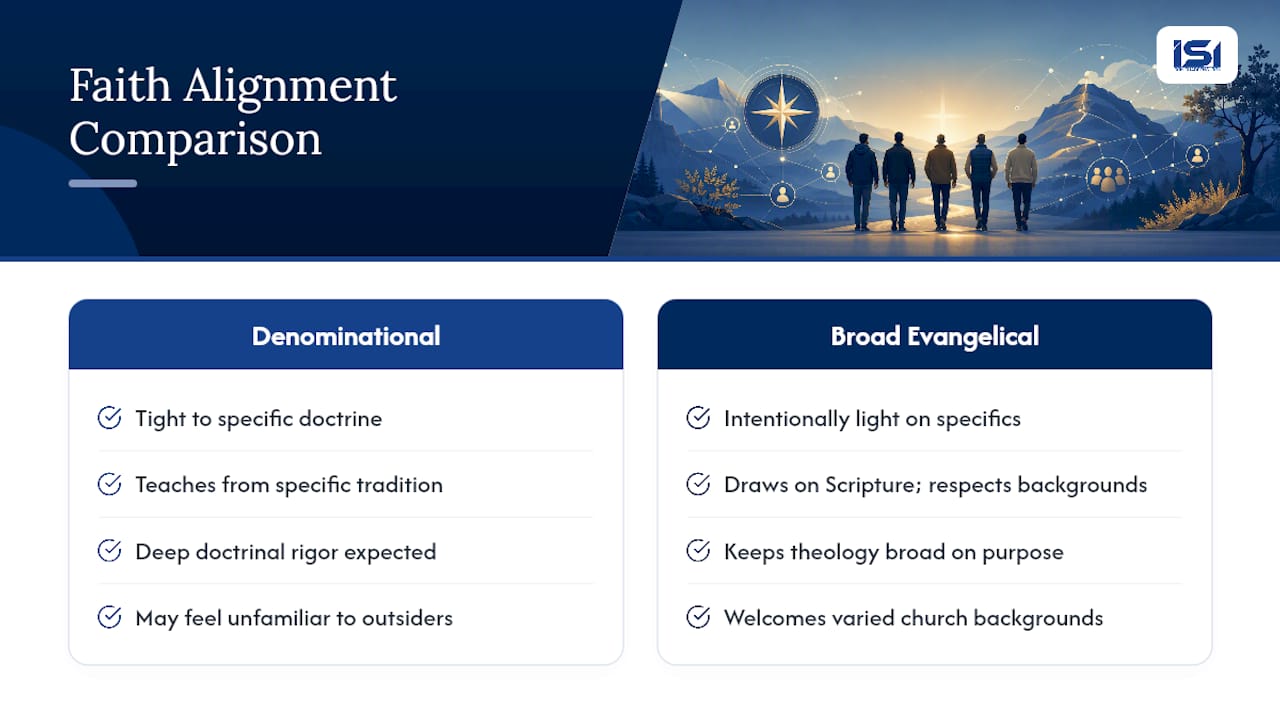
Neither approach is wrong, but mismatch causes real problems. A man from a liturgical tradition dropped into a group built on non-denominational assumptions may find the language unfamiliar. A man expecting deep doctrinal rigor may feel unsatisfied in a group that keeps theology broad on purpose.
Before you apply, ask directly how the group handles denominational differences among members. Does the facilitator teach from a specific tradition, or does the group draw on Scripture in a way that respects varied backgrounds? Leader presence and theological alignment matter as much as business fit, maybe more, because you're inviting these men into decisions your pastor and family also weigh in on.
If your church tradition shapes how you read Scripture, pray, or take communion, say so during your interview. A well-run program will tell you plainly whether it's a fit rather than promising universal compatibility just to close the sale.
How Do You Judge the Culture Before You're Fully In?
Culture is the hardest thing to evaluate from outside a group, and it's also the thing that determines whether you stay past month three. Marketing copy can't show you how members actually treat each other when someone admits a failure.
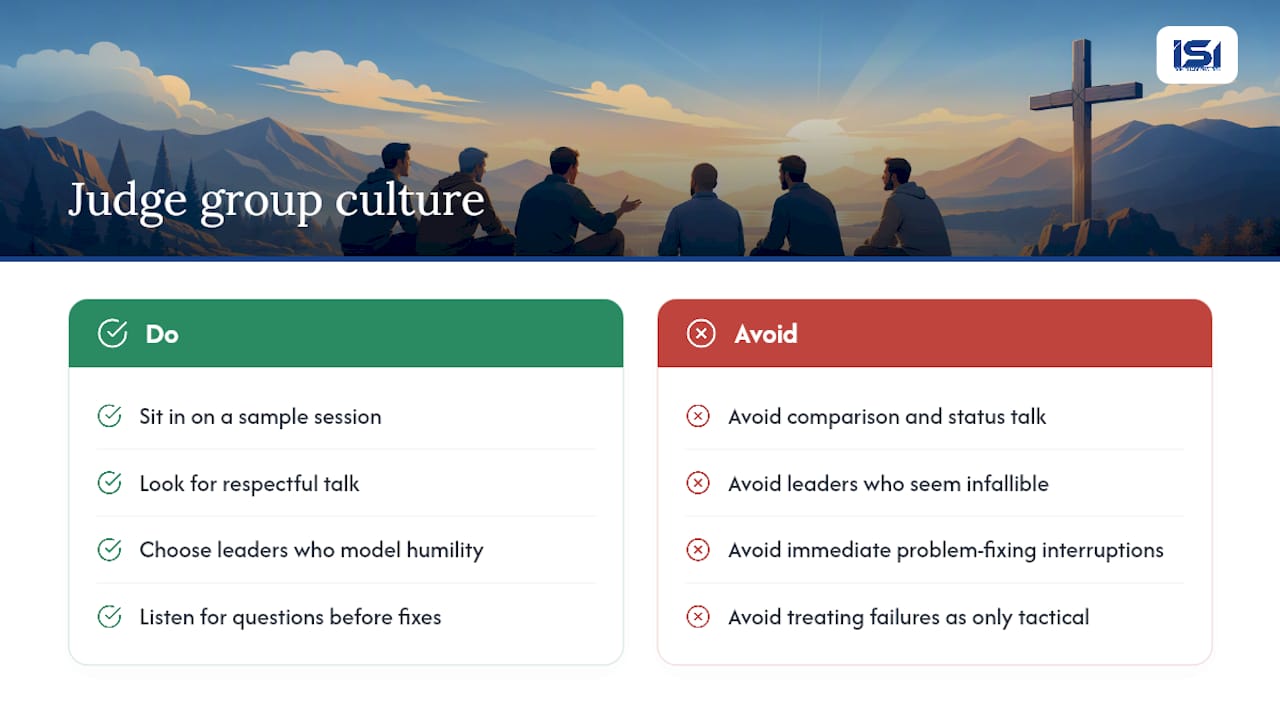
Watch for a few concrete signals during your interview or trial period. Do current members speak about each other with respect, or does the conversation lean toward comparison and status? Does the facilitator model humility when discussing their own mistakes, or do they present themselves as having already arrived? A leader who models humility alongside competence sets the tone the whole group follows.
Ask to sit in on a sample session if the program allows it. Listen for whether members interrupt to fix each other's problems immediately or whether they ask questions first. Groups with strong culture tend to slow down for the person struggling instead of rushing toward the next agenda item.
Pay attention to how the group talks about failure, both business failure and moral failure. A mastermind that treats every setback as a tactical problem to solve, without room for confession or grace, isn't building the kind of accountability that actually changes a man over time. The Personal Board of Advisors model works precisely because the small size lets culture show up clearly, for better or worse, within a few sessions.
What Red Flags Should Send You Looking Elsewhere?
A few warning signs show up consistently across weak mastermind programs, and spotting them early saves you a wasted year.
Watch for a group with no application or vetting process at all. Open enrollment sounds inclusive, but it usually means the facilitator hasn't thought carefully about member fit, and chemistry suffers as a result. Similarly, be cautious of any program that avoids specifics about theology, cost, or commitment length when you ask directly. Vague answers to direct questions are rarely a good sign.
Watch for facilitators who talk primarily about their own success rather than about the members they've helped grow. A leader's testimony matters, but a program built entirely around one person's story, with no alumni you can actually contact, deserves extra scrutiny.
Be wary of groups that treat confidentiality as an unwritten assumption rather than a stated expectation. If nobody can tell you what happens when someone breaks trust, that silence is itself the answer. Finally, notice pricing pressure. A program pushing you toward a long-term commitment before you've sampled a single session is prioritizing revenue over fit.
From Performance to Stewardship: A Closer Look
Somewhere along the way, most driven men start measuring their worth by output, revenue, headcount, the next milestone. Choosing a mastermind well means choosing a group that will interrupt that pattern rather than reinforce it.
Three practices matter more than any feature list. Protect the rhythm: once you find a group with the right weekly cadence, guard that time like you'd guard a board meeting with your biggest investor. Get the right men in the the room: a handful of honest peers will do more for your growth than fifty acquaintances ever will. Make confidentiality clear from day the one, spoken plainly in the first meeting, not assumed and discovered broken later.
Before you commit, pray through it. Talk to your spouse, your pastor, or a friend who knows you well enough to tell you the truth. The goal isn't finding the most impressive program. It's finding the men who will help you steward what you've been given, in your business and everywhere else, well past the point where performance alone runs out.
— Derek
Ready to Sample Iron Sharpens Iron?
If everything above sounds right but you're still unsure where to start, this kind of mastermind gives you a faster way to test the fit than researching a dozen programs cold. Instead of guessing at culture from a landing page, you can sample real content first, then apply once you've seen what the community actually sounds like.
Start by reading What a Privilege It Is to Be the Patriarch for a sense of ISI's tone on leadership and stewardship, then follow up with Why Do I Need a Coach? if you're still weighing whether outside accountability is worth the commitment. Both give you a real feel for the theology and voice behind the weekly meetings before you apply anywhere.
The application and interview process works the same way described throughout this piece: a conversation to check fit, not a sales pitch. Confidentiality expectations are made clear from day one, and the weekly Personal Board of Advisors format means you'll know your group and your commitment level before you're asked to decide anything long term. When you're ready, visit the ISI Brotherhood membership page to see current openings and start your own application.
Sources
- The Forge – Significant Man Ministries
- Bibleconclusions
- Why business mentoring is the critical path for the faith-driven entrepreneur
- All About Masterminds for Christian Women: What They Are, What to Look For, and Should You Join One?