

For Christian men who own businesses, lead teams, or carry the weight of an executive role, the right paid Christian accountability group is Iron Sharpens Iron (ISI). Apply now or request a placement call at Isibrotherhood to get placed into a Personal Board of Advisors: a small cohort of non-competing Christian peers who meet weekly, challenge your thinking, and hold you accountable across every dimension of your life.
Key Takeaways
A paid Christian accountability mastermind delivers the most value when members are non-competing peers, meetings follow a disciplined agenda, and spiritual accountability is built into the structure from the start.
| Point | Details |
|---|---|
| Choose curated, non-competing peers | Candor requires that no member risks competitive exposure by speaking honestly. |
| Require written confidentiality | A signed NDA or governance agreement is the foundation of real vulnerability and trust. |
| Expect results in 6–12 months | Behavioral shifts often appear within 3 months; strategic and business outcomes typically follow at 6–12 months. |
| Prepare process-focused challenges | Arrive at every meeting with a specific, prepared challenge to extract maximum value from your cohort. |
| Isibrotherhood places you in a Personal Board of Advisors | Apply at Isibrotherhood for a placement call and weekly mastermind cohort built for Christian business leaders. |
Table of Contents
- What is a paid Christian accountability mastermind?
- Why Christian leaders need a paid accountability group
- How a Christian men's mastermind actually operates
- How to evaluate and choose the right paid Christian mastermind
- What does a paid mastermind cost, and when will you see results?
- How Iron Sharpens Iron implements this model
- The thing most Christian leaders get wrong about accountability
- Ready to apply to Iron Sharpens Iron?
- Sources
What is a paid Christian accountability mastermind?
A paid Christian accountability mastermind is not a church small group. It is a professionally structured, curated cohort of Christian business owners, founders, CEOs, executives, and senior professionals who meet on a regular cadence to provide peer advisory, spiritual accountability, and strategic counsel to one another. The group functions as your Personal Board of Advisors: men who know your numbers, your marriage, your faith struggles, and your leadership blind spots.
This model differs from informal church accountability in several specific ways:
- Non-competing peers: Members are drawn from different industries or markets so candor is never compromised by competitive risk.
- Confidentiality agreements: Formal NDAs or written governance protect everything shared in the room.
- Leadership advisory focus: Meetings address professional decisions, financial pressures, and strategic challenges, not only spiritual confession.
- Spiritual formation integrated: Biblical wisdom, prayer, and scripture are woven into the meeting structure, not treated as optional.
- Facilitated process: A trained facilitator runs the agenda, manages conflict, and holds members to commitments.
This model fits you if you are a business owner, founder, CEO, C-suite executive, or senior professional who wants peers who understand the weight of leadership and can speak into your life with both faith and experience.
Why Christian leaders need a paid accountability group
Leaders who join curated peer groups consistently report clearer decisions and less isolation. That is not a soft benefit. Research from MIT Sloan shows that industry peer networks help leaders detect distant market signals and overcome the organizational inertia that comes from only consulting people inside their own walls. The higher you climb, the fewer people can actually see what you are carrying.
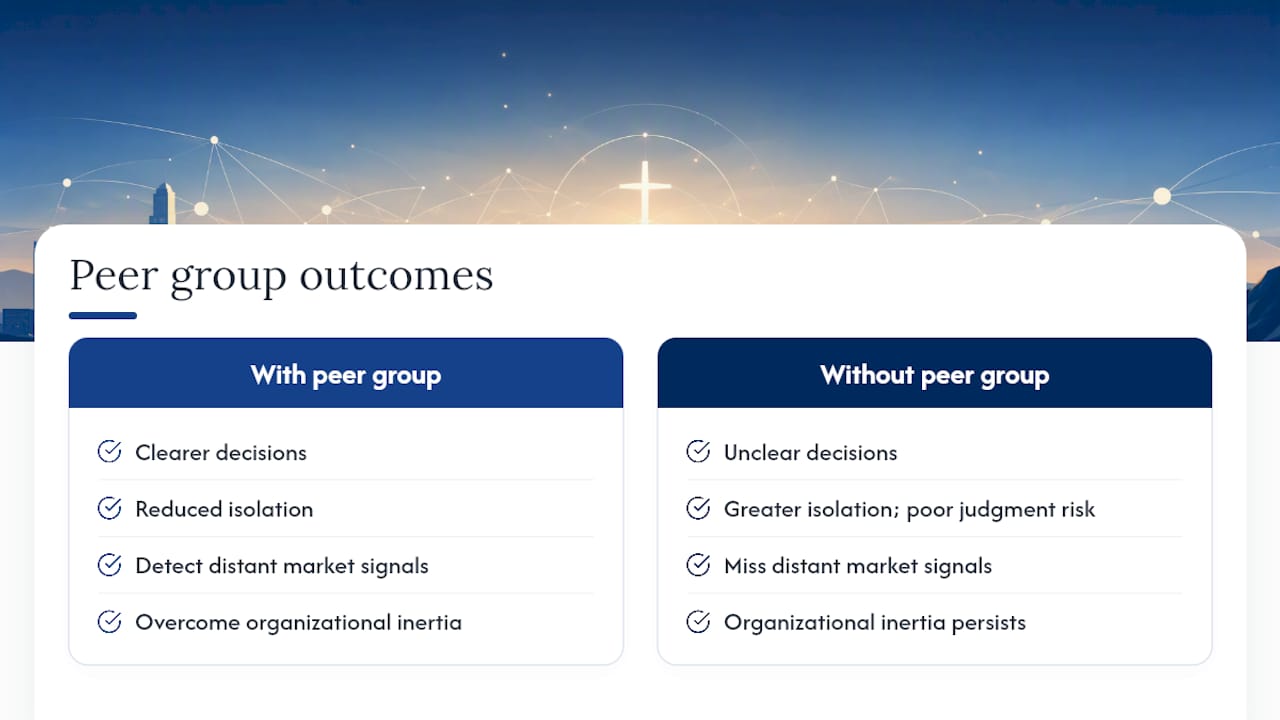
Forbes research on CEO peer groups frames this plainly: peer advisory groups function as a non-political practice field for high-stakes decisions, reducing the isolation that makes leaders vulnerable to poor judgment. You stop practicing your most important conversations in real time, with real consequences, and start rehearsing them with trusted peers first.
The spiritual stakes are just as real. A reflective analysis from Eternal Perspective Ministries argues that the absence of intentional inner-circle accountability is a recurring factor in catastrophic leadership failure among Christian men. Blind trust without probing questions creates the conditions for moral collapse. A multilayered accountability framework that includes external oversight and periodic health assessments, such as the CLERA™ leadership health tool, can help prevent burnout and moral failure before they become public.

Pro Tip: When evaluating any faith-based accountability group, ask whether the program includes direct spiritual questions in every meeting, not just prayer at the close. Groups that skip the hard spiritual questions tend to drift into business coaching with a devotional opener. The accountability that protects leaders lives in the uncomfortable questions.
How a Christian men's mastermind actually operates
A well-run paid mastermind typically places a small group of non-competing members into a cohort, meets regularly for about an hour, and operates under a written confidentiality agreement. Mastermind structure research published in Newsweek confirms that limited membership, time-boxed agendas, and a confidential environment are the structural elements that produce real accountability and problem-solving.
A sample weekly agenda looks like this:
- Check-in round (5–10 minutes): Each member states one win and one current pressure.
- Hot seat (20–30 minutes): One member presents a live challenge; peers ask clarifying questions and offer perspective.
- Strategic feedback (10 minutes): Facilitator synthesizes themes and surfaces blind spots.
- Spiritual check-in (10 minutes): Scripture, a direct spiritual question, or a brief devotional tied to the week's themes.
- Accountability review (10 minutes): Members report on commitments made in the prior meeting.
- Action commitments (5 minutes): Each member states one specific next step before the group closes in prayer.
Core governance elements every serious program should have:
- Written membership vetting criteria and an application process
- Non-compete clause governing group composition
- Signed confidentiality or NDA agreement
- A trained facilitator with defined authority to manage conflict
- A clear replacement policy when a member exits
- A conflict-resolution process that does not rely solely on the facilitator
Peer advisory guides for C-suite leaders emphasize that value comes from the process, not from one-off advice. Members who arrive with prepared, process-focused challenges extract far more than those who show up looking for quick answers.
How to evaluate and choose the right paid Christian mastermind
The single selection rule: prioritize curated, non-competing peers, proven facilitation, integrated spiritual accountability, and clear written governance. Everything else is secondary.
| Membership tier | Typical features | Best fit |
|---|---|---|
| Entry-level community | Online forum, resources, podcast access, member directory | Professionals exploring peer community before committing to a cohort |
| Core mastermind | Weekly cohort meetings, facilitator-led, confidentiality agreement, events | Business owners and executives ready for structured peer accountability |
| Premium mastermind | All core features plus priority placement, retreats, one-on-one advisory, advanced assessments | Founders and C-suite leaders who want maximum depth and personal advisory |
Questions to ask on any discovery call:
- How are members selected, and how do you prevent competing businesses in the same group?
- What does your confidentiality agreement cover, and who enforces it?
- What is your facilitator's background and training?
- Can you share examples of member outcomes without breaking confidentiality?
- What is your annual member turnover rate?
- How do you handle conflict between members?
Red flags to walk away from:
- No formal vetting process for new members
- Membership so broad that competitors could end up in your cohort
- Facilitators who avoid direct spiritual questions or skip prayer entirely
- No written confidentiality agreement
- High-pressure pricing conversations before you have seen the program in action
Forbes research on curated masterminds confirms that the non-competing peer dynamic is what makes candor possible, and candor is what makes the group worth paying for. Understanding church leadership models can also help you see how spiritual accountability structures complement the professional advisory work happening in a paid mastermind.
What does a paid mastermind cost, and when will you see results?
Paid Christian mastermind memberships typically follow a tiered structure: a lower monthly or annual fee for community access, and a higher premium for a facilitated weekly cohort. Retreat and event fees are usually separate. Treat this as a leadership development budget line, not a discretionary expense.
The typical commitment path runs like this:
- Application and placement call: 1–2 weeks from inquiry to cohort match
- Trial or onboarding period: 30–60 days to assess fit before full commitment
- Baseline period: 3 months before behavioral changes become visible
- Strategic and business outcomes: typically 6–12 months of consistent participation
Pro Tip: Before your first meeting, write down three specific business challenges you are carrying right now. That preparation signals to your cohort that you are serious, and it gives your facilitator material to work with from day one. Members who arrive prepared consistently report faster early traction.
Peer advisory group research from CEOworld notes that collateral learning, watching how other leaders handle problems you have not faced yet, compounds over time. The 12-month member is a different leader than the 3-month member.
Budget for travel to at least one in-person event per year. The relational depth built in a room together accelerates what takes months to build on a video call.
How Iron Sharpens Iron implements this model
ISI places every member into a Personal Board of Advisors and runs weekly mastermind cohorts alongside a year-round online community, leadership events, and a podcast built for Christian business leaders.
Key program elements that map directly to the evaluation criteria above:
- Curated placement: ISI matches members based on business stage, industry, and life season, keeping competitors out of the same cohort.
- Non-compete group composition: Group structure is designed so members can speak freely about revenue, strategy, and personal struggles.
- Weekly facilitated meetings: Every cohort meets weekly with a trained facilitator running the ISI agenda.
- Member directory and online community: Year-round access to a broader network of Christian business leaders beyond your cohort.
- Events and retreats: Virtual and in-person gatherings that deepen relationships and accelerate growth.
- Podcast and resources: Content that reinforces the five growth areas: personal, spiritual, relational, professional, and financial.
Your onboarding path after applying:
- Submit your application at Isibrotherhood.
- Complete a placement call where ISI assesses your business stage, goals, and fit.
- Attend an onboarding session and meet your cohort.
- Participate in your first weekly mastermind meeting.
- Set your 90-day goals with your Personal Board of Advisors and commit to your first hot seat.
The member experience centers on trusted accountability: peers who know your real numbers, ask the hard spiritual questions, and pressure-test your decisions before you make them. That combination of confidential peer counsel and biblical grounding is what separates ISI from a generic business mastermind.
The thing most Christian leaders get wrong about accountability
Most men in leadership treat accountability as a safety net for moral failure. That framing is too small. The leaders who get the most from a small-group accountability structure are the ones who bring their ambition into the room, not just their confessions. They show up with the acquisition they are afraid to make, the partnership that feels off, the season of spiritual dryness they have been hiding from their team. That kind of vulnerability is not weakness. It is the discipline that keeps a leader's inner world and outer world aligned.
The risk of isolation is not just moral failure. It is the slow drift toward decisions made in an echo chamber, where the only voice pushing back is your own doubt at 2 AM. A peer advisory forum gives you something rarer than advice: men who have watched you long enough to tell you what you cannot see about yourself. That is the sacred pause most leaders never take. Understanding how church leadership structures support accountability can deepen your appreciation for why this kind of peer structure matters beyond the boardroom.
Ready to apply to Iron Sharpens Iron?
Isibrotherhood gives Christian business leaders something most masterminds cannot: a Personal Board of Advisors built around your faith, your business stage, and your life, not just your industry.
The placement call is a focused conversation about where you are in your business, what you are carrying, and which cohort fits your season. Most members move from application to first meeting within a few weeks. In your first 30–90 days, you will set goals with your cohort, take your first hot seat, and begin building the kind of peer relationships that hold up under real pressure.
Apply today at Isibrotherhood and take the first step toward a Personal Board of Advisors that sharpens you across every area of your life.
Sources
The claims and frameworks in this guide draw from the following sources. Each is worth reading in full if you want to go deeper before your placement call.
- The Power Of Curated Mastermind Groups: Unlocking Success For Business Owners
- Improving capabilities through industry peer networks
- Christian leaders need accountability
- A healthy approach to leadership accountability deficiencies
- Mastermind groups accelerate business growth
- Twenty-Five Reasons to Join a Peer Advisory Group or Forum
- Executive Peer Group Guide for C-Suite Leaders
If you want case studies or a deeper reading list on any of these topics, bring that question to your placement call. ISI's team can point you toward resources matched to your specific leadership season.