

When most men search for Christian business networking groups, what they actually need is a men-only paid mastermind built for accountability, not another card exchange. The right move is applying to a vetted cohort like ISI Brotherhood, where you get placed on a small Personal Board of Advisors, meet weekly, and bring your real struggles to a confidential hot seat instead of a small-talk circuit.
TL;DR:
- Men-only Christian masterminds focus on accountability and character development, offering weekly meetings and small, trusted groups rather than surface-level networking.
- Small cohort sizes, typically five to eight men, foster trust and honesty, leading to sharper decision-making, leadership growth, and spiritual maturity.
- Evaluating a mastermind involves checking for member fit, structure, confidentiality, spiritual emphasis, measurable outcomes, and clear pricing, avoiding vague accountability and inconsistent membership.
- ISI Brotherhood exemplifies this model through weekly personalized boards of advisors, online community resources, and a deliberate focus on ongoing formation across life's key areas.
- Success depends more on group fit and consistent rhythm than size or polish, requiring men to choose groups they'll reliably show up for beyond initial attractions.
Table of Contents
- Why a Men-Only Christian Mastermind Beats Standard Networking
- How Do You Evaluate a Paid Men's Mastermind Before Joining?
- What Does Membership Actually Look Like Week to Week?
- How ISI Brotherhood Matches This Model
- A Practitioner's Take on Choosing the Right Cohort
- Ready to Explore ISI Brotherhood?
- Sources
Why a Men-Only Christian Mastermind Beats Standard Networking
Most networking events trade in surface talk. You swap business cards, promise to "circle back," and drive home no different than you arrived. A men-only Christian mastermind is built for something else entirely: character formation, not just connections.
Lifeway Research found that 7 in 10 pastors believe the most effective discipleship happens one-on-one or in groups of five or fewer. That number matters because it confirms what most networking events get backward: growth happens in small rooms, not big ones. The same research points to mentoring and triads, not seminars, as the format that actually produces lasting spiritual and leadership change.
There's a reason for that. A small room of men who know your name and struggles creates a different kind of pressure than a large room of strangers. That pressure is where honesty lives. Men confess what's actually going on with a business, a marriage, or a private temptation only when the room feels small enough to trust and consistent enough to matter.
What this produces, in practice:
- Sharper decisions, because you're pressure-testing ideas with men who will push back
- Real leadership growth, measured over months, not a single conference high
- Spiritual maturity that shows up in your home, not just your office
- A standing group of men who notice when you go quiet and ask why
Leadership research backs this up further: cohorts built around character development, not just skill-building, produce more durable influence in the leaders who go through them. Skills fade. Character compounds.
How Do You Evaluate a Paid Men's Mastermind Before Joining?
Not every group calling itself a "Christian mastermind" delivers what it promises. Before you apply anywhere, run the group through a short evaluation framework built on eight questions:
- Membership fit. Are the other men roughly your stage of business and leadership, or wildly mismatched?
- Cohort size. Is it small enough for real trust, or padded to boost revenue?
- Meeting cadence. Weekly? Biweekly? What happens when someone misses three in a row?
- Facilitator role. Is there a trained leader guiding the room, or is it unstructured venting?
- Confidentiality. Is there a clear stated policy, or just an assumption?
- Spiritual emphasis. Is prayer and Scripture woven into the format, or bolted on as an afterthought?
- Measurable outcomes. Can the group point to specific changes in members' lives and businesses?
- Price and tier structure. Does the cost map to a clear format, or is it vague and shifting?
Ask these eight questions directly on your discovery call. A group with nothing to hide will answer all of them without hesitation.
Watch for three red flags. First, vague accountability, language about "checking in" with no actual structure behind it. Second, pulpit talk without a system, meaning someone preaches at the group instead of leading a disciplined process. Third, inconsistent membership, where the room's makeup changes so often that nobody ever builds real trust.
Principles for lasting cohorts include beginning with prayer, using real discernment about who gets invited, and keeping the group small with a defined purpose, according to a practitioner's guide on starting local leadership cohorts. Those same principles are worth applying anytime you choose a mastermind for yourself.
Pro Tip: Protect the rhythm before you protect anything else. A cohort that meets consistently with the right men in the rooms will outperform a flashier group that meets whenever it's convenient.
What Does Membership Actually Look Like Week to Week?
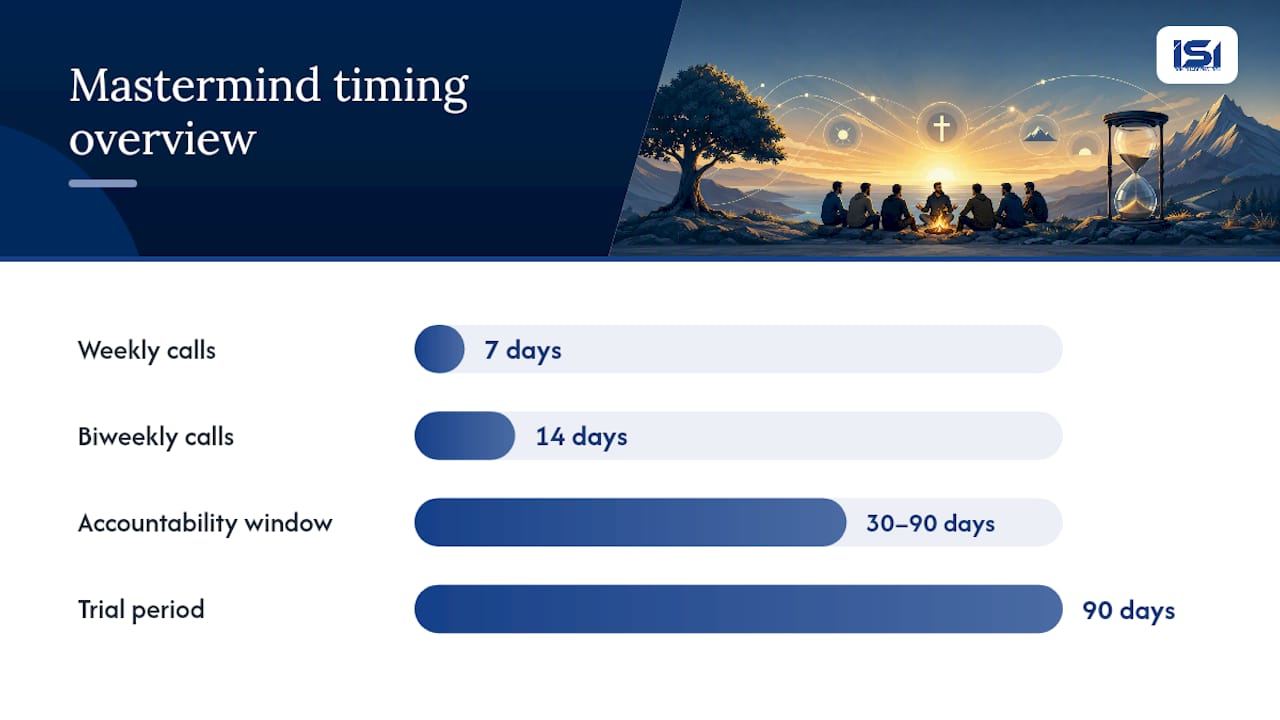
Expect a rhythm, not a random series of events. Most serious cohorts run weekly or biweekly calls that combine a hot seat (one man presents a real problem for direct feedback), a prayer component, and a short accountability check-in on commitments from the last meeting. Layer in an annual retreat and you have the full shape of a working mastermind year.
Cohort size tends to stay small on purpose. Groups capped around five to eight men, sometimes structured as a tighter Personal Board of Advisors, build trust faster than larger rooms because everyone actually gets known. That size also makes the 30 to 90 day accountability window that follows onboarding far more effective.
Onboarding typically runs through a few stages:
- An application that screens for fit, not just payment ability
- A vetting conversation to confirm the group and the man are a match
- Placement into a specific board or cohort
- A trial period, often the first 90 days, to confirm the rhythm works both ways
Pricing shapes vary. Some groups run tiered annual or monthly memberships; others charge separately for retreats and deep-dive events layered on top of a base membership. For current pricing details, visit the organization's website.
One expectation to set from the start: make confidentiality clear from day the one. Don't assume it. Ask how the group handles it, get it stated plainly before your first hot seat, and you'll walk into that first meeting with the trust already half built.
How ISI Brotherhood Matches This Model
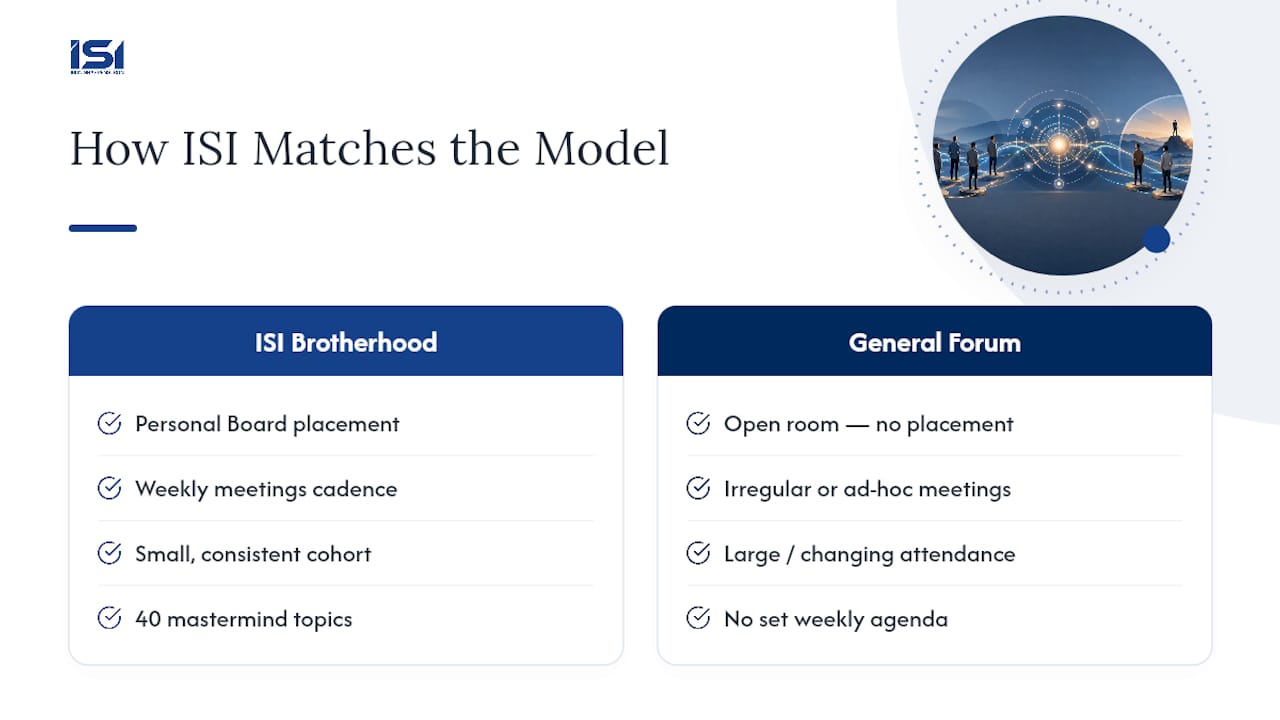
ISI Brotherhood was built around the exact structure this evaluation framework asks for. Every member gets placed into a Personal Board of Advisors, a small cohort of Christian men who meet weekly to challenge, encourage, and hold each other to real commitments across five areas: personal, spiritual, relational, professional, and financial.
That weekly cadence isn't a bonus feature. It's the backbone. Combined with a year-round online community, leadership events, and the ISI Brotherhood Foundation, the model is designed for ongoing formation rather than a single conference high that fades by March. The 40 mastermind meeting topics used across ISI cohorts give a sense of how deliberately the weekly agenda is built, and the men's accountability structure behind it reflects the same small-group principles the research points to.
If you're weighing ISI against a general forum or a broader entrepreneur network built for Christian men, the difference comes down to structure: a Personal Board placement versus an open room of strangers.
A Practitioner's Take on Choosing the Right Cohort
Most men chase the wrong variable when picking a group. They chase size, polish, or how impressive the other members sound on paper. None of that predicts whether you'll actually change. What predicts change is whether the room is small enough to know you and consistent enough to hold you to something.
Fit and rhythm matter more than perks. A retreat with a great speaker means nothing if the weekly follow-through disappears by February. Before you sign anything, ask yourself if this specific group of men, meeting on this specific schedule, is one you'll actually show up for when you don't feel like it.
If the answer is yes, stop researching and apply.
— Derek
Ready to Explore ISI Brotherhood?
If the evaluation checklist above sounds like what you've been missing, the next step is simple: start a conversation. ISI Brotherhood gives you something a general networking group can't, a standing Personal Board of Advisors that meets weekly and holds you accountable across your whole life, not just your P&L.
A discovery call is a quick, no-pressure conversation. Expect a short vetting discussion, a look at your current goals across personal, spiritual, relational, professional, and financial areas, and a conversation about which cohort or Personal Board placement fits you best. For a deeper look at how ISI members talk about leadership and faith under pressure, read What a Privilege It Is to Be the Patriarch or listen to When God Goes Silent for a candid take on faith when answers don't come easily.
If you're ready to see where you fit, start your membership application and get matched to a cohort built around the rhythm and confidentiality this article just walked through.
Sources
- Equipping men for spiritual leadership (Lifeway Research)
- Starting a local leader’s cohort — Toby DeHay