

Christian financial stewardship means God owns everything you have, and you are the manager entrusted to handle it well. That single shift, from owner to steward, changes how you budget, save, give, and spend. This week, you can start living that out with three moves: track every dollar for seven days, add a giving line item to your budget before anything else gets spent, and set a 15-minute weekly money review on your calendar.
- Track your spending for seven days without judgment, just observation.
- Set a giving line item first, before bills or discretionary spending.
- Schedule a 15-minute weekly review to check progress against your plan.
"The earth is the Lord's, and everything in it, the world, and all who live in it." (Psalm 24:1)
Key Takeaways
Christian financial stewardship treats every dollar as God's resource, managed faithfully through planned giving, disciplined habits, and consistent accountability rather than sporadic effort.
| Point | Details |
|---|---|
| God owns it all | Every financial decision starts from Psalm 24:1's claim that everything already belongs to God. |
| Habits beat motivation | Automating giving and savings produces more lasting change than relying on willpower alone. |
| Giving comes first | Treat generosity as a planned budget line item, not whatever is left over at month's end. |
| Debt needs a plan, not panic | Use a structured payoff sequence and avoid impulsive borrowing rather than treating all debt as sin. |
| Community sustains formation | Isibrotherhood's mastermind groups pair biblical principles with weekly accountability for lasting stewardship habits. |
Table of Contents
- What Is Christian Financial Stewardship?
- What Are the Core Principles of Biblical Stewardship?
- How Do I Start Practicing Financial Stewardship This Month?
- Should Christians Tithe, Save for Retirement, or Avoid All Debt?
- How Do Accountability Groups Strengthen Financial Stewardship?
- Why Formation Matters More Than Perfection
- Where Can You Find Ongoing Accountability for Stewardship?
- Frequently Asked Questions About Christian Financial Stewardship
- Sources
What Is Christian Financial Stewardship?
Stewardship starts with a claim most budgeting advice ignores: none of it is yours. Psalm 24:1 says the earth and everything in it belongs to God. Genesis 1 shows Him as creator and original owner of every resource. Colossians 1:16 extends that ownership to "all things," visible and invisible, which includes your paycheck, your house, and your retirement account. Christian financial stewardship is the practice of managing what God owns according to His priorities, not your preferences.
That reframing does more than sound pious. It changes motive. An owner asks, "How do I grow this for myself?" A steward asks, "How do I use this well for the one who gave it?" The same dollar behaves differently depending on which question drives it. Your job becomes a stewardship post rather than a personal achievement. Your home becomes a resource for hospitality and provision rather than a status marker. Your savings account becomes margin for generosity and stability rather than a hedge against a God you're not sure will provide.
Picture two people who each get an unexpected financial bonus. The owner-minded one upgrades a gadget or books a trip because it's "their" money and they earned it. The steward-minded one pauses, asks what God might want done with it, and directs part of it toward debt payoff, savings, and giving before deciding what's left for enjoyment. Same money, opposite starting question. The Grace College Seminary resource on stewardship frames this well: acknowledging God's ownership isn't a one-time confession, it's a daily operating assumption.
What Are the Core Principles of Biblical Stewardship?
Scripture doesn't leave stewardship vague. These eight principles form the backbone of how faithful money management actually works, each with a practical hook you can apply.
- God owns everything. Psalm 24:1 and Genesis 1 establish this as the foundation. Practically, this means checking major purchases against the question: "Would I make this choice if I remembered whose money this is?"
- You are called to be faithful, not flashy. Luke 16:10 says whoever is faithful in little will be faithful in much. Small, consistent budgeting habits matter more than occasional grand gestures.
- Seeking God's kingdom comes before financial security. Matthew 6:33 tells believers to seek His kingdom first, trusting provision to follow. This shapes priorities when giving and saving compete for the same dollars.
- Contentment guards against financial anxiety and greed. First Timothy 6:6-8 ties godliness with contentment to great gain. Practically, this means resisting lifestyle inflation every time income rises.
- Generosity is planned, not leftover. 2 Corinthians 9:7 describes giving that is cheerful and deliberate, not reluctant. A giving line item at the top of your budget puts this principle into action.
- Work and diligence are part of stewardship, not separate from it. Proverbs consistently ties diligent labor to provision. Treat your paycheck as the fruit of stewardship over your time and skills, too.
- Debt requires caution, not blanket condemnation. Proverbs 22:7 warns that the borrower is servant to the lender. This principle calls for avoiding impulsive or exploitative debt while recognizing that not every loan violates stewardship, Grace College Seminary notes integrity and planning matter more than the mere presence of debt.
- Wise counsel improves decisions. Proverbs 15:22 says plans fail without counsel but succeed with many advisers. This is where trusted community, not solo decision-making, protects you from blind spots.
These principles connect directly to giving percentages, budgeting categories, debt payoff order, and even how you evaluate a job offer. Stewardship isn't a side category of faith. It's woven into daily decisions about work, money, and time, a point the Faith Driven Entrepreneur community emphasizes when applying these principles beyond personal budgets into business leadership.
How Do I Start Practicing Financial Stewardship This Month?
Good intentions rarely survive without a plan. Here's a sequence that moves from immediate action to sustained rhythm, so you build habits instead of relying on willpower alone.
First 7 days:
- Write down every expense, no exceptions, to see where money actually goes.
- List all debts with balances, interest rates, and minimum payments.
- Open a separate savings account if you don't already have one, even with $25.
First 30 days: 4. Build a simple budget with four categories: giving, savings, debt payoff, living expenses. 5. Automate your giving and savings transfers so they happen before you can spend the money. 6. Cut one recurring expense you don't use enough to justify.
Monthly routine: 7. Hold a 15-minute weekly review, then a slightly longer monthly check-in comparing actual spending to your plan. 8. Adjust one category based on what the past month taught you.
Quarterly review: 9. Reassess your debt-reduction sequence, either the debt snowball (smallest balance first) or debt avalanche (highest interest first), and confirm you're still moving. 10. Revisit your giving percentage as income changes.
Annual stewardship check: 11. Review the full year: total given, total saved, debt eliminated, and where contentment slipped into comparison or accumulation.
A basic emergency fund of one month's expenses typically takes three to six months to build on an average income if you're automating savings consistently. Full debt elimination varies widely, but households following a structured payoff sequence often see meaningful progress within 18 to 36 months, faster with intentional cuts and windfalls redirected toward the goal.
- Automate everything you can, giving and saving included, so discipline isn't required daily.
- Use a 24-hour rule on non-essential purchases over $100 to interrupt impulse spending.
- Calendarize your giving so it's a decision made once a year, not renegotiated every paycheck.
Pro Tip: Automate your giving transfer for the same day your paycheck lands. Money that leaves before you see it never feels like a sacrifice, it just becomes normal.
This habit-first approach matters because most financial struggles among Christians aren't a knowledge gap, but a consistency gap. Jesus Teaches Money argues that repeated small actions, tracking, automating, reviewing, produce lasting change far more reliably than sudden bursts of motivation.

Should Christians Tithe, Save for Retirement, or Avoid All Debt?
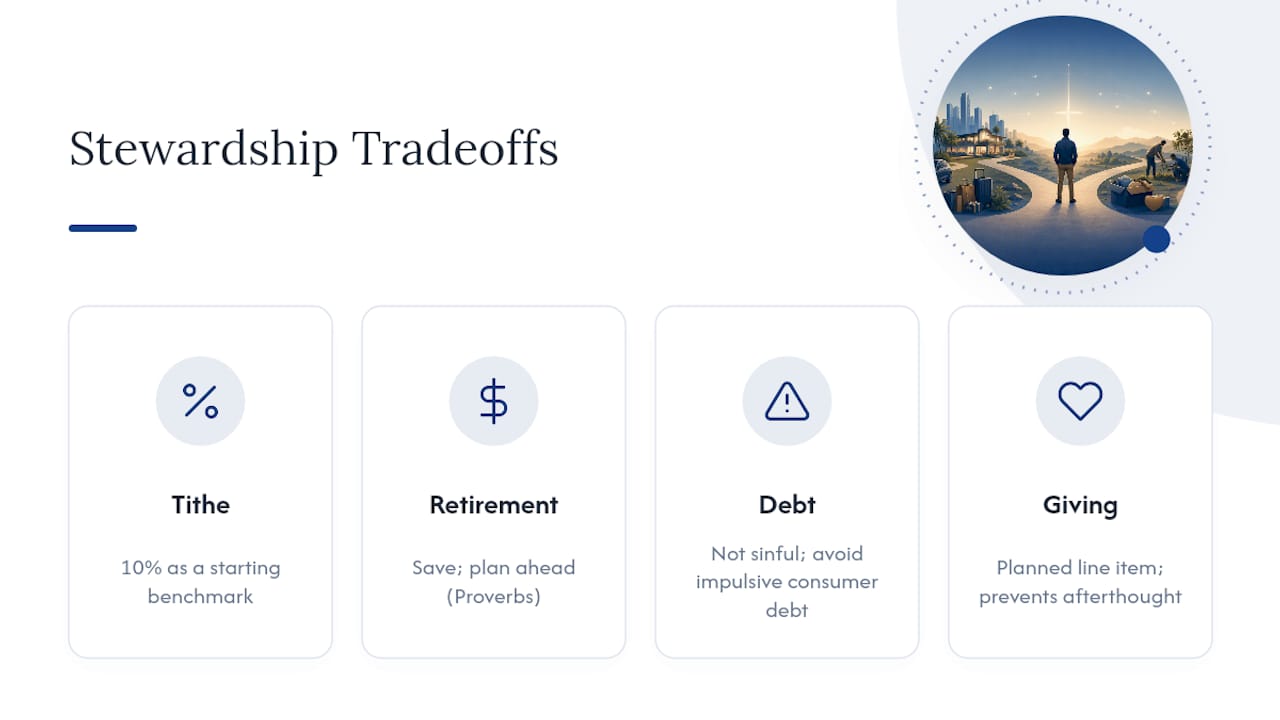
Should I tithe a specific percentage? Many Christians use the biblical tithe (10%) as a starting benchmark, though 2 Corinthians 9:7 emphasizes a cheerful, planned gift over a rigid legal formula. Treat it as a floor to build from, not a ceiling.
Should I save for retirement? Yes. Proverbs praises the ant for storing up provisions in season, and planning ahead reflects wisdom, not distrust in God. Retirement savings and generosity aren't competitors when both are budgeted intentionally.
Is all debt sinful? No. Proverbs 22:7 warns against the power debt gives a lender over a borrower, but a mortgage or reasonable business loan differs from impulsive consumer debt. The concern is presumption and lack of a repayment plan, not debt itself.
How much should I give? There's no single legal number, but a planned line item, whether 10% or another figure, prevents giving from becoming an afterthought. GuideStone's framework places generous giving alongside providing for family and cultivating contentment as core, not optional.
Should I own a home? Homeownership is a stewardship decision, not a spiritual mandate. Weigh it against your season of life, calling, and whether it strengthens or strains your ability to give and save. Life-stage guidance for Christian business owners makes the same point: principles stay fixed, but application shifts with your circumstances.
How Do Accountability Groups Strengthen Financial Stewardship?
Knowing these principles rarely produces change on its own. One small group that committed to a monthly financial check-in, each member sharing giving, saving, and debt progress, saw members follow through on stewardship goals at a far higher rate than those managing money alone. Accountability closes the gap between knowing and doing.
To start or join one:
- Define the purpose upfront: giving accountability, debt payoff support, or general budgeting discipline.
- Keep the group small, four to six people works well for honesty and consistency.
- Set a rhythm, weekly or biweekly meetings sustain momentum better than monthly ones.
- Agree on a simple covenant: what you'll share, how you'll follow up, and how confidentiality works.
Pro Tip: Each meeting, review three numbers together: amount given, amount saved, and debt balance change. Structured questions produce honest answers faster than open-ended check-ins.
Structured mastermind models, like the kind Isibrotherhood builds around a Personal Board of Advisors, show how this rhythm works at scale for business owners managing both personal and company finances simultaneously.
Why Formation Matters More Than Perfection
Money struggles rarely come from ignorance. Most Christians I've studied on this topic already know the principles, they just haven't built the rhythms that make faithfulness sustainable. Stewardship is formation, not performance. You won't get every decision right, and grace covers that. What matters is steady, faithful progress: a giving line item that stays funded, a weekly review that actually happens, a debt plan you stick with even when it's slow. Isibrotherhood exists around this same conviction, that men grow through consistent accountability, not isolated willpower, applied to finances just as much as leadership or family.
Where Can You Find Ongoing Accountability for Stewardship?
Reading about stewardship principles is one thing. Sticking with them for a full year, through a slow month or an unexpected expense, is another challenge entirely. That's where a Personal Board of Advisors changes the equation. Isibrotherhood places Christian business owners, executives, and professionals into small mastermind groups that meet regularly to talk through financial decisions alongside personal, spiritual, relational, and professional growth, not as a side conversation, but as a built-in part of the covenant.

A local church small group or a trusted mentor can offer this same kind of accountability, and either path is worth pursuing if it gives you consistent, honest checkpoints. If you're a business owner or executive looking for a structured cohort built specifically around faith, leadership, and financial accountability, you can explore Isibrotherhood's mastermind community and see whether a Personal Board of Advisors fits where you are right now.
Frequently Asked Questions About Christian Financial Stewardship
What is Christian financial stewardship in simple terms? It's managing your money, time, and resources as things God owns and you're entrusted to handle well, guided by biblical principles rather than personal preference alone.
Do Christians have to tithe exactly 10 percent? The tithe is a common benchmark, but 2 Corinthians 9:7 emphasizes cheerful, planned generosity over a rigid legal percentage.
Is it wrong for Christians to save for retirement? No, planning ahead reflects biblical wisdom. The key is balancing retirement savings with ongoing generosity rather than letting one crowd out the other.
Is all debt against biblical stewardship? Not automatically. Proverbs warns against the power debt gives lenders, but the real concern is impulsive borrowing without a repayment plan, not debt as a category.
How do I start budgeting as a Christian if I've never done it before? Start by tracking a week of spending, then build a simple budget with giving, savings, debt, and living expenses as your four core categories.
This article is general information, not a substitute for advice from a qualified financial advisor. Consult a qualified financial professional about your own circumstances before acting on anything here.