
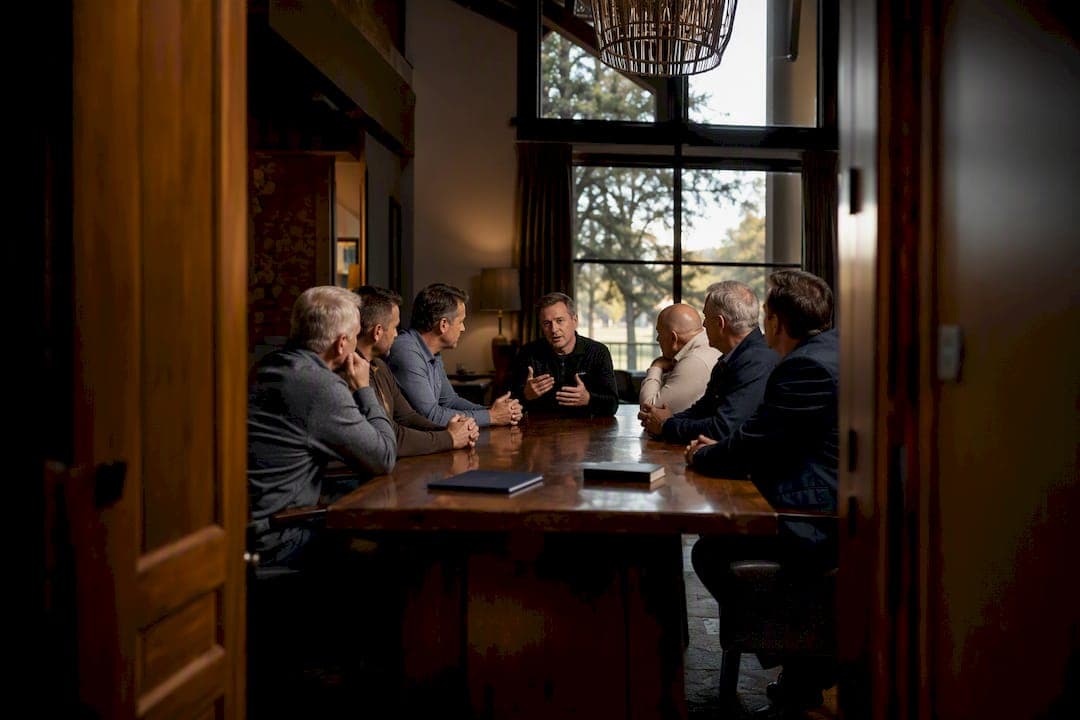
Christian leadership accountability, in practical terms, is a small, confidential mastermind of vetted peers, often called a Personal Board of Advisors, who meet on a fixed cadence to review commitments and press each other toward growth. The strongest version pairs recorded action items with a report-back at the next meeting, so talk turns into follow-through. ISI Brotherhood builds this exact structure for Christian business leaders who want faith-aligned peers instead of generic networking.
TL;DR:
- Mastermind groups should have 4 to 10 Christian leaders who meet regularly to review commitments and address personal, spiritual, and business challenges.
- Confidentiality and recorded action steps are essential for honest dialogue and high follow-through, with progress often visible within 30 to 90 days.
- Faith alignment fosters deeper conversations, encouraging ethical decision-making and accountability rooted in Scripture principles like restoration and mutual submission.
- Operational discipline, clear facilitation, and a focus on shared conviction prevent common pitfalls such as drifting agendas or dominance by outspoken members.
- Combining peer accountability with mentoring and spiritual direction enhances long-term growth in integrity, decision quality, and spiritual maturity.
Table of Contents
- What Is Mastermind-Based Christian Leadership Accountability?
- Why Peer-Led, Faith-Aligned Accountability Actually Works
- How to Find or Start a Faith-Based Mastermind That Holds You Accountable
- Keeping the Group Effective: Rules, Roles, and Pitfalls
- The Biblical and Theological Foundations of Accountability
- The Spiritual Disciplines That Support Real Accountability
- Where a Mentor or Spiritual Director Fits
- Handling Conflict With Grace, Not Avoidance
- Keeping Accountability Aligned With Church and Doctrine
- Why Faith Alignment Changes What Accountability Actually Costs You
- How ISI Brotherhood Delivers This Model in Practice
- Sources
What Is Mastermind-Based Christian Leadership Accountability?
Forget the image of a Bible study bolted onto a networking event. A Personal Board of Advisors is a standing group of five to ten Christian business leaders who commit to meeting on a set schedule and holding each other to specific commitments across personal, spiritual, relational, professional, and financial areas of life.
A typical meeting follows a rhythm: wins from the past cycle, a "hot seat" where one or two members bring a live problem for group input, and a review of accountability check-ins from the last meeting. That hot-seat format is a defining feature of mastermind groups generally, not just faith-based ones, and it works because it forces specificity instead of vague encouragement.
This is worth stating plainly: this model addresses business leadership accountability, not church governance. It has nothing to do with pastoral oversight, congregational discipline, or denominational structures for ministry leaders. It concerns owners, executives, and entrepreneurs who want peers to challenge their decisions and their character.
Group size matters more than most leaders assume. Groups tend to work best with 4 to 10 members, a range Wikipedia's overview of mastermind groups also identifies as ideal for giving everyone real hot-seat time. Cadence varies by group: some meet weekly, others biweekly or monthly, but the frequency has to be sustainable enough that it survives a bad quarter.
- Weekly cadence: fastest feedback loop, best for high-growth or high-stress seasons
- Biweekly cadence: common default, balances depth with member bandwidth
- Monthly cadence: workable only with strong facilitation and disciplined follow-up between sessions
Why Peer-Led, Faith-Aligned Accountability Actually Works
Confidentiality is the hinge everything else swings on. When members know a failed deal or a marriage strain won't leave the room, they say the true thing instead of the safe thing, and the group can actually help. That confidentiality boundary is described as foundational to effective masterminds by Deliberate Directions' breakdown of mastermind mechanics, which notes that explicitly agreed rules are what let members surface sensitive failures they wouldn't discuss anywhere else.
The second engine is the forcing function: recorded next steps, reviewed out loud at the next meeting. Practitioners consistently point to this single feature, more than any other, as the one that raises execution rates in peer groups. Skip it, and a mastermind quietly becomes a support group that feels good and changes nothing.
Faith alignment changes the character of the room, too. Groups built around shared conviction tend to raise psychological safety and depth of conversation, according to reporting on the rise of faith-based executive peer groups, because members aren't just optimizing for revenue. They're weighing decisions against stewardship and calling.
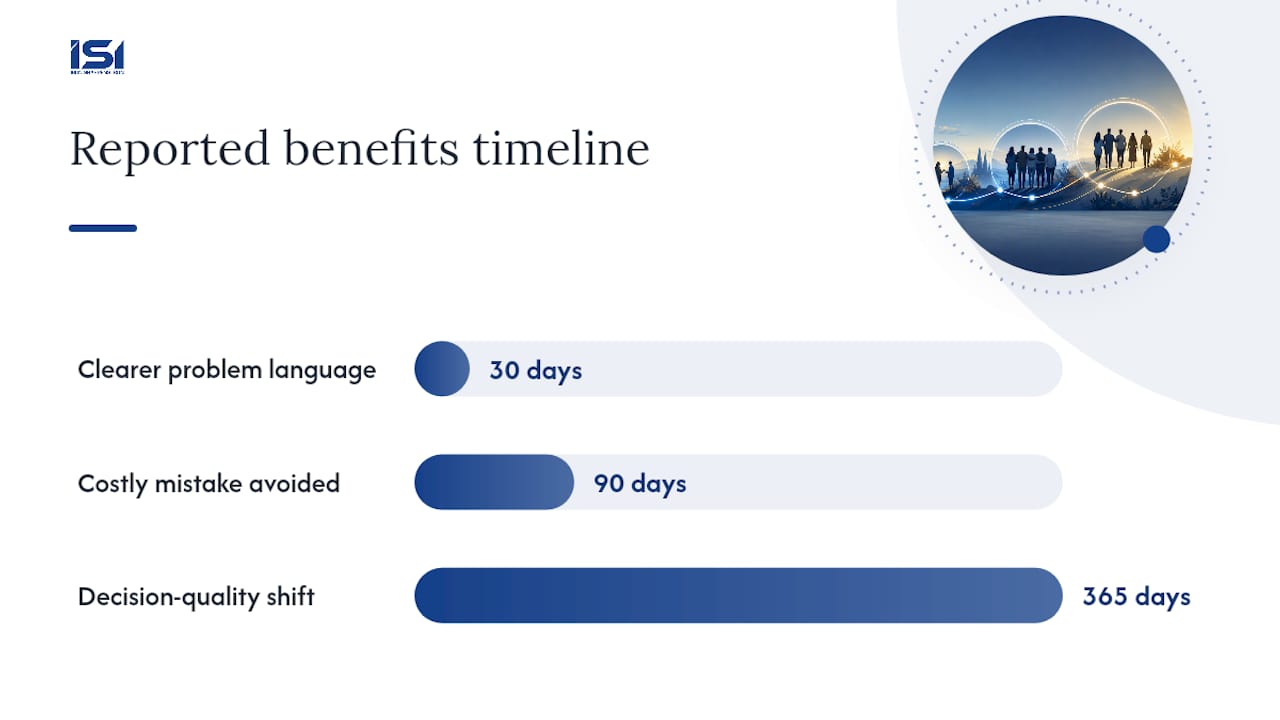
By the numbers: Members of curated masterminds often report tangible business movement within 30 to 90 days, with benefits compounding over one to three years of consistent participation.
What that looks like in practice:
- 30 days: clearer language for the problem you're actually facing, plus your first recorded commitments
- 90 days: at least one costly mistake avoided because someone in the room had already made it
- 365 days: a visible shift in decision quality across the five areas ISI tracks: personal, spiritual, relational, professional, financial
How to Find or Start a Faith-Based Mastermind That Holds You Accountable
Most men join the wrong group because they never defined what they needed before they went looking. Fix that first.
- Name your goal and your capacity. Are you looking for strategic sharpening, personal discipline, or both? Be honest about how much time you can protect weekly or monthly before you commit.
- Get the right men in the room. Vet for business stage, character, and shared conviction, not just industry. A group where one member's revenue dwarfs everyone else's tends to slide into one-way mentoring instead of peer exchange, a dynamic MDS's guide to mastermind groups flags as a common failure mode.
- Protect the rhythm. Choose a cadence you can actually sustain for a year, and assign facilitator duties so no single meeting drifts into whoever talks loudest.
- Make confidentiality clear from day one. Write down the rule, say it out loud at the first meeting, and repeat it whenever a new member joins.
- Build the agenda around a forcing function. Every meeting needs a hot seat, fresh commitments, and a report-back on the last round's action items. Without that loop, Shopify's overview of mastermind structure notes the format loses what separates it from casual coaching: peer-to-peer exchange rather than one expert doling out advice.
Before joining any group, whether one you're building or one you're evaluating from a directory of Christian entrepreneur forums, ask these questions:
- What's the real time commitment, per meeting and between meetings?
- What does membership cost, and what's included beyond the meeting itself?
- Who facilitates, and what's their track record running groups?
- Can you talk to a current member about what actually changed for them?
- What happens when confidentiality is broken?
Pro Tip: Ask a prospective group for one concrete example of a commitment a member made and followed through on in the last quarter. If nobody can name one, the group has no forcing function, no matter how good the conversation sounds.
Keeping the Group Effective: Rules, Roles, and Pitfalls
A mastermind's value decays fast without operational discipline. The facilitator's job is to run the clock, protect hot-seat time, and keep side conversations from eating the agenda. Groups without a clear facilitator drift toward whoever's most confident, not whoever needs the floor most.
Size failures run in both directions. Fewer than four committed members and the group collapses the first time two people miss a meeting. More than ten or fifteen, and hot-seat time gets so thin nobody gets real help. The 4 to 10 range holds for a reason: it's small enough for depth, large enough to survive attrition.
Watch for mismatch and dominance early. If one member consistently talks more than he listens, or if a member's business scale is wildly out of step with the rest, name it directly rather than letting resentment build quietly.
- Keep meeting notes, but store them with one designated person, not scattered across group texts
- Set a clear visitor policy: no drop-ins without unanimous consent
- Review progress qualitatively as often as numerically; a man's marriage or prayer life doesn't reduce to a KPI
| Failure mode | Root cause | Fix |
|---|---|---|
| Meetings feel like venting | No recorded action items | Add a report-back at the start of every session |
| Group loses members quietly | No facilitator enforcing cadence | Assign facilitator duties explicitly |
| Advice feels one-sided | Business-stage mismatch | Vet for similar scale before inviting |
The Biblical and Theological Foundations of Accountability
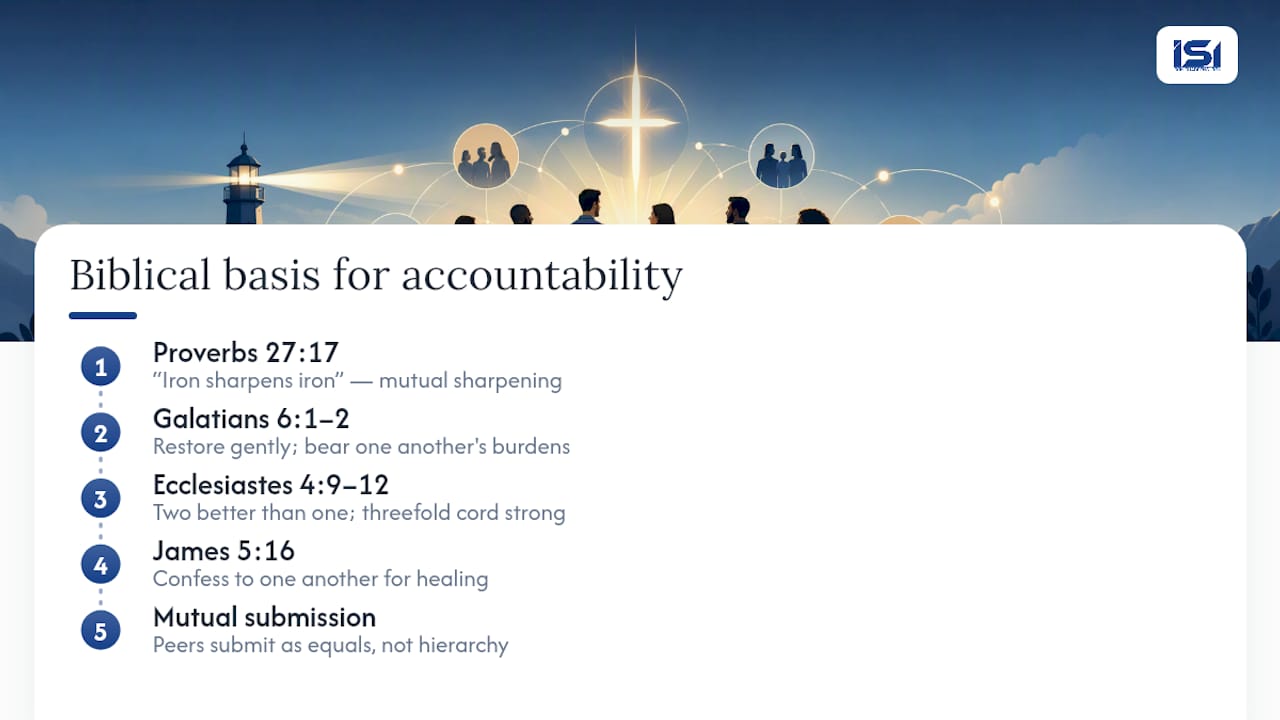
Accountability isn't a productivity hack borrowed from business culture and dressed up with a Bible verse. It's woven into how Scripture describes the Christian life. Proverbs 27:17 says iron sharpens iron, "and one man sharpens another," a picture of friction producing something sharper than either party started with. Galatians 6:1 to 2 tells believers to restore one another gently and "bear one another's burdens," which assumes a level of closeness where burdens are actually known.
Ecclesiastes 4:9 to 12 makes the practical case: two are better than one, and a cord of three strands is not quickly broken. That's a direct argument for peer structure over solo leadership. James 5:16 goes further, urging believers to confess to one another so they can be healed, tying confession to actual restoration rather than private guilt management.
None of this is about hierarchy or oversight from above. It's about mutual submission among equals who've agreed to see each other clearly. That distinction matters for business leaders specifically: a mastermind isn't a substitute for church membership or pastoral care. It's the outworking of a biblical pattern applied to the specific pressures of running a business, leading employees, and managing money in a way that honors God. The theology isn't decoration on top of the practice. It's the reason the practice works.
The Spiritual Disciplines That Support Real Accountability
A mastermind meeting is only as strong as the spiritual life each man brings into the room. Prayer is the obvious starting point, and not just as a formality that opens the meeting. Leaders who pray specifically for the men in their group, by name, between meetings, tend to show up with more patience and less competitiveness than leaders who treat the group as another business obligation.
Confession does real work here too. James 5:16 links confession to healing, and a hot-seat structure gives that command an actual venue. Saying "I lied to a vendor to save a deal" or "I've been avoiding my wife for three weeks" out loud, to men who won't repeat it, is a different act than journaling the same sentence privately.
Scripture study grounds the group's language. When members share what they're reading and wrestling with, whether it's a passage on stewardship or a hard teaching on money, it gives the group shared vocabulary for decisions that go beyond spreadsheets. A Christian accountability group built around this kind of shared framework tends to produce advice that accounts for conscience, not just margin.
None of these disciplines require special training. They require consistency, and a group that expects them from every member, every meeting.
Where a Mentor or Spiritual Director Fits
A mastermind gives you peers. A mentor or spiritual director gives you someone further down the road, and both roles matter for different reasons. Peer accountability works because the men in the room are facing similar pressures in real time; there's no power gap, so advice feels earned rather than lectured. A mentor works precisely because there is a gap: he's already made the mistakes you're about to make.
The two aren't competing structures. A mentor can speak into long-arc questions, calling, legacy, how a faith conviction should shape a decade-long business decision, in a way a weekly peer group usually can't, simply because those conversations need more time than a rotating hot seat allows. A spiritual director adds a layer focused specifically on the interior life: prayer patterns, besetting sin, the state of a man's walk with God apart from his P&L.
Leaders who combine both tend to get the best of each. The mastermind catches drift fast, often within weeks, because peers see you constantly and notice small shifts. The mentor or director catches the deeper patterns that only show up over months or years. A men's accountability group built for Christian leaders works best as one layer in that stack, not the only one.
Handling Conflict With Grace, Not Avoidance
Conflict inside an accountability group isn't a sign it's failing. It's usually a sign the group is doing its job. The failure mode is avoidance, letting tension sit quietly until someone stops showing up.
Galatians 6:1 sets the tone: restore a brother "in a spirit of gentleness," watching yourself so you don't fall into the same trap. That rules out two common errors. One is silence dressed up as grace, where nobody names the pattern because it feels unkind. The other is correction without gentleness, where a real fault gets pointed out in a way that humiliates instead of restores.
Practically, that means a few things for how a group handles friction:
- Address a pattern directly with the person, not around him through other members
- Separate the behavior from the man; "you missed three commitments" is different from "you're unreliable"
- Give room for repentance and change before assuming the relationship is over
- If a member consistently breaks confidentiality or refuses correction, the facilitator has to address it, even if it means an uncomfortable exit conversation
Grace and honesty aren't opposites here. A group that only offers comfort isn't actually loving its members; neither is one that only offers criticism. The Ecclesiastes picture of a cord of three strands assumes tension is part of the design, not a defect in it.
Keeping Accountability Aligned With Church and Doctrine
A Personal Board of Advisors is a supplement to church life, never a replacement for it. That distinction protects both the group and the men in it. A mastermind has no authority to exercise church discipline, administer sacraments, or speak for a congregation, and it shouldn't try to.
Where doctrine varies across denominations, a wise group stays anchored to shared conviction, Scripture's authority, the call to holiness, the priority of family, and leaves denominational specifics to each man's own church and pastor. A group that tries to adjudicate doctrinal disagreement usually damages trust faster than it builds it.
The healthiest pattern treats the mastermind and the local church as complementary structures answering different questions. The church shepherds a man's soul and holds him within a covenant community. The mastermind sharpens his leadership and holds him to commitments in the arenas, business, money, marriage, where he spends most of his waking hours. Leaders who lean on one and neglect the other tend to end up either spiritually isolated or practically unaccountable. Mastermind ground rules built around trust should explicitly encourage members to stay planted in a local church, not compete with it for their time or loyalty.
Why Faith Alignment Changes What Accountability Actually Costs You
Generic accountability asks you to show up and report your numbers. Faith-aligned accountability asks something harder: it asks you to let men see the gap between what you say you believe and how you actually run your business. That's a different level of exposure, and it's uncomfortable in a way secular peer groups rarely are, because there's no way to hide behind performance metrics when the conversation turns to integrity.
What gets underestimated is how much faster real accountability moves once shared conviction is in the room. Men stop negotiating with each other about whether a standard applies and start asking how to meet it. That's not a soft benefit. It's the entire reason a Personal Board of Advisors outperforms a Rolodex of business contacts who happen to check in occasionally.
The honest caveat: this only works if the group actually enforces the forcing function. I've seen the theory of faith-based accountability get treated as sufficient on its own, as though shared belief automatically produces follow-through. It doesn't. Belief creates the safety to be honest; structure is still what makes honesty produce change.
Author note: credentials and specific case studies from ISI members are available on request and will be added as this piece is updated with named examples.
— Derek
How ISI Brotherhood Delivers This Model in Practice
ISI Brotherhood built its entire membership around the structure this article just walked through, rather than treating accountability as an add-on to a networking club. Every member gets placed into a Personal Board of Advisors, a small group that meets weekly and works through the same five areas covered here: personal, spiritual, relational, professional, and financial.
Vetting happens before you're placed, so you're not guessing whether the men across the table are in a comparable season of business and life. Confidentiality is established as a ground rule from the first meeting, facilitators are trained to run the agenda rather than let it drift, and the group's cadence is protected by design, not left to whoever remembers to send a calendar invite. Beyond the weekly meeting, members get access to a year-round online community, leadership events, and the ISI Brotherhood Foundation, so the accountability doesn't disappear between sessions.
If you've read this far because you already know a Rolodex isn't cutting it, the next step is straightforward: visit ISI's mastermind group overview to see whether the model fits your stage of business, and request a conversation about joining a Personal Board of Advisors built around the same convictions you're already trying to lead by.
Sources
- Inside a mastermind group: what happens behind closed doors — Deliberate Directions
- Six reasons why you need a mastermind — Forbes
- Mastermind groups for entrepreneurs — MDS blog