

Christian leadership questions are diagnostic prompts across five domains, personal, spiritual, relational, professional, and financial, that Christian businessmen use weekly or in a Personal Board of Advisors to test identity, calling, stewardship, and next action. The right move is not to read them once. Pick one question this week, sit with it, and bring your answer to a man who has permission to push back. The mastermind model is built around exactly this practice, and Derek's work helped shape the framework below.
TL;DR:
- Leaders should focus on one domain at a time, rotating questions weekly to ensure consistent, honest reflection rather than attempting all five at once.
- External accountability with trusted peers significantly improves the quality of answers and prevents self-deception in spiritual, relational, and financial assessments.
- Asking questions about the impact on character and calling helps prevent impulsive decisions and aligns actions with biblical principles and long-term fruit.
- Regular quarterly reviews combining personal, spiritual, and professional questions deepen self-awareness and strategic clarity, especially when backed by a trusted advisory group.
- Building a consistent rhythm of honest questioning through structured mastermind groups or Personal Boards fosters sustained growth and accountability in leadership.
Table of Contents
- Personal Leadership Questions: Identity, Rhythms, and Character
- Spiritual Leadership Questions: Scripture, Calling, and Discernment
- Relational Leadership Questions: Team Health and Fairness
- Professional Leadership Questions: Strategy and Capacity
- Financial Leadership Questions: Stewardship Beyond Profit
- How to Actually Use These Questions Without Letting Them Slide
- Why Derek and ISI Brotherhood Built This Framework
- Historical Context and Biblical Examples
- Common Pitfalls When Reflecting on These Questions
- Adapting the Questions to Your Specific Context
- What the Research Actually Supports, and What Gets Overrated
- Practice These Questions Inside a Christian Mastermind
- Sources
- FAQ
Personal Leadership Questions: Identity, Rhythms, and Character
Before you lead anyone else, you have to know who you actually are when the business is losing money and nobody is watching. These questions surface the gap between the man you present and the man you are becoming.
- Am I building an identity on results, or on being a son of God first?
- What does my calendar say I worship, regardless of what I claim?
- Where have I let hustle replace obedience this month?
- Do I still keep a Sabbath, or has "urgent" quietly canceled it?
- When did I last sit in silence long enough to hear anything?
- What sin am I still negotiating with instead of confessing?
- Who would say I am a different man at church than at work?
- What habit, if my kids copied it exactly, would alarm me?
Pro Tip: Pick one question Sunday night, write a two-sentence honest answer in a notebook, then reread it the following Sunday before you write the next one. The pattern across four weeks tells you more than any single answer does.
Spiritual Leadership Questions: Scripture, Calling, and Discernment
Good leaders resist the urge to rush toward answers before they have asked the right question, and nowhere does that discipline matter more than when Scripture, calling, and gut instinct seem to point three different directions. Great leaders slow down and let curiosity do the work first, as Christian Business Concepts argues.
- Does Scripture already settle this, or am I looking for permission to ignore it?
- Is this decision consistent with what I sense God has called me to build?
- Would this opportunity fit a man in a different season of life, but not me right now?
- What fruit, in people and character, would this decision likely produce a year from now?
- Have I actually prayed about this, or just thought about it while calling it prayer?
- What would three men I trust say if I described this decision honestly?
- Do I have genuine peace, or am I mistaking excitement for peace?
- What is the next concrete action, not the eventual outcome, but the next step?
Run those last five through the five-filter check Regent University outlines: Scripture, calling, counsel from three trusted advisors, the Spirit's peace, and a defined next action. When all five line up, move. When two or three disagree, wait, and don't confuse a lack of peace with a lack of courage. That distinction alone has saved men from decisions that looked biblical but weren't theirs to make, a point our biblical decision making guide covers in more depth.
Relational Leadership Questions: Team Health and Fairness
Your business reflects your character toward the people who can't fire you. These questions expose blind spots most owners never think to check.
- Do I pay people what their work is actually worth, or what I can get away with?
- Would my employees describe me as fair when I am not in the room?
- What feedback have I received in the last quarter that I dismissed too quickly?
- Is there tension on my team I have chosen not to see because addressing it is inconvenient?
- Do I treat my highest performer and my newest hire with the same dignity?
- Have I created a culture where someone could tell me a hard truth without fear?
- Who on my team feels unseen right now, and why haven't I noticed sooner?
- Does my leadership honor the people below me the way I want to be honored above?
Honest business conduct grows out of reverence for God, which shows up first in how leaders treat the people they have power over, according to Theology of Work's analysis of biblical business ethics. One practical test: run a single anonymous pulse question every month, something like "Do you believe leadership treats you fairly?" A dropping trend line will tell you what a hallway conversation never will.
Professional Leadership Questions: Strategy and Capacity
Ambition and calling are not the same thing, and a business idea can be exciting without being yours to build. Before committing capital, time, or your team's energy, test the opportunity against reality, not enthusiasm.
- Is this market real, or am I convincing myself of demand that doesn't exist yet?
- Do I have a genuine, defensible advantage here, or am I hoping hard work substitutes for one?
- Can my team actually deliver this at the quality I am promising?
- What would have to be true for this to fail, and is that likely?
- Am I scaling faster than my systems, staff, or cash position can support?
- Does this opportunity move me toward my calling, or away from it, dressed up as growth?
- What is the actual return, financial, relational, and spiritual, if this succeeds?
- If I said no to this, what would I say yes to instead?
The Enterprise Stewardship framework compresses this into three blunt filters before committing capital: Is it real (the market genuinely exists)? Can you win (you have a distinctive capacity to deliver)? Is it worth it (the return justifies the resources across every kind of capital, not just cash)? Run every serious opportunity through those three before you sign anything.
Financial Leadership Questions: Stewardship Beyond Profit
Money reveals character faster than any other area of leadership. These questions push past "is it profitable" into whether the profit was earned honestly and distributed wisely.
- Did I earn this profit in a way that honors the people on the other side of the transaction?
- Am I transparent with my team about how the business actually performs?
- Who benefits from this financial decision besides me and my shareholders?
- Have I confused personal comfort with responsible reinvestment in the business?
- What would an outside auditor of my character, not my books, find concerning?
- Am I stewarding surplus toward long-term impact, or hoarding it out of fear?
- Does this decision protect the dignity of everyone it touches, employees, vendors, customers?
- What proportion of this quarter's profit reflects generosity rather than obligation?
Christian leadership measures success through what one framework calls the quadruple bottom line, weighing economic return alongside social and spiritual capital, not profit in isolation, per Houston Christian University's Center for Christianity in Business. A simple quarterly review works: ask these eight questions in one sitting, every ninety days, and compare your answers to last quarter's. Our financial stewardship guide walks through building that habit in more detail.
How to Actually Use These Questions Without Letting Them Slide
A question set on a page changes nothing. A question asked out loud to a man who has permission to follow up changes everything.
- Weekly: Pick one question, any domain, and give God or your journal an honest answer before Friday. This single practice protects your rhythm from being swallowed by tactical urgency.
- Monthly: Bring one answer to your Personal Board of Advisors and let them ask a follow-up question you didn't expect.
- Quarterly: Run the full financial and identity sets together as a deeper audit. Monthly catches tactical drift; quarterly catches the strategic drift monthly check-ins miss entirely.
Choosing who sits on that board matters more than the questions themselves. Get the right men in the rooms, two or three max, and give them explicit standing to ask about your marriage, your finances, and your integrity without you flinching. Christian business leaders who function well long term have pre-negotiated that permission before the hard season arrives, not during it.
A workable Personal Board agenda runs short: one man reads his answer to the week's question, the group asks one clarifying follow-up, and everyone names one action step before the meeting ends. Keep it under thirty minutes so it survives busy seasons instead of getting canceled by them. Our guide on 30 to 90 day accountability rhythms breaks this cadence down further.
Pro Tip: Protect the rhythm before you protect anything else on your calendar. A Personal Board that meets sporadically produces sporadic honesty, and sporadic honesty is functionally the same as none.
Why Derek and ISI Brotherhood Built This Framework
Derek's work with ISI Brotherhood centers on one conviction: Christian men lead better when someone else has permission to ask them hard questions on a fixed schedule.. The community runs on weekly mastermind meetings and Personal Boards of Advisors, small groups of vetted Christian men who meet consistently to challenge one another across the same five domains covered here, personal, spiritual, relational, professional, and financial.
insert specific case studies or testimonials involving Derek or ISI]. The community's structure exists specifically so these questions don't stay theoretical. Members bring real answers to real men who follow up.. For a deeper look at the principles behind the model, our [biblical leadership principles guide covers the foundation ISI builds on.
Historical Context and Biblical Examples
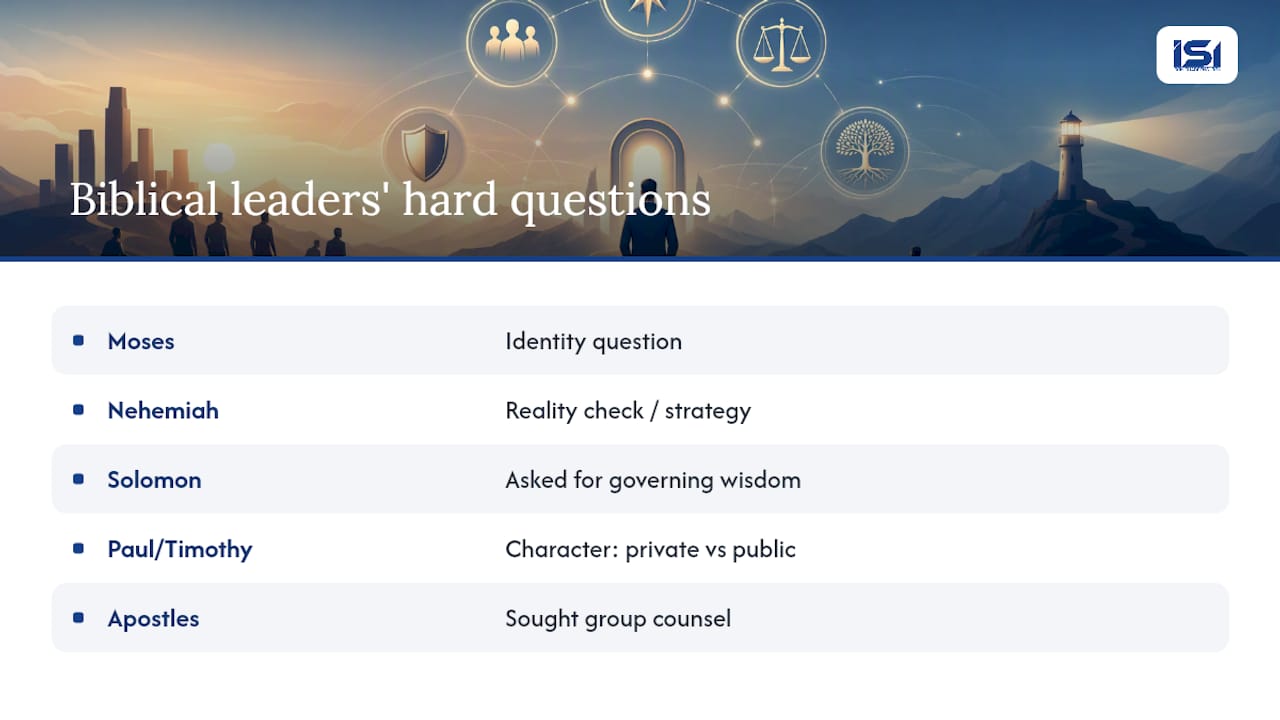
Leaders in Scripture rarely arrived at obedience without wrestling with a hard question first. Moses asked God directly who he was to lead Israel out of Egypt, a personal identity question before he ever accepted the calling. Nehemiah surveyed the broken walls of Jerusalem before acting, asking what was actually true about the situation before committing resources, a professional and strategic question centuries before modern business language existed for it. Solomon, given the chance to ask for anything, asked for wisdom to govern well, a spiritual question about calling and capacity rather than a request for wealth or comfort.
Paul's letters to young leaders like Timothy repeatedly circle back to character questions: what kind of man are you becoming, and does your private life match your public teaching? That pattern, testing identity before testing strategy, runs through nearly every biblical leadership narrative worth studying. The apostles themselves modeled relational accountability in Acts, submitting major decisions to group counsel rather than acting unilaterally.
None of this is coincidental. Structured self-examination, run consistently rather than in a crisis, is what separates leaders who last decades from leaders who burn out or compromise quietly. The five-domain framework used today is a modern packaging of a very old discipline: ask hard questions before the pressure forces the answer out of you. Biblical leaders who skipped that step, Saul avoiding accountability, Solomon's later drift from his own wisdom, tend to appear in Scripture as cautionary examples rather than models.
Common Pitfalls When Reflecting on These Questions
The most common failure is not asking the wrong questions. It's asking the right ones alone, in your head, where every answer gets a pass.
Isolation is the first trap. A question like "am I treating my team fairly" is nearly impossible to answer honestly without outside input, because self-assessment tends to default toward self-protection. The second trap is treating reflection as a one-time event rather than a rhythm. Men journal for two weeks after a conference, then stop when the calendar fills back up, which defeats the entire purpose of a diagnostic tool meant to catch drift over time.
A third pitfall is answering questions with the version of yourself you wish were true rather than the one currently running your business. This shows up most in the financial and relational domains, where admitting a hard truth, that you underpay someone, that you've ignored a team member's growing resentment, feels costly in the moment. A fourth issue is picking questions that flatter rather than challenge. It's easy to gravitate toward "am I calling generous" and avoid "am I calling transparent" if transparency is where you're currently failing.
The fix for all four traps is the same: a Personal Board of Advisors with standing permission to push back when your answer sounds too clean. Self-reflection without an external check tends to drift toward comfort, not truth.
Adapting the Questions to Your Specific Context
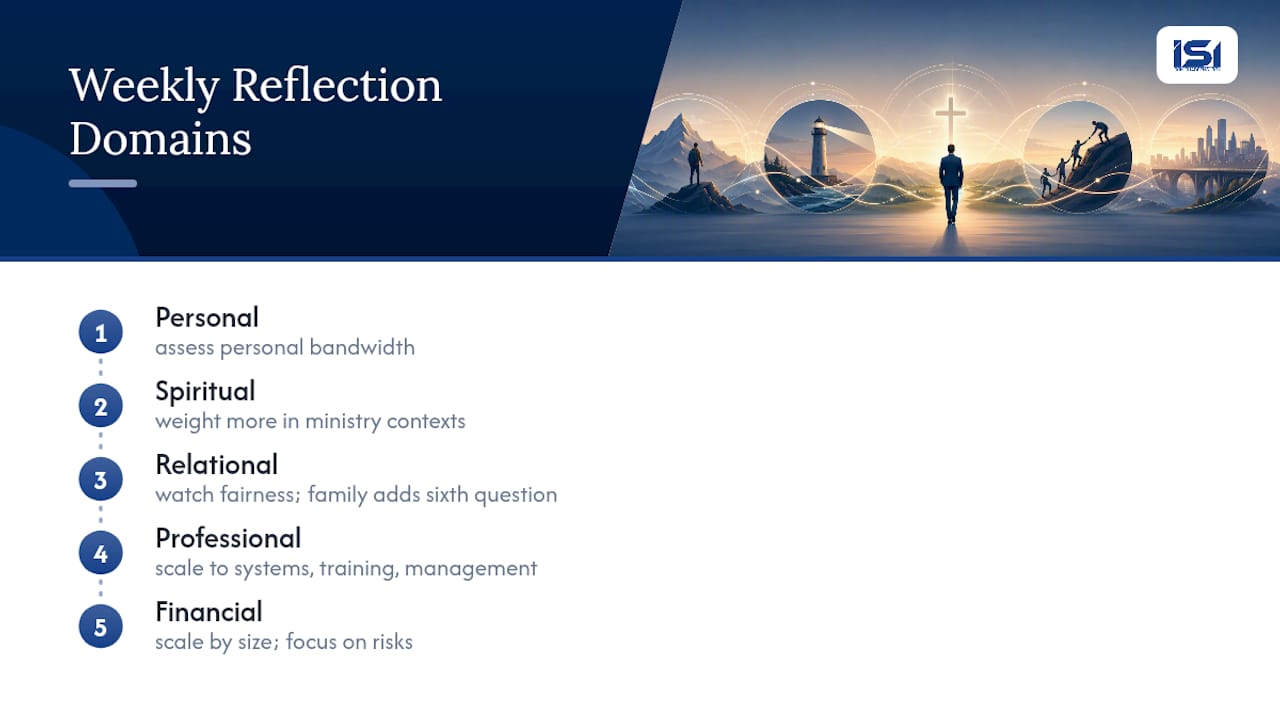
A solo consultant and a fifty-employee manufacturing owner will use these questions differently, even though the five domains stay identical. The professional and financial questions scale most obviously. A one-man operation asking "can my team actually deliver this at the quality I'm promising" is really asking about personal bandwidth, while a fifty-person company is asking about systems, training, and management depth. Adjust the language, not the underlying test.
Ministry-adjacent business contexts, a Christian school, a faith-based nonprofit arm attached to a for-profit, tend to need heavier weighting on the spiritual and relational domains, since mission drift there damages trust faster than a slow quarter does. A straightforward B2B services business can lean harder into the professional and financial sets without losing anything essential.
Family businesses carry a unique wrinkle: relational questions about fairness and dignity apply doubly, since favoritism toward a family member reads as both a management failure and a spiritual one. If you lead a team that includes relatives, add a sixth implicit question to the relational set: would I treat a non-family employee this same way in this same situation?
Whatever your context, resist the urge to answer every question every week. Rotate domains, weight them toward your current season's actual risk, and let your Personal Board help identify which domain needs the most attention right now rather than guessing on your own.
What the Research Actually Supports, and What Gets Overrated
Most leadership content treats self-reflection questions like a personality quiz, interesting, low stakes, easy to skip. That framing undersells what's actually happening when these questions work. The leaders who benefit most aren't the ones with the sharpest questions. They're the ones with someone else in the room who won't let a weak answer stand.
Here's what conventional advice gets wrong: it treats journaling and solo reflection as sufficient. They aren't. A question asked in isolation gets an answer shaped by whatever you already want to believe about yourself. The research on curiosity-based leadership backs this: leaders who slow down and question themselves outperform leaders who rush to defend decisions they've already made, but that slowing down works best with a second voice in the process, not just a notebook.
What should you prioritize first? Not the longest list of questions. Pick the domain where you already suspect trouble, usually relational or financial, since those are the ones men avoid, and bring exactly one honest answer to exactly one trusted peer this week. Depth in one domain, done consistently, beats breadth across five domains done once and forgotten.
— Derek
Practice These Questions Inside a Christian Mastermind
Reading a list of hard questions is easy. Answering them out loud to men who won't let you off the hook is where the actual change happens, and that's precisely the gap ISI Brotherhood exists to close. Rather than leaving you to journal alone and hope for consistency, The program places you in a Personal Board of Advisors, a small group of vetted Christian men who meet on a fixed weekly cadence built to protect the rhythm this kind of reflection requires.
The model follows the same principles covered above: get the right men in the rooms, make confidentiality clear from day one, and hold the weekly meeting even when the calendar gets crowded. ISI's community membership gives you that structure already built, mastermind cohorts, ongoing accountability, and events designed around the same five domains this article walks through. If you're ready to stop reflecting alone, check the membership details and see whether a cohort has room for you this cycle.
Sources
- The four Cs of Christian leadership
- The quadruple bottom line (Christian leadership & business stewardship)
- 20 questions Christian leaders should ask
- How reverence for God leads honest business practices
FAQ
How often should I use these leadership questions?
Use one question weekly on your own, bring an answer to your Personal Board monthly, and run the full five-domain set as a deeper audit quarterly.
Who should I invite into this kind of accountability?
Choose two or three trusted peers and give them explicit permission to ask hard questions about your marriage, finances, and integrity before a crisis forces the conversation.
What if a hard question causes conflict with someone on my team?
Treat the friction as information, not failure. Follow up privately, ask a clarifying question rather than a defensive one, and let the relational question set guide the conversation toward fairness rather than blame.
Are these questions only for solo reflection, or for groups too?
Both, but groups work better. A Personal Board of Advisors catches blind spots that solo journaling consistently misses, especially in the relational and financial domains.
Does ISI Brotherhood help facilitate this kind of accountability?
Yes. ISI Brotherhood's mastermind cohorts and Personal Boards are structured specifically to give men a weekly rhythm and trusted peers for exactly this kind of question-driven accountability.