

The most effective format for a Christian men's mastermind retreat is a 3-day offsite built around one clear transformation and three non-negotiables: a curated attendee list, a 60/40 agenda split (60% structured strategic work, 40% reflection and connection), and three required deliverables before anyone leaves.
Here is the checklist you can copy into your planning doc today:
- One transformation sentence: What will attendees think, feel, and do differently by Sunday afternoon?
- Curated room: A curated group of men screened by application and short interview
- 60/40 agenda: Limit structured sessions to a few hours per day
- 90-minute hot seats: Peer counsel with a silence rule for the person in the seat
- Pre-departure deliverables: One-page strategic summary, owner + deadline per action, 30-day follow-up scheduled before departure
Everything else, venue, devotionals, guest speakers, flows from these five decisions.
Key Takeaways
A high-ROI Christian men's mastermind retreat requires one clear transformation, a curated room, and a structured follow-up system that begins before anyone leaves the venue.
| Point | Details |
|---|---|
| Define one transformation | Write a single sentence naming what attendees will think, feel, and do differently before you plan anything else. |
| Curate the room | Screen every attendee by application and interview; room quality drives retreat ROI more than any other variable. |
| Use the 60/40 agenda | Allocate 60% of the schedule to structured strategic work and 40% to reflection, connection, and white space. |
| Enforce pre-departure deliverables | Require a one-page summary, owner and deadline per action, and a 30-day follow-up on the calendar before departure. |
| Isibrotherhood as your resource | ISI's mastermind model provides the curation, facilitation, and accountability infrastructure to run this well year-round. |
Table of Contents
- What should your retreat actually change?
- Which format fits your group's size and urgency?
- What do sample agendas actually look like?
- How do you recruit the right men for the room?
- Who runs the room and how?
- What makes a venue work for this kind of retreat?
- How do you turn retreat energy into lasting action?
- How do you measure whether the retreat worked?
- What does a 4–6 month planning timeline look like?
- What actually works when faith meets business at a retreat
- Isibrotherhood is built for exactly this kind of retreat
- Sources
What should your retreat actually change?
Before you book a venue or draft an invite, write one sentence that names the single transformation this men's spiritual retreat must produce. Not a theme. A transformation.
Ask three decision prompts:
- What is the one strategic decision every attendee needs to make or clarify?
- Which KPI should move at 30, 90, and 180 days as a result?
- What leadership behavior needs to change for that KPI to move?
A weak transformation sounds like "grow in faith and business." A strong one sounds like "every man leaves with a written 90-day plan to exit one operational role and hire or delegate into it." The second version tells you exactly which sessions to run, which speakers to invite, and what success looks like when you measure it three months later.
Which format fits your group's size and urgency?
Four formats work well for Christian men's retreat ideas at the mastermind level. Each fits a different combination of group size, urgency, and desired depth.
- Mastermind retreat (3–4 days, 6–20 men): Peer hot seats are the engine. Every man gets time in the seat; every man gives counsel. Best for groups with an existing trust baseline and a shared business stage.
- Executive offsite (1–2 days, 8–15 men): Decision-forcing format. Fewer hot seats, more plenary alignment on a single strategic question. Best when the group faces a shared challenge (market shift, succession, scaling).
- Intensive (2–3 days, 6–10 men): Small-group deep work with minimal plenary time. Best for men who already know each other well and want to go deeper than a standard mastermind session allows.
- Mini-retreat (1 day, any size): Re-entry or follow-up format. Use it 60–90 days after a full retreat to review commitments and reset accountability.
For a first-time group, the 3-day mastermind is the right call. Practitioners recommend small groups of several participants, generally less than ten, for the deepest work, though Christian business retreats often run up to 20 when the facilitation is strong. Plan 4–6 months out. That timeline gives you enough runway for applications, venue contracts, and pre-retreat communications without losing momentum.
What do sample agendas actually look like?
Every agenda should follow the Educate → Engage → Exhale rhythm: mornings for strategic input and hot seats, afternoons for application and connection, evenings for reflection, worship, or unstructured time.
1-day format
| Time | Block | Type |
|---|---|---|
| — | Opening devotional + covenant statement | Faith/Connection |
| — | Teaching or guest speaker | Educate |
| — | Hot seat (one man) | Engage |
| — | Lunch + open conversation | Exhale |
| — | Hot seat (second man) | Engage |
| 2:30–3:30 PM | Strategic planning workshop | Educate/Engage |
| 3:30–4:30 PM | Closing: deliverables, owners, 30-day follow-up | Commit |
2-day format
Add a second morning of hot seats on Day 2, a shared dinner with no agenda on Day 1 evening, and a brief prayer or Scripture reflection to open each day. Reserve Day 2 afternoon for white space, a walk, or an optional activity.
3-day format
Day 1 is arrival, orientation, and one teaching session. Day 2 is the high-output day: two hot seats in the morning, a workshop in the afternoon, and a communal dinner in the evening. Day 3 opens with devotional, runs one final hot seat, and closes with the deliverables protocol. Protect Day 2 afternoon as white space. Practitioners consistently report that unstructured time mid-retreat produces some of the highest-value conversations of the entire event.
The 90-minute hot seat blueprint
- Minutes 0–10: The man in the seat presents his challenge, context, and the specific question he wants answered.
- Minutes 10–25: Clarifying questions from the group only. No advice yet.
- Minutes 25–75: Peer counsel. The man in the seat goes silent and listens. No defending, no explaining.
- Minutes 75–85: The man in the seat responds: what landed, what he will do, and by when.
- Minutes 85–90: Group prayer over the man and his commitment.
Pro Tip: Set a visible timer and assign a timekeeper. The silence rule in minutes 25–75 is the single most uncomfortable and most valuable norm in the room. Brief it explicitly before the first hot seat.
How do you recruit the right men for the room?
Retreat ROI depends more on who is in the room than on any other single variable. An open-door policy kills the dynamic. Use a two-step screen: a written application followed by a 20-minute interview.
Application prompts that surface readiness:
- Describe your business: revenue stage, team size, and your primary role today.
- What is the one decision or challenge you most need outside perspective on?
- What have you contributed in a peer group or accountability relationship in the past 12 months?
- What does your faith look like in your business decisions right now?
Selection criteria to weight:
- Business stage alignment: Men at wildly different revenue stages rarely give each other useful counsel.
- Values fit: Shared commitment to integrity, family, and faith-based decision-making.
- Capacity to contribute: Not just to receive. The best rooms are full of givers.
- Coachability: Look for men who ask better questions than they give answers.
Reject anyone who cannot commit to the full schedule. Partial attendance fractures trust and disrupts hot-seat continuity.
Who runs the room and how?
Four roles keep a mastermind retreat on track.
- Lead facilitator: Holds the process, enforces norms, and manages group energy. Does not participate in hot seats as a peer.
- Logistics coordinator: Handles meals, AV, rooming, and transportation. This role and the facilitator role must be separate people. Combining them collapses both.
- Timekeeper/referee: Watches the clock during hot seats and signals transitions. Can be a rotating participant role.
- Note-taker/recorder: Captures commitments, owners, and deadlines in real time for the closing summary.
Facilitator norms to brief on Day 1:
- Confidentiality is absolute. What is shared in the room stays in the room.
- No unsolicited advice outside hot-seat time.
- Phones off during sessions. One designated break for messages.
- Challenge with questions before you challenge with opinions.
The closing protocol is where most retreats either succeed or fail. Before anyone walks to their car, require three deliverables: a one-page strategic summary per man, an owner and deadline assigned to every action item, and a 30-day follow-up meeting on the calendar. The ride home is the most dangerous moment for implementation. Remove the gap.
What makes a venue work for this kind of retreat?
The venue should serve the mission, not distract from it. A shared house beats a hotel for groups under 12. Communal meals, shared hallways, and late-night conversations around a kitchen table produce the relational depth that a conference center cannot replicate.
Venue checklist:
- Travel accessibility: within a 2-hour drive or a direct flight for most attendees
- Quiet zones: at least one room with no foot traffic for prayer or solo reflection
- Nature access: a trail, a lake, or open land for walking conversations
- Reliable Wi-Fi (for the note-taker) but no temptation to default to work
- Rooming: private rooms preferred; shared rooms only with prior consent
For meals, keep it simple and communal. Hire a local caterer or assign a meal coordinator. Dietary forms go out with the pre-arrival packet. Health and safety basics include a first-aid kit, emergency contact list, and a clear protocol if someone needs to leave early.
Packing guidance to send attendees: Bible, journal, one-page business summary prepared in advance, casual clothes, and anything they need for a digital detox.
How do you turn retreat energy into lasting action?
The 30-day follow-up is not optional. It is the mechanism that separates a retreat that produces results from one that produces memories.
Required before departure:
- Each man completes a one-page strategic summary (challenge, decision made, three actions, owner, deadline).
- Every action item has a named owner and a specific date.
- The 30-day group check-in is on everyone's calendar before the room clears.
Tracking template structure:
| Name | Commitment | Deadline | Progress | Blocker |
|---|---|---|---|---|
| [Man's name] | [Specific action] | [Date] | [% or status] | [What is in the way] |
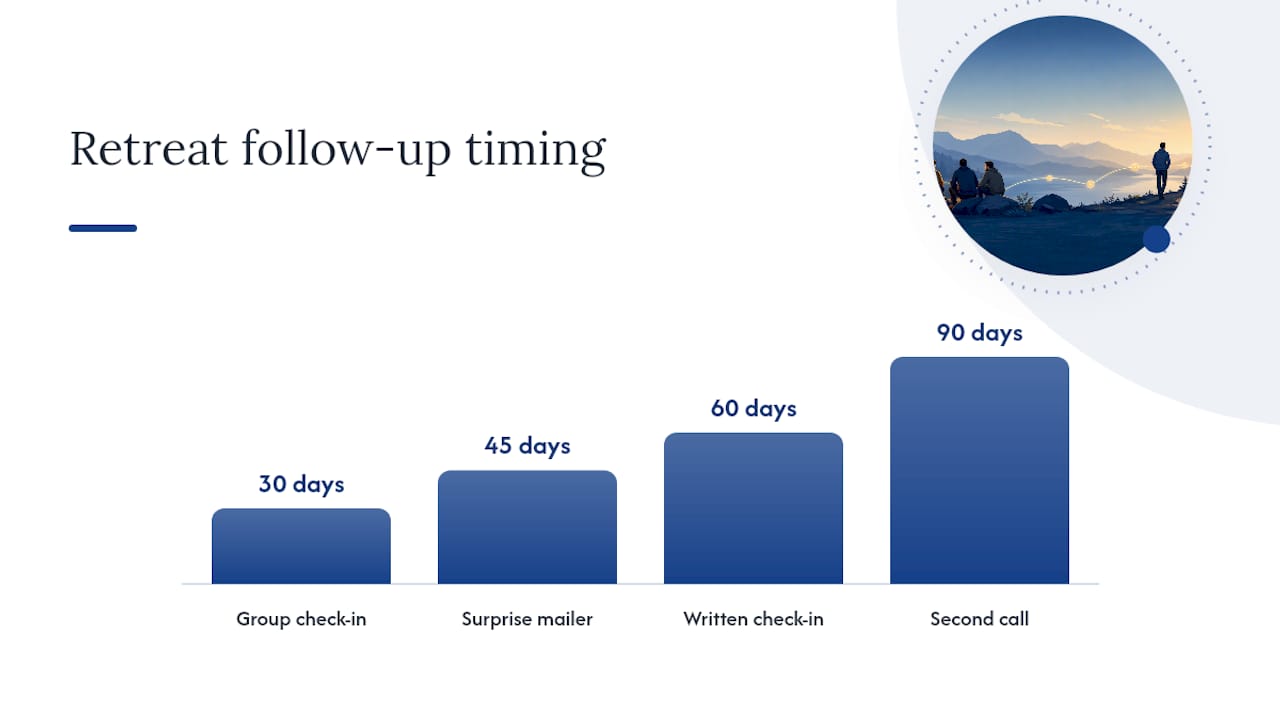
Run the 30-day check-in as a 60-minute video call. Each man reports on his commitment in 5 minutes or less. The group asks one clarifying question. No advice unless asked.
At 60 days, send a brief written check-in by email. At 90 days, run a second call and begin seeding the next retreat. A surprise mailer at 45 days, a handwritten note or a relevant book, sustains momentum between touchpoints and signals that the community did not end when the van pulled out of the driveway.
How do you measure whether the retreat worked?
Measure at three horizons: 30 days (activity), 90 days (early outcomes), and 180 days (business results).
| Metric | 30-Day Signal | 90-Day Signal | 180-Day Signal |
|---|---|---|---|
| Committed actions completed | % of action items with documented progress | % fully closed | Cumulative completion rate |
| Revenue/lead indicator | Pipeline changes tied to retreat decisions | New revenue attributed to retreat decisions | Year-over-year comparison |
| Retention/renewal | Attendance at 30-day follow-up call | Registration for next retreat | Renewal rate for annual membership |
| Qualitative signal | Net Promoter Score survey sent after the retreat | Testimonial or case note collected | Published story or referral |
Capture baseline data before the retreat: current revenue, open decisions, and the specific KPI each man named in his application. Without a baseline, you cannot prove the retreat moved anything.
What does a 4–6 month planning timeline look like?
Month 1 (4–6 months out): Define the transformation sentence, set dates, and open applications.
Month 2: Review applications, conduct interviews, confirm attendees, and sign the venue contract.
Month 3: Confirm guest speakers or mentors, build the agenda, and send save-the-dates with arrival windows.
Month 4: Send pre-retreat materials: one-page business summary template, packing list, dietary form, and confidentiality agreement.
Month 5 (30 days out): Final headcount, meal orders, AV setup, and facilitator briefing.
Week of retreat: Send a final logistics email with directions, parking, rooming assignments, and the day-one schedule.
Budget formula: estimate a per-person, per-night cost that covers venue, meals, materials, and facilitation. Add a contingency buffer. Paid mastermind participants typically need 90 or more days' notice to clear their calendars, which is why the 4–6 month runway matters.
Pre-departure checklist items to confirm the day before:
- Printed one-page summaries for every attendee
- Commitment tracking sheets ready for the note-taker
- 30-day follow-up calendar invite drafted and ready to send
- Devotional materials and scriptural community principles distributed for opening session
What actually works when faith meets business at a retreat
Running retreats for Christian business men reveals a pattern that surprises most first-time organizers: the faith elements do not slow the business work down. They accelerate it.
A 10-minute opening devotional tied directly to the day's strategic theme, not a generic Scripture reading, sets a tone of honesty that makes hot seats more productive. Men who have prayed together are more willing to say the hard thing. A covenant statement signed on Day 1, committing to confidentiality, candor, and follow-through, functions as both a spiritual act and a facilitation tool.

What organizers consistently underestimate is the power of guided prayer at the close of a hot seat. When a man has just laid out his most pressing business challenge and received peer counsel, a brief, specific prayer over him and his decision lands differently than any closing summary could. It signals that the group is invested not just in his strategy but in his whole life.
The temptation is to treat faith elements as the warm-up and business sessions as the real work. The men who get the most out of these retreats are the ones who stop making that distinction. You can explore biblical accountability frameworks to deepen the covenant language you use in your opening session.
Isibrotherhood is built for exactly this kind of retreat
If you want the outcomes described in this article without building the infrastructure from scratch, Isibrotherhood is the direct path. ISI's mastermind model places Christian business owners, executives, and entrepreneurs into a Personal Board of Advisors, a small, curated group that meets with the accountability rhythms and facilitation norms this article describes, running year-round, not just at a single event.
For retreat-specific needs, ISI brings guest curation, facilitation expertise, and a post-retreat accountability system that keeps commitments alive past the 30-day mark. The community infrastructure, weekly meetings, a member directory, leadership events, and an online platform, means the retreat is a catalyst, not a one-time experience. Apply to join ISI and find out whether the mastermind model fits where you are right now.