

Christian mentoring for business is a long-term, faith-integrated relationship that shapes character, leadership, and practical business skill over time, not a single consultation. It differs from coaching because it treats your whole life, not just your quarterly numbers, as the subject. Your next move is simple: evaluate whether a Personal Board of Advisors or a mastermind cohort fits your season of leadership, and treat that choice as the real starting line.
TL;DR:
- Christian mentoring emphasizes long-term relationships that integrate faith, character, and leadership development over years, unlike short-term coaching focused on specific goals.
- Leaders should track both business metrics and character growth quarterly to measure progress in ethical decision-making, team perception, and personal development.
- Selecting a mentor involves assessing spiritual maturity, integrity, experience, and availability, while avoiding vague answers or pressure tactics.
- Building momentum in mentoring requires establishing confidentiality, setting clear goals, and maintaining regular meetings within the first 90 days.
- A Personal Board of Advisors provides a trusted, multi-faceted support system across personal, spiritual, and professional areas, fostering holistic leadership growth.
Table of Contents
- What Is Christian Mentoring for Business, and How Does It Differ From Coaching?
- What Results Should Leaders Expect From Faith-Integrated Mentoring?
- What Are the Main Formats for Christian Business Mentoring?
- How Do You Choose the Right Mentor or Format?
- How Do You Get Started in the First 90 Days?
- How Does a Personal Board of Advisors Model Work in Practice?
- What Are the Common Challenges in Christian Business Mentoring?
- Why Relational Mentoring Is Worth Protecting
- How Can ISI Brotherhood Help You Take the Next Step?
- Where Can You Read More on This Topic?
- Sources
What Is Christian Mentoring for Business, and How Does It Differ From Coaching?
Coaching solves a specific problem in a defined window. Mentoring is a longer walk. Coaching tends to be goal- and skills-focused, often short-term, while mentoring addresses vocation, character, and the daily rhythms that shape how you actually lead. Christian mentoring for business layers a third dimension onto that distinction: faith.
Scripture gives us the blueprint. Paul poured into Timothy not just as a colleague but as a spiritual son, modeling ministry, doctrine, and endurance across years, not weeks, a pattern the Journal of Biblical Perspectives in Leadership traces in detail. Moses handed leadership to Joshua only after sustained proximity and instruction, a succession model built for the long game, not a single handoff meeting. And Proverbs 27:17 still says it best: iron sharpens iron.
That ancient wisdom has a modern name. Social learning theory holds that people change behavior primarily by watching someone else model it in relationship, which is exactly what makes Christian leadership mentoring work.
- Coaching: short-term, tactical, often ends when the goal is met
- Mentoring: long-term, relational, addresses character and calling
- Christian mentoring: adds a shared spiritual framework and accountability to both
What Results Should Leaders Expect From Faith-Integrated Mentoring?
The return on faith-integrated mentoring shows up in three places: your decisions, your organization, and your reputation. Leaders who submit to regular, prayerful self-inventory make fewer ethical missteps and recover faster from the ones they do make, a practice Colorado Christian University treats as non-negotiable for leaders serious about their witness.
Mentored leaders also tend to build organizations that outlast them. Mentoring exists, in part, to produce succession and multiplication, not just personal improvement, often supported through business loans to fuel growth.
Pro Tip: Track two kinds of progress every quarter: a business metric (revenue, retention, hiring) and a character metric (a specific temptation you're resisting or a discipline you're building). Mentoring that only tracks one is incomplete.
Expect movement in these areas within a few months to a year:
- Sharper, faster ethical decision-making under pressure
- A visible improvement in how your team describes your leadership
- At least one person you are now developing the way you were developed
- Fewer isolated, unaccountable decisions made late at night
Mentors who model visible integrity are consistently the strongest predictor of positive long-term outcomes for the person being mentored, which is worth remembering the next time you're tempted to choose a mentor for their bank account instead of their character.
What Are the Main Formats for Christian Business Mentoring?
Not every leader needs the same structure. Your season of business, and your season of life, should decide the format.
- One-on-one mentoring. A single seasoned mentor meets with you regularly, often monthly or biweekly. Best for leaders who want deep, personalized spiritual and vocational direction, though it depends entirely on one relationship holding steady.
- Mastermind groups. Peer cohorts of six to ten leaders meet on a fixed cadence to solve problems and hold each other accountable. Practical write-ups on Christian business masterminds note these fit leaders who already have traction and need strategic clarity, not basic skills.
- Personal Board of Advisors. A small, standing group that speaks into every area of your life, not just the business line items. It trades the narrowness of one mentor for the breadth of several trusted voices.
- Group coaching. Structured curriculum delivered to a cohort, often blending teaching with peer accountability and prayer. Good for leaders who want structure more than open-ended relationship.
Pro Tip: A three-day intensive can reset your focus, but it isn't a substitute for ongoing mentoring. Use intensives to sharpen the ax; use mentoring to keep swinging it.
How Do You Choose the Right Mentor or Format?
Choosing a mentor is a discernment process, not a transaction. Get the right men in the room before you commit years of your life to the relationship.
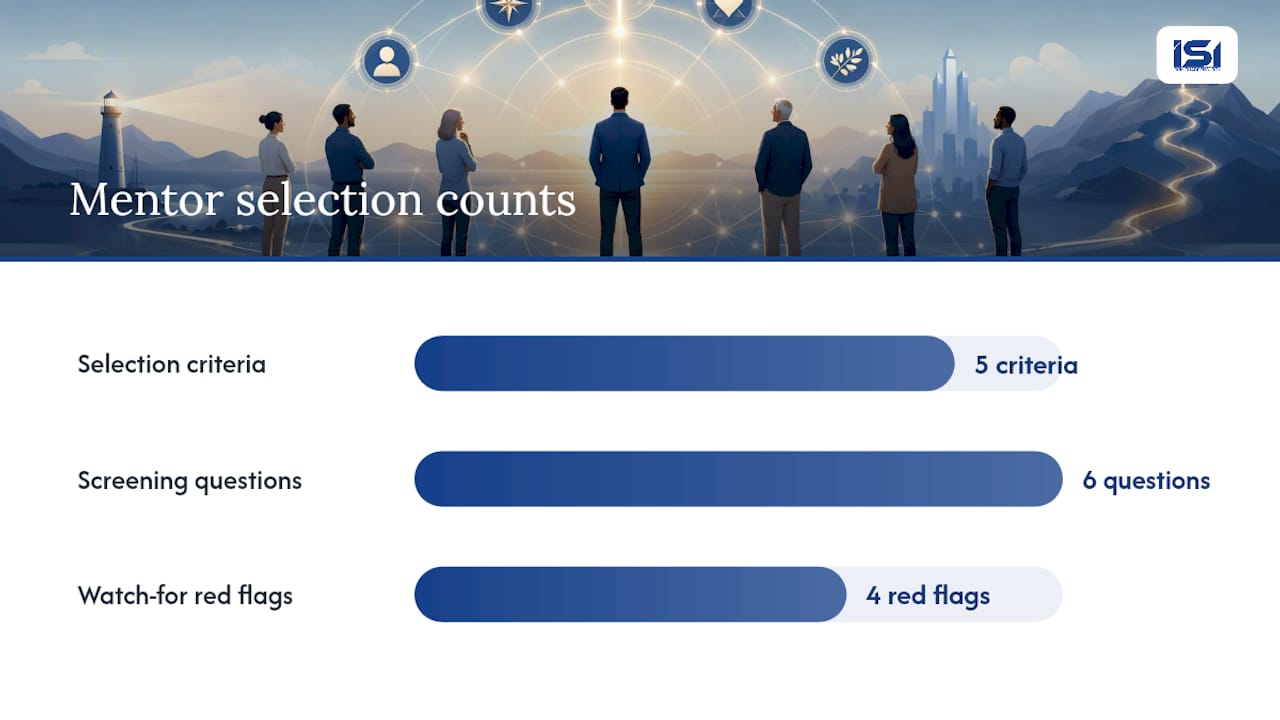
Weigh candidates against five criteria:
- Spiritual maturity you can see in how they handle setbacks, not just success
- Demonstrated integrity, especially when no one was watching
- Relevant business experience at a stage close to or ahead of yours
- Real availability, not aspirational availability
- A track record of holding others accountable, not just being nice
Ask these six questions before you commit:
- How do you handle a mentee who is clearly avoiding a hard truth?
- What does confidentiality mean to you in practice?
- How many other people are you currently mentoring or advising?
- Can you describe a time a mentoring relationship ended poorly, and why?
- What do you expect from me in return?
- How do we handle disagreement or correction?
Watch for red flags: vague answers about confidentiality, pressure to recruit others into a program, fuzzy expectations about outcomes, or a mentor who talks more than he listens. Commitment lengths vary widely, from a single quarter to multi-year relationships, and fees range from free peer arrangements to paid memberships with structured curriculum. Match the commitment to the depth of change you're actually pursuing.
How Do You Get Started in the First 90 Days?
Momentum in mentoring is built in the first quarter or lost there entirely.
- Weeks 1 to 2: Confirm the format, agree on meeting cadence, and make confidentiality clear from day one, in writing if the relationship is more formal than casual.
- Weeks 3 to 4: Set two or three combined goals, one spiritual (a discipline or character area) and one professional (a specific business outcome).
- Weeks 5 to 8: Meet consistently. Protect the rhythm even when the calendar gets loud, because this is where most mentoring relationships quietly die.
- Weeks 9 to 12: Hold a checkpoint conversation. Review what changed, what stalled, and whether the format still fits.
Pro Tip: Write your confidentiality agreement down, even informally, in the first meeting. A verbal understanding fades under pressure; a written one doesn't.
By day 90, you should know whether this mentor or group is a long-term fit or whether you need to look elsewhere, and that clarity alone is worth the quarter.
How Does a Personal Board of Advisors Model Work in Practice?
A Personal Board of Advisors takes the mastermind concept and narrows it to the people who know your whole life, not just your P&L. The membership structure is built around this idea because no single mentor can speak credibly into personal, spiritual, relational, professional, and financial health all at once.
Here's what that structure typically provides:
- A small, consistent cohort instead of a rotating cast of acquaintances
- Regular mastermind meetings that protect the rhythm mentoring relationships need to survive
- Access to an online community and leadership events
- Accountability across multiple life domains, not just business metrics
- A structure built for men who want to lead their businesses, families, and communities with more intention
Related reading on the ISI Brotherhood blog covers how biblical leadership principles inform this kind of accountability structure in practice.
What Are the Common Challenges in Christian Business Mentoring?
The most common failure point isn't a bad mentor. It's a good mentor and mentee who never protect the time.
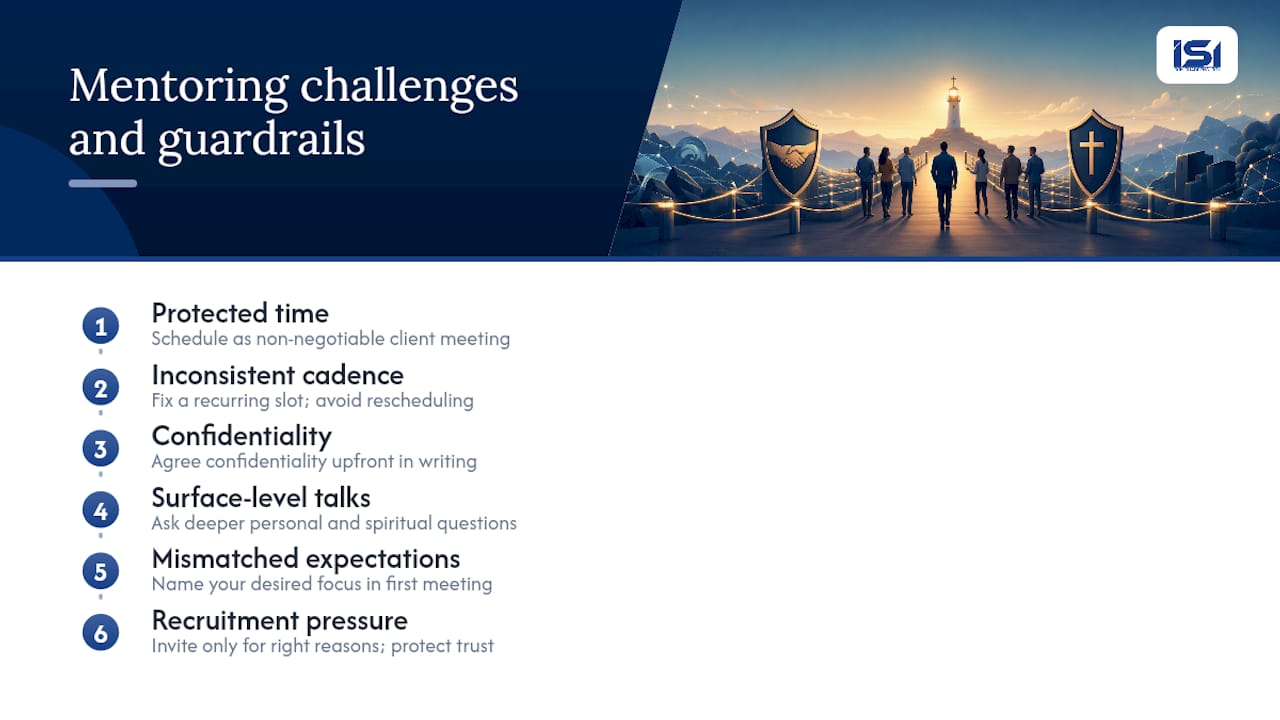
Inconsistent cadence. Meetings get rescheduled, then skipped, then quietly forgotten. Fix this by treating your mentoring meeting like a client obligation on your calendar, not a nice-to-have.
Confidentiality confusion. One person assumes discretion; the other assumes they can mention things to a spouse or business partner. Make confidentiality clear from day one, ideally with a short written agreement, so no one is guessing later.
Surface-level conversation. Mentoring relationships stall when both parties stay in business talk and avoid the harder personal or spiritual questions. Push past small talk deliberately, especially in the first few months, or the relationship will plateau at "friendly acquaintance."
Mismatched expectations. One party wants deep spiritual direction; the other wants tactical business advice. Neither is wrong, but the mismatch causes quiet frustration. Name what you actually want out loud in the first conversation.
Isolation disguised as independence. Some leaders treat asking for help as weakness, then wonder why their mentoring relationship never gets past pleasantries. The leaders who benefit most are the ones willing to bring their real struggles, not just their highlight reel.
Recruitment pressure. Some group formats subtly pressure members to bring in new participants. Get the right men in the room for the right reasons, or the trust in the group erodes fast.
None of these challenges are disqualifying. They're predictable, which means they're preventable if you name them early and build the guardrails before you need them.
Why Relational Mentoring Is Worth Protecting
Relational mentoring works because it's slow, personal, and hard to fake. Get the right men in the room, protect the rhythm of meeting consistently, and make confidentiality clear from day one. These aren't slogans. They're the difference between a mentoring relationship that changes a life and one that fades after two meetings. If that resonates, an ISI Brotherhood info session or application is a reasonable next step to consider.
— Derek
How Can ISI Brotherhood Help You Take the Next Step?
If you've read this far, you already know mentoring alone doesn't happen by accident. It happens because someone builds the structure, protects the rhythm, and gets the right men in the room before things get hard. That's the entire premise behind ISI Brotherhood's Personal Board of Advisors model: a small, trusted group of Christian men meeting weekly across personal, spiritual, relational, professional, and financial areas, backed by a year-round community and leadership events instead of a single mentor you hope stays available.
The ideal member is someone with business experience who values accountability. Applications typically involve a conversation to confirm fit, followed by placement into a consistent cohort. If you're weighing whether this kind of structured mastermind fits your season, Mastermind Group ~ Is it for You? walks through exactly that question, and it's the right place to start.
Where Can You Read More on This Topic?
For deeper study, review the academic grounding in social learning theory and Christian leadership mentoring, practical guidance on finding a mastermind group, and the biblical framework behind kingdom entrepreneurship.
Sources
- Paul and Timothy — Journal of Biblical Perspectives in Leadership (Regent University)
- Leadership modeling: Christian leadership development through mentoring (Journal of Applied Christian Leadership)
- Mentoring vs coaching — Newable
- The Moses–Joshua succession (Enrichment Journal)