

Faith and work is the practice of living out your Christian calling so that daily labor serves God, builds neighbors, and shapes culture. That is the whole idea in one sentence. The rest is application.
Three things you can do this week to start integrating faith into work:
- Open each workday with a 60-second prayer that names your specific tasks and asks for wisdom in them.
- Identify one colleague you can serve with unusual generosity or excellence today, not as a project but as a neighbor.
- Write down one ethical decision you are facing at work and ask: what would a person grounded in Christ's character do here?
The sections below unpack the theology behind those three moves, point you to the best organizations and books, and give you a practical template for building the kind of peer community where this integration actually sticks.
Key Takeaways
Faith and work integration is not a weekend project; it is a daily practice grounded in Scripture, sustained by community, and expressed through character, ethics, and neighbor-focused excellence.
| Point | Details |
|---|---|
| Work is a calling, not just a career | Every legitimate role is a vocation when done to God's glory, from Genesis 1 through Colossians 3:17. |
| Honest labor connects to generosity | Ephesians 4:28 frames your paycheck as a tool for neighbor care, not only personal provision. |
| Daily habits make theology real | A Monday prayer anchor, a midweek ethics check, and a Friday Sabbath rhythm translate doctrine into practice. |
| Community closes the knowing-doing gap | Peer mastermind groups and workplace fellowships turn theological conviction into accountable, weekly behavior change. |
| Isibrotherhood offers structured accountability | The Personal Board of Advisors model gives Christian men a weekly rhythm to integrate faith across all five life areas. |
Table of Contents
- What does "faith and work" really mean?
- What does the Bible actually say about work?
- Why integrating faith and work matters right now
- How to integrate faith and work in practical, daily terms
- Where to learn and who to join: key organizations and books
- How to start a workplace faith group or vocation cohort
- What do Ephesians 4:28 and Colossians 3:17 say about work?
- How peer mastermind groups help you live out faith at work
- Why the faith-and-work question keeps coming back
- Isibrotherhood offers one clear path forward
- Sources
What does "faith and work" really mean?
The phrase carries at least four distinct meanings, and mixing them up is where most confusion starts.
Theological (vocation). Work is a calling, not just a paycheck. The Reformers, particularly Martin Luther and later Abraham Kuyper, argued that ordinary secular roles are sacred when done to God's glory. A nurse, a contractor, and a CFO are each exercising a vocation as genuinely as any pastor. This is the doctrinal core of the faith-and-work conversation.
Practical (ethics and excellence). At the daily level, faith shapes how you work: with honesty, care for quality, fair treatment of employees, and refusal to cut corners. This is Christian faith at work expressed through character rather than conversation.
Missional (witness). Work is a primary point of entry for the Gospel. Christians who work with unusual excellence and integrity create natural openings for conversations about why they operate differently. The goal is not to preach at colleagues but to be, as 1 Peter 3:15 frames it, ready to give a reason for the hope that is visible in how you work.
Communal (workplace fellowship). Faith and work also describes the growing movement of workplace groups, vocation cohorts, and peer masterminds where Christians support one another across the week, not just on Sunday.
Three common misunderstandings worth correcting
- "Only ministers are truly called." Luther demolished this in the 16th century. Every legitimate role that serves human flourishing is a calling.
- "Working hard earns God's favor." Work flows from grace, not toward it. Treating productivity as a path to salvation is a theological error and a fast road to burnout.
- "Faith at work means being vocal about religion." Integration is mostly about character, not proclamation. Quiet integrity often speaks louder than any announcement.
What does the Bible actually say about work?
The biblical case for faith-and-work integration is not a modern invention. It runs from Genesis to Revelation, and three theological pillars hold it up.
The creation mandate: work as image-bearing stewardship
Genesis 1 and 2 place human beings in a garden with a mandate: cultivate and keep it. Before the Fall, before any church, before any ministry, there was work. God himself works in creation, and human beings made in his image are designed to reflect that creative, ordering activity. Work is not a consequence of sin; it is part of what it means to be human. A biblical theology of work frames every paid and unpaid role as stewardship of gifts given to serve neighbors and glorify God.
The incarnation: Jesus worked with his hands
Jesus spent roughly 30 years as a craftsman before his public ministry. That is not a throwaway biographical detail. It is a theological statement about the dignity of ordinary labor. The Son of God sanctified material work by doing it. The Incarnation means the physical world, including the daily grind of a job, is not spiritually neutral territory to be escaped. It is the very arena where God meets people.
Key texts and what they mean for Monday morning
- Colossians 3:17 — "Whatever you do, in word or deed, do everything in the name of the Lord Jesus." The scope is total. There is no category of work excluded from this command. Excellence in a spreadsheet and integrity in a contract negotiation are both acts of worship.
- Ephesians 4:28 — Paul tells believers to work honestly with their own hands so they have something to share with those in need. The purpose of honest labor is explicitly generosity, not accumulation. Work is a vehicle for neighbor care.
- 1 Thessalonians 4:11–12 — "Aspire to live quietly, and to mind your own affairs, and to work with your hands... so that you may walk properly before outsiders." Faithful, diligent work is itself a form of witness to those who are watching.
The Theology of Work Project has catalogued hundreds of biblical passages that address work directly, demonstrating that this is not a niche theme but a thread woven through the entire scriptural story.
Why integrating faith and work matters right now
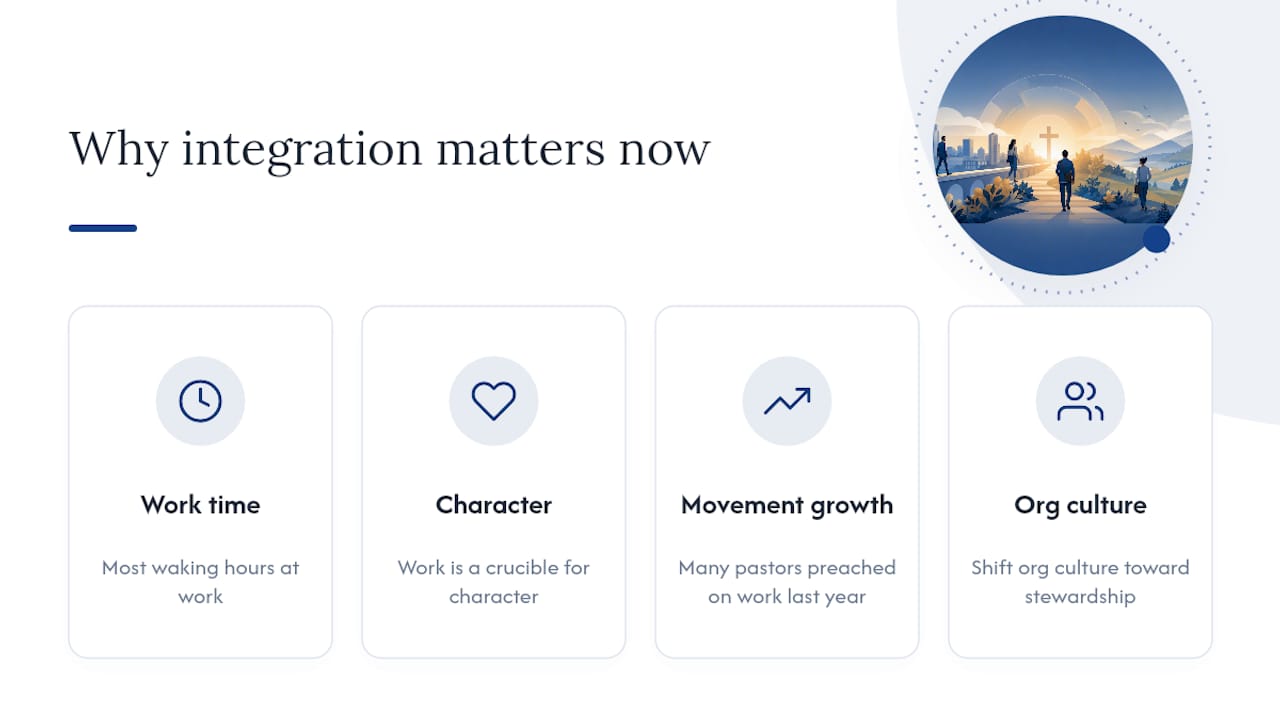
Most Christians spend more waking hours at work than anywhere else. That gap is the core problem faith-and-work integration addresses.
Spiritually, work is one of the most consistent crucibles for character formation. The pressure of a difficult client, the temptation to shade a number, the choice to treat a subordinate with dignity when no one is watching: these are the moments where faith either shapes behavior or stays theoretical. Everyday work, according to movement scholarship, is an essential setting for discipleship and cultural influence.
The movement has grown significantly. Movement literature cites surveys showing that a large share of pastors preached at least one sermon on work in the prior year, and networks like Made to Flourish have expanded their reach. Philanthropic funding has supported academic research and the Theology of Work Bible Commentary, signaling that institutions are taking this seriously, not just individual practitioners.
For communities and neighbors, the stakes are equally high. Christians in the marketplace who lead from a Christ-grounded identity rather than a status-driven one tend to shift organizational cultures from competition toward stewardship. That is not a small thing. Businesses and institutions shaped by people who genuinely care about neighbor flourishing produce different outcomes than those shaped by people chasing rank.
How to integrate faith and work in practical, daily terms
Theology without practice is just vocabulary. Here is a framework you can actually use.
A three-point weekly action plan (try it for one month)
- Monday morning anchor. Before your first meeting, spend five minutes in prayer naming your specific work for the week. Ask for wisdom in one particular challenge you are facing. This is not a ritual; it is a reorientation.
- Midweek ethics check. On Wednesday, identify one decision or interaction that tested your integrity. Write one sentence about how you handled it and one sentence about what you would do differently. This builds the habit of moral self-examination without requiring a therapist.
- Friday gratitude and Sabbath prep. Name three things your work accomplished for someone else this week. Then close the laptop with intention. Sabbath is not laziness; it is a theological statement that you are not the engine of the world.
Daily and weekly habits that compound over time
- Pray specifically for colleagues by name, not just "bless my workplace."
- Practice excellence as a form of love: do the work well because the person receiving it matters.
- Give generously from your income, treating Ephesians 4:28 as a literal operating principle.
- Build a Sabbath rhythm that is non-negotiable, even during busy seasons. A Christian work ethic that ignores rest eventually collapses into workaholism.
Navigating ethical dilemmas at work
When you hit a hard ethical call, run it through three quick questions: Would I be comfortable if my pastor, my spouse, and my team all saw exactly what I am doing and why? Does this decision treat the other person as a neighbor or as a means to an end? Is there a way to do this that costs me something but honors God?
Expressing faith without overstepping
Keep faith expression invitational rather than coercive. Mention your church or prayer life when it comes up naturally in conversation. Never leverage authority over a subordinate to push religious participation. The goal is to be so genuinely different in character that people ask questions, not to manufacture religious moments.
Pro Tip: Prepare a 60-second answer to the question "Why do you work the way you do?" Most Christians have never rehearsed this. When a colleague notices your integrity or generosity and asks about it, a clear, honest, non-preachy answer is one of the most effective forms of workplace witness available.
Where to learn and who to join: key organizations and books
The faith-and-work movement has produced a rich ecosystem of organizations and literature. Here is where to start.
Core organizations
Center for Faith & Work (Redeemer City to City). Founded through Redeemer Presbyterian Church in New York City, the Center for Faith & Work offers programs, events, and resources for Christians integrating vocation with theology. Its Gotham Fellowship and vocational group curricula are among the most developed in the movement, particularly for urban professionals.
Faith & Work Movement. A broader network and descriptor for the ecosystem of churches, parachurch organizations, and scholars working on vocation theology. Made to Flourish is one of the most active networks within this space, connecting pastors and church leaders who want to equip their congregations for Monday.
Theology of Work Project. An extensive, peer-reviewed biblical commentary covering hundreds of Scripture passages related to work. It is the most thorough academic resource in the movement and is freely available online. Lilly Endowment funding helped make this resource possible, which signals the level of institutional investment behind it.
Recommended books
- Every Good Endeavor by Timothy Keller and Katherine Leary Alsdorf. The clearest theological case for why work matters to God, grounded in Genesis and the Gospel. Start here if you want the doctrinal foundation.
- Work Matters by Tom Nelson. More practically oriented than Keller's book, with direct application for pastors and laypeople who want to connect Sunday theology to Monday reality.
- The Theology of Work Bible Commentary. Not a traditional read-through book but an invaluable reference for studying specific passages. Use it alongside your regular Bible reading.
For reliable Scripture study resources that support this kind of vocational reading, curated Bible study guides can help you identify curricula aligned with your theological tradition and workplace context.
How to choose where to start: If you want theology, begin with Every Good Endeavor. If you want practical church programming, look at Made to Flourish. If you want deep biblical study, go straight to the Theology of Work Project. If you want peer accountability in a small group, the next section is for you.
How to start a workplace faith group or vocation cohort
A workplace fellowship does not need a budget or a formal charter. It needs a clear purpose, a few committed people, and a repeatable meeting structure.
Launch checklist (four steps)
- Get permission or clarify context. If you are forming a group inside a company, check HR policy on employee resource groups. Most organizations allow voluntary, non-coercive faith-based ERGs. If you are forming a group outside work hours with colleagues, no permission is needed.
- Define the shape. Decide: Is this a Bible study, a vocational reflection group, a prayer group, or a peer accountability cohort? Each has a different agenda. Mixing all four without clarity produces confusion.
- Invite three to five people personally. Mass invitations produce low commitment. A personal conversation explaining why you thought of this specific person produces the right kind of group.
- Run a pilot meeting before committing to a schedule. One meeting with no strings attached lets people experience the value before they commit to a recurring calendar slot.
Sample 60-minute meeting agenda
- 0–10 min: Check-in. Each person answers: "What is one thing at work that challenged or encouraged you this week?"
- 10–25 min: Scripture or reading. Read one passage or a short excerpt from a book like Work Matters. Two or three reflection questions, not a lecture.
- 25–45 min: Case discussion. One person brings a real workplace situation they are navigating. The group asks questions and offers perspective. No advice unless asked.
- 45–55 min: Action commitments. Each person names one specific thing they will do differently at work before the next meeting.
- 55–60 min: Prayer. Pray specifically for the commitments just named.
Legal and cultural guardrails
- Keep participation entirely voluntary. Never use positional authority to pressure attendance.
- Maintain confidentiality about what is shared in the group. What is said in the room stays there.
- Welcome people of different denominational backgrounds without requiring doctrinal uniformity on secondary issues.
- Respect colleagues who decline. A group that is known for respecting boundaries earns more trust than one that is known for recruiting.
Understanding how community shapes faith formation is worth studying before you design your group's structure. The research on community-based learning consistently shows that relational accountability accelerates both theological understanding and behavioral change.
Three signals that your group is working
- Members bring real, specific workplace situations rather than generic prayer requests.
- Attendance stays consistent without reminders after the first two months.
- At least one person reports making a different decision at work because of a conversation in the group.
What do Ephesians 4:28 and Colossians 3:17 say about work?
These two passages come up constantly in faith-and-work conversations, and both reward careful reading.
Ephesians 4:28
Paul writes to former thieves: stop stealing, work honestly with your own hands, and produce so you have something to give to those in need. The logic is striking. Honest labor connects directly to generosity: the purpose of your paycheck is not only your household but your neighbor's need. In a workplace context, this passage reframes your job as a generosity engine. You work well so you can give well.
Application: Review your giving practices alongside your work practices. Are they connected in your mind, or do you treat them as separate categories?
Colossians 3:17
"Whatever you do, in word or deed, do everything in the name of the Lord Jesus, giving thanks to God the Father through him." The scope of "whatever" is the point. There is no secular category of work that falls outside this command. Filing a report, managing a team, writing code, or running a meeting: all of it is covered.
Application: Before your next meeting, ask: "Am I doing this in a way I could genuinely offer to God?" That question alone changes the quality of attention you bring.
What the Bible says about work, in brief
- Work is created good (Genesis 1–2) and reflects God's own creative nature.
- Work is a vehicle for neighbor love, not just personal provision (Ephesians 4:28).
- Work done with integrity is a form of witness to those outside the faith (1 Thessalonians 4:11–12).
The Theology of Work Project's biblical commentary offers detailed exegesis of each of these passages and dozens more, making it the most thorough reference available for anyone who wants to go deeper than a single verse.
How peer mastermind groups help you live out faith at work
Theology changes minds. Accountability changes behavior. The gap between knowing what faith-and-work integration means and actually doing it on a Tuesday afternoon is where most Christians get stuck. Peer mastermind groups are one of the most effective tools for closing that gap.
Why the format works
Small, regular accountability groups translate theology into habit by combining honest confession, practical coaching, and specific commitments. When you know you will report back to three or four trusted peers next week, the ethical decision you face today carries a different weight. The group becomes an external conscience that reinforces the internal one.
A workable model: the Personal Board of Advisors
One model worth studying is the Personal Board of Advisors structure, which Isibrotherhood uses with its members. Each member is placed in a small cohort of Christian men who meet weekly to address five areas: personal, spiritual, relational, professional, and financial. The meeting rhythm is consistent, the roles are defined (a facilitator keeps the group on track, an accountability partner follows up between sessions), and confidentiality is non-negotiable.
The structure matters because it prevents the two most common failure modes of faith-based small groups: drift into social gathering without accountability, and accountability without grace. A defined agenda with a prayer component and a commitment-reporting component holds both in tension.
Pro Tip: The most effective mastermind groups set a 90-day commitment window before evaluating whether to continue. This is long enough to build trust and short enough that members do not feel trapped. Revisit the group's purpose and format at the 90-day mark, adjust what is not working, and recommit deliberately.
Confidentiality and boundary norms
- Agree explicitly at the first meeting: nothing shared in the group is repeated outside it, including to spouses, without the speaker's permission.
- Keep the group focused on the member's own choices and responses, not on judging absent third parties (a difficult boss, a difficult client).
- If a member discloses something that requires pastoral or professional intervention, have a clear, pre-agreed protocol for how the group will respond.
Biblical community living principles provide a useful framework for setting these norms in a theologically grounded way before your first meeting.
Why the faith-and-work question keeps coming back
The persistence of this question is not a sign that Christians have failed to answer it. It is a sign that the question is permanently alive because work is permanently alive.
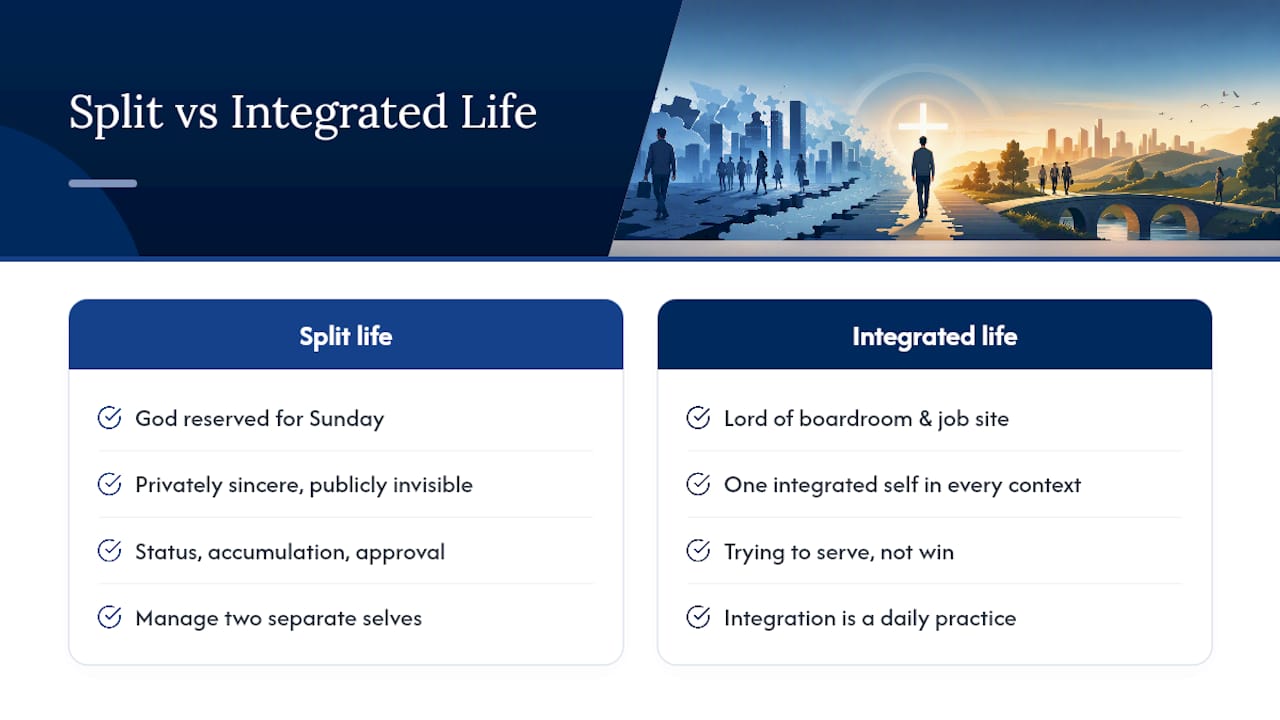
Every generation of Christians faces the same temptation: to split life into the sacred and the secular, to reserve God for Sunday and manage Monday on their own terms. The sacred/secular divide is not a modern invention. It is a recurring human instinct, and it produces the same result every time: a faith that is privately sincere and publicly invisible, and a work life that slowly drifts toward whatever the surrounding culture values most, usually status, accumulation, or approval.
What the faith-and-work movement gets right is the insistence that this split is theologically incoherent. If Christ is Lord, he is Lord of the boardroom and the job site, not only the sanctuary. That claim is not a slogan. It is a demand, and it is a liberation. When you stop managing two separate selves and start bringing one integrated self to every context, the pressure of performance eases. You are not trying to win. You are trying to serve.
The realistic caveat: integration is not a destination you arrive at. It is a daily practice you return to, often after failing at it yesterday. The men who make the most progress are not the ones with the clearest theology. They are the ones with the most honest community around them.
Isibrotherhood offers one clear path forward
If you have read this far, you already know what you want: a community of men who take both their faith and their work seriously, and who will hold you to the standard you say you believe in.
Isibrotherhood is a Christian business mastermind built specifically for that. Every member is placed in a Personal Board of Advisors, a small cohort of Christian men who meet weekly to work through the five areas where faith and work intersect most: personal growth, spiritual formation, relational health, professional decisions, and financial stewardship. This is not a networking group or a Bible study. It is structured accountability with men who understand what it costs to lead a business or a team with integrity.
Membership includes weekly mastermind meetings, a year-round online community, leadership events, and access to resources designed for Christian business owners and executives. It is one path among several valid ones, and it is the most structured, peer-accountable option available for men who want to stop theorizing about faith-and-work integration and start practicing it with people who will notice if they don't.
Apply for membership at Isibrotherhood and find out whether the Personal Board of Advisors model is the right fit for where you are right now.
Sources
- Faith and Work: A Biblical View of Work | Next Step Disciple
- Ephesians 4:28 Commentary | Precept Austin
- Faith‑Work integration: Trendy or essential? | FullerStudio
- Work, faith movement analysis | Christianity Today
- Theology of Work
Choosing where to start: If your primary need is theological grounding, begin with Every Good Endeavor and the Theology of Work Project. If you want practical community and accountability, look at the Center for Faith & Work's vocational groups or a peer mastermind structure like Isibrotherhood. If you want to study Scripture more deeply alongside others, reliable Scripture study resources can help you identify curricula that fit your tradition and context. Prioritize resources that align with your theological convictions and the specific pressures of your workplace.