

A faith-based mastermind is right for you if you're a Christian founder, executive, or business owner who wants peer accountability that treats scripture and strategy as equally serious. Done well, it produces two things: real spiritual formation and measurable business progress. Skip to the evaluation criteria below before you commit to any group.
TL;DR:
- Faith-based masterminds are most beneficial for established Christian business owners with real revenue who can engage in deep, biblically integrated problem-solving.
- Effective groups maintain small size, structured agendas, confidentiality, and a focus on applying scripture directly to current business challenges.
- Facilitators must combine business experience with biblical fluency, ensuring success metrics align with members' specific stage and goals.
- Meetings typically include prayer, focused discussions, and accountability, with formats blending biblical teaching and open dialogue for relevance and depth.
- Members should evaluate the group's training, success criteria, and stage fit carefully before joining, as trust and discipline are essential for real spiritual and business growth.
Table of Contents
- What Is a Faith-Based Mastermind, Really?
- Who Actually Benefits From This Kind of Group?
- How Are Meetings Actually Run?
- How Do You Evaluate and Choose the Right Mastermind?
- What Should You Expect: Time, Cost, and Results?
- ISI Brotherhood as a Working Example
- What Makes These Groups Harder to Run Than Standard Masterminds?
- What Role Does Prayer Actually Play in Meetings?
- Structured Teaching or Open Discussion: Which Format Works Better?
- Why Peer Accountability and Theological Clarity Beat Either One Alone
- How to Get Started With ISI Brotherhood
- Sources
What Is a Faith-Based Mastermind, Really?
A faith-based mastermind is a small peer cohort, usually meeting on a fixed schedule, where members apply biblical wisdom directly to the decisions running their businesses. It is not a Bible study, and it is not a networking mixer with a prayer tacked on. The distinction matters more than most people realize before they join their first group and discover it is neither.
The core mechanics look like most secular masterminds: a defined group, structured meetings, and mutual accountability for stated goals. What changes is the lens. Members bring a real pricing decision, a hiring dilemma, or a leadership failure, and the group works it through scripture and spiritual discipline as much as spreadsheets. Experts who study this space warn that the value collapses when groups skip that translation step. Faith principles have to convert into business language, not stay abstract encouragement, or the group drifts into what one analysis calls "fluffy spiritual cheerleading."
Here's how a faith-based mastermind differs from the formats it gets confused with:
- Coaching is directive, with one expert advising a client. A mastermind is peer-driven, with members advising each other.
- Bible study centers on curriculum and interpretation. A mastermind centers on applying that interpretation to a live business problem this week.
- Networking trades breadth of contacts for depth. A mastermind trades a wide circle for a handful of people who know your numbers, your marriage, and your prayer life.
That depth is the entire point, and it's why the group size stays deliberately small.
Who Actually Benefits From This Kind of Group?
Founders, CEOs, and established business owners get the most out of a faith-based mastermind, particularly leaders past the survival phase who now carry decisions no employee can share. If you're still validating whether your business has a market, a mastermind built for six-figure and seven-figure operators will feel like a mismatch, not encouragement.
Stage alignment isn't a minor detail. Leaders who join cohorts mismatched to their revenue or team size often find the conversation irrelevant, or worse, feel pressure to adopt operational models built for a different scale entirely, a pattern documented in analysis of Christian entrepreneur groups. A solo consultant sitting in a room built for multi-location operators will spend more time translating than growing.
Good-fit profiles typically share a few traits:
- Someone actively running a business with real revenue, not just an idea in development.
- A leader ready to be questioned on financial decisions, not just praised for effort.
- A person whose faith is not incidental to how they lead, but central to it.
- Someone who can commit to a recurring schedule for six months or longer.
Faith alignment expectations vary by group. Some cohorts assume a shared theological tradition and dig into specific doctrine. Others stay broadly Christian and focus more on shared conviction than denominational agreement. Neither approach is wrong, but you should know which one you're joining before your first meeting, not after a disagreement surfaces.
How Are Meetings Actually Run?
The best faith-based masterminds run on structure, not vibes. A mastermind is typically a peer group of four to seven members, meeting regularly, bound by confidentiality. Go smaller and you lose diversity of perspective. Go bigger and half the room never gets real airtime.
Here's what a functional session structure tends to include:
- Opening and check-in (5 to 10 minutes), often including prayer or a short spiritual grounding before business talk starts.
- Rotation through each member (15 to 30 minutes per person), where one person presents a challenge and the group responds with counsel, not just sympathy.
- Closing commitments, where each member states what they'll act on before the next meeting.
Cadence varies by group. Weekly meetings build the tightest accountability but demand the most from busy schedules. Biweekly and monthly formats work for cohorts spread across time zones, often paired with an annual or semiannual retreat for deeper, in-person work.
The facilitator's job is protecting that rotation. Without a rigid format, the most vocal member dominates the room and everyone else leaves having gotten nothing. Credible facilitation means a written agenda shared in advance, a clock that gets respected, and a facilitator willing to redirect a conversation that's run long.
Confidentiality has to be explicit, not assumed. Make confidentiality clear from day explicit, in writing, before anyone shares a real number or a real struggle. A group that never states its confidentiality policy out loud is a group that hasn't thought seriously about trust.
Pro Tip: Ask to see a sample meeting agenda before you join. If a group can't produce one, that tells you more about its seriousness than any sales pitch will.
How Do You Evaluate and Choose the Right Mastermind?
Vetting a faith-based mastermind comes down to three questions, and you should ask all three before you pay anything.
First, does the facilitator have real business experience alongside biblical fluency? A facilitator who can quote scripture but has never made payroll will struggle to help you through a cash flow crisis. The reverse problem, a sharp operator with no spiritual depth, produces a group that's Christian in name only. You want both, and treating the facilitator's background as a screening criterion rather than an afterthought protects you from both failure modes.
Second, do the group's success metrics match yours? Some masterminds measure success by revenue growth. Others weight personal character and family health as heavily as the P&L. Ask directly what the group considers a "win" for its members.
Third, does the cohort match your business stage? A room full of solo founders won't have much to offer a leader managing forty employees, and vice versa.
Bring these questions to a facilitator or current member before you apply:
- What does a typical session actually look like, start to finish?
- How is confidentiality enforced when someone breaks it?
- Can I talk to two current members about their experience before I commit?
- What happens if a member misses several sessions in a row?
- How long has this specific cohort been meeting together?
Faith-aligned peer groups exist because they foster a level of trust and honesty that generic industry peer groups rarely reach. That's the upside worth pursuing. But the upside only shows up when the group is run with real discipline, not just shared belief.
Treat the application process itself as a two-way audition. Good groups use applications to screen candidates, but you should be screening back, checking whether the facilitator asks real diagnostic questions or just collects a fee. If a group offers a trial session or guest meeting, take it. One sit-in tells you more than any testimonial page.
What Should You Expect: Time, Cost, and Results?
Faith-based masterminds often use pricing models including monthly or annual memberships, tiered options, and additional fees for retreats. Most serious groups ask for a multi-month commitment, long enough for real trust to build and real business cycles to play out.
Attendance matters more than it seems like it should. Missing three sessions in a row doesn't just cost you that content, it costs the group its rhythm, and rhythm is what makes accountability work. Protect the rhythm before you protect anything else about the group.
What should you actually track to know if it's working?
- Revenue or margin movement tied to specific decisions made in group.
- Clarity on decisions that were stuck for months before joining.
- Leadership behaviors that changed, not just intentions that improved.
- Spiritual disciplines that became consistent rather than sporadic.
A simple ROI check: if a $500 monthly membership helps you avoid one bad hire or close one delayed deal worth $10,000, the math justifies itself for the rest of the year. The harder-to-quantify return, character growth and marriage health, won't show up on a spreadsheet, but ask any member three years in which return mattered more.
ISI Brotherhood as a Working Example
A faith-based mastermind can place each member into a small cohort aligned by business stage and matched for genuine fit rather than random assignment. The structure runs on the same principles this guide has laid out: get the right men in the in the room instead of filling seats, and protect the rhythm of the meeting instead of letting it drift.
Members work through five areas, personal, spiritual, relational, professional, and financial, inside regular mastermind meetings, a year-round online community, and periodic leadership events and retreats. That combination addresses a gap: some faith-branded groups can stay comfortable and avoid hard financial decisions.
What that looks like in practice:
- Weekly cohort meetings with a structured agenda.
- A year-round digital community for accountability.
- Leadership events and retreats for deeper work outside the weekly schedule.
- Confidentiality expectations set from the first meeting.
If you want to see how ISI approaches trust specifically, the trust-building practices behind its cohorts are worth reading before you apply anywhere.
What Makes These Groups Harder to Run Than Standard Masterminds?
Faith adds a layer of vulnerability that pure business masterminds don't touch, and that layer creates its own set of problems. Members disclose marriage struggles, doubt, and moral failure alongside quarterly numbers, and that mix demands more discretion than a standard peer group ever requires.
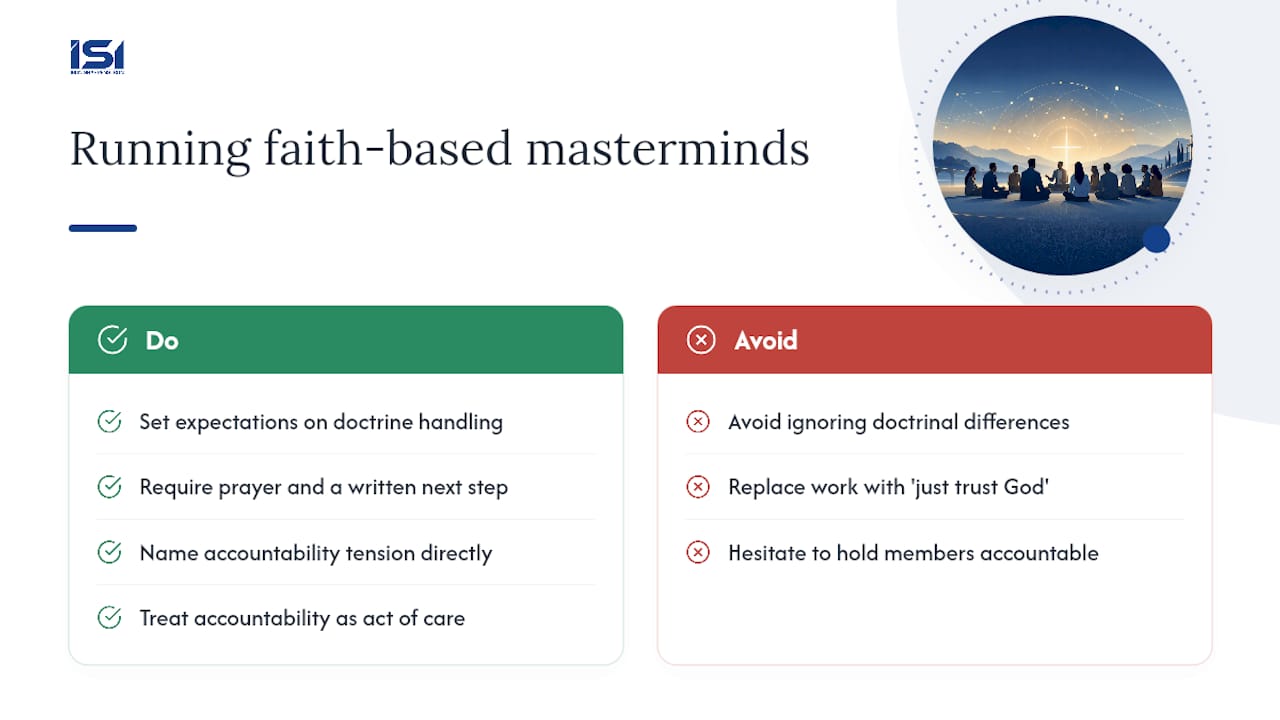
Theological disagreement is the challenge nobody warns you about. Two members from different denominational backgrounds can clash over how scripture applies to a specific decision, and a facilitator without the skill to navigate that gap will either avoid the topic entirely or let it derail the meeting. The fix isn't picking a side. It's setting expectations upfront about how doctrinal differences get handled, before the first disagreement happens live.
Spiritual bypassing is the quieter danger. It's tempting to answer a hard business problem with "just trust God" and call that accountability. That's not faith, it's an exit from the actual work. The groups that last insist on both: prayer over the situation and a concrete next step written down before the meeting ends.
Uneven commitment creates a third problem specific to these groups. Because the bond feels spiritual, members sometimes hesitate to hold each other accountable the way they would in a purely transactional business relationship. Guilt over challenging a "brother" can quietly erode the honesty the group exists to protect. Naming that tension directly, and agreeing as a group that accountability is itself an act of care, keeps it from becoming a permanent blind spot.
What Role Does Prayer Actually Play in Meetings?
Prayer in a faith-based mastermind usually functions as both an opening ritual and a working tool, not a formality bookending the real content. Most groups open with prayer to reorient the room before business talk starts, a short practice that resets the tone from transactional to relational.
The more valuable use of prayer happens mid-meeting, when a member presents a genuinely stuck problem. Pausing to pray specifically over that decision, rather than generically for the group, treats the business problem as a spiritual one worth bringing to God directly. That's different from a Bible study's devotional prayer. It's applied, tied to a real decision someone will make by Friday.
Spiritual disciplines beyond prayer show up too: scripture read aloud in response to a specific struggle, moments of silence before a hard conversation, or members holding each other to fasting or Sabbath commitments made in a previous session. None of this replaces the business rigor. It sits alongside it, and the groups that get this balance right tend to be the ones members stay in for years rather than months.
Structured Teaching or Open Discussion: Which Format Works Better?
Faith-based masterminds generally lean one of two directions, and knowing which one you're joining prevents a lot of frustration. Some groups build sessions around framed biblical teaching, a facilitator or rotating member presents a passage or principle, and the group applies it to a shared theme for that meeting. Others run on open spiritual discussion, where whatever a member is wrestling with that week sets the agenda, scripture included.
Framed teaching gives structure and depth on a specific topic, useful for cohorts that want to work systematically through, say, biblical principles of stewardship over a quarter. The risk is rigidity. A framed curriculum can feel disconnected if a member walks in with an urgent, unrelated crisis that week.
Open discussion adapts to whatever is actually happening in members' lives and businesses, which keeps relevance high. The tradeoff is depth. Without any structure, conversations can stay surface-level or repeat the same themes without ever building toward mastery of a principle.
The strongest groups tend to blend both: a loose thematic framework for the quarter, with enough flexibility built in that an urgent situation can hijack a session when it needs to. Ask any group you're considering which model they use. The answer tells you a lot about how they'll handle your worst week, not just your best one.
Why Peer Accountability and Theological Clarity Beat Either One Alone
The leaders who grow fastest inside a mastermind aren't the ones with the most polished testimony. They're the ones willing to be told, by peers who know their numbers, that a decision they made was driven by fear instead of conviction. That kind of correction rarely comes from a coach you're paying, and it never comes from a Bible study that never asks about your P&L.
Stewardship is a community discipline, not a private one. Leadership built in isolation tends to bend toward whatever pressure is loudest that quarter. Leadership built inside a group with real theological grounding and real business stakes tends to hold its shape longer.
If you're weighing whether this is worth your time, start with the evaluation questions above, not with a sales call.
— Derek
How to Get Started With ISI Brotherhood
If the vetting criteria in this guide describe what you're looking for, ISI Brotherhood is built around exactly that standard. Every member gets placed into a Personal Board of Advisors, a small cohort matched for business stage and genuine fit rather than dropped into a random group and hoping for chemistry.
The path in typically starts with an application, which functions the same way this guide recommends: as mutual vetting. You're evaluating the facilitator and cohort as much as they're evaluating you. From there, members commit to regular mastermind meetings, gain access to a year-round online community for accountability between sessions, and can join leadership events and retreats built for deeper work. Structured agendas and clear confidentiality expectations aren't an afterthought here, they're set from the first meeting.
If you want to understand how trust actually gets built inside a cohort before you commit your time, the trust-building framework ISI uses is the right next read, and the natural next step toward applying.
Sources
For deeper vetting criteria, see Why Most Christian Entrepreneur Groups Leave You Empty and the case for faith-aligned executive peer groups. For structure and rules specific to running one well, ISI Brotherhood's guides on finding a mastermind group and mastermind rules that build trust expand the checklist covered here.
- The Problem With Most “Faith-Based” Entrepreneur Groups
- The hidden power of mastermind groups for Christian speakers
- The rise of faith-based executive peer groups