

Yes, practicing forgiveness at work usually improves wellbeing, trust, and productivity, but only when it travels alongside accountability. Research links forgiving a coworker's offense to lower stress and better health outcomes, and to stronger job satisfaction and engagement over time. The caveat matters as much as the benefit: forgiveness is not the same as excusing bad behavior, ignoring a pattern, or skipping the conversation that needs to happen.
TL;DR:
- Forgiveness enhances wellbeing and trust only when combined with accountability and clear behavioral changes.
- Leaders must model sincere apologies, specify behavioral improvements, and ensure follow-up for forgiveness to be effective.
- Forgiveness is less suitable for repeated violations, abuse, or serious misconduct, where formal reporting and safety take precedence.
- Trust rebuilds through consistent, observable actions over weeks, not just a single apology or conversation.
- A strong culture of forgiveness over time fosters team resilience, reduces turnover, and encourages early conflict resolution.
Table of Contents
- What Forgiveness at Work Actually Means
- What the Research Says About Forgiveness at Work
- What Leaders Can Do to Make Forgiveness Normal
- A Step-By-Step Framework for Forgiving a Colleague
- When Forgiveness Is Not the Right Move
- How ISI Brotherhood Members Practice This
- What Happens Inside You When You Forgive Someone at Work
- What Forgiveness Looks Like When It Actually Happens
- How HR and Company Policy Shape Whether Forgiveness Sticks
- Why Forgiveness Looks Different Across Cultures and Teams
- Rebuilding Trust After the Conversation Is Over
- Why a Forgiving Culture Pays Off Over Years, Not Weeks
- A Leader's Take on Forgiveness as a Strategic Skill
- Practice Forgiveness Inside a Community Built for It
- Where This Research Comes From
- Sources
What Forgiveness at Work Actually Means
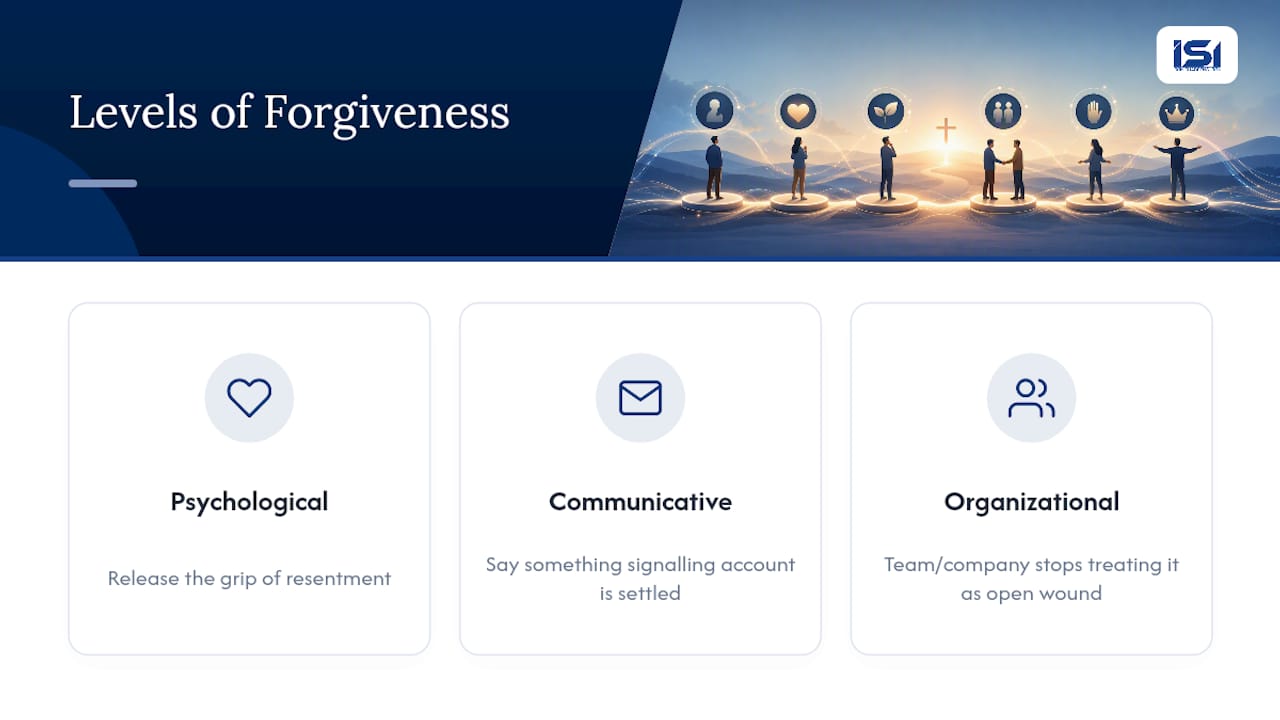
Forgiveness at work operates on three levels: psychological (you release the grip of resentment), communicative (you say something, even briefly, that signals the account is settled), and organizational (the team or company stops treating the incident as an open wound). Missing any one of these leaves the process incomplete.
It also is not the same as excusing, tolerating, or forgetting. Excusing removes responsibility; forgiveness assigns responsibility and chooses not to let it define the relationship. Tolerating just absorbs repeated harm without resolution, which is closer to burnout than healing.
Forgiveness never overrides HR or legal process. If an offense involves harassment, discrimination, theft, or safety violations, those channels take precedence. Forgiveness can follow accountability. It cannot replace it.
What the Research Says About Forgiveness at Work
The strongest evidence connects forgiveness to measurable drops in workplace strain. One body of research on forgiveness, health, and productivity found correlations as strong as r = −0.32 between forgiveness and mental health problems, and a meaningful association between forgiveness and unproductivity. Those are meaningful associations for a workplace variable that costs organizations almost nothing to encourage.
A separate longitudinal panel study tracked employees over time and found forgiving a coworker predicted higher job satisfaction, higher engagement, and lower burnout, with effects holding across short follow-up periods.
Two conditions shape whether these benefits show up:
- Relationship quality matters. Forgiveness lands differently between peers who already trust each other than between a manager and a direct report with a power gap.
- Timing matters. Forgiveness offered too fast, before the hurt is even named, tends to feel hollow rather than healing.
The short version: forgiveness lowers interpersonal stress and tends to raise engagement, but it works best as a deliberate practice, not a reflex.
What Leaders Can Do to Make Forgiveness Normal
Leaders set the emotional temperature of a team, and forgiveness spreads or stalls based on what they model. Leadership research from the University of Michigan's Ross School of Business outlines concrete practices that separate genuine forgiveness cultures from performative ones.
- Model the apology first. A leader who owns a mistake publicly, names the impact, and offers restitution gives everyone else permission to do the same.
- Never let forgiveness look like excusing. Pair it with a clear statement of what changes going forward.
- Use third-party mediation for serious conflicts. A neutral facilitator keeps the conversation from becoming a rehash of who is right.
- Build in structured follow-up. Check back in at 30 and 90 days rather than assuming the issue resolved itself.
- Train for empathy and direct communication. Teams that can name a feeling accurately resolve conflict faster than teams that avoid the subject.
- Mark the transition symbolically. A short ritual, a team lunch, a closing statement in a meeting, gives everyone a shared signal that the chapter is closed.
Pro Tip: Protect the rhythm of your regular team check-ins after a conflict. A single skipped meeting right after a hard conversation often reads as avoidance, even when that's not the intent.
A Step-By-Step Framework for Forgiving a Colleague
Forgiveness rarely happens in one conversation. It happens in a sequence, and skipping steps is usually why it doesn't stick.
- Name the grievance specifically. Vague resentment ("they're difficult") is harder to release than a specific offense ("they took credit for my proposal in the client meeting").
- Regulate the emotion before you speak. Give yourself a day, take a walk, journal it out. Reacting from a spike of anger rarely produces a conversation you're proud of later.
- Decide to release it for your own sake. This step happens internally, before any conversation. You are not doing this as a favor to them.
- Communicate directly, using a simple script. Something like: "When you [specific action], it affected [specific impact]. I want to move past it, and I need [specific ask] going forward."
- Set a boundary if one is needed. Forgiveness and a boundary are not contradictions.
- Repair and monitor. Agree on what changes, write it down in a shared note or email, and revisit it in two to four weeks.
A few things worth remembering as you go:
- Document any agreement in writing, even briefly, so both people remember the same terms.
- Check progress at a set interval rather than waiting for the next blowup to reassess.
- If the same offense repeats, treat it as new information, not proof you forgave wrong.
When Forgiveness Is Not the Right Move
Forgiveness is not appropriate as a first response to repeated violations, abuse, safety risks, or anything that belongs in a formal complaint. If someone has crossed that line more than once, the priority is documentation and reporting, not reconciliation.
Recent research on unsuccessful forgiveness found that forgiveness granted out of pressure or a desire to avoid conflict predicts worse outcomes: more rumination, lower job satisfaction, and weaker reconciliation than cases where forgiveness happened on the forgiver's own timeline. Forced forgiveness doesn't heal anything. It just buries the resentment somewhere it can resurface later, usually at a worse moment.
The safeguards are simple. Involve HR or a third party for anything beyond a routine disagreement. Keep a written record of the incident and any resolution. Prioritize physical and psychological safety before you prioritize the relationship. And never mistake a fast "I forgive you" for a resolved conflict. Sometimes the healthiest answer is distance, not forgiveness at all.
How ISI Brotherhood Members Practice This
Inside a Personal Board of Advisors, forgiveness gets tested in real time. One pattern shows up often: a business owner feels wronged by a partner or employee, brings it to his small group, and gets pushed by other men to separate the relationship from the accountability. The group doesn't let him skip the hard conversation, and it doesn't let him nurse the grudge either.
That tension, holding both grace and standards, is the whole point of a mastermind built around biblical wisdom. [brand_signal] Faith-informed leaders often find that forgiveness becomes easier when it's practiced inside a structure that also expects follow-through.
Pro Tip: Bring the specific offense to your board before you bring the apology to the person. A few honest questions from men who know you well will sharpen what you actually need to say.
What Happens Inside You When You Forgive Someone at Work
Forgiveness is not a single decision. It's a process that moves through distinct emotional stages, and understanding those stages keeps you from expecting instant resolution.

The first stage is usually denial or minimization, where you tell yourself it wasn't a big deal, even though it clearly bothered you. That gives way to anger, which is often the most uncomfortable stage because professional norms discourage expressing it. Many people skip straight past anger into a rushed, premature forgiveness that never actually processed the hurt, which is part of why that forced version predicts worse outcomes down the line.
Genuine forgiveness requires sitting with the anger long enough to understand what it's protecting, usually a sense of fairness, respect, or safety that got violated. Only after that does the emotional shift happen: the offense stops occupying central mental real estate. You still remember it. You just stop replaying it.
Cognitively, this involves reframing the other person as more than the sum of one bad moment, which is genuinely hard when you work alongside them daily. Physiologically, chronic resentment keeps the body in a low-grade stress response, which is part of why the correlation between forgiveness and mental health shows up so clearly in workplace studies. Letting go of the grudge is not just an emotional relief. It changes what your nervous system is doing all day.
What Forgiveness Looks Like When It Actually Happens
The clearest examples of workplace forgiveness tend to follow a similar arc: a specific offense, a direct conversation, a visible change, and enough time for trust to rebuild.
Consider a common scenario in small businesses: a co-founder makes a unilateral financial decision that puts the company at risk without consulting his partner. The wronged partner has every reason to walk away. Instead, in cases where the relationship survives, the pattern usually involves a genuine apology that names the specific decision and its cost, a concrete change (a new approval process for spending above a set threshold), and a probationary period where trust rebuilds through demonstrated behavior rather than promises.
Another common case: a manager publicly criticizes an employee in a meeting, damaging morale on the team. The repair that works isn't a private apology alone. It's a private apology plus a public acknowledgment, because the damage happened publicly and the repair needs to match that visibility.
The pattern across both examples: forgiveness stuck when it paired a real apology with a structural change, not just words. Where it failed, the apology came without any adjustment to the behavior that caused the harm, and the same offense resurfaced within months.
How HR and Company Policy Shape Whether Forgiveness Sticks
Most companies have conflict escalation procedures. Very few have anything that supports reconciliation once the formal process ends, and that gap is where a lot of workplace resentment quietly festers.
HR's role isn't to mandate forgiveness. Nobody can be required to feel it, and trying usually backfires. HR's role is to remove the obstacles that make genuine forgiveness harder: unclear expectations about what happens after a conflict is resolved, no defined follow-up check-in, and no safe channel for the person who was wronged to flag a repeat offense without it feeling like reopening old wounds.
A few structural moves matter more than most policy documents acknowledge. Clear timelines for when a formal complaint transitions into a coaching or mediation conversation prevent conflicts from lingering in limbo. Documented follow-up meetings, built into the process rather than left to a manager's memory, signal that the company is tracking whether repair actually happened. And a stated norm that public mistakes get public acknowledgment, while private mistakes stay private, keeps the response proportional to the offense.
Companies that build this into onboarding and management training tend to see fewer conflicts escalate into formal HR cases, simply because managers know how to have the mid-level conversation before it becomes a filed complaint.
Why Forgiveness Looks Different Across Cultures and Teams
Forgiveness is not a universal script. What counts as a sincere apology, an appropriate boundary, or a resolved conflict varies by cultural background, and diverse teams need leaders who notice that variation instead of assuming one style fits everyone.
In some cultural contexts, a direct verbal apology carries the weight; in others, the apology is expected to come through action and restored behavior over time, with words treated as almost secondary. A leader who expects an explicit "I'm sorry" from someone raised in the second tradition may misread silence as a lack of remorse when it's actually a different, equally sincere, process underway.
Power distance also shapes how forgiveness flows between levels of hierarchy. In cultures with a high tolerance for hierarchical authority, a direct report may feel it's not their place to confront a manager's mistake at all, which means the forgiveness conversation has to be initiated from the top or it simply won't happen.
None of this means lowering the bar for accountability. It means recognizing that the path to the same outcome, a repaired working relationship, can look different depending on who's walking it. Leaders of diverse teams do well to ask rather than assume, and to build in more than one acceptable way to apologize and be forgiven.
Rebuilding Trust After the Conversation Is Over
The apology is the easy part compared to what comes next. Trust rebuilds through repeated, observable behavior, not through the strength of the original conversation.
Small, consistent follow-through matters more than grand gestures. If someone agreed to communicate differently, loop others in earlier, or hit a deadline they'd missed before, the recovery of trust tracks almost entirely with whether that specific behavior actually changes over the following weeks.
A short check-in cadence, at two weeks and again at six weeks, gives both people a structured moment to name whether things feel different, rather than letting the question hang unspoken. Skipping this step is one of the most common reasons forgiveness stalls: the conversation happened, but nobody ever confirmed whether the repair held.
It also helps to let some tension exist without forcing full ease immediately. Trust returning in stages, with occasional awkwardness in the first few interactions, is normal and not a sign that forgiveness failed. What matters is the trend line, not any single tense moment three weeks in.
Why a Forgiving Culture Pays Off Over Years, Not Weeks
The compounding value of workplace forgiveness shows up less in any single resolved conflict and more in what a team becomes capable of over time.
Teams with a track record of handling conflict directly, rather than letting grudges calcify into permanent alliances and grudges, tend to take more interpersonal risk. People raise disagreements earlier, because they've watched disagreements get resolved before without anyone's career or relationships getting permanently damaged. That earlier surfacing catches small problems before they become expensive ones.
Retention improves for a less obvious reason: people don't leave jobs over a single bad conflict nearly as often as they leave over an unresolved one that never got addressed. A culture that actively practices repair keeps good people who might otherwise quietly disengage and start job hunting.
Over years, this builds something close to institutional resilience. Teams that have forgiven well together handle the next crisis, a bad quarter, a failed launch, a leadership change, with more cohesion than teams still carrying old resentments into the new problem. The forgiveness itself is never the finish line. It's the mechanism that keeps the team available for whatever comes next.
A Leader's Take on Forgiveness as a Strategic Skill
Forgiveness gets treated as a soft skill, something nice to have if you're a naturally patient person. Treat it instead as a leadership competency with a direct line to retention, engagement, and how fast your team recovers from setbacks. The leaders who handle conflict well aren't the ones who avoid it. They're the ones who've built a repeatable process for moving through it. If you're carrying a grievance right now, try the six-step framework above on the smallest one first. See what changes before you take it to the harder conversation.
— Derek
Practice Forgiveness Inside a Community Built for It
Forgiveness at work is easier to practice when you're not doing it alone, and that's exactly what a Personal Board of Advisors is built for. ISI Brotherhood connects Christian business owners, executives, and entrepreneurs into small, trusted mastermind groups that meet weekly to work through the real conflicts happening in their businesses and relationships, not abstract leadership theory. Members bring the actual grievance to the table, get pushed toward honesty instead of avoidance, and leave with a plan instead of a grudge. Get the right men in the room and make confidentiality clear from day one, because the conversations that change a business rarely happen in a group that doesn't feel safe. If you're ready to work through a real conflict with men who will tell you the truth, visit the ISI Brotherhood membership page and see how a mastermind group fits your situation.
Where This Research Comes From
- Forgiveness Working: Forgiveness, Health, and Productivity in the Workplace: the core correlational study behind the wellbeing and productivity claims.
- Forgiveness predicts better work outcomes: a longitudinal look at engagement and burnout.
- The Power of Forgiveness at Work — Greater Good Science Center: accessible synthesis of leader practices.
- Leadership Through Organizational Forgiveness — Ross School of Business: the ten-point leadership prescriptions.
- Unsuccessful forgiveness in the workplace: the caution on pressured or premature forgiveness.
Sources
- Forgiveness Working: Forgiveness, Health, and Productivity in the Workplace
- Forgiveness predicts better work outcomes (longitudinal study)
- The Power of Forgiveness at Work — Greater Good Science Center
- Leadership Through Organizational Forgiveness — Ross School of Business (UMich)
- Unsuccessful forgiveness in the workplace: motives, rumination, and outcomes