

Scripture-based goal setting means surrendering your ambitions to God before you write a single target, testing your motives against biblical stewardship, and turning what survives that test into measurable, accountable action. Start there: before you draft a goal, pause and pray. Then let a verse, not a quarterly quota, set the tone for what you build next.
TL;DR:
- Goals should be rooted in prayer and scripture to ensure they align with God's will and are genuinely driven by calling rather than ambition.
- Every goal must be tested for motives, ensuring it honors God, steward’s resources well, and considers the impact on others before formalizing it.
- Breaking long-term goals into monthly milestones and weekly actions, along with regular accountability checks, keeps progress aligned with spiritual principles.
- Incorporating biblical verses tailored to specific goal categories enhances motivation, focus, and perseverance through setbacks.
- Prioritizing surrender and accountability over frameworks ensures that goals remain spiritually anchored and practically achievable.
Table of Contents
- Why the Bible Supports Intentional Goal Setting
- How Do You Set Goals With Scripture, Step By Step?
- Which Bible Verses Fit Which Kind of Goal?
- What Frameworks Help Carry Goals Into Daily Routine?
- Why Accountability Turns Written Goals Into Results
- A 30-Day Plan to Start Setting Scripture-Based Goals
- Where Conventional Goal-Setting Advice Misses the Point
- Sources
Why the Bible Supports Intentional Goal Setting
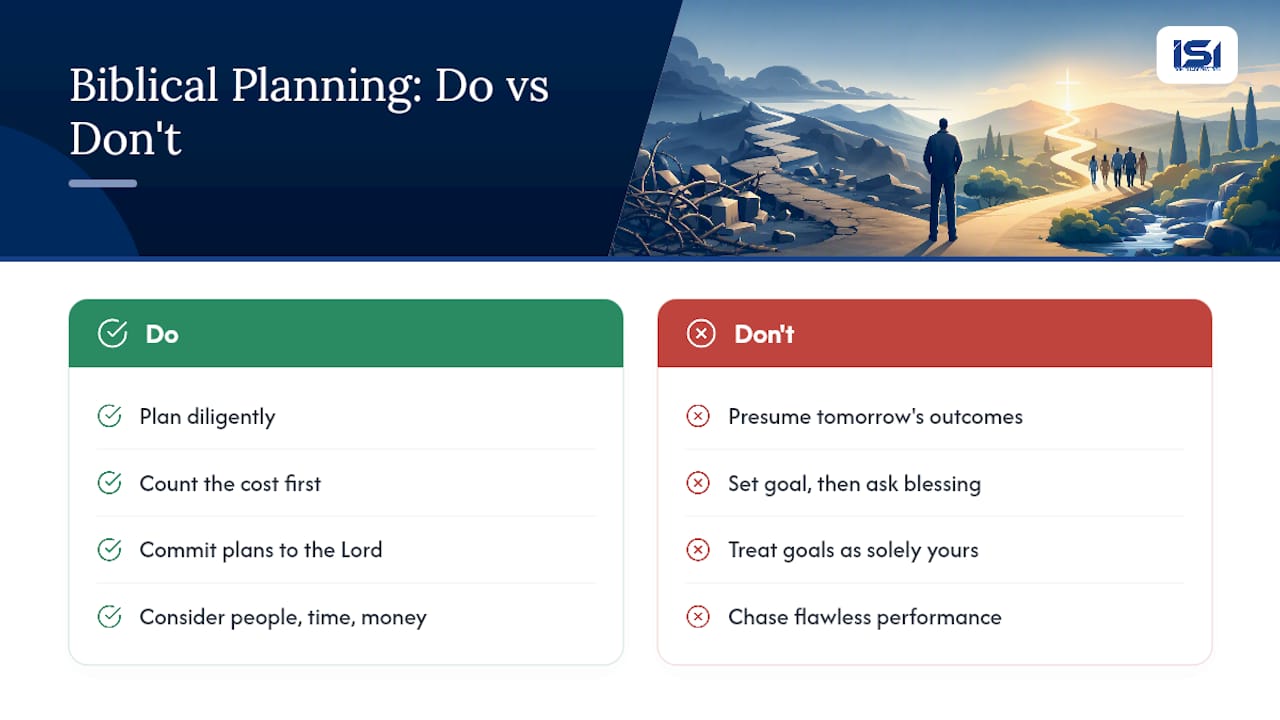
The Bible does not treat planning as a lack of faith. Proverbs 21:5 says diligent planning leads to profit, and Luke 14:28 asks whether a builder would start a tower without first counting the cost. Scripture assumes you will think ahead. The tension shows up in James 4:13-15, where the same writer who commends planning also warns against presuming on tomorrow.
"If it is the Lord's will, we will live and do this or that." That single qualifier reframes every ambition a Christian leader writes down.
That verse from James is the hinge of the whole discipline. You plan, but you plan with an open hand. Proverbs 16:3 puts the order plainly: commit your work to the Lord, and your plans will be established. Not the reverse. Philippians 3:14 adds a different kind of pressure. Paul describes pressing toward a goal, but the goal is a "heavenward call," measured by faithful progress rather than flawless performance.
The failure mode most Christian leaders fall into is goal-first planning: set the target, then ask God to bless it. Gotquestions as planning plus humble dependence, not planning instead of dependence. Stewardship theology sharpens that further. Every goal you set touches time, relationships, and money God has entrusted to you, which means the real question is never just what you want to achieve. It's how the goal treats the people affected by it.
How Do You Set Goals With Scripture, Step By Step?
This is the workflow. Five moves, in order, repeated every planning cycle.
- Surrender before you draft. Before you write anything, pray and listen. This is not a formality. It changes the posture from "here's my plan, Lord, bless it" to "here's the assignment, Lord, show me." Give this at least a full sitting alone, not a rushed line before a meeting.
- Run a motive check. Ask four questions of any ambition before it becomes a goal: Does it honor God? Does it steward what I've been given well? Does it witness to how I do business? Does it provide for my family and the people who depend on me, consistent with the standard 1 Timothy 5:8 sets for providers?
- Write it with Kingdom-aware criteria. Take the familiar SMART formula and add two filters. A goal should be specific, measurable, and accountable to someone else, but also surrendered (you'd let it go if God redirected you) and scripture-tested (you can name the verse that shaped it).
- Cascade it down to daily action. A goal that lives only as an annual statement dies by March. Break your long-range vision into annual "Big Rocks," those into monthly milestones, and those into weekly and daily actions. This cascade model, outlined in the faith-based life plan framework, is what keeps a 25-year vision connected to what you do on a Tuesday.
- Build in a review rhythm. A goal without a recurring checkpoint is a wish. Weekly or biweekly, someone else needs to ask how it's going.
Here's what that looks like in practice. A business owner feels the pull to grow revenue this year. Run it through the motive check, and it survives, because growth funds better wages for employees and frees up margin for giving. The Big Rock becomes growing net revenue while maintaining team compensation above market rate. The weekly checkpoint: one sales conversation logged, one pricing review completed, one prayer specifically for the team's provision. Anchor verse: Proverbs 16:3.
Pro Tip: Don't skip step one because you're in a hurry. A goal drafted without the pause almost always defaults to ambition dressed up as calling. Give the surrender step its own separate block of time, not a rushed prayer squeezed before you open a spreadsheet.
For decisions that feel weightier than a routine goal, a scripture-first decision framework can slow you down enough to test the call properly.
Which Bible Verses Fit Which Kind of Goal?
Pin these to whatever goal category you're working through. Each one carries a specific angle, not a generic blessing.
Spiritual growth
- Philippians 3:14: frame the goal as pursuit of Christ, not personal achievement.
- 2 Peter 1:5-7: build a goal around adding one virtue at a time rather than overhauling everything at once.
- Psalm 90:12: ask God to number your days before you set a five-year target.
Family
- Deuteronomy 6:6-7: make a family goal about consistent, ordinary conversation, not one big event.
- Joshua 24:15: frame a household goal as a decision, stated out loud, not a private hope.
- Ephesians 6:4: shape parenting goals around instruction, not just correction.
Work and career
- Colossians 3:23: set the goal so its real audience is God, not a boss or a market.
- Proverbs 22:29: aim goals at skill and excellence rather than shortcuts to visibility.
- 1 Corinthians 10:31: let "does this glorify God" be the filter on a career move.
Finances
- Proverbs 21:5: build financial goals around steady contribution, not quick wins.
- Malachi 3:10: set a giving goal before you set a savings goal.
- 1 Timothy 5:8: let provision for family sit at the top of any income target.
Health
- 1 Corinthians 6:19-20: frame a fitness goal as care for something entrusted to you.
- 3 John 1:2: let a health goal include the soul, not just the body.
Perseverance through setbacks
- James 1:2-4: reframe a missed goal as a testing ground, not a failure.
- Galatians 6:9: set the goal's timeline with patience for a harvest that comes "in due season."
- Habakkuk 3:17-19: hold a goal loosely enough to still rejoice if the outcome delays.
Twenty verses, six categories. Stewardship-based financial goal setting benefits especially from this kind of verse-first framing, since money goals drift toward pure ambition faster than most.
What Frameworks Help Carry Goals Into Daily Routine?
Two tools do the heavy lifting once your goals are written: the life-plan cascade and the 7F framework.
- The life-plan cascade. Start with a 25-year vision statement, one paragraph describing who you want to be and what you want to have stewarded well by then. Break that into annual Big Rocks, three to five per year, no more. Break each Big Rock into monthly milestones, then weekly and daily checkpoints. The 10X Life Plan model anchors every level in prayer and Scripture, not just calendar math.
- The 7F framework. Faith, Foundation, Fitness, Focus, Frameworks, Fellowship, Fruit. Score yourself on each pillar quarterly, then govern whichever pillar scored weakest first rather than trying to fix everything simultaneously. RNH Media's breakdown of the 7F model treats this as a diagnostic instrument, not a checklist you complete once.
A mini-case: a Big Rock to "mentor two junior leaders this year" becomes a monthly milestone (one structured one-on-one each), a weekly action (fifteen minutes of prep before each meeting), and a quarterly review question: did this actually build faith and skill in the other person, or did it just fill a calendar slot? That review is what separates a framework from decoration.
Why Accountability Turns Written Goals Into Results
A goal written alone rarely survives contact with a busy quarter. That's the entire logic behind a Personal Board of Advisors: a small, trusted group of Christian men who meet on a set rhythm to press on your goals, not just cheer for them. Get the right men in the room. Two or three people who will actually ask a hard follow-up question do more for your goals than a large network that never checks back in.
Protect the rhythm once you've found it. A board that meets "whenever things line up" stops meeting within a year. Make confidentiality clear from day one, before anyone shares a real number or a real struggle, so nobody hesitates to bring the goal that matters most.
A working agenda for a goal-review meeting:
- Open with a short passage of Scripture tied to someone's current goal.
- Report status on each man's Big Rocks: on track, stalled, or abandoned.
- Ask one direct question: where has ambition quietly replaced calling this month?
- Each man makes one ask and one offer before closing in prayer.
That structure, close to how ISI Brotherhood's mastermind groups run their weekly sessions, is what keeps a scripture-anchored goal from fading into a forgotten resolution.
A 30-Day Plan to Start Setting Scripture-Based Goals
Four weeks, one goal system, built in order.
- Week 1: Pause and draft. Set aside real time to pray before you write anything. Draft three Big Rocks for the year and run each through the motive check.
- Week 2: Cascade and anchor. Break each Big Rock into monthly milestones and weekly actions. Attach one anchor verse to each Big Rock.
- Week 3: Bring in accountability. Ask one person, or convene a Personal Board, to review your three Big Rocks. Run that first review meeting and note what got exposed.
- Week 4: Adjust and schedule. Revise anything that didn't survive week 3's scrutiny. Set a quarterly review date now, before momentum fades.
Pro Tip: Keep the daily rhythm small on purpose: one opening prayer, one verse, one measurable action. The micro-rhythm approach works precisely because it asks so little of a busy day, which is why it survives weeks a bigger system would not.
Where Conventional Goal-Setting Advice Misses the Point
Most goal-setting content treats faith as a garnish on a secular framework: set your SMART goal, then say a prayer over it. That order is backwards, and it's the single biggest gap between what typically gets taught and what Scripture actually models. Proverbs 16:3 doesn't say pray after you plan. It says commit the work first, and the plans get established after.
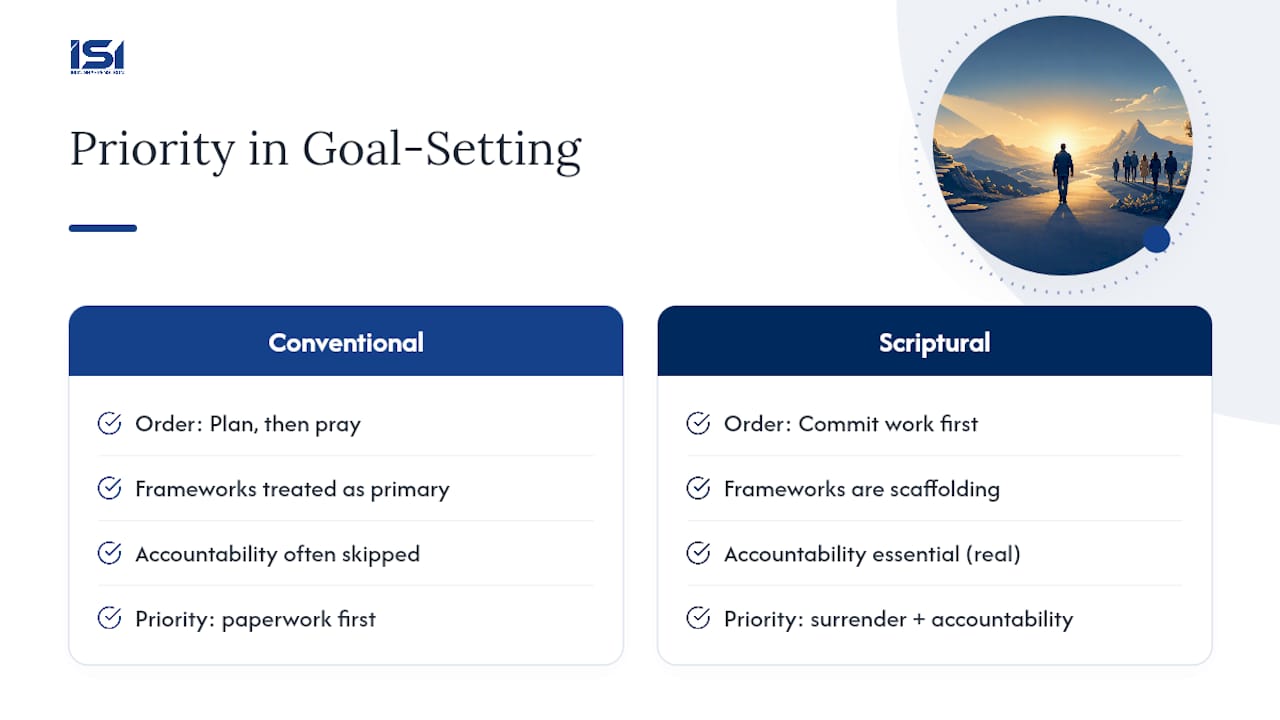
The overrated piece of this whole conversation is the framework itself. The 7F model and the life-plan cascade are useful, but they're diagnostic tools, not spiritual technology. A man can run a flawless quarterly review and still be chasing ambition dressed as calling. The step that actually changes outcomes is the one people skip fastest: real accountability with people who know your specific goals well enough to ask a pointed follow-up question.
If you take one thing from this, prioritize the surrender step and the accountability step over the paperwork. Everything else, the frameworks, the verse banks, the cascades, is scaffolding. It only holds weight once those two are in place.
— Derek
Sources
- 4 principles of stewardship | Liberty University
- Gotquestions
- Faith-Based Life Plan for Christian Men | 10X Life Plan