

Handling success biblically means treating every win as God's property loaned to you for His purposes, not proof of your own greatness. Practically, that looks like naming God as the source out loud, planning your generosity before the money arrives, protecting your Sabbath and prayer rhythms when your calendar gets crowded, and staying inside honest, accountable relationships that will tell you the truth when you don't want to hear it.
TL;DR:
- Success should be viewed as faithful stewardship, emphasizing using entrusted resources for God's purposes rather than pure accumulation or personal greatness.
- Regularly review five areas—worship, integrity, stewardship, family, and service—to detect spiritual drift, involving accountability partners for honest feedback.
- Cultivate daily habits like naming God as the source, protecting Sabbath, and automating giving to keep success Christ-centered amid growth.
- Build structured accountability groups to support ongoing reflection and prevent the erosion of routines that reinforce biblical values during times of wins.
- Prioritize early, scheduled check-ins over reactive corrections, as failure to do so can allow subtle, long-term spiritual and operational drift to occur.
Table of Contents
- What Does the Bible Say About Success?
- The Core Principles of Faithful Stewardship
- How to Review Your Success in Five Areas
- What Goes Wrong Spiritually After a Big Win
- Daily and Weekly Habits That Keep Success Christ-Centered
- How ISi Brotherhood Helps Leaders Steward Success Well
- Why the Conventional Advice on Success Falls Short
- Find Structured Accountability Built for Christian Leaders
- Sources
- FAQ
What Does the Bible Say About Success?
Scripture doesn't treat success as a scoreboard. It treats it as a test. The clearest warning sits in Deuteronomy 8, where Moses tells Israel exactly what will happen once they're settled, fed, and prosperous: they'll build houses, watch their herds multiply, and see silver and gold pile up, and their hearts will start to forget who provided it. The Enduring Word commentary on Deuteronomy 8 frames this as the central danger of any blessing: not that wealth is evil, but that comfort has a way of making a person feel self-made. Moses' remedy isn't guilt. It's memory. Name who gave you the ability to produce wealth in the first place, because you didn't invent that ability yourself.
Jesus builds on this in the Parable of the Talents in Matthew 25. A master entrusts three servants with resources and leaves. Two invest and grow what they were given; one buries his out of fear and hands it back untouched. The master doesn't praise the servant who merely preserved what he had. He praises the ones who put their resources to work and multiplied them. The Gospel Coalition's analysis of the biblical meaning of success points out that this parable defines success as faithful use of what's entrusted to you, not the raw size of what you accumulate. A modest business run with integrity and effort can be more "successful" in God's eyes than a much larger one coasting on inherited advantage.
Luke 12 sharpens the warning with the Parable of the Rich Fool: a farmer whose harvest is so large he tears down his barns to build bigger ones, then dies the same night he plans to finally enjoy it all. R.C. Sproul's reading of that passage, in a commentary on Luke 12, notes that the farmer's failure wasn't ambition. It was hoarding without ever becoming "rich toward God" through generosity. Paul rounds this out with a completely different metric for success: contentment. Writing from prison in Philippians 4, he says he has learned to be content whether he has plenty or nothing. That's not resignation. It's a leader who has decoupled his identity from his circumstances.
Four scriptural threads run through all of this:
- Deuteronomy 8: prosperity tempts the heart to forget God as the source.
- Matthew 25: success means productive stewardship of what's entrusted, not accumulation for its own sake.
- Luke 12: hoarded treasure without generosity toward God and others is spiritual foolishness.
- Philippians 4 and 1 Timothy 6: contentment and faithful work matter more than the size of the win.
The Core Principles of Faithful Stewardship
You don't need a new theology every time your business grows. You need a lens you can apply consistently, whether the win is a record quarter or a promotion you didn't expect. Here are five principles that hold up under pressure.
- Remember God as the source, out loud. Deuteronomy 8's remedy for pride is deliberate memory. Build a habit of naming, specifically, the people, open doors, timing, and hard seasons that got you here, rather than defaulting to "I built this."
- Treat resources as entrusted, not owned. The Ligonier teaching on stewardship makes the point that stewardship covers far more than money. Your time, your vocation, your relationships, and your influence are all on loan, managed for someone else's purposes.
- Pair character with competence. Joseph in Genesis is the model here: he ran Pharaoh's economy with real skill while keeping his integrity intact through prison, betrayal, and temptation. A look at Joseph's vocation from SEBTS argues that biblical success requires both, not one at the expense of the other. Excellence without character corrupts; character without competence stalls.
- Plan your generosity before the money shows up. Waiting until a windfall lands to decide how much you'll give almost guarantees you'll give less than you intended. Set your giving percentage, your family provision, and your reinvestment plan in advance, while you're still thinking clearly.
- Put yourself under real accountability. Success is disorienting precisely because it removes the friction that used to keep you honest. Counsel and correction from people who aren't impressed by your win are one of the few safeguards that actually work.
Pro Tip: Write down, in one sentence each, three specific things you didn't control that led to your last big win. Read that list before your next big decision. It's a fast way to interrupt the "I earned this alone" narrative before it takes root.
None of these principles are complicated. What's hard is practicing them consistently once success starts generating its own momentum, more requests for your time, more people telling you what you want to hear, more reasons to skip the parts of your life that feel slower than the business does.
How to Review Your Success in Five Areas
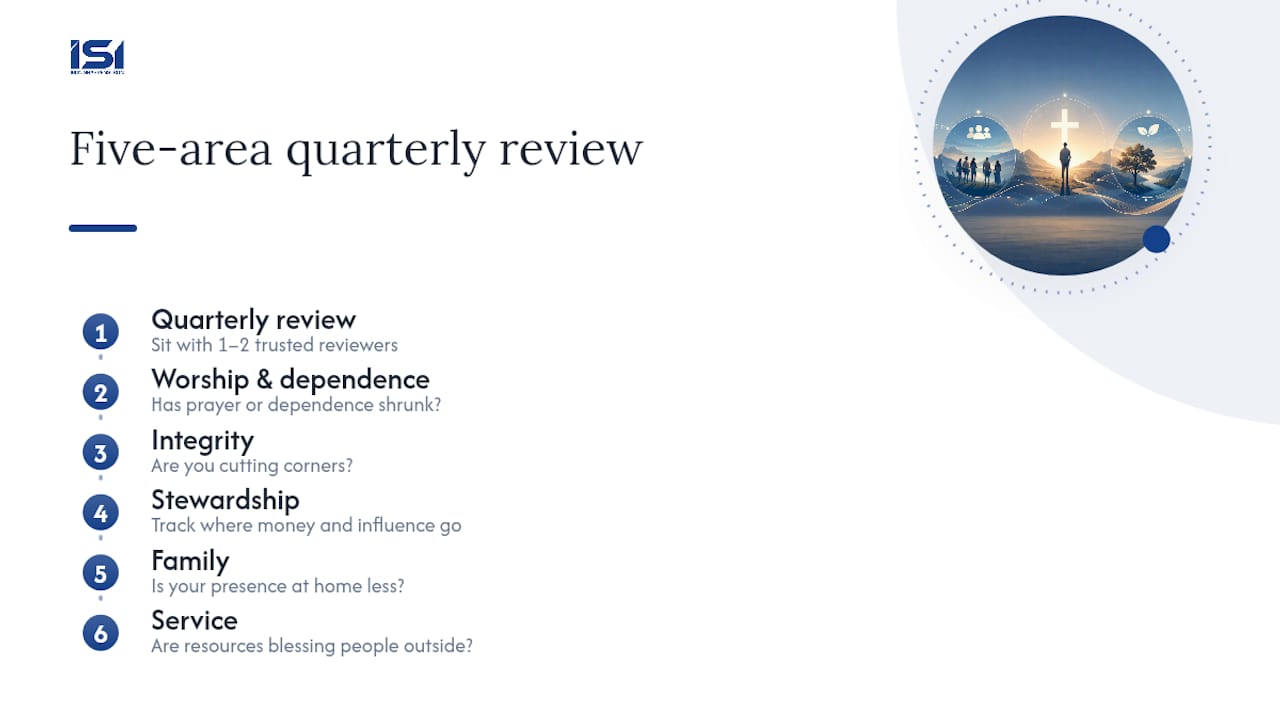
A single win rarely damages a life. What damages a life is the slow erosion that happens when nobody stops to check. The Gospel Coalition India's piece on the faithful stewardship of success recommends a structured review across five specific areas, run quarterly, or immediately after any major win.
Worship and dependence. Has your prayer life shrunk since the win? Do you still sense your need for God, or has confidence in your own judgment quietly replaced it?
Integrity. Are you cutting corners you wouldn't have cut a year ago? Would the people who know you best say your word still means what it used to mean?
Stewardship. Are you tracking where the money and influence actually go, or just assuming it's fine because there's more of it now?
Family. Has your presence at home shrunk in proportion to your success growing? Would your spouse and kids describe you as more available or less?
Service. Are you using your new resources, platform, or connections to bless people outside your immediate circle, or has everything gotten more insular?
Run this as a real conversation, not a checklist you fill out alone. Sit down with one or two people who have permission to push back, ideally the same people in your accountability structure, and go through all five areas out loud once a quarter. One especially useful discipline here comes from Ligonier's teaching on stewardship: build your accountability group so it includes someone who will always ask about family impact and someone who will always ask about financial stewardship, so you're never getting uniform affirmation from people who only see one slice of your life.
If two or more of the five areas come back weak, that's your signal to pause. Delay the next major decision, the next hire, the next expansion, until you've addressed what the review surfaced. Success has a way of making leaders feel like they can't afford to slow down. The five-area review exists precisely because that feeling is usually wrong.
What Goes Wrong Spiritually After a Big Win
Here's the pattern nobody warns you about: your beliefs don't change first. Your routines do. You still believe prayer matters. You just stop doing it as often. You still believe Sabbath matters. You just tell yourself this season is temporary and you'll rest once things settle down. The Enduring Word commentary on Deuteronomy 8 makes this exact point: leaders can hold orthodox beliefs while quietly letting prayer, confession, and honest counsel slip, and the drift is so gradual it rarely triggers alarm until real damage has already happened.
Watch for these warning signs once success arrives:
- You start narrating wins with "I" language and losses with "we" or "the market."
- Correction from your accountability group starts to feel like an inconvenience rather than a gift.
- Giving becomes reactive and emotional instead of following the plan you set earlier.
- Sabbath and family time are the first things to get sacrificed when the calendar fills up.
- You notice you're comparing your success to other people's instead of measuring faithfulness against what God actually gave you.
If you catch even one of these early, the correction is not complicated. Confess it, specifically, to someone who will hold you to it. Bring in outside counsel before you make your next major decision rather than after. Scale back your decision-making pace deliberately for a season. And revisit your generosity plan immediately, because reactivating a giving habit you let slip is far easier than trying to build one from scratch during your next windfall.
Daily and Weekly Habits That Keep Success Christ-Centered
Big spiritual corrections rarely happen in a single dramatic moment. They happen in small, repeated choices that either protect your rhythms or slowly trade them away.
- Start with a five-minute naming practice. Before your workday begins, name one specific thing you didn't create that contributed to your current success. John Piper's framing of business success, drawn from a Desiring God interview on glorifying God in business, centers on five postures: thankfulness, a sense of undeservingness, amazement, humility, and a joy that overflows into generosity toward others. That's a daily posture, not a one-time realization.
- Protect your Sabbath like you protect a client deadline. Growth pressure will always argue that this week is the exception. Treat one full day of rest as non-negotiable, and put it on the calendar before the rest of the week fills in around it.
- Set a weekly accountability call with two or three people who know your numbers, not just your headlines. Share what's actually happening in your business, your marriage, and your prayer life, not a curated highlight reel. Ask them directly whether they've noticed any drift in you.
- Automate your giving plan so it runs whether you feel generous that month or not. Piper's point about choosing your goals before pursuing success applies directly here: decide your giving percentage in a calm season, then let the plan execute itself during a hectic one.
Pro Tip: Put your accountability call on the calendar with the same priority as a board meeting. If it's the first thing that gets rescheduled when things get busy, it will eventually disappear entirely, right when you need it most.
How ISi Brotherhood Helps Leaders Steward Success Well
Reading about accountability is easy. Building it is harder, especially once success starts filling your calendar with people who want something from you rather than people who'll challenge you. That's the exact gap ISi Brotherhood exists to close.
Every ISI member gets placed into a Personal Board of Advisors, a small group of Christian men who meet consistently to press into five specific areas of life: personal, spiritual, relational, professional, and financial. It's the same instinct behind the five-area review above, except it's built into a weekly rhythm instead of something you have to remember to schedule yourself.
If you want to go deeper on the ground this article covers, a few resources worth reading next:
- Biblical decision making for how to pause and think clearly before your next major move.
- Biblical leadership principles for the character-and-competence balance Joseph modeled.
- Christian financial stewardship for building your giving plan before the next windfall lands.
Why the Conventional Advice on Success Falls Short
Most advice on handling success well tells you to "stay humble" and leaves it there. That's not wrong, it's just useless as a plan. Humility isn't a feeling you summon on command. It's a byproduct of specific practices: naming your dependence on God out loud, submitting your calendar to people who'll ask hard questions, and setting your generosity before you're emotionally compromised by a big number in your account.
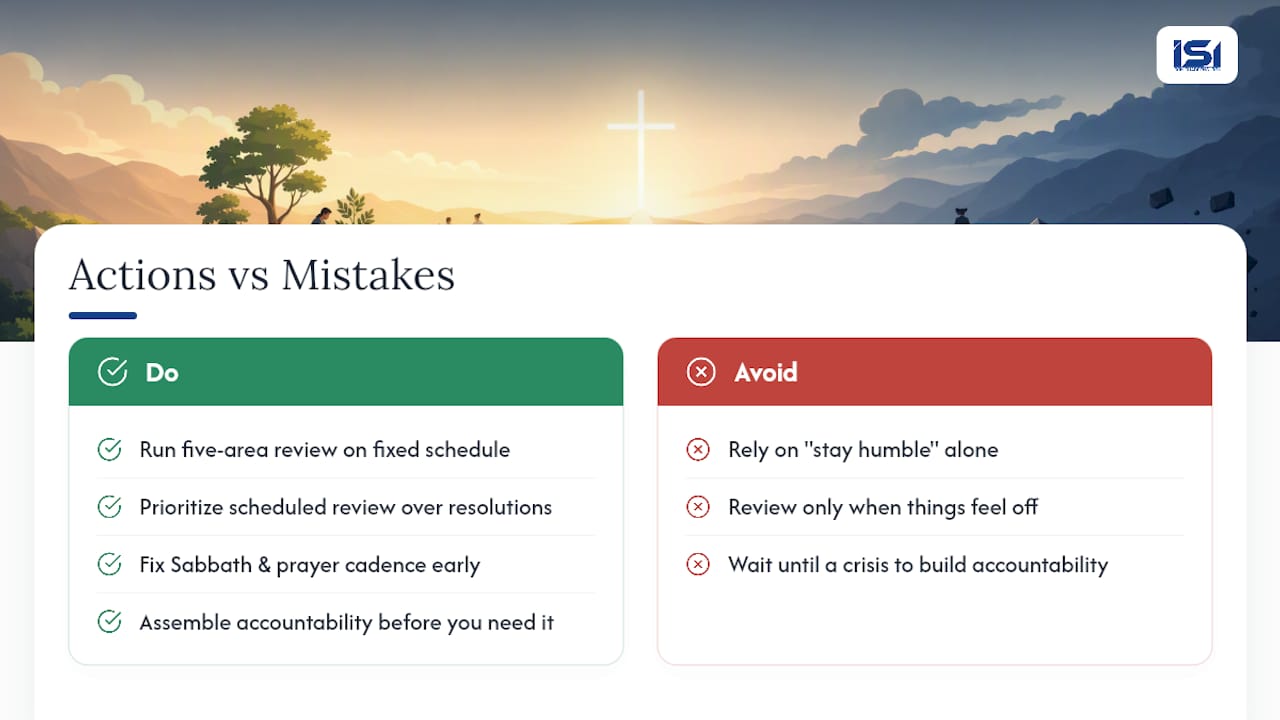
What the research behind this article actually supports is narrower and more actionable than most success advice admits. Run the five-area review on a fixed schedule, not "whenever things feel off," because by the time things feel off, the drift is already old. Fix your cadence early of Sabbath and prayer before growth pressure hits, not after, because reduced routines almost always precede changed beliefs, not the other way around. And get the right men in the room before you need them. Waiting until a crisis to build accountability is like buying insurance after the accident.
If you take one thing from this, prioritize the review over the resolution. Good intentions fade. A scheduled, structured checkpoint with people who have permission to push back does not.
— Derek
Find Structured Accountability Built for Christian Leaders
Most men trying to steward success well end up doing it alone, piecing together a mentor here, an accountability partner there, hoping it holds when the pressure is highest. A different kind of accountability group offers members a Personal Board of Advisors designed to make confidentiality clear from day one and support a weekly rhythm of honest conversation across personal, spiritual, relational, professional, and financial life.

If you're a business owner, entrepreneur, or executive who wants exactly what this article describes, real accountability across all five review areas, not just business talk, ISI Community at $97 per month gives you weekly mastermind access and a Personal Board of Advisors built for that purpose. Leaders who want a deeper level of engagement can look at ISI Mastermind at $650 per month, which places you in more intensive Personal Board relationships and structured accountability. Either way, the first step is simple: visit the ISI Community page and see which fit matches where you are right now.
Sources
- Enduring Word commentary on Deuteronomy 8
- The Gospel Coalition — The biblical meaning of success
- The Faithful Stewardship of Success — The Gospel Coalition (India)
- How to glorify God in business success — Desiring God interview
- Ligonier learning — Gospel and stewardship
FAQ
What Is a Powerful Bible Verse About Success?
Joshua 1:8 ties success directly to obedience: meditating on and doing what God's word says leads to genuine prosperity. Deuteronomy 8:18 pairs well with it, reminding readers to "remember the Lord your God, for it is he who gives you the ability to produce wealth."
What Are the Biblical Principles of Success?
The core principles are remembering God as the source, treating resources as entrusted rather than owned, pairing character with competence, planning generosity in advance, and staying inside real accountability. The Gospel Coalition's teaching on the biblical meaning of success frames all of it around faithful stewardship of what's been entrusted to you, not accumulation for its own sake.
What Did Jesus Say About Success?
Jesus never measured success by accumulation. In the Parable of the Talents, He praised faithful use of entrusted resources over mere preservation of them, and in Luke 12's Parable of the Rich Fool, He warned that hoarded wealth without being "rich toward God" is spiritual foolishness.
How Should Christians Handle Ambition Versus Contentment?
Ambition and contentment aren't opposites in Scripture; Paul pursued demanding, faithful work while writing from prison that he'd learned to be content in any circumstance. Handling success biblically means pursuing excellence while keeping your identity anchored in Christ rather than in outcomes. A closer look at what the Bible says about ambition unpacks that balance further.
What's the First Practical Step After a Big Win?
Pause before making your next major decision and run a five-area review covering worship, integrity, stewardship, family, and service, ideally with someone in your accountability circle. Programs like ISI Community build that kind of weekly review directly into a Personal Board of Advisors, so it happens on schedule rather than only in a crisis.