

A mastermind is a small, recurring peer group that improves decisions through structured feedback, mutual accountability, and confidentiality. That's how masterminds work at the mechanical level: a handful of people commit to meeting on a fixed cadence, one member takes the "hot seat" to present a real challenge, the group responds with questions and counsel, and everyone leaves with a commitment they'll report on next time.
Three elements make the engine run:
- Recurring rhythm — the group meets on a schedule members can count on, not "whenever it works."
- Structured format — a hot seat and agenda keep the conversation focused instead of drifting into small talk.
- Accountability loop — you declare what you'll do, and next meeting you report whether you did it.
The people who benefit most are those craving candid feedback from peers who have no stake in flattering them.
Key Takeaways
A mastermind works when a small, curated group meets on a fixed rhythm, uses a structured hot seat format, and holds members accountable to stated commitments in a confidential setting.
| Point | Details |
|---|---|
| Keep groups small | Aim for 4 to 10 members meeting monthly or biweekly for 1 to 2 hours per session. |
| Protect the hot seat | Enforce questions before advice and use a visible timer to keep participation balanced. |
| Treat accountability as the engine | Commitments stated aloud and reviewed next meeting drive far more follow-through than inspiration alone. |
| Run a trial cycle first | Test chemistry over roughly six sessions before anyone commits long-term. |
| Review quarterly | Track commitment completion and satisfaction to catch drift before it becomes dropout. |
Table of Contents
- How Masterminds Work: What They Are (and What They Aren't)
- Why Masterminds Actually Produce Results
- What a Mastermind Meeting Actually Looks Like
- How to Join or Start a Mastermind
- The Ground Rules That Keep a Mastermind Healthy
- What to Expect and When
- Common Failure Points and How to Fix Them
- How Isibrotherhood Puts the Mastermind Model Into Practice
- Ready to Join a Group Built for Accountability?
- What the Research Actually Supports
- Sources
How Masterminds Work: What They Are (and What They Aren't)
The term traces back to Napoleon Hill, who described the "Master Mind" principle in his early 20th century writings on coordinated effort between people pursuing a shared purpose. Modern groups have kept the spirit but sharpened the mechanics: structure, rules, confidentiality, and continuity now define a functioning mastermind far more than any motivational framing does.
A mastermind is not a support group, where the goal is emotional validation. It's not coaching, where one expert directs a client. And it's not networking, where the point is expanding contacts. A mastermind sits in its own category: peers of roughly similar standing who exchange direct feedback and hold each other to commitments.
Groups take different shapes:
- Peer-led groups rotate leadership among members with no outside facilitator.
- Facilitated groups hire or appoint someone to run the agenda and enforce time limits.
- In-person groups trade convenience for depth; virtual groups trade some intimacy for reach.
Statistic Callout: Best-practice guidance points to groups of 4 to 10 members, meeting monthly or biweekly for 1 to 2 hours per session. Smaller than four and you lose diversity of perspective; larger than ten and the hot seat time per person shrinks past the point of usefulness.
Size and rhythm aren't arbitrary. A group of six meeting monthly for 90 minutes gives each member roughly 15 minutes of dedicated attention when it's their turn, enough to unpack a real problem without turning the meeting into a marathon.
Why Masterminds Actually Produce Results
Masterminds work because they combine three forces solo effort can't replicate: collective intelligence, external accountability, and psychological safety. Strip out any one of the three and the group degrades into either a chat group or an advice column.
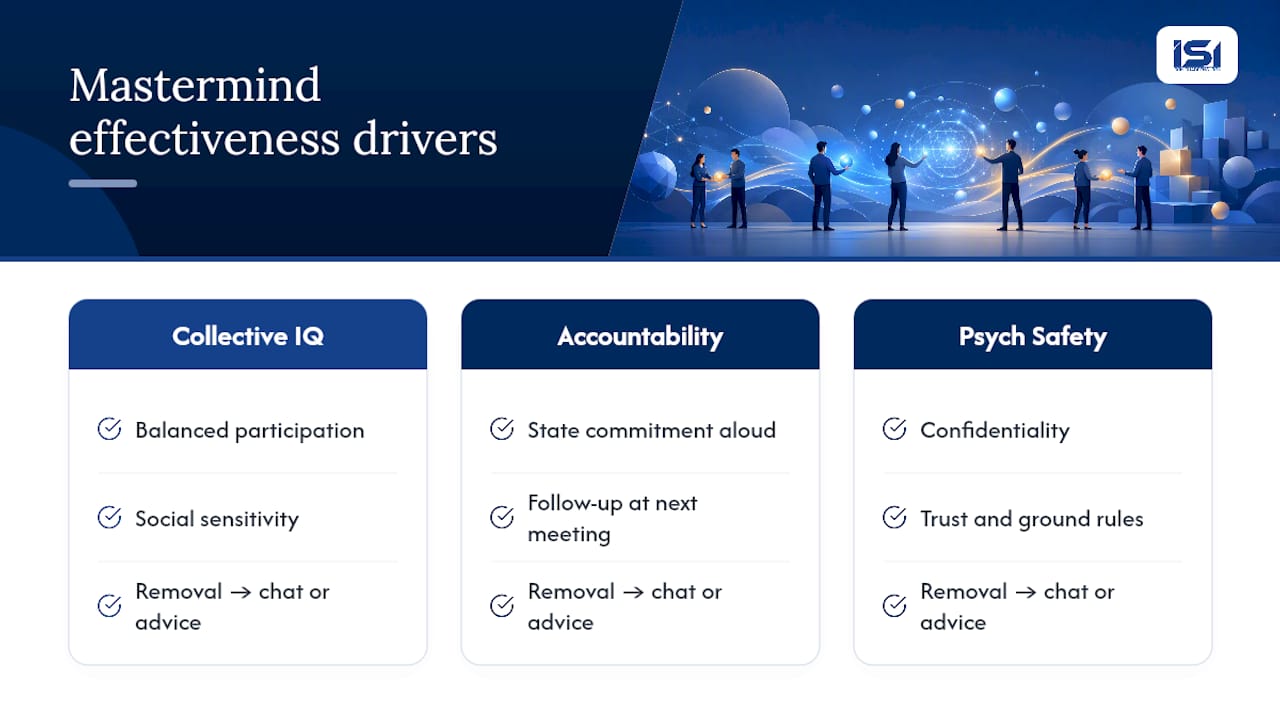
Collective intelligence isn't about stacking the room with the smartest people available. Research on group performance suggests balanced participation and social sensitivity predict outcomes better than raw credentials — a group where everyone talks and listens in roughly equal measure outperforms one dominated by its loudest voice, regardless of who's smartest on paper.
The accountability loop is simple but unforgiving: you state a commitment out loud, and at the next meeting, someone asks whether you did it. That single mechanism, repeated across months, is what separates a mastermind from a nice conversation you had once.
None of this works without psychological safety. Members won't surface real problems, admit failures, or ask for blunt feedback in a room where they fear judgment or leaks. Confidentiality isn't a nicety here; it's the precondition for candor. A commentary on mastermind teams in professional settings notes that ground rules and engagement practices specifically designed for psychological safety matter most for leaders who otherwise feel isolated in their roles.
The evidence isn't just theoretical. A formal study of an online mastermind-style faculty development program found participants rated the experience 9.4 out of 10, and 78.6% called it very valuable. That's a rare case of a soft, relationship-driven format producing hard, measurable satisfaction data.
What a Mastermind Meeting Actually Looks Like
A working mastermind meeting isn't a free-form conversation. It runs on a repeatable agenda that protects everyone's time and keeps the group from spiraling into whoever talks loudest.
- Quick wins (10 minutes). Each member shares one win since the last meeting. This isn't small talk. It builds momentum and surfaces progress worth celebrating.
- Updates (20 minutes). Brief round of what's changed, what's stuck, and what's coming up for each member.
- Hot seat (45 minutes). One or two members present a specific challenge. The group asks clarifying questions first, then offers direct feedback.
- Commitments (15 minutes). Each member states exactly what they'll do before the next meeting.
That 90-minute structure with firm time blocks is the closest thing the mastermind world has to a standard template, and it works because the timing forces discipline nobody would enforce on themselves.
The hot seat has its own internal rule that gets skipped more often than it should: questions before advice. The group must understand the actual problem before offering solutions. Jumping straight to advice almost always means solving the wrong problem, because the presenter hasn't finished explaining the real one yet. A practical facilitation tip worth adopting verbatim: no one gives advice until the presenter has answered at least two clarifying questions.

Facilitation matters as much as the agenda. A single designated facilitator keeps consistency but can create dependency. Rotating facilitation spreads ownership and prevents one voice from steering every session, though it takes longer for a new facilitator to find their rhythm.
Pro Tip: Keep a visible timer during the hot seat. Groups that skip this almost always let the loudest or most articulate member eat into everyone else's time, and resentment builds long before anyone says something.
Format varies by context. Retreat-based masterminds might run a single extended hot seat over a full day instead of four rotating slots. Hybrid groups meet virtually most months but gather in person once or twice a year, trading some flexibility for deeper trust built face-to-face.
How to Join or Start a Mastermind
Finding an existing group starts with asking pointed questions before you commit. Ask about attendance history, how long the group has run, what happens when someone misses three meetings in a row, and whether members are at a similar stage to you. A mismatch in experience level is one of the fastest ways a mastermind stalls, since alignment on stage and challenges produces sharper, more usable advice than a room full of wildly different business sizes.
If no group fits, building one follows a clear sequence:
- Write a purpose statement. Define who this group serves and what problem it solves that a coach or networking event doesn't.
- Set membership criteria. Decide on industry, stage, revenue range, or values alignment. Vague criteria produce mismatched groups.
- Define the commitment level. Weekly, biweekly, or monthly. In person, virtual, or hybrid. State it upfront so no one joins under false pretenses.
- Run a trial cycle. A short run of roughly six sessions lets everyone test chemistry before anyone commits long-term.
Pricing shapes vary widely. Peer-run groups are often free, with members simply agreeing to show up and contribute. Facilitated groups typically charge for the organizer's time, curation, and structure. Neither shape is inherently better. The free version demands more self-discipline from members; the paid version outsources structure and accountability to someone whose job is to enforce it.
Your first three meetings set the tone for everything after:
- Meeting one: introductions, purpose statement, and ground rules.
- Meeting two: first full hot seat rotation to test the format.
- Meeting three: honest check-in on whether the group's rhythm and chemistry are working, with room to adjust before habits calcify.
The Ground Rules That Keep a Mastermind Healthy
A mastermind lives or dies by a short list of enforceable rules, not by good intentions. Skip these and even a group of talented, well-meaning people will quietly fall apart within a few months.
- Confidentiality is absolute. What's said in the group stays in the group, full stop.
- No pitching. Members aren't there to sell each other products or services.
- Attendance is a commitment, not a suggestion. Chronic absence erodes trust faster than almost anything else.
- Reciprocity is expected. Everyone gives feedback, not just the people who happen to be confident speaking up.
Selection criteria matter just as much as the rules. Members should be at a similar stage or slightly ahead of each other, bring genuinely different perspectives rather than an echo chamber, and show demonstrated follow-through before joining, not just interest.
Trust signals worth checking before you join any group: does the facilitator have real credentials or a track record running groups, is there a documented agenda instead of an improvised conversation, and can current or former members speak to actual outcomes rather than vague enthusiasm.
What to Expect and When
The first one to three months typically produce clearer next steps and small, concrete wins rather than dramatic transformation. Members report better decision clarity almost immediately, since a room full of engaged peers is faster at spotting blind spots than a solo brainstorm ever will be.
By month three to twelve, results shift toward completed commitments and measurable progress on specific projects or metrics. This is also roughly when groups that survive move past the storming phase into norming and performing, the stage where trust and productivity both climb.
A handful of simple metrics tell you whether a group is actually working:
| Metric | What it reveals |
|---|---|
| Percent of commitments completed | Measures whether accountability is real or just theater |
| Member satisfaction score | Simple post-meeting rating flags disengagement early |
| Concrete changes reported | Business or personal shifts members can point to directly |
| Attendance consistency | Dropping attendance almost always signals a deeper problem |
A quarterly review, where the group pauses to ask what's working and what isn't, keeps the format from calcifying into a routine nobody questions anymore.
Common Failure Points and How to Fix Them
Every mastermind eventually shows strain. The symptoms are predictable: attendance drops off, one or two members dominate every hot seat, the group's original purpose quietly drifts, or someone breaks confidentiality and trust never fully recovers.
- Dwindling attendance usually means the schedule doesn't fit real life or the value isn't clear anymore. Fix it with a renewal conversation, not silence.
- Domination by a few voices calls for a strict timer and rotating facilitation to redistribute airtime.
- Mission drift happens when new members join without matching the original purpose statement. Screen harder, not looser.
- Confidentiality breaches are the fastest way to kill a group. There's rarely a second chance worth taking here.
Pro Tip: Build a renewal window into the group's design from day one, every six or twelve months, where members explicitly recommit or gracefully exit. It turns an awkward "should I leave?" conversation into a built-in checkpoint nobody has to initiate alone.
If a group has lost its purpose beyond repair, sunsetting it cleanly is healthier than limping along on inertia.
How Isibrotherhood Puts the Mastermind Model Into Practice
Isibrotherhood runs on the same mechanics described above, built specifically for Christian men leading businesses, teams, and families. Instead of a single large group, every member is placed into a Personal Board of Advisors, a small, curated group of men who meet weekly rather than monthly, covering five areas most masterminds never touch together: personal, spiritual, relational, professional, and financial.
That weekly cadence matters. It shortens the accountability loop from a month to seven days, which means commitments get tested and reported far more often than in a typical peer group.
Isibrotherhood's structure includes:
- Personal Board of Advisors — a small group matched for stage and life circumstance, not just industry.
- Weekly mastermind meetings — a tighter accountability rhythm than the monthly norm.
- Year-round online community — continuity between meetings instead of a cold restart each time.
- Leadership events — in-person and virtual gatherings that deepen trust beyond the weekly call.
Selection and confidentiality aren't afterthoughts here. Placement into a Personal Board of Advisors is deliberate, matching men on stage and circumstance the same way any well-run mastermind screens for alignment, with confidentiality treated as foundational rather than optional....
Ready to Join a Group Built for Accountability?
If you've read this far, you already understand what separates a mastermind that works from one that fizzles: structure, confidentiality, and a rhythm nobody skips. Isibrotherhood was built around exactly that model, with weekly meetings instead of monthly ones and a Personal Board of Advisors matched to your stage of life and business. If you're a Christian business owner or executive looking for that kind of structured, faith-grounded accountability, explore membership with Isibrotherhood and see whether a Personal Board of Advisors fits where you are right now.
What the Research Actually Supports
Most advice on masterminds oversells inspiration and undersells mechanics. The research doesn't back that emphasis. What actually predicts whether a group works is boring by comparison: a firm meeting cadence, a timer nobody ignores, and a confidentiality rule that's never tested. Groups fail not because members lack ambition but because nobody enforced the structure once the novelty wore off.
The conventional advice to "find your tribe" undersells screening. Alignment on stage and circumstance matters more than shared passion, and it's the piece most people skip when they're excited to start a group with friends.
If you're evaluating a mastermind, or building one, prioritize the agenda and the rules before you worry about who's in the room. A mediocre group with strict structure will outperform a brilliant group with none, because structure is what survives the sixth meeting, when enthusiasm alone rarely does.
— Derek