

The fastest path to finding a mastermind is a warm referral from a mentor, investor, or trusted peer. If no one in your network can make that introduction, targeted searches on Meetup, LinkedIn, and vetted organizations like the Entrepreneurs' Organization (EO) or Isibrotherhood are your next best moves. Your single action in the next 24 hours: message three people in your network and ask, "Do you know anyone in a mastermind I should talk to?"
The highest-quality groups rarely advertise openly. Warm referrals and deliberate networking are the most reliable way to find them, which is why that first message matters more than any Google search.
Here is what to do after you send it.
Key Takeaways
Finding the right mastermind requires clarity about your goals, deliberate outreach through warm referrals, structured vetting, and the willingness to build your own group if no existing one fits.
| Point | Details |
|---|---|
| Start with warm referrals | Message three trusted peers in the next 24 hours; warm intros bypass vetting and shorten the search to 1–4 weeks. |
| Match by stage, not just industry | Revenue-stage alignment is one of the strongest predictors of a group's usefulness, especially for B2B founders. |
| Vet before you commit | Attend at least one guest session, ask for member profiles, and test-drive two groups before signing up. |
| Build your own if needed | Recruit 4–8 peers, codify operating rules on day one, and run your first three meetings with a defined agenda. |
| Isibrotherhood (ISI) | A structured Christian men's business mastermind placing members into weekly Personal Boards of Advisors — a strong fit for faith-centered accountability. |
Table of Contents
- How to decide what you want from a mastermind
- Where can you find existing mastermind groups?
- How do you evaluate a mastermind before joining?
- What does a mastermind typically cost, and how long will it take to find one?
- How to start your own mastermind if you can't find the right fit
- Is Iron Sharpens Iron (ISI) the right mastermind for you?
- How to network your way into a personal introduction
- How to read a group's culture before you commit
- How to stay accountable and engaged after you join
- Virtual, in-person, and hybrid: which format works best?
- Why the right mastermind is a strategic decision, not a social one
- A mastermind built for Christian business men
- Sources
How to decide what you want from a mastermind
Before you search, get clear on what you actually need. A group built around accountability looks very different from one built around deal flow or spiritual growth. Showing up without clarity wastes your time and theirs.
Ask yourself these questions first:
- Primary goal: Do you want strategic advice, peer accountability, referrals, faith-based growth, or executive-level coaching?
- Member fit: Are you looking for peers at a similar revenue stage, business model, or industry? Groups with a small number of members tend to produce the most honest, useful conversations.
- Format and cadence: Can you commit to weekly virtual sessions, monthly in-person meetings, or a hybrid model with quarterly retreats?
- Time and money: Beyond the meeting itself, factor in prep time, between-meeting platform activity (Slack, Circle, or a private forum), and any retreat travel.
Pro Tip: Ask the organizer for a recent anonymized member profile or the group's last retreat agenda. Most serious groups will share this without hesitation. If they deflect or pivot to a sales pitch, that tells you everything.
Where can you find existing mastermind groups?
Finding a quality mastermind takes deliberate effort across multiple channels. Here is a prioritized list, starting with the highest-yield sources.
Warm referrals first
Ask mentors, investors, board members, and close peers directly. A warm introduction bypasses the vetting process that cold applicants face and signals to the group that you come endorsed. When asking, be specific: "I'm looking for a peer mastermind of a few business owners at a mid-range revenue stage. Do you know anyone running or in a group like that?"
Vetted organizations and associations
EO (Entrepreneurs' Organization) and YPO (Young Presidents' Organization) both run structured peer groups with formal vetting. Industry trade associations often host informal mastermind-style cohorts at their annual conferences. These organizations do the curation work for you, which is worth the membership cost if you qualify.
Online platforms
- Meetup: Search "mastermind" plus your city or "online" and filter by upcoming events. Attending one session as a guest is a low-risk way to evaluate fit.
- Eventbrite: Search "mastermind" plus your industry or niche. Many paid programs use Eventbrite for their intake events.
- LinkedIn: Use the advanced search to find people with "mastermind" in their activity, then look for shared connections who can introduce you. LinkedIn Groups with active moderation are another signal of a serious community.
- Facebook Groups and Circle communities: Search your niche plus "mastermind" or "accountability group." Look for active moderation, a vetting process, and a low signal-to-noise ratio — those three signals separate real communities from ghost towns.
Conferences and retreats
The attendee list at a niche conference is a pre-filtered pool of potential mastermind peers. Identify two or three people you'd want in your group before you arrive, have real conversations, and follow up within 48 hours with a specific ask. Converting a conference connection into a mastermind invite takes one honest conversation, not a formal pitch.
Niche paid communities
Membership platforms built around a specific audience (e-commerce founders, SaaS operators, Christian business owners) often spawn organic mastermind cohorts. Look for a published code of conduct, active moderators, and evidence that members actually help each other.
How do you evaluate a mastermind before joining?
Effective vetting focuses on member quality, group structure, facilitator competence, confidentiality, and total all-in cost — not just the monthly fee. Use this checklist before you commit.
Core evaluation checklist:
- Member quality and stage alignment (are they solving problems you'll face in 12–24 months?)
- Facilitator role (is there one, and do they enforce structure?)
- Confidentiality norms (is there a signed agreement or a clear spoken covenant?)
- Meeting format (hot seat, open discussion, or structured agenda?)
- Accountability mechanisms (do members track goals between sessions?)
- Total all-in cost (dues + retreat fees + travel + tools)
Sample questions to ask organizers or members:
- What does a typical meeting look like, start to finish?
- How do you handle a member who stops showing up?
- Can you share an example of a real outcome a member achieved in the last six months?
- What happens if two members become direct competitors?
- How is confidentiality enforced?
Red flags to watch for:
- High-pressure upsells during the sales call
- Vague promises about "transformation" with no concrete member outcomes
- No defined meeting structure or facilitator
- Poor attendance history or frequent roster changes
- Reluctance to let you attend a guest session before committing
Paid, curated programs tend to attract more serious members because financial commitment filters out casual participants. That said, price alone is not a quality signal. Attend at least one guest session and test-drive two groups before you decide.
What does a mastermind typically cost, and how long will it take to find one?
Pricing varies widely, and the range reflects real differences in curation, facilitation, and access.
Common pricing models:
- Free to $50/month: Informal peer groups, self-organized, no facilitator. High variance in quality.
- $100–$500/month: Structured programs with a facilitator, defined format, and some member vetting. The most common range for serious peer masterminds.
- $500–$1,000+/month: Premium curated programs with application processes, skilled facilitation, and often quarterly retreats. Members who pay at this level tend to show up and participate.
- Retreats: Usually charged separately, ranging from a few hundred dollars for a local day event to several thousand for a multi-day destination retreat.
Realistic timelines:
- Warm-referral path: 1–4 weeks from first message to guest session.
- Targeted search and applications: 4–8 weeks, especially for B2B founders matching by revenue stage.
- Building your own cohort: 4–12 weeks from first outreach to first meeting.
Quick budgeting checklist: Add up monthly dues, estimated annual retreat costs, any platform or tool subscriptions, and the value of your time in meetings and prep. That is your true all-in number.
How to start your own mastermind if you can't find the right fit
Building a mastermind from your own network with clear operating rules is a reliable path when no existing group fits. Here is how to do it in a month.
- Identify 6–10 candidates from your network, events, and LinkedIn. Aim for peers at a similar stage who are not direct competitors.
- Send a short recruiting message that names the format, time commitment, and what you're looking for in members. Keep it to three sentences. Specificity converts better than a vague "want to start a mastermind?" ask.
- Hold a founding call with the 4–6 people who say yes. Agree on mission, confidentiality covenant, meeting cadence, hot-seat format, attendance policy, and how shared costs will be split.
- Run your first three meetings with a clear agenda:
- Kickoff: Introductions, goal-sharing, and ground rules.
- First hot seat: One member presents a real challenge; others advise.
- Accountability check-in: Each member reports on commitments made at the last session.
- Set up your tools: Zoom or Teams for meetings, a shared Google Doc or Notion workspace for goals and notes, and Slack or Circle for between-meeting accountability.
- Plan for growth: When the group's chemistry shifts or someone outgrows the cohort, spin off a new group rather than forcing the original to stretch. Small, tight groups outlast large, loose ones.
Pro Tip: A founding cohort that codifies its operating rules in writing creates psychological safety from day one. One page is enough. Skip this step and you will spend the first six months negotiating norms instead of doing real work.
Is Iron Sharpens Iron (ISI) the right mastermind for you?
For Christian business owners, executives, and entrepreneurs who want faith-centered accountability alongside real business strategy, Iron Sharpens Iron (ISI) is a purpose-built option worth examining closely.
ISI places every member into a Personal Board of Advisors — a small, trusted cohort of Christian men who meet weekly to challenge and support one another across five areas: personal, spiritual, relational, professional, and financial. Beyond the weekly mastermind meeting, members access a year-round online community, leadership events (virtual and in-person), and the ISI Brotherhood Foundation.
ISI fits you best if:
- You are a Christian man who owns a business, leads a team, or holds an executive role.
- You want a group that holds you accountable in your faith and your finances simultaneously.
- You value a structured weekly rhythm over a loose monthly check-in.
- You are looking for men who will speak truth into your blind spots, not just affirm your plans.
Questions to ask ISI specifically:
- How are cohorts formed, and how is member vetting handled?
- What is the confidentiality covenant, and how is it enforced?
- What are the full membership costs, including any retreat or event fees?
- Can I attend a guest session before committing?
How to network your way into a personal introduction
Cold applications to masterminds have a low conversion rate. A warm introduction from a mutual connection changes the dynamic entirely. Here is how to engineer those introductions deliberately.
Start by mapping your second-degree network. On LinkedIn, search for people who list "mastermind" in their activity or bio, then check for shared connections. A single mutual contact who can vouch for you is worth more than a polished cold message.
At events and conferences, shift your goal from collecting contacts to having three or four real conversations. Ask people what peer groups they belong to and whether those groups ever accept guests. Most people are flattered to be asked and willing to make an introduction if you have shown genuine interest in their work.
Follow up within 48 hours with a specific, low-friction ask: "Would you be open to introducing me to the organizer?" That is easier to say yes to than "Can you get me in?"

How to read a group's culture before you commit
The formal evaluation checklist tells you what a group does. Culture tells you whether you will actually grow there. These two things are not the same.
Sit in on a guest session and watch how members respond when someone shares a real struggle. Do they offer honest feedback, or do they default to encouragement that avoids the hard truth? A group that cannot hold tension is a group that cannot produce growth.
Notice who talks most. If one or two voices dominate every session, the facilitator is either absent or ineffective. The best groups distribute airtime deliberately, and members leave feeling heard rather than lectured.
Pay attention to what members celebrate. Groups that celebrate revenue milestones exclusively tend to neglect the personal and relational dimensions that make a mastermind sustainable. Groups that celebrate hard decisions, honest admissions, and course corrections are usually the ones worth staying in.
How to stay accountable and engaged after you join
Joining is the easy part. Staying engaged when business gets demanding is where most members drift.
Set a personal commitment threshold before your first meeting: what is the minimum level of participation you will hold yourself to, regardless of how busy things get? Write it down. Share it with the group. That act of public declaration is one of the most reliable accountability mechanisms available.
Between meetings, use whatever platform the group runs on to post one update per week, even a short one. Visibility between sessions keeps you present in the group's mind and makes the next meeting more productive because members already know your context.
When you are the one in the hot seat, bring a real problem, not a polished presentation. The members who get the most from their groups are the ones willing to be genuinely vulnerable about what is not working. That kind of honesty is what separates a mastermind from a networking event.
Virtual, in-person, and hybrid: which format works best?
Each format has a distinct trade-off, and the right choice depends on your schedule, your location, and how you build trust.
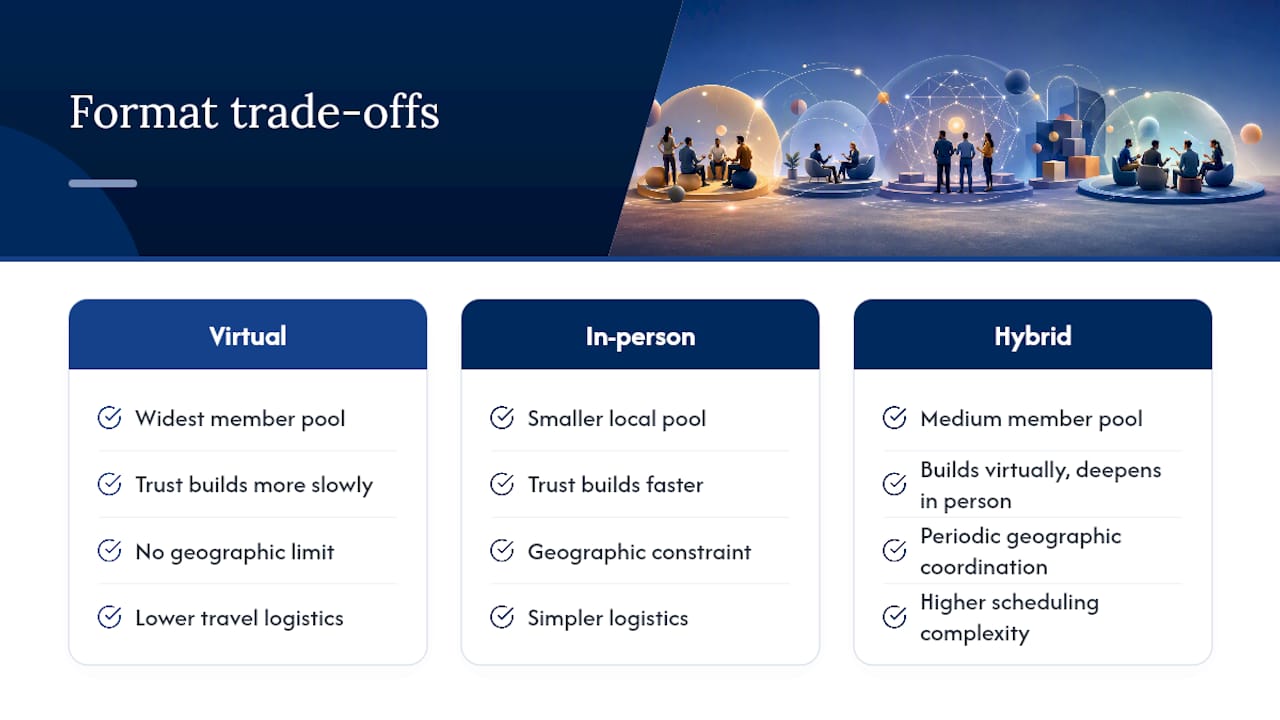
Virtual masterminds offer the widest possible member pool. You can join a group of peers from across the country or the world, which matters when your niche is narrow. The trade-off is that relationship depth builds more slowly over video, and it is easier to disengage when life gets busy. Strong facilitators and consistent between-meeting communication compensate for this.
In-person masterminds build trust faster. Shared meals, face-to-face conversations, and body language create a relational depth that video rarely matches. The constraint is geography: your member pool shrinks to whoever is within a reasonable drive, which can limit the quality of peer matching.
Hybrid models attempt to capture both advantages. A group might meet virtually every month and gather in person for a quarterly retreat. This format tends to work well for groups that have already established trust virtually and want to deepen it periodically. The logistical complexity is real, though: coordinating travel and schedules for even a small group requires planning months in advance.
The format matters less than the people in the room, virtual or otherwise. A mediocre group in person is still a mediocre group.
Why the right mastermind is a strategic decision, not a social one
Most entrepreneurs treat finding a mastermind the way they treat attending a networking event: casually, opportunistically, and without a clear standard for what they are looking for. That approach produces casual results.
The entrepreneurs who grow fastest inside a mastermind are the ones who treated the search like a hiring decision. They defined what they needed, vetted multiple options, attended guest sessions, asked hard questions, and walked away from groups that did not meet the bar. They understood that the wrong group is not neutral — it costs time, money, and the opportunity cost of not being in the right one.
A mastermind is not a nice-to-have. It is a peer board of directors for your life and business. Treat the selection process accordingly.
A mastermind built for Christian business men
If you are a Christian business owner, executive, or entrepreneur who wants more than a peer group — who wants brothers who will speak truth into your faith, your family, and your finances — Isibrotherhood is built for exactly that. Every member is placed into a Personal Board of Advisors: a small cohort of vetted Christian men who meet weekly, hold each other accountable across all five dimensions of life, and show up with the kind of honesty that most professional networks never reach.
Unlike a general mastermind where faith is an afterthought, ISI integrates biblical wisdom and business strategy from the first meeting. The weekly rhythm, year-round online community, and leadership events mean you are never more than a few days from your group. No cold applications to anonymous programs. No guessing whether the culture fits.
Request a guest session and see whether ISI is the right room for you.
Sources
A short list of resources to visit as you continue your search:
- How to Find a Mastermind Group and Build Your Network
- How to Find a Peer Mastermind Group for B2B Founders - Success Knocks | The Business Magazine
- How to Use a Mastermind Group to Grow Your Small Business (A Plain-English Guide) - Hustler's Library
- Mastermind Groups: What to Look for in a Paid Professional Program