

Integrity in business means your promises, your daily decisions, and the systems around you all point the same direction. When they do, trust rises and risk falls. This isn't a soft value to post on a break room wall. It's the operating discipline that determines whether your best people stay, whether customers renew, and whether a crisis breaks you or barely bends you.
TL;DR:
- Building a culture of integrity requires aligning individual conduct, decision-making, and organizational systems to reinforce trust and reduce risk.
- Visible systems such as transparent decision logs, promise ledgers, and enforceable codes of conduct significantly strengthen integrity beyond mere compliance.
- Social media and AI increasingly expose internal decisions to public judgment and highlight the need for consistent, defensible practices under pressure.
- Peer accountability through regular, honest discussions about commitments and behaviors is essential to sustain integrity over time.
- Leaders should start small by implementing one accountability practice weekly, with external peer groups like Isibrotherhood aiding in consistent enforcement.
Table of Contents
- What Integrity in Business Actually Means
- Why Integrity Matters More Than Most Leaders Admit
- The Core Principles That Show Integrity in Action
- Building Systems That Make Integrity Repeatable
- A 90-Day Checklist for Operationalizing Integrity
- Why Peer Accountability Changes the Outcome
- The Legal Ground Rules Behind Business Integrity
- How AI and Social Media Are Reshaping Business Integrity
- Leading Integrity as a Daily Habit, Not a Policy
- An Honest Next Step for Leaders Who Want Real Accountability
- Sources
What Integrity in Business Actually Means
Integrity gets confused with honesty, ethics, and compliance so often that the words practically blur into one. They aren't the same thing, and the difference changes how you lead.
Honesty is telling the truth in a single moment. Compliance is following the rules someone else wrote. Integrity is consistency between what you say, what you do, and what your systems reward, sustained across many moments when nobody's checking. A salesperson can be honest about a product's flaws and still work inside a company whose incentive structure quietly punishes that honesty. That's a compliance culture without integrity.
Think of it as a three-part model:
- Individual conduct — does this person's behavior match their stated values under pressure, not just in comfortable moments?
- Consistent decision-making — do similar situations get similar treatment, or does the answer depend on who's asking?
- Organizational systems — do policies, incentives, and reporting channels reinforce the stated values, or quietly undercut them?
Miss any leg of that stool, and the whole thing wobbles.
Why Integrity Matters More Than Most Leaders Admit
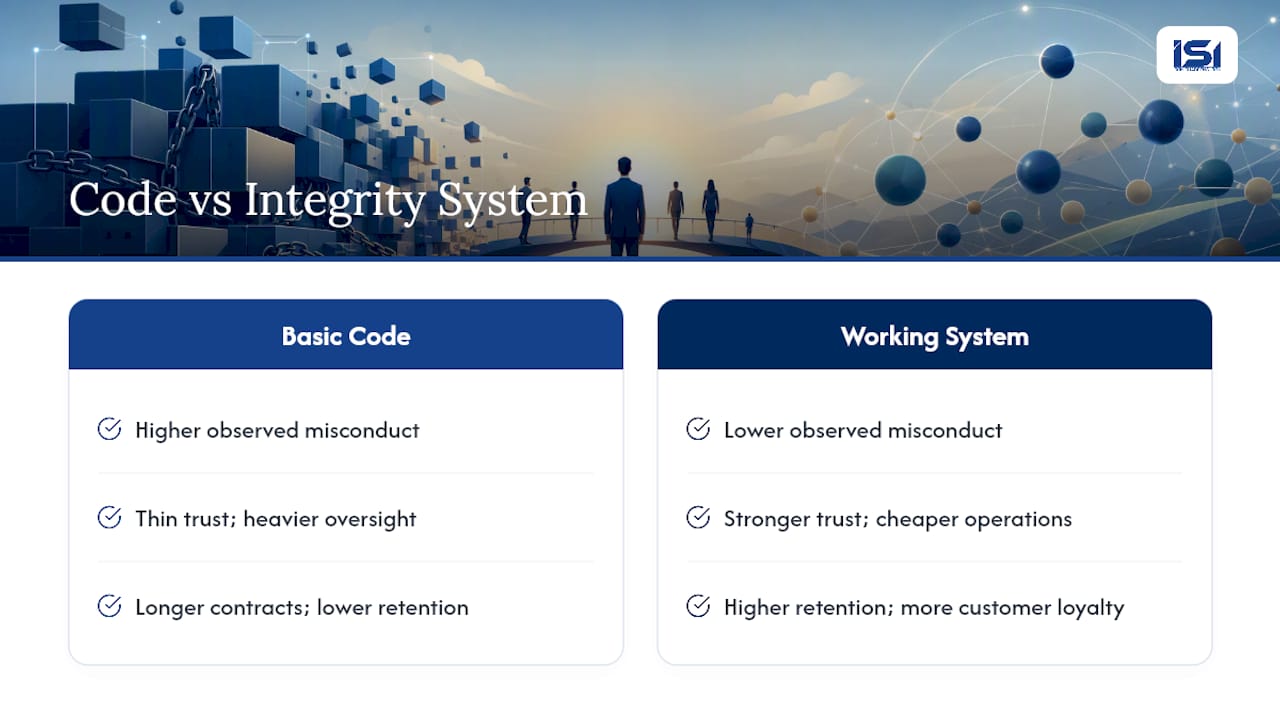
Trust is the currency that makes every other business function cheaper to run. Where trust is thin, contracts get longer, oversight gets heavier, and good people leave for organizations that don't make them justify why they told the truth. Ethical leadership grounded in honesty, respect, accountability, justice, and service builds trust and strengthens workplace culture over time, which shows up directly in retention and customer loyalty.
The failure side is just as real. Enron, Wells Fargo's fake-accounts scandal, and Theranos didn't collapse from a single lie. They collapsed because systems rewarded the lie repeatedly until it became structural. Unethical behavior turns out to be common enough inside American organizations to justify serious, systematic oversight rather than an occasional ethics memo.
Statistic to sit with: research on integrity climates consistently ties weak ethical cultures to higher observed misconduct, and the gap between "having a code of conduct" and "having a working integrity system" is exactly where that risk lives.
The Core Principles That Show Integrity in Action
Integrity isn't a personality trait. It shows up as specific, observable behaviors you can actually watch for in a meeting, a contract negotiation, or a quarterly review.
The five that matter most:
- Transparency — sharing the real reasoning behind a decision, not just the sanitized version.
- Accountability — owning outcomes publicly, including the ones that went sideways on your watch.
- Fairness — applying the same standard to your top performer and your newest hire.
- Service — making decisions that prioritize the customer or team's actual interest over the easiest path.
- Consistency — doing the same thing under pressure that you'd do in a calm boardroom.
You can test for these. Keep a promise ledger and see how often commitments get honored on time. Watch whether leaders renegotiate a bad deal early or let it fester until it explodes. Check whether conflicts of interest get disclosed before a decision, not discovered after one.
Pro Tip: Pull the last ten decisions your leadership team made under time pressure. If the reasoning behind each one isn't written down somewhere, you don't have a decision process. You have a series of guesses that happened to work out.
Building Systems That Make Integrity Repeatable
Individual virtue burns out. Systems don't. Integrity-based governance models built on active commitments, institutionalization, and implementation reduce corporate risk and support performance that holds up over years, not quarters — and that structure is what separates a company that talks about values from one that operationalizes them.
Three levers do most of the work:
- Codes of conduct that connect to real decisions. A code that never gets referenced in an actual meeting is decoration, not governance.
- Safe reporting channels with visible enforcement. Whistleblower protections only matter if people believe a report leads somewhere, and if at least one enforcement case becomes visible enough to prove it.
- Incentives and governance aligned with the stated values. Compensation, promotion criteria, and board oversight either reward integrity or quietly punish it. There's no neutral setting here.
Practical anti-corruption guidance from UNODC and the UN Global Compact frames these elements as an integrated ethics and compliance programme, not a stack of separate initiatives. Codes without enforcement don't just fail to help. They erode trust faster than having no code at all, because people notice the gap between the poster on the wall and the behavior in the room.
A 90-Day Checklist for Operationalizing Integrity
Concepts don't change behavior. Sequences do. Here's a seven-step order that turns integrity from a value statement into a working system.
- Publish "we will / we won't" rules. Make them specific enough that an employee could catch you breaking one.
- Run a short code-and-process audit. Find the three biggest gaps between stated policy and actual practice, and fix those first.
- Start a promise ledger. Track commitments made and kept across leadership, updated weekly.
- Keep a decision log. Write down the reasoning behind major calls before the outcome is known, not after.
- Complete one visible enforcement case. A single real consequence, communicated clearly, does more than a hundred training slides.
- Add integrity checks to hiring, reviews, and incentive design. Ask what behavior your bonus structure actually rewards.
- Publish a short quarterly integrity summary. Two paragraphs on what worked, what didn't, and what changed.
None of these require a big budget. They require someone willing to go first.
Why Peer Accountability Changes the Outcome
Here's what most integrity frameworks skip: even a well-designed checklist decays without someone checking whether you actually did it. That's the gap peer accountability closes, and it's the premise behind the Personal Board of Advisors structure inside Isibrotherhood. Every ISI member sits inside a small group of Christian men who meet weekly, not quarterly, to ask direct questions about decisions, incentives, and the gap between stated values and actual behavior.
That rhythm mirrors the checklist above almost exactly. Weekly mastermind meetings function like a live decision log. The group itself becomes the visible enforcement mechanism a solo leader can't build alone. Members report on commitments made the week before, which is a promise ledger with a heartbeat behind it. None of this replaces the internal systems your organization needs. It reinforces the one thing systems alone can't provide: someone who knows your specific commitments asking whether you kept them.
The Legal Ground Rules Behind Business Integrity
Integrity and legal compliance overlap, but they aren't interchangeable, and treating them as the same thing is a common leadership mistake. Compliance sets the floor: the specific laws, regulations, and contractual obligations that apply to your industry, your jurisdiction, and your size of organization. Integrity is what you do in the wide space above that floor, where the law is silent but the choice still matters.
Anti-corruption law is the clearest example. The Foreign Corrupt Practices Act governs U.S. companies operating internationally, and state-level fraud and fiduciary-duty statutes govern domestic conduct regardless of industry. UNODC's practical guide to anti-corruption and ethics programmes recommends corruption risk assessments and stakeholder involvement as the foundation for a compliant integrity system, rather than treating legal compliance as a document you file once and forget.
Whistleblower protection deserves specific attention here. Federal statutes including the Sarbanes-Oxley Act and Dodd-Frank Act protect employees who report certain kinds of misconduct, and state laws add further layers depending on where you operate. A reporting channel that technically exists but that employees don't trust isn't legal protection. It's a liability waiting to surface in a deposition. Leaders should treat the legal minimums as a floor to build above, not a target to hit exactly.
How AI and Social Media Are Reshaping Business Integrity
Two forces are compressing the distance between a private decision and its public consequence, and most leaders haven't adjusted their systems to match.
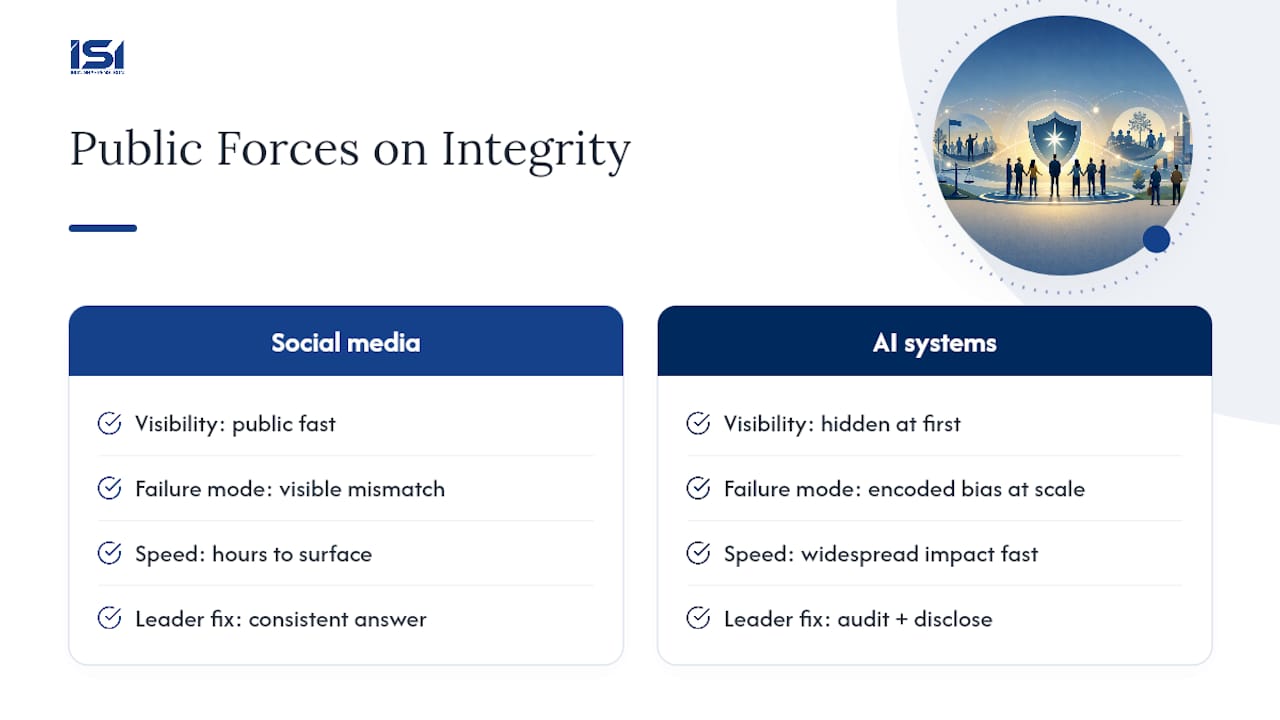
Social media turned every customer interaction into a potential public record. A decision that once stayed inside a conference room now surfaces in a screenshot within hours. That speed rewards leaders who already have a consistent, defensible answer, and punishes anyone whose public statements and internal practices don't match. Integrity used to be tested occasionally, in a crisis. Now it's tested continuously, in public.
AI adds a subtler pressure. Automated decision systems, from hiring screens to pricing algorithms, can encode bias or misalignment at scale before a single human notices. An algorithm that quietly discriminates isn't a rogue actor. It's an organizational system failing the same integrity test a biased manager would fail, just faster and with less visibility. Leaders who assume "the algorithm decided" removes them from accountability are making the same mistake as a leader who blames a bad hire on the recruiting process rather than the incentives behind it.
The practical response looks like the same systems already discussed: audit AI-driven decisions the way you'd audit a human one, disclose when AI shapes a customer-facing outcome, and keep a human decision log even when a model does the first pass. The tools changed. The underlying test, whether your systems match your stated values under pressure, did not.
Leading Integrity as a Daily Habit, Not a Policy
The leaders who actually build integrity into their organizations aren't the ones with the best-written code of conduct. They're the ones who let someone else check their homework every week. Pick one item from the checklist above. Start it this Monday. Then tell a trusted peer what you did, and let them ask if you actually followed through.
— Derek
An Honest Next Step for Leaders Who Want Real Accountability
Everything in this checklist works better with a witness. You can build a promise ledger alone, but it's easier to keep one when someone asks about it every week instead of every quarter. That's the gap peer accountability closes, and it's the whole premise behind Isibrotherhood.
Isibrotherhood places Christian business owners, executives, and entrepreneurs into a Personal Board of Advisors, a small group of men who meet regularly to press on the exact questions this article raises: did you keep the promise you made last week, does your incentive structure match your stated values, and who's checking? Weekly mastermind meetings, a year-round online community, and leadership events built around personal, spiritual, relational, professional, and financial growth give the checklist above a place to live instead of a drawer to sit in. If you're ready to stop being the only person auditing your own integrity, explore Isibrotherhood's mastermind community and see what a weekly accountability rhythm actually looks like.
Sources
- What Is Ethical Leadership and Why Is It Important? | Harvard DCE
- Organizational integrity triad & dimensions (peer-reviewed article)
- An Anti-Corruption Ethics and Compliance Programme for Business: A Practical Guide (UNODC / UN Global Compact)
- How common is unethical behavior in U.S. organizations? | HBR