

The best mastermind hot seat questions fall into five categories: context, clarifying, probing, brainstorming, and commitment. Use one category per phase of the hot seat, not all five at once, and keep your prep down to a single-sentence "Ultimate Question" you can state in under fifteen seconds.
That's the whole system. Everything else in this article is the copy-and-paste version.
Here's a preview of six prompts you can use tonight:
- "What decision are you actually stuck on, in one sentence?"
- "What have you already tried, and why didn't it work?"
- "What would you need to see to feel confident moving forward?"
- "If you had to decide in the next 24 hours, what would you do?"
- "What's the real cost of staying stuck on this for another quarter?"
- "What's one commitment you're willing to make before we close this out?"
Key Takeaways
A hot seat produces real decisions only when it separates fact-finding from advice-giving and ends with one named commitment and a deadline.
| Point | Details |
|---|---|
| Use five question categories | Move through context, clarifying, probing, brainstorming, and commitment questions in that order. |
| Write one Ultimate Question | Frame your issue as a single decision-shaped sentence before your turn, not a vague topic. |
| Protect the clarifying round | Facts only, no advice, for 5 to 10 minutes before the group offers input. |
| End with one commitment | Name one action, one deadline, and one person who checks in afterward. |
| Join a structured cohort | Isibrotherhood pairs members into weekly Personal Boards of Advisors that run this format consistently, with a trained facilitator protecting the process. |
Table of Contents
- Mastermind Hot Seat Questions Organized by Phase
- How Do You Frame a Hot Seat Topic?
- How Long Should a Hot Seat Last?
- What Should You Prepare Before Your Hot Seat?
- Hot Seat Norms and the Mistakes That Kill Them
- Session Templates for Different Group Sizes
- Closing With Commitments and Accountability
- Tailoring Hot Seat Questions to Different Mastermind Types
- What Follow-Up Questions Deepen a Hot Seat Discussion?
- How Do You Create a Safe Environment for Honest Sharing?
- How Do You Give Constructive Feedback in a Hot Seat?
- Why This Structure Actually Produces Decisions
- Ready for a Structured Mastermind, Not Just a One-Off Hot Seat
- Frequently Asked Questions
- Sources
Mastermind Hot Seat Questions Organized by Phase
Good hot seat questions aren't random. They follow the shape of the session itself, which means the right question depends entirely on which phase you're in. Ask a brainstorming question during the clarifying round and you'll derail the whole thing.
Context prompts (the presenter uses these to set up their own turn):
- What's happening right now that brought this to the group?
- Why does this matter this month, not eventually?
- What have you already tried?
- What outcome are you hoping to walk away with?
Clarifying questions (facts only, no advice hidden inside a question):
- What's your current revenue or conversion number on this?
- Who else is involved in this decision?
- What's the actual deadline, and is it real or self-imposed?
- Have you talked to the other party about this directly?
- What would it cost you to do nothing?
Probing / deep-dive prompts:
- What are you assuming that might not be true?
- What would you tell a friend in this exact situation?
- What's the fear underneath this decision?
- Where has this pattern shown up before in your business?
- What's the version of this problem you haven't said out loud yet?
Brainstorming prompts (group input, rapid-fire):
- What's one thing you'd do in their shoes?
- What's a resource or contact that could help right now?
- What's a smaller experiment that tests this before you commit fully?
- What would the boldest version of this decision look like?
- What's the cheapest way to get data on this in the next two weeks?
Commitment / accountability prompts:
- What's the one thing you're doing in the next 48 hours?
- Who's holding you accountable to that?
- What would make you come back next week and say "I did it"?
- What does success look like in 30 days?
By business use case:
- Pricing: "What's stopping you from raising prices 10% tomorrow?"
- Hiring: "What does this role need to be true in six months for the hire to be worth it?"
- Partnership: "What happens to this relationship if the deal falls through?"
- Growth strategy: "What's the channel you're avoiding because it's uncomfortable, not because it's ineffective?"
- Leadership/team: "What conversation have you been putting off with this person?"
How Do You Frame a Hot Seat Topic?
The Ultimate Question turns a messy, sprawling problem into one decision-shaped sentence the group can actually respond to. Vague topics get vague feedback; sharp questions get sharp answers, which is why focusing on the outcome you want matters more than describing the problem in detail.
Examples you can copy directly:
- "Should I raise my prices 15% for new clients starting next quarter?"
- "Do I hire a full-time ops person now, or wait until Q3 revenue confirms the need?"
- "Should I walk away from this partnership, or renegotiate the terms first?"
- "Is it time to sunset this product line, or give it one more quarter?"
- "Should I pivot the offer, or fix the sales process first?"
Before your turn, prepare:
- Two relevant numbers (revenue, conversion rate, cost, timeline)
- Two or three options you're actually weighing
- The one constraint making this hard
- What you've already tried
How Long Should a Hot Seat Last?
A typical hot seat runs 20 to 30 minutes and moves through four distinct phases: a short context statement, a clarifying-questions round, structured group input, and a final response and commitment. One commonly cited protocol breaks it down as roughly a 1-minute problem statement, 5 to 10 minutes of clarifying questions, 20 to 25 minutes of structured response, and a final 5 minutes for the member to integrate and commit. Other groups compress the whole cycle into 20 to 30 minutes total, which works better for larger cohorts with less time per person.
Facilitator duties during this window:
- Keep visible time, not a mental guess
- Protect the context phase from turning into a therapy session
- Enforce "clarifying questions only" during round two, no exceptions
- Prevent the loudest voice from eating the group's input time
- Pull a specific commitment before the timer runs out
Smaller groups can stretch each phase slightly; larger cohorts of six or more should hold the line tighter or split into two rounds across the meeting.
What Should You Prepare Before Your Hot Seat?
Show up with your thinking already done, not your thinking still forming. A hot seat works best on decision-shaped problems where you bring a one-sentence question, your main options, two relevant numbers, and the constraint that's actually making this hard.
Before your turn:
- Write your Ultimate Question in one sentence
- List two numbers that matter (revenue, cost, time, conversion)
- Name two or three options you're weighing
- Identify the one constraint blocking a decision
- Decide what success looks like if this goes well
In your final one to two minutes, fill in a mini action plan: one action, one deadline, one person who'll check on it. Capture the session itself, too. Voice memos or a shared notes doc work fine, and reviewing that capture within 24 hours meaningfully increases the odds an insight turns into action instead of evaporating by Friday.
- State your Ultimate Question
- Share your two numbers and constraint
- Receive group input without defending
- Commit to one action with a deadline
- Log the output before you leave the room
Hot Seat Norms and the Mistakes That Kill Them
Confidentiality is the floor, not a nice-to-have. Nothing shared in a hot seat leaves the room, and every member needs to trust that before they'll say anything real. Beyond confidentiality, a few norms separate a useful hot seat from a wasted half hour:
- Ask clarifying questions before offering a single opinion
- Frame feedback as "If I were you, I would X because Y," not a flat directive
- Stay present. Put the phone away for someone else's turn.
- Respect the timer, even when the conversation is good
Common mistakes to avoid:
- Bringing a vague ask ("I don't know, just give me feedback on my business")
- Using your hot seat turn to vent instead of decide
- Dominating the input round with your own similar story
- Prescribing solutions nobody asked for, especially before the clarifying round ends
The clarifying-questions round isn't optional. Skip it, and the group ends up giving sharp, confident advice to a problem that isn't the real one.
Pro Tip: Write your one-sentence Ultimate Question and text it to the facilitator an hour before the session. It forces clarity early, and it gives the facilitator a chance to flag if your topic needs reframing before you're on the spot.
Session Templates for Different Group Sizes
Group size determines how much room each person gets, and the math has to work before you build the agenda. A structured protocol with a short problem statement, a clarifying round, and a longer response block scales cleanly across group sizes when you adjust the input phase.
Virtual sessions need a stricter timer since nobody can read the room's body language to know when to wrap up. In-person groups can flex the input phase a little longer if energy is high. Groups wanting faster rounds can compress to 15 minute hot seats by trimming the input phase, not the clarifying round, which stays non-negotiable regardless of total time.
Closing With Commitments and Accountability
A hot seat that ends without a commitment was just an expensive conversation. The last few minutes matter more than the previous twenty, because that's where feedback either turns into action or quietly dissolves into "yeah, I'll think about it."
The facilitator's job in this window is to ask one direct question: "What's the one thing you're doing, and by when?" Not three things. One. Multiple commitments after an intense feedback round almost never survive contact with a normal Tuesday.
Write the commitment down where the group can see it, not just in the presenter's head. Some groups keep a running accountability doc; others simply have the next facilitator open the following meeting by asking, "Last time you said you'd do X. Did you?" That single follow-up question does more for group culture than almost any other practice, because it signals the group takes its own words seriously.
The commitment also needs a name attached, meaning someone besides the presenter agrees to check in. Self-accountability is fragile under deadline pressure. A second person asking "how'd that go" by a specific date turns a good intention into a tracked one.
If the presenter can't name a concrete action in the room, that's diagnostic information itself. It usually means the Ultimate Question wasn't decision-shaped enough, or the real constraint never got named. Better to catch that in the room than to let the meeting end on a vague "lots to think about."
Tailoring Hot Seat Questions to Different Mastermind Types
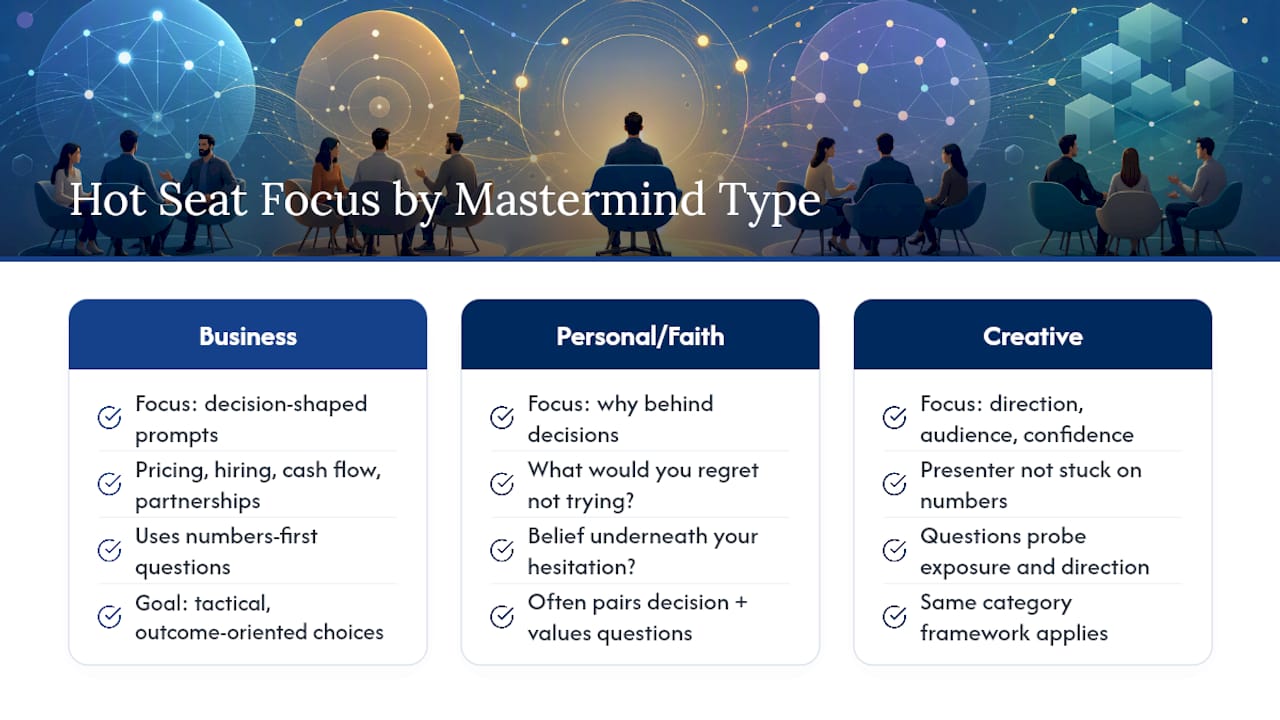
Business masterminds and personal development groups need different question sets, because they're solving for different outcomes. A business-focused hot seat leans hard into decision-shaped prompts: pricing, hiring, cash flow, partnership terms. The numbers-first questions from earlier in this article fit that context well.
Personal development and faith-based groups need more room for the "why" behind the decision, not just the "what." Questions like "What would you regret not trying?" or "What's the belief underneath your hesitation?" surface material that a pure business framework skips past entirely. Groups organized around personal, spiritual, relational, professional, and financial growth, the structure Isibrotherhood uses for its Personal Board of Advisors cohorts, often blend both: a decision-shaped Ultimate Question paired with a values-based probing question, so the group addresses both the tactical choice and the character question sitting underneath it.
Creative masterminds shift again. The presenter usually isn't stuck on a number. They're stuck on direction, audience, or confidence in the work itself. Questions like "What would you make if nobody was going to judge it?" or "What's the version of this you're avoiding because it feels too exposed?" do more work than a spreadsheet-style probing question ever could.
The category framework from earlier (context, clarifying, probing, brainstorming, commitment) still applies across all three types. Only the content inside each category changes to match what the group actually values.
What Follow-Up Questions Deepen a Hot Seat Discussion?
The first answer someone gives in a hot seat is rarely the real answer. Follow-up questions are what get you past the polished, rehearsed version of the problem into the version that's actually true.
If someone says "I'm not sure I should hire," a strong follow-up isn't "why not?" It's "what would need to be true for you to feel ready?" That question forces a concrete answer instead of another round of hesitation. Similarly, "what have you already decided but haven't admitted yet?" tends to surface the real answer faster than any amount of open-ended probing, because most presenters already know what they want to do. They're looking for permission or a reality check, not a fresh idea.
Other high-leverage follow-ups:
- "What's the actual worst case if this doesn't work?"
- "Whose opinion are you most afraid of on this?"
- "What did you decide the last time you faced something similar?"
- "What would you tell your best client to do here?"
These work because they redirect the presenter's attention from the abstract problem to a concrete, personal frame they can actually answer. Vague questions get vague answers. Specific, slightly uncomfortable follow-ups get the truth.
How Do You Create a Safe Environment for Honest Sharing?
Nobody gives their real problem to a room that feels unsafe. Safety in a mastermind hot seat comes from consistent, boring reliability, not from any single trust exercise or icebreaker.
Confidentiality has to be absolute and enforced without exception. One leak, even a small one, and the group's honesty drops for months. Beyond that baseline, preparation itself builds safety: when members clarify their focus, reflect on assumptions, and commit to group norms before the session even starts, everyone arrives with the same expectations for how vulnerable the room is meant to be.
Facilitators play the biggest role here. Rigid enforcement of format, meaning consistent timing, consistent turn order, and consistent protection from interruption, is what actually produces equitable value across the whole group rather than just for the most confident member. Safety isn't a feeling the facilitator generates through warmth alone. It's a structural guarantee the group can rely on every single week.
Groups that pair mastermind work with a faith or values foundation often find this easier, since shared conviction gives members a reason to extend grace during an awkward or exposing hot seat. A structured framework like the one a coaching-integrated approach from Prism Counseling & Coaching uses for readiness and reflection work can also help individual members show up more prepared to be vulnerable in the first place.
How Do You Give Constructive Feedback in a Hot Seat?
Good feedback in a hot seat has a shape: "If I were you, I would X, because Y." That structure forces specificity and forces the feedback-giver to own the opinion as theirs, not as a universal truth.
Avoid the two most common feedback failures. The first is the vague compliment sandwich, which wastes everyone's limited input time and gives the presenter nothing to act on. The second is the unsolicited deep-dive, where someone spends four minutes on a tangent nobody asked about because it reminded them of their own situation.
During the session, feedback should stay concise, specific to the Ultimate Question asked, and framed as one option among several rather than the obvious right answer. After the session, the most valuable feedback often comes as a short follow-up message: a resource, an introduction, or a one-line thought that arrived after the meeting ended. Encourage that. Some of the best insight in a mastermind group surfaces at 11 p.m. the night after the hot seat, not during the 20 minute window itself.
The presenter's job during feedback is almost entirely to listen and take notes, not to defend or explain. Defending a decision mid-feedback shuts down the exact input the hot seat exists to generate.
Why This Structure Actually Produces Decisions
The categories in this article work because they force separation between understanding a problem and solving it, which is the single most common failure point in a group that means well but rambles. Groups that skip straight to advice almost always end up solving the wrong problem with real conviction. Isibrotherhood built its Personal Board of Advisors model around this same discipline, pairing men into small, consistent groups precisely because ad hoc encouragement rarely produces the accountability that a structured hot seat does. Try one of these templates in your own group this week and see what changes.
Ready for a Structured Mastermind, Not Just a One-Off Hot Seat
A hot seat question bank gets you through one meeting. It doesn't give you the trained facilitator, the consistent weekly cadence, or the accountability partner who follows up on your commitment three weeks later, which is where most solo attempts at this quietly fall apart. Isibrotherhood places you into a Personal Board of Advisors, a small group of Christian business owners and professionals who run this exact structure every week, with a facilitator who protects the format so you don't have to police your own group.
Instead of building a hot seat framework from scratch and hoping your group sticks to the timing, you join a cohort where the structure, the accountability, and the faith foundation are already in place. If you're ready to see what a weekly mastermind built around this framework looks like, explore Isibrotherhood's mastermind cohorts and find out how to join one near you.
Frequently Asked Questions
What is a mastermind hot seat? A hot seat is a structured turn where one member presents a specific problem and receives focused group feedback within a set time, typically 20 to 30 minutes, moving through context, clarifying questions, group input, and a final commitment.
What are the best hot seat questions to ask? The most effective questions are decision-shaped and specific: what have you tried, what would success look like, what's the real constraint, and what's one action you'll commit to by a set date.
How long should a hot seat last? Most run 20 to 30 minutes total, though a full protocol with a longer response phase can stretch closer to 35 minutes for a single presenter.
Who should ask clarifying questions first? Every group member should ask clarifying questions before anyone offers advice, and the facilitator should enforce this round strictly since skipping it often leads to advice aimed at the wrong problem.
How do I prepare for my own hot seat? Write a one-sentence Ultimate Question, bring two relevant numbers, list two or three options you're weighing, and name the one constraint making the decision hard.
Can hot seat questions work outside business masterminds? Yes. The same phase structure applies to personal development and creative groups; only the content of the questions changes to match what the group values most.
Sources
- Mastermind groups — Think & Save the World
- How a mastermind meeting actually runs — Mastermind Better
- How to maximize a mastermind experience — Mike Kim
- Hot seat coaching: How founders get unstuck faster — Self Employed
- MM Preparation Guide Feb 2026 (DPC MasterMind Sessions) — Navy Supply Corps Foundation (PDF)