

Mastermind member screening is a short, intentional process that confirms alignment, commitment, contribution, and capacity before a man joins a paid group. The best version of it runs an application, a 10-minute video call, and a facilitator decision, not a lengthy vetting committee. A Personal Board of Advisors model can benefit from this exact rhythm, and meeting agenda templates help make the process easy to run well from week one.
TL;DR:
- Screening should assess alignment, engagement, contribution, and capacity to ensure members will positively impact the group.
- A brief application form and a ten-minute video call effectively filter serious applicants and reveal behavioral signals impossible to gauge in writing.
- Confidentiality and strict attendance policies are essential operational rules to maintain trust and prevent group disruption.
- Proper onboarding and early enforcement of rules during the first 30 to 60 days set the foundation for active and committed participation.
- Clear rejection and exit processes, along with highlighting the importance of contribution over charisma, protect group integrity and long-term success.
Table of Contents
- What Does Mastermind Member Screening Actually Check?
- Building an Application Form That Filters Correctly
- How Do You Run an Interview That Predicts Real Behavior?
- Setting Confidentiality and Conduct Rules Members Respect
- Getting the First 30 to 60 Days Right
- How to Reject or Remove a Member Without Damaging Trust
- How ISI Brotherhood Puts Screening Into Practice
- Handling Diversity and Inclusion in Member Selection
- Assessing Member Goals and Compatibility With Group Vision
- Tools and Technologies for Managing Applications and Screening
- Common Red Flags and How to Spot Them During Screening
- A Facilitator's View on What Actually Matters When Vetting Men
- Ready to Join a Group That Screens for the Right Reasons?
- Sources
What Does Mastermind Member Screening Actually Check?
Screening isn't a background check. It's a fit check, and it rests on four pillars that determine whether a man will make the room better or quietly drain it.
Alignment comes first. Does his stated faith commitment, business goals, and personal values match what the group actually stands for? You spot this in application language before you ever get on a call: vague answers about "wanting community" often signal a man who hasn't thought through what a mastermind costs him in vulnerability and time. Specific answers about wrestling with a hiring decision, a marriage strain, or a stalled revenue line tell you he already knows the work.
Engagement is the second filter. Has he shown up consistently for anything, ever? Church commitments, a previous peer group, a coaching relationship. Willingness to be coached matters more than credentials. A man with a thinner resume who takes correction well will outperform a polished executive who bristles at feedback.
Contribution asks what he brings, not what he needs. Skills, industry networks, and a track record of candid feedback all count. Groups fail when every member is a taker.
Capacity protects peer-level interaction. Matching business stage and revenue band keeps advice relevant. The most effective groups run a moderate number of members at a similar professional stage, tight enough for depth, wide enough for perspective.
Round out the checklist with operational checks:
- Meeting cadence expectations, stated plainly and confirmed in writing
- Payment readiness, since a hesitant "maybe I can afford it" predicts future attendance problems
- Reference checks for anyone claiming a specific revenue band or prior group experience
Pro Tip: Ask for one reference from someone who has seen him under pressure, not just someone who likes him. Character shows up fastest in stress, not in comfort.
Building an Application Form That Filters Correctly
The application form does the first round of work for you, so build it to surface real signal rather than polite generalities. Screening every applicant protects the room, and a well-built form is the cheapest way to start that filter before a single conversation happens.
Recommended fields to include:
- Role and business stage (founder, executive, solo practitioner)
- Revenue band (broad ranges are fine, precision isn't the point)
- Availability (specific days and times he can commit weekly)
- A short goal statement (two or three sentences, not a paragraph)
- Why now (what prompted this application today)
High-leverage screening questions to include directly on the form:
- "Why do you want to join this group?"
- "What can you offer the other men here?"
- "What are you working on right now that you'd want feedback on?"
- "Can you commit to consistent attendance for the next 90 days?"
Keep the form under ten questions. A form that takes fifteen minutes to complete filters out serious men along with the flaky ones. Be explicit about the paid commitment on the form itself, not buried in a follow-up email. Ambiguity about cost breeds resentment later.
How Do You Run an Interview That Predicts Real Behavior?
Forms tell you what a man wants you to know. A live call tells you who he is. A short video call, often just around ten minutes, reveals behavioral signals a written application simply cannot.
Structure the call in four parts:
- Two minutes of rapport. How he opens the conversation tells you something about his posture toward people he's meeting for the first time.
- Four minutes on his current challenge. Listen for specificity. Vague answers ("business is tough") signal a man who hasn't done the internal work yet.
- Three minutes on contribution. Ask directly what he'd bring to other members. Prepared answers here separate collaborators from performers.
- One minute on logistics and commitment. Confirm cadence, payment, and attendance expectations out loud.
Collaborators come prepared, ask reframing questions instead of just answering yours, and mention a past failure without prompting. Performers talk about wins, deflect follow-up questions, and treat the call like an audition. Make your decision within 24 hours and communicate it directly. A platform like Facecruit can help structure video interview scheduling if you're running several calls a week.
Setting Confidentiality and Conduct Rules Members Respect
Confidentiality works only when it's operational, not aspirational. That means written rules: no recordings of sessions, no public retelling of another member's story, and an explicit acceptance checkbox during onboarding rather than a verbal assurance nobody remembers three months later.
Pair confidentiality with a contribution-or-exit policy. Groups that use strict application barriers and confidentiality protocols maintain trust because members know the standard applies equally to everyone, not just newcomers.
Attendance rules matter more than most facilitators admit upfront. A member who shows up late twice in his first month rarely tightens up on his own. Small noncompliance early is a preview of larger noncompliance later, and treating it as a minor issue now costs you credibility with the rest of the group down the line.
Pro Tip: Document every breach in writing, even minor ones, and address the first instance directly rather than waiting to see if a pattern forms. The rules that build lasting trust are the ones enforced consistently from day one.
Getting the First 30 to 60 Days Right
The first 48 hours after acceptance shape whether a new member becomes a contributor or a spectator. A premium onboarding sequence signals seriousness immediately.
- Review his intake answers before his first meeting so you can reference them directly
- Send agenda templates and platform access before day one, not after
- Schedule a facilitator check-in within the first week
- Set a 30 to 60 day trial window with simple metrics: has he attended, has he contributed, has he followed up on anything discussed
Good onboarding isn't hospitality for its own sake. It protects the cohort by making the standard visible immediately.
How to Reject or Remove a Member Without Damaging Trust
A direct, brief rejection protects your reputation more than a vague "we'll be in touch" ever will. Men respect honesty, even when it stings.
- Use language like: "This isn't the right fit for you right now, and here's why." Specific, kind, final.
- Offer an alternative resource if one genuinely fits his stage.
- For facilitator-initiated exits, follow a documented process: a private conversation first, then written confirmation, with clear language on any refund policy.
- Keep records of every screening decision and rejection in case an appeal comes later.
Vetting doesn't end at intake. Ongoing mechanisms for graceful exits keep the group's quality intact as members' stages and engagement shift over time.
How ISI Brotherhood Puts Screening Into Practice
Some mastermind groups run on the Personal Board of Advisors model: small groups of Christian men meeting weekly across five areas of life, personal, spiritual, relational, professional, and financial. That structure only works if screening pillars are applied consistently before anyone joins a cohort.
The Mastermind Meeting Agenda template gives new members a clear structure from their very first meeting, which reinforces the alignment and engagement pillars from day one rather than leaving early sessions to chance. Some writing and podcast contributions cover the facilitator side of this work in more depth, walking through how weekly cadence and community resources reinforce the standards set during screening. The operational discipline behind admission, onboarding, and ongoing participation is what keeps a Personal Board of Advisors functioning as advisors rather than acquaintances.
Handling Diversity and Inclusion in Member Selection
A faith-based mastermind isn't built around uniformity of industry, age, or background. It's built around shared values and a genuine willingness to be challenged. Screening should test for that willingness, not for sameness in resume or life stage.
A group of six men from six different industries, at slightly different revenue bands but similar seasons of leadership responsibility, often produces sharper insight than a room of near-identical peers. Diverse professional backgrounds surface blind spots faster because members can't assume shared context, which forces clearer explanation and deeper questions.
What should stay consistent, regardless of industry or age, is the faith commitment and the willingness to engage honestly. Screening for those two things while staying open on everything else, business type, company size, career stage, gives a facilitator room to build a group that challenges itself rather than one that simply agrees with itself. The goal isn't a checklist of demographic boxes. It's a room where a construction company owner and a healthcare executive can both bring something the other doesn't already have.
Assessing Member Goals and Compatibility With Group Vision
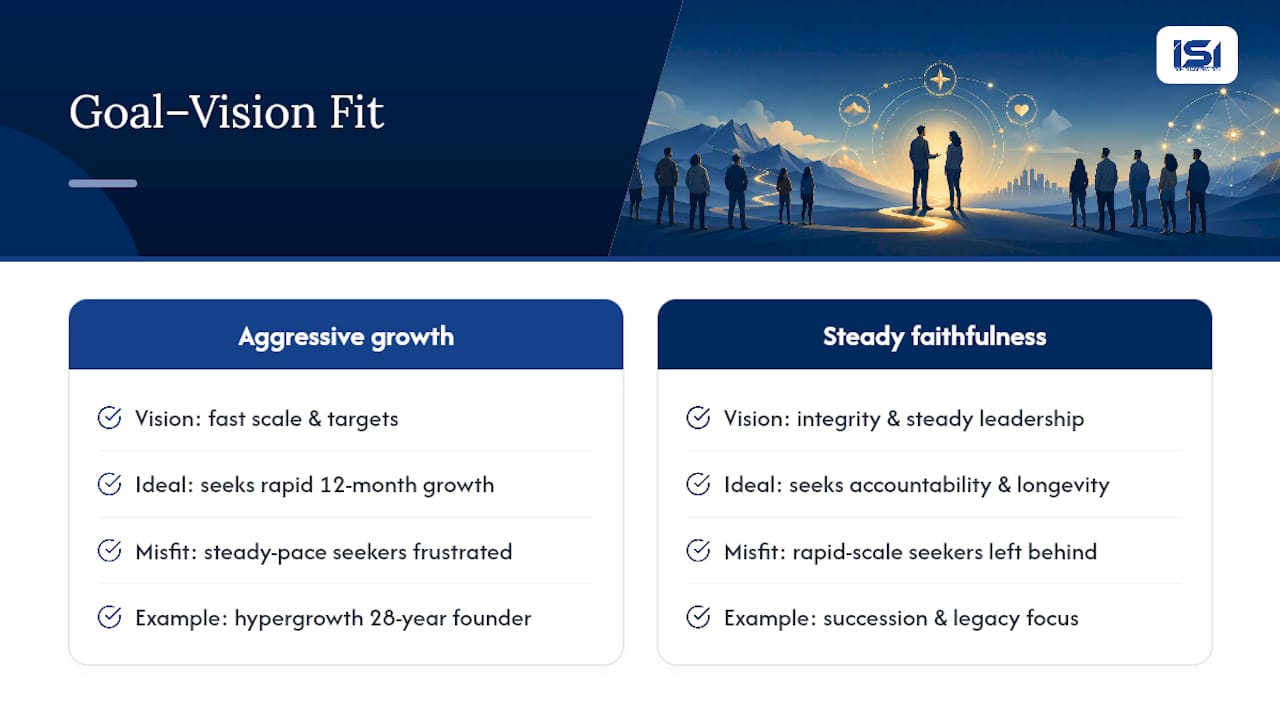
Every mastermind has an implicit vision, whether it's stated outright or not. Some groups exist for aggressive growth strategy. Others center on integrity and steady faithfulness through business seasons. A candidate whose goals don't match that vision will feel out of step even if he's a genuinely good man.
Ask directly during screening: what does he want from the next twelve months, personally and professionally? A man chasing rapid scale in a group built around sustainable, faith-centered leadership will likely feel frustrated by the pace. A man seeking steady accountability in a group oriented toward aggressive growth targets may feel like the conversations move past him.
This is where the application's goal statement earns its place. Compare his stated goals against the group's actual rhythm and current conversations. If a facilitator already runs a group focused on succession planning and legacy, a 28 year old founder in hypergrowth mode probably belongs somewhere else, not because he isn't capable, but because the peer-level exchange won't serve either side well. Compatibility isn't about talent. It's about whether his season matches the group's season.
Tools and Technologies for Managing Applications and Screening
Most facilitators start with something as simple as a shared form and a spreadsheet, and that's genuinely fine for a single group of 6 to 15 men. The tool matters far less than the discipline behind it.
A basic online form, Google Forms or a similar builder, handles intake fields and screening questions without any real cost. Calendar scheduling tools remove the back-and-forth of booking the 10-minute video call. Video conferencing software handles the interview itself. For facilitators managing multiple cohorts or a longer applicant pipeline, a lightweight CRM tool can track where each applicant sits: applied, interviewed, accepted, or declined, and store notes from the call itself.
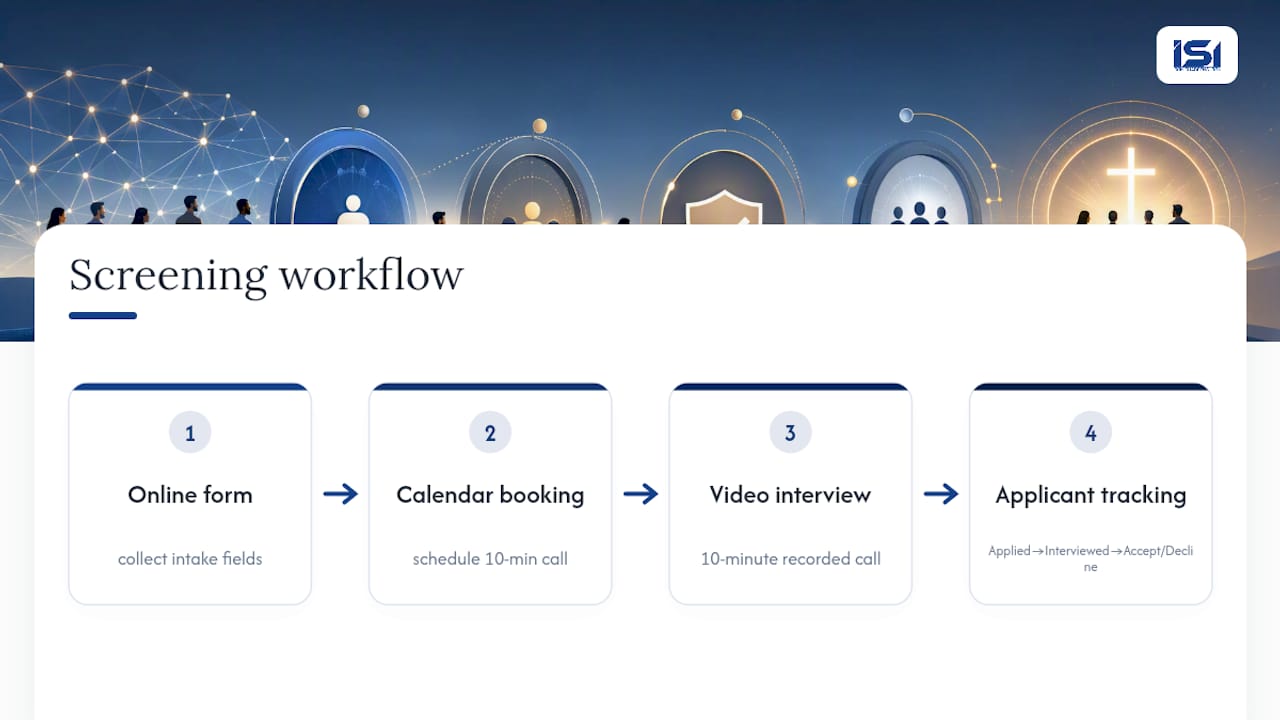
The video interview step is worth setting up deliberately rather than improvising. A structured video interviewing platform can standardize how calls are scheduled and recorded internally, which matters more as a group scales past one cohort. Whatever stack you choose, the goal is the same: a clean, repeatable process that doesn't rely on memory or good intentions to catch a mismatched applicant before he joins.
Common Red Flags and How to Spot Them During Screening
Certain patterns show up again and again in applicants who don't work out, and most of them are visible before a man ever joins if you're watching for them.
Vague answers about goals, paired with strong enthusiasm about "networking," often signal a man looking for contacts rather than accountability. Reluctance to name a specific current challenge during the interview usually means he isn't ready to be vulnerable in front of peers yet, which is the actual currency of a mastermind. Hesitation or negotiation around payment terms predicts attendance problems down the line, since financial commitment and time commitment tend to track together.
Watch also for a man who talks primarily about his own wins during the call and never asks a question about the group itself. That imbalance tends to continue once he's a member. A facilitator's role is closer to matchmaker than gatekeeper, and matchmakers learn to trust these early signals rather than talk themselves out of a gut read because a man's resume looks impressive on paper.
A Facilitator's View on What Actually Matters When Vetting Men
Charisma is the easiest trait to overrate on a screening call. What actually predicts a good member is contribution and long-term fit, not how well a man interviews. Protect the rhythm of the group through consistent attendance enforcement rather than trying to manage personalities. Make confidentiality clear from day one, before the first meeting, not after a breach forces the conversation. Selectivity is a reputation tool: the groups men fight to stay in are the ones that were never afraid to say no.
— Derek
Ready to Join a Group That Screens for the Right Reasons?
This kind of brotherhood is built for men who want a Personal Board of Advisors, not a networking event with a monthly fee. Cohorts run on the screening discipline described here: alignment, engagement, contribution, and capacity, checked before anyone joins, and protected through weekly meetings, onboarding templates, and clear conduct expectations.
That structure is what keeps the room worth showing up to. Weekly mastermind meetings, a year-round online community, leadership events, and resources across the personal, spiritual, relational, professional, and financial areas of life all rest on the same standard applied to every member from the start. If you're weighing whether a faith-based mastermind is worth the investment, read what a privilege it is to be the patriarch for a sense of the leadership themes ISI Brotherhood groups actually wrestle with. Then reach out and start your own application. The process is the same one described above: a short form, a real conversation, and a decision that respects your time either way.
Sources
- How to Start a Mastermind Group in 2026 That People Show Up For
- How to Build a High-Ticket Mastermind or Group Programme | HighTicketHQ
- Understand architecting Private High-Level Masterminds