

Yes, mastermind ROI is measurable when you treat membership as a capital allocation decision instead of a subscription expense. The math runs on three pillars: financial return, strategic decision speed, and network value. Expect early signals within 90 days and clearer financial payback somewhere between 6 and 24 months, depending on how fast you act on what the room gives you.
TL;DR:
- Mastermind ROI includes financial gains, strategic decision improvements, and network opportunities, with signals emerging within 90 days and full payback in 6 to 24 months.
- Tracking decision velocity, actions implemented, new introductions, and tests launched weekly, along with quarterly revenue or margin impacts, provides a comprehensive management dashboard.
- Cost-avoidance, referral value, and mentorship quality offer tangible ways to estimate the hidden or intangible benefits, assigning dollar figures to otherwise non-measurable value.
- Log every idea or introduction with its source immediately to create a credible record that supports renewal decisions, avoiding reliance on memory or vague impressions.
- Attending regularly and applying group insights within 30 to 60 days are the behaviors most strongly linked to realizing significant ROI from the mastermind.
Table of Contents
- What Mastermind ROI Actually Includes
- Your Mastermind Measurement Dashboard: What to Track
- Simple ROI Formulas and Worked Examples
- The Real Cost of a Mastermind: Tuition, Time, and Travel
- How to Vet a Mastermind Before You Join or Renew
- What to Expect in Months 1, 6, and 24
- An ISI Brotherhood View on Measuring What Matters
- Putting a Number on Intangible Value
- When a Mastermind Is the Right Capital Allocation
- ISI Brotherhood: A Faith-Based Mastermind Built for Measurable Growth
- Sources
- FAQ
What Mastermind ROI Actually Includes
Most business owners undercount their return because they only look for new revenue in a bank statement. That is a narrow lens. Mastermind group benefits show up in three distinct places, and missing any one of them means you are measuring only part of the picture.
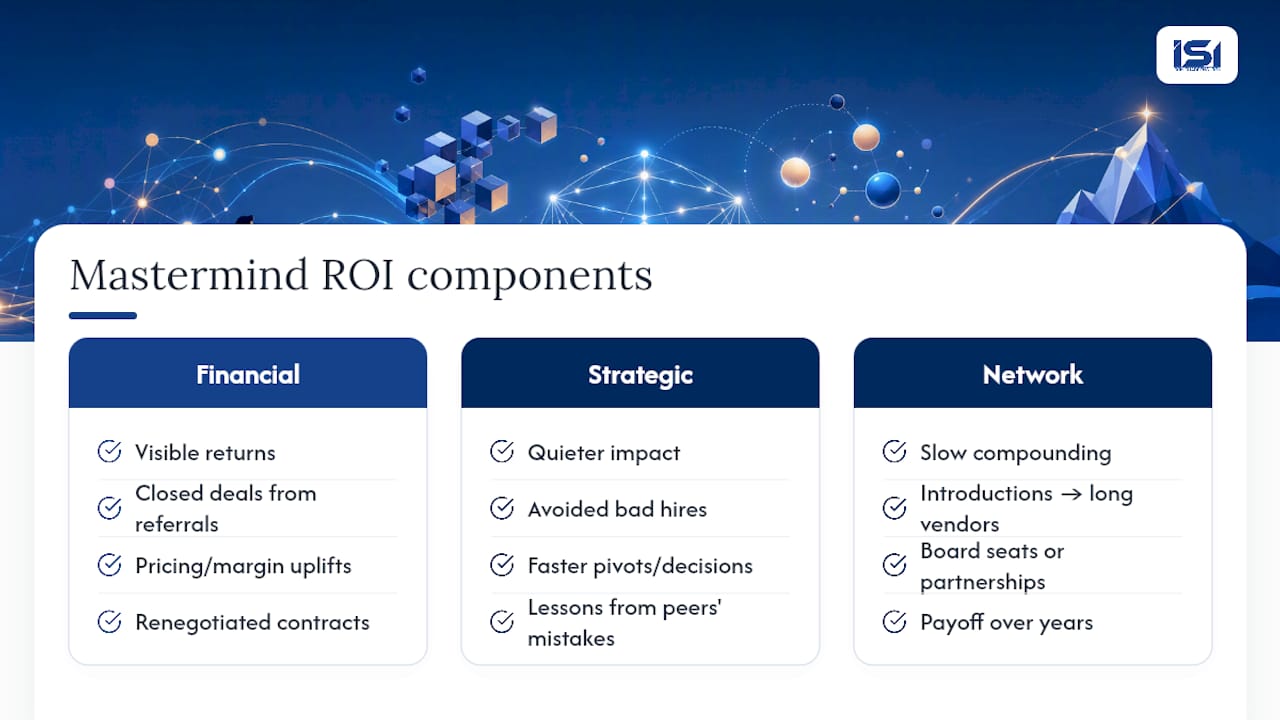
Financial return is the easiest to spot: a closed deal from a referral, a pricing change that lifted margin, a vendor contract renegotiated after a peer flagged you were overpaying. Strategic return is quieter but often bigger. It is the bad hire you did not make because three men in the room had already made that mistake and told you what it cost them. It is the pivot you made in March instead of October because someone asked the one question you had been avoiding. Network return compounds slowest and pays longest. It is the introduction that turns into a five-year vendor relationship or a board seat two years later.
A business mastermind ROI guide from Deliberate Directions makes a point worth sitting with: avoided mistakes and accelerated decisions often generate more value over time than any single referral, precisely because they compound. A decision made three months faster is worth more than the decision itself.
Statistic Callout: Leaders who treat mastermind membership as strategic capital allocation, rather than a line-item cost, consistently report higher measured ROI because they track outcomes with the same discipline they'd apply to any other investment.
That means cost-avoidance and decision velocity belong in your ROI math, not just closed revenue. The practical fix is simple: tag every idea, introduction, or pivot with its source the day it happens, not the day you try to remember it during a renewal decision.
Your Mastermind Measurement Dashboard: What to Track
You cannot manage what you do not log, and most members lose track of their own wins within a few weeks. Build a simple dashboard split into two categories.
Leading indicators (track weekly or per session):
- Decision velocity: how many stalled decisions got resolved in the room
- Actions implemented: ideas that moved from discussion to execution within 30 days
- Introductions made: warm connections to vendors, hires, clients, or capital
- Experiments launched: pricing tests, offer changes, or process changes tried because of group input
Lagging indicators (review quarterly):
- Incremental revenue tied to a specific introduction or idea
- Margin change from a pricing or cost decision surfaced in a session
- Cost avoided (bad hires skipped, bad contracts avoided, legal exposure flagged early)
- Time-saved valuation: hours saved on a problem multiplied by your effective hourly rate
The tagging method matters more than the spreadsheet you use. When a decision traces back to a mastermind conversation, write "source: mastermind, [date]" in your notes immediately. Documenting the connection between advice and action is what lets you credibly attribute a deal to the group later, rather than guessing months after the fact.
Set a weekly five-minute note habit and a quarterly hour-long audit. That is the entire system.
Numeric targets should scale with your stage. An early-stage founder under $500,000 in revenue might reasonably expect two to three implemented actions per quarter and one meaningful introduction every 90 days. A scaling business between $2 million and $10 million should look for at least one lagging financial indicator (real revenue or margin impact) inside two quarters. An enterprise leader running a larger organization should weight strategic and network returns more heavily, since a single peer-sourced insight at that scale can be worth more than a dozen smaller wins combined.
Pro Tip: Keep a single running document titled "Sourced From the Room." Every time you act on group input, log it there with a date and a rough dollar estimate. By your renewal date, that document does more to justify (or kill) the membership than any gut feeling ever will.
Simple ROI Formulas and Worked Examples
Two formulas cover almost every mastermind ROI calculation you will need.
Payback period = All-in annual cost ÷ Monthly value generated
ROI multiple = (Total value generated − All-in cost) ÷ All-in cost
Value generated includes financial gains, cost avoided, and a conservative dollar figure for time saved. All-in cost includes tuition, travel, and the opportunity cost of your hours.
Run three conservative scenarios:
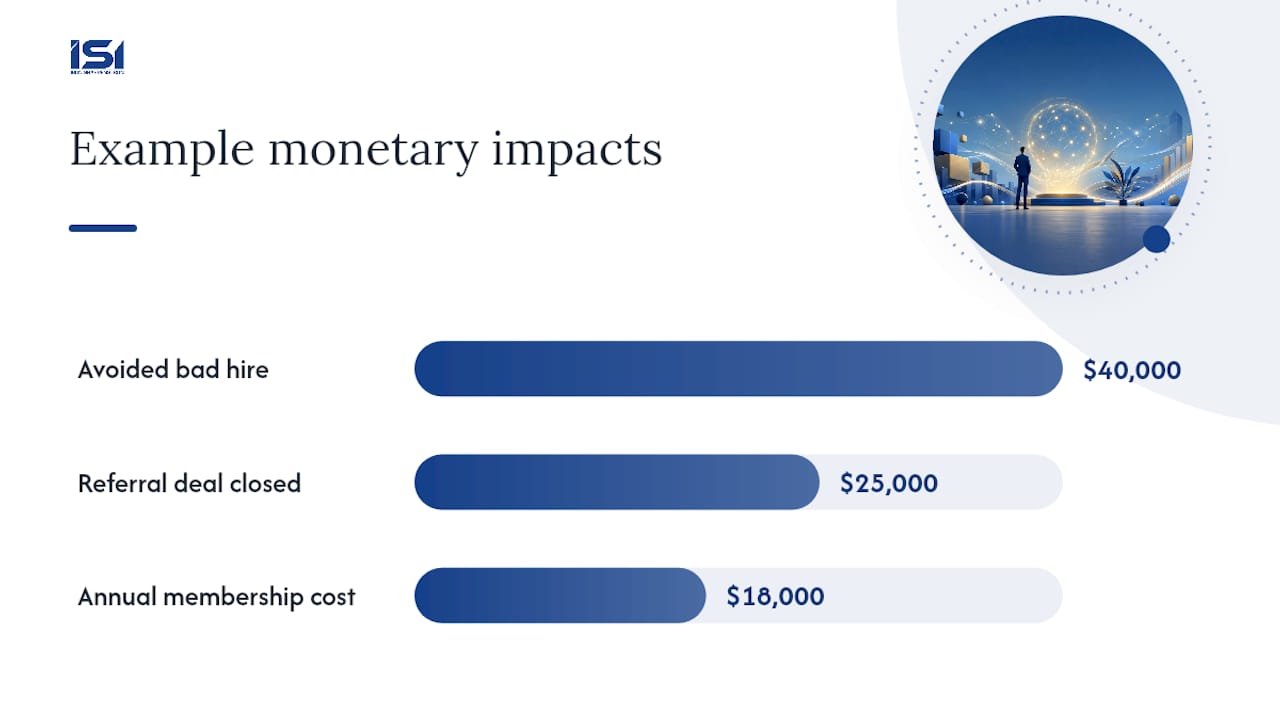
- Avoided bad hire: A member was about to promote an internal candidate into a sales leadership role. Two peers who had made the same mistake talked him out of it, saving an estimated $40,000 in severance, backfill costs, and lost sales momentum over six months.
- One referral deal: A warm introduction from a fellow member closed a $25,000 contract that would not have existed otherwise, against an annual membership cost of $18,000.
- Pricing change after peer review: A member raised prices 8% after a session exposed he was underpricing relative to market. On substantial annual revenue, an estimated percentage increase in pricing can generate additional annual margin.
Run the math twice: once with conservative assumptions (lower estimated value, higher time cost) and once with optimistic ones. If the conservative version still clears breakeven, the membership is doing real work. If only the optimistic version does, you are rationalizing a sunk cost.
The Real Cost of a Mastermind: Tuition, Time, and Travel
Tuition is the number on the invoice. It is rarely the number that matters.
Entry-level peer groups often run several thousand dollars annually. Mid-tier programs typically charge significantly more, and premium or executive-tier cohorts can exceed those amounts. Whatever tier you are evaluating, the honest ROI math on agency masterminds shows that once you add time and travel, realistic all-in costs often run 1.5 to 2 times the tuition sticker price.
Calculate time cost with a simple hours times value formula. If sessions, prep, and follow-up eat 6 hours a month and your effective hourly value is $150, that is $10,800 a year, on top of tuition.
Before you sign anything, check for:
- Cancellation and refund terms if the group is not delivering
- Whether events and retreats are included or billed separately
- Confidentiality terms, and whether they are written down or assumed
- Minimum commitment length and renewal notice windows
How to Vet a Mastermind Before You Join or Renew
Room quality predicts outcomes more reliably than curriculum or branding. A mastermind ROI vetting framework built around leading and lagging indicators gives you a structure; here is how to apply it before you commit a dollar.
Fit criteria to look for, including tips on finding complementary founders and peers, are detailed in this guide on how to find a cofounder:
- Member caliber matches or exceeds your own stage of business
- The facilitator actively directs the conversation instead of just moderating
- Every member is expected to contribute, not just observe
- Confidentiality is stated plainly, not implied
- The group can show you specific, recent outcomes from real members
Red flags that predict a wasted year, according to analysis on why most masterminds fail to deliver:
- Nobody can cite a number. No revenue impact, no cost avoided, nothing concrete
- One person dominates every session while others stay quiet
- High member turnover between cohorts
- No accountability structure between sessions
- Sales pitches disguised as content
Use your first 90 days as a trial, then apply a renewal filter: did leading indicators show up on schedule, and did you document the value? If the answer is no on both counts, that is your answer on renewal too.
Pro Tip: Ask to sit in on a sample session before joining. Watch who talks, how disagreements get handled, and whether the facilitator lets vague answers slide. That one visit tells you more than any sales call.
What to Expect in Months 1, 6, and 24
The first 90 days should produce leading indicators only: faster decisions, a few implemented actions, maybe one solid introduction. Do not expect revenue yet.
By months 4 to 6, if you have actually implemented ideas rather than just discussed them, you should see at least one measurable outcome. That could be a pricing change, a closed introduction, or a documented cost avoided.
Network effects compound over 6 to 24 months as trust deepens and members start bringing you opportunities unprompted. If you hit month 6 with zero leading indicators and no implemented actions, that is the signal to change groups, not push through another renewal hoping it improves.
An ISI Brotherhood View on Measuring What Matters
Iron Sharpens Iron built its structure around the same principle this article argues for: room quality drives outcomes, so get the right men in the room before you worry about content or curriculum. Every member sits inside a Personal Board of Advisors, a small cohort built for depth of accountability rather than breadth of networking.
Weekly meetings protect the rhythm that makes leading indicators possible in the first place. Miss the cadence and you lose the compounding effect long before you lose the tuition. A year-round online community and leadership events extend the network pillar past the weekly session, and the ISI Brotherhood Foundation adds a layer of purpose beyond the balance sheet.
Confidentiality gets made clear from day one, not assumed and not left to a handshake. That single practice is what lets men actually say the number, not just the version of the story that makes them look good.
Members may track attendance, actions taken between sessions, introductions made, and outcomes from leadership events, the same dashboard outlined earlier in this piece. Author Derek's reflections on whether a mastermind group is right for you explore this fit question directly.
Putting a Number on Intangible Value
Network value and mentorship quality resist a clean dollar figure, but you can still bound them instead of waving them off as unmeasurable.
One method: assign a replacement cost. If a peer connection saved you from hiring a consultant, price the membership against what that consultant would have charged. A strategic pivot suggested by a mentor figure in the room can be valued against the cost of a business coach charging by the hour for the same insight.
A second method: track referral density. Count how many warm introductions came from the group over a year and multiply by your average deal value, even if only a fraction convert. If you get eight introductions and your close rate on warm leads is 25%, at an average deal size of $8,000, that is a projected $16,000 in pipeline value, whether or not every deal closes this quarter.
A third method: score mentorship quality on a simple 1 to 5 scale after each session based on whether the advice changed a decision you actually made. Low scores over several months are data too. They tell you the room is talking, not helping.
None of these give you audit-grade precision. They give you a defensible number instead of a shrug, and a defensible number is what a renewal decision actually needs.
When a Mastermind Is the Right Capital Allocation
Join when you have real decisions to bring to the room and the discipline to act on what you hear. Wait if you cannot commit to weekly attendance or if you are joining to feel less alone rather than to solve a specific problem.
Two behaviors separate members who see returns from those who do not: show up every week without fail, and apply at least one idea within 30 to 60 days of hearing it. Track everything conservatively. A number you can defend at renewal beats a feeling you cannot.
— Derek
ISI Brotherhood: A Faith-Based Mastermind Built for Measurable Growth
Most masterminds ask you to trust the process. ISI Brotherhood gives you a structure built to produce the leading indicators this article just walked through: a Personal Board of Advisors instead of a large anonymous cohort, a weekly cadence instead of a monthly call you forget to prepare for, and confidentiality made clear from day one instead of assumed.
That structure supports growth across five key areas often measured: personal, spiritual, relational, professional, and financial. If you are weighing whether a faith-based peer group can produce the same financial and strategic returns outlined in the dashboard above, the honest answer is that it depends entirely on whether you show up and apply what you hear, the same rule that governs every mastermind on this list.
If that sounds like the room you have been looking for, read what it means to lead your household and your business at the same time and reach out to learn about faith-based mastermind cohorts.
Sources
FAQ
How much do masterminds typically cost?
Entry-level peer groups often run $3,000 to $10,000 a year, mid-tier programs commonly range from $10,000 to $50,000, and premium executive cohorts can exceed that. Once you add time and travel, realistic all-in costs often run 1.5 to 2 times the tuition price.
Is 100% ROI the same as breaking even?
No. A 100% ROI means the value generated equals the cost, doubling your money on that investment, while breaking even means value generated exactly matches cost with zero net gain.
What is the mastermind principle?
The mastermind principle describes a peer-learning format where members support one another in solving business or personal challenges through structured, ongoing accountability, a concept detailed on Wikipedia's mastermind group entry. ISI Brotherhood applies this through its Personal Board of Advisors model.
How soon should I expect measurable returns from a mastermind?
Expect leading indicators like faster decisions and implemented ideas within the first 90 days, with clearer financial payback typically showing up between 6 and 24 months depending on how quickly you act.