

Every faith-based mastermind that lasts follows five non-negotiable mastermind rules: curate membership deliberately, set a fixed cadence, require confidentiality in writing, run a structured agenda, and enforce accountability with real consequences. Skip any one of these, and the group drifts into a coffee chat with better attendance.
These rules are built for Christian men's cohorts, where trust runs deeper than a typical networking circle because the conversation touches faith, marriage, and financial pressure in the same breath. Isibrotherhood structures its Personal Board of Advisors model around this exact framework.
Here's what following just one rule looks like in practice:
- Cadence rule in action: a group defaults to a 75 to 90 minute session every two weeks, no exceptions, no rescheduling for convenience.
- Confidentiality rule in action: every new member signs a one-page guideline before their first hot seat, not after an awkward moment forces the conversation.
Key Takeaways
A faith-based mastermind works when membership is curated deliberately, meetings follow a fixed cadence and structured agenda, confidentiality is written down rather than assumed, and accountability carries real consequences.
| Point | Details |
|---|---|
| Curate before you recruit | Target six to ten members at similar ambition and life stage rather than filling seats quickly. |
| Fix your cadence early | Choose weekly, biweekly, or monthly based on urgency, then commit to it without exception. |
| Put confidentiality in writing | Draft a Group Guidelines document covering attendance, recordings, and payment terms before your first hot seat. |
| Escalate conflict fairly | Use a private conversation, formal warning, mediation, and removal ladder instead of ad hoc reactions. |
| Consider a pre-built model | Isibrotherhood places vetted Christian men into weekly Personal Board of Advisors groups with confidentiality standards already in place. |
Table of Contents
- Who Belongs in Your Mastermind Group?
- How Often Should a Mastermind Meet?
- What Confidentiality Rules Should Every Group Have?
- Should Your Mastermind Use a Paid Facilitator or Peer-Led Rotation?
- How Do You Make Accountability Actually Work?
- What Happens When Conflict Arises in the Group?
- How Should New Members Be Onboarded?
- How Should Members Communicate Between Sessions?
- How Do You Handle Diversity Within a Faith-Based Mastermind?
- How ISI Applies These Mastermind Rules in Practice
- Ready to Join a Group Built on These Rules?
- Sources
Who Belongs in Your Mastermind Group?
Six to ten members is the working range that shows up across peer advisory research, and there's a reason it holds. Below six, you lose the range of perspective a hot seat needs. Above ten, someone stops talking by month three, and silence in a mastermind is a slow leak. MindTools frames this size band as the point where accountability and intimacy coexist.
Vetting isn't about pedigree. It's about fit. Ask each prospective member:
- What are you building toward in the next 12 months, spiritually and professionally?
- Can you commit to attendance for a full quarter before evaluating fit?
- Are you willing to be corrected by peers, not just encouraged by them?
- What would make you leave a group like this?
Curating for shared ambition and comparable life stage, rather than star power, keeps the room honest. Forbes Coaches Council members consistently point to intentional curation as the single biggest predictor of whether a group survives past its first six months.
Pro Tip: Write a one-sentence mission statement before your first meeting. Something like, "We exist to help each other lead our businesses, marriages, and faith with integrity over the next year." Read it aloud at every session.
How Often Should a Mastermind Meet?
Cadence depends on what your group needs to accomplish, not on what's convenient to schedule.
- Monthly works for established executives with lower urgency, where the goal is strategic reflection rather than weekly course correction.
- Biweekly is the sweet spot for most Christian business owners balancing growth pressure with family and church commitments.
- Weekly fits early-stage founders or men in a season of crisis, where accountability needs a shorter feedback loop.
A copyable 75 to 90 minute agenda:
- Opening wins and prayer (10 minutes)
- One or two hot seats, 20 to 25 minutes each
- Group feedback and Scripture-informed counsel (15 minutes)
- Commitments recorded aloud (10 minutes)
- Next session scheduling and closing (5 minutes)
Rotate the hot seat so the same two guys don't dominate every session. A simple sign-up sheet or shared spreadsheet keeps sharing even and prevents the quietest member from going three months without airtime.
What Confidentiality Rules Should Every Group Have?
A mastermind without written confidentiality rules is a rumor mill waiting to happen. Some groups use a mutual non-disclosure agreement; others rely on a written Group Guidelines document. Either works, but it has to exist on paper, not just in someone's memory of what was agreed at the first meeting. SCORE's guidance on building a mastermind that gets results lists cadence, meeting length, member limits, and vetting criteria as the baseline items every document needs.
Your Group Guidelines should include:
- What's said in the room stays in the room, full stop, including business figures and family struggles.
- No recording sessions without unanimous consent.
- Attendance expectations and what triggers a conversation about commitment.
- Payment terms if a facilitator is compensated, including what happens on a missed month.
- A review date, so the document gets revisited rather than forgotten.
A tool like ClickUp's host service agreement template offers useful language for formalizing scope and dispute resolution if your group hires an outside facilitator.
Pro Tip: Store your guidelines in a shared folder every member can access, and read the confidentiality clause aloud at the start of any session with a guest or new member present.
Should Your Mastermind Use a Paid Facilitator or Peer-Led Rotation?
A paid facilitator brings coaching skill and someone willing to enforce hard conversations without personal stakes in the outcome. That costs money, and it shifts the group's dynamic from purely peer to lightly coached. Peer-led rotation costs nothing but requires members willing to hold each other accountable without a neutral referee in the room, a tradeoff Phoenix Forum's founder checklist treats as one of the seven core decisions any group has to make deliberately.
Whichever model you choose, define these roles clearly:
- Facilitator or lead: keeps time, enforces the agenda, and calls out avoidance.
- Timekeeper: protects the hot seat structure so one story doesn't eat the whole session.
- Secretary: records commitments so nothing gets forgotten by the next meeting.
- Coordinator: handles scheduling and onboarding logistics for new members.
Rotate the lead role quarterly if you're peer-led. It spreads ownership and keeps the group from depending on one personality to hold it together.
How Do You Make Accountability Actually Work?
Vague commitments produce vague results. "I'll work on my marketing" doesn't survive contact with a busy week. A SMART commitment does: specific, measurable, achievable, relevant, time-bound. "I will call three past clients by Friday" is something the group can actually follow up on next session.
Track commitments in a shared document or a simple accountability tracker, not in your head.
- Log every commitment with the member's name, the specific action, and the deadline.
- Assign accountability partners for between-meeting check-ins, ideally a quick text or call midweek.
- Report progress at the start of the next session before moving to new business.
Consequences for repeated non-compliance should escalate, not punish out of proportion. A first miss deserves a direct but gracious conversation. A pattern deserves a formal check-in about whether the group is still the right fit. Continued non-compliance, after fair warning, justifies a probation period or respectful exit.
Pro Tip: Ask each member to state their commitment as a question at the end of the meeting: "Will I call three clients by Friday?" Answering aloud creates a different kind of ownership than writing it silently.
What Happens When Conflict Arises in the Group?
Conflict in a mastermind isn't a sign of failure. It's a sign the group is real. What matters is having a process before you need one.
- Private conversation first. The facilitator or a trusted peer addresses the issue directly with the member involved, away from the group.
- Formal warning. If the behavior continues, the group states the concern explicitly and in writing, referencing the Group Guidelines.
- Mediation. A neutral third party, often a facilitator or an outside advisor, helps work through unresolved tension.
- Removal. If nothing changes, the member exits with dignity, and confidentiality obligations continue after departure.
Document each step briefly, dates and decisions only, so memory doesn't become the record. After a removal, give the remaining group time to rebuild trust before adding someone new. The Success Alliance notes that written guidelines give facilitators a neutral standard to point to, which keeps enforcement from feeling personal.
How Should New Members Be Onboarded?
A new member walking into a mastermind cold, without context, is set up to either overshare or stay guarded for months. Neither serves the group.
Start with a pre-meeting orientation call, ideally with the facilitator or a founding member. Cover the Group Guidelines document line by line, not as a formality but as a real conversation about what confidentiality and commitment mean in this specific room. Share a brief history of the group: how long it's been running, what kinds of challenges members have brought to the table, and what tone the hot seat conversations typically take.

Give the new member a "first 90 days" expectation. Attend every session without exception. Listen more than you speak for the first two or three meetings before taking a hot seat slot yourself. Bring one real challenge to the table by the second month, not a polished success story.
Assign a buddy, an existing member who checks in between the first few sessions to answer questions and smooth the transition. This matters more in faith-centered groups than in standard business networking circles, because vulnerability comes faster when someone's spiritual life is part of the conversation. A member who feels rushed into disclosure without trust often withdraws rather than engages.
Close the onboarding loop with a short written recap: who's in the group, what the current commitments are, and where the shared documents live. A new member who starts organized stays engaged longer than one left to piece things together from context clues over several sessions.
How Should Members Communicate Between Sessions?
The meeting itself is only part of what makes a mastermind work. What happens between sessions determines whether accountability sticks or quietly evaporates.
Set expectations early for outside communication. A private group chat or forum works well for quick wins, prayer requests, and short check-ins, but it should never become a substitute for the deeper conversation reserved for meetings. Define what's appropriate to share there versus what waits for the hot seat.
Midweek accountability check-ins, a text between partners asking "did you make that call?", keep commitments alive without turning into constant monitoring. Keep these light and specific. A one-line update beats a paragraph nobody has time to read.
Avoid using outside channels to relitigate a disagreement from the meeting. If tension surfaces in a text thread, move it to a phone call or the next session rather than letting it fester in writing where tone gets lost.
Respect response-time boundaries. Business owners run on unpredictable schedules, and a group that expects instant replies outside of meetings creates quiet resentment. Agree on a reasonable window, 24 to 48 hours is common, and let the group guidelines document reflect it.
Pro Tip: Designate one thread or channel purely for prayer requests and wins. Keeping it separate from logistics and scheduling chatter means members actually read it.
How Do You Handle Diversity Within a Faith-Based Mastermind?
The strongest peer advisory groups combine diversity of background with a shared altitude of responsibility. Members from different industries, different denominations within the Christian faith, and different life stages bring perspective a room of identical founders never will. What matters more than uniformity of background is comparable weight of decision-making responsibility, according to guidance from Great Game's research on effective peer advisory groups.
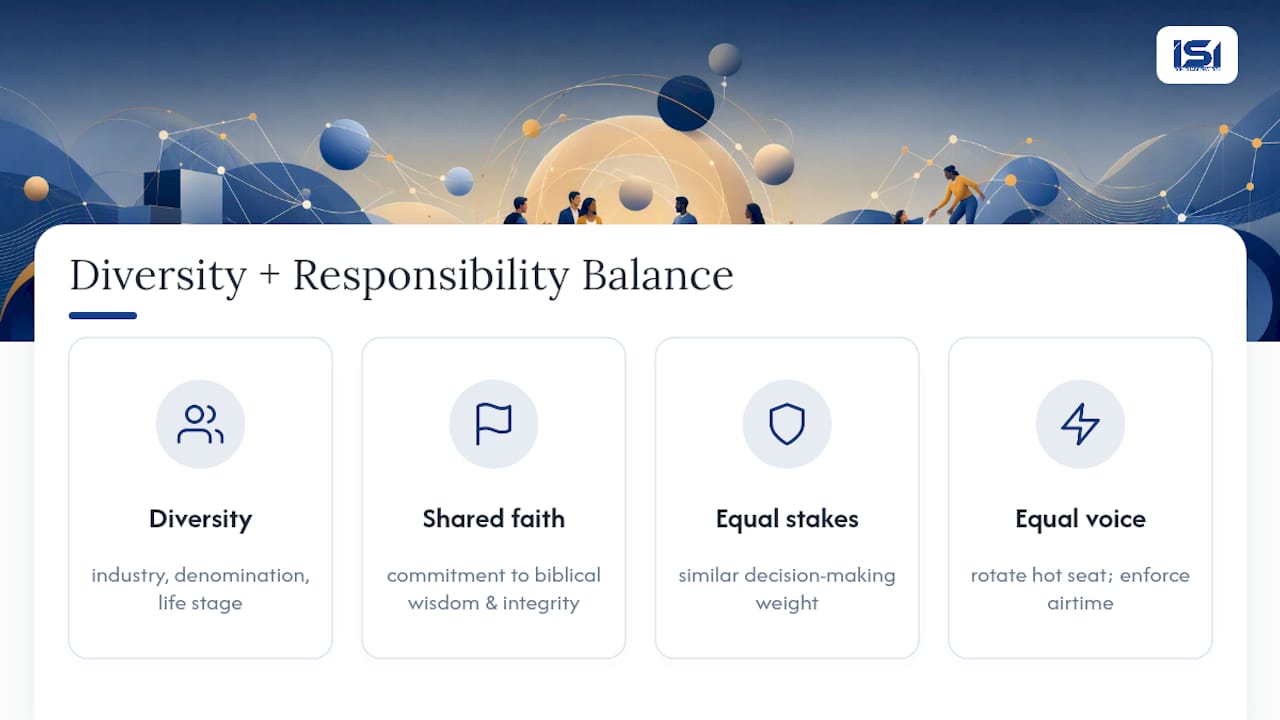
A group of business owners at similar revenue stages, even across different industries and denominational backgrounds, tends to give better feedback than a group split between a solo consultant and a 200-employee CEO. The gap in stakes makes advice feel theoretical rather than relevant.
Faith diversity within a Christian mastermind deserves the same care. Members may come from different traditions, different worship styles, different theological emphases. The unifying thread should be a shared commitment to biblical wisdom and personal integrity, not agreement on every doctrinal detail. Groups that get specific about this in their guidelines, naming the shared faith commitment without demanding denominational uniformity, avoid friction that derails otherwise strong cohorts.
Watch for lopsided dynamics where one member becomes the unofficial mentor and others become passive listeners. Rotating the hot seat and enforcing equal airtime, covered earlier in the agenda structure, keeps the group from tilting into an informal coaching relationship that undercuts genuine peer accountability.
How ISI Applies These Mastermind Rules in Practice
Isibrotherhood built its entire model around the rules covered here, not as an afterthought but as the foundation. Every member gets placed into a Personal Board of Advisors, a small, trusted group of Christian men who meet regularly and hold each other accountable across personal, spiritual, relational, professional, and financial ground.
ISI enforces vetting before placement, requires confidentiality as a baseline expectation, and runs on a consistent weekly meeting cadence rather than leaving frequency to chance. The faith commitment shared across every group changes what "accountability" means. It's not just business metrics; it's character. Men considering placement should expect a genuine screening conversation, not a rubber stamp, because the whole model depends on the room being right.
— Derek
Ready to Join a Group Built on These Rules?
Building your own mastermind from scratch means writing every guideline, vetting every member, and hoping the cadence holds once life gets busy. Isibrotherhood removes that startup friction entirely: you get placed directly into a Personal Board of Advisors that already runs on weekly meetings, written confidentiality standards, and a vetting process designed specifically for Christian business leaders.
Membership includes weekly mastermind meetings, access to a year-round online community, leadership events, and a group screened for shared ambition and faith commitment, the exact curation this article recommends building yourself. You won't spend months recruiting the right six to ten men or drafting a guidelines document from a blank page.
If you're ready to stop building a mastermind alone and start meeting with one, request placement with Isibrotherhood and expect a real vetting conversation before you're matched to a group.
Sources
- How to start a mastermind group: 20 expert tips for entrepreneurs - Forbes Coaches Council
- 5 essential rules to building a mastermind group that gets results - SCORE
- How to Choose a Peer Advisory Group: A Founder’s Checklist - Phoenix Forum
- Why mastermind group guidelines matter - The Success Alliance