
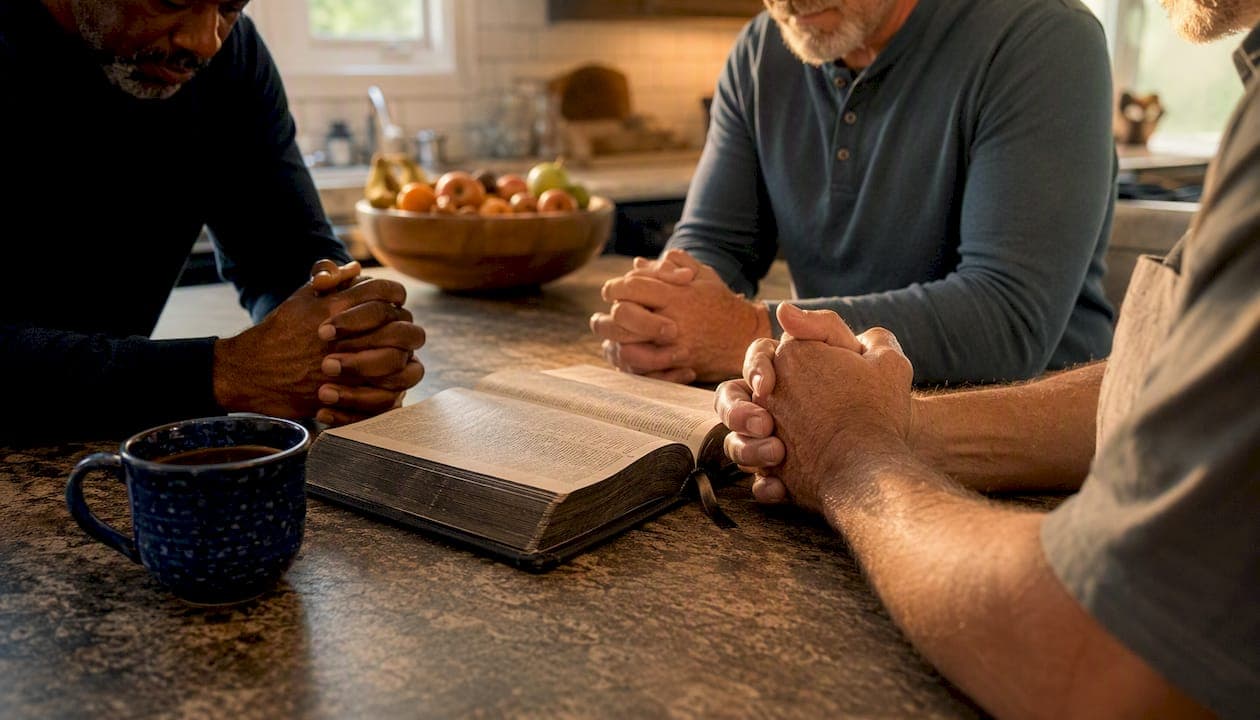
A Christian men's accountability group is a small, committed circle of men who meet regularly to pray together, confess honestly, study scripture, and hold one another to the life God has called them to live. The verdict is simple: join or start a structured small group of men, sign a written covenant, and commit to a regular meeting cadence before you feel ready. Waiting for the perfect moment is how years slip by. Attend one meeting this week, or recruit two men and draft a 3-month trial covenant. Resources like Lifeway's guidance on group size, Patrick Morley's small-group practices, and structured programs like Iron Sharpens Iron (ISI) give you proven starting points so you are not building from scratch.
Key Takeaways
A Christian men's accountability group works when it combines relationship-first culture, a written covenant, regular cadence, and a clear referral pathway for serious disclosures.
| Point | Details |
|---|---|
| Ideal group size | Lifeway guidance recommends 4–8 men to give every member sufficient air time each meeting. |
| Written covenant is non-negotiable | A signed covenant covering confidentiality, attendance, and consequences separates groups that last from those that drift. |
| Shame kills honesty | Groups that actively eliminate shaming dynamics create the safe table where real confession and restoration can happen. |
| Structure enables vulnerability | The Five Locks framework (cadence, container, contract, calibration, consequence) correlates with groups that can persist long term. |
| Isibrotherhood as a structured option | ISI places men into trained, facilitated Personal Boards of Advisors covering personal, spiritual, relational, professional, and financial growth. |
Table of Contents
- What is a Christian men's accountability group, and why does it exist?
- Why do most men's accountability groups fail or cause harm?
- What are the core keys to making a men's accountability group actually work?
- How do you start a new group or find and join an existing one?
- What should you realistically expect from membership?
- How do you handle sensitive disclosures and protect everyone involved?
- How do you evaluate an existing group before you join or lead it?
- What a structured mastermind model looks like: the Iron Sharpens Iron example
- What accountability groups taught me that no one talks about
- Isibrotherhood offers a proven path for men who want more
- Sources
What is a Christian men's accountability group, and why does it exist?
At its core, a Christian men's accountability group is a faith-centered brotherhood. Men gather not to perform or impress but to be known, challenged, and restored. The activities are straightforward: prayer, scripture discussion, honest confession, mutual encouragement, and agreed-upon action steps. What makes these groups distinct from a Bible study or a men's breakfast is the mutual accountability. You are not just learning together; you are answerable to one another.
Lifeway's practical guidance reports that most men's accountability cohorts run small groups of men, with a moderate number recommended to give every participant enough "air time." Meetings are commonly weekly or monthly. Smaller groups build deeper trust faster; larger ones dilute vulnerability.
The purposes these groups serve tend to cluster around four areas:
- Spiritual growth: Regular scripture engagement and prayer create habits that solo devotion rarely sustains.
- Honest confession: A safe table where sin and struggle can be named without shame.
- Mutual encouragement: Men speaking truth into one another's marriages, businesses, and faith.
- Leadership development: Sharpening one another's capacity to lead families, teams, and communities.
A typical meeting moves through a recognizable rhythm: a brief personal check-in, an accountability round where each man answers his standing questions, a scripture passage with discussion, group prayer, and specific action steps each man commits to before the next meeting. That structure is not rigid for its own sake. It exists because authentic biblical brotherhood requires repeated investment, and a clear agenda protects that investment from being consumed by small talk.
Why do most men's accountability groups fail or cause harm?
The uncomfortable truth is that most groups dissolve within 6–9 months, and some leave men worse off than when they started. Understanding why is the first step toward building something that lasts.
The most common failure modes include:
- Performance culture: Men answer accountability questions to look good rather than be honest. The group becomes a weekly confession theater.
- Lack of vulnerability: No one goes first. Shallow answers become the norm, and depth never develops.
- Poor structure: No agenda, no facilitator, no covenant. Meetings drift into sports talk and prayer requests for distant relatives.
- Cadence rot: Meetings become biweekly, then monthly, then "we should get together sometime."
- No consequences: Missed commitments carry no weight, so commitments stop meaning anything.
- Shame as a weapon: Leaders or members use confession as leverage, creating a culture of fear rather than grace.
- Absence of pastoral support: Serious disclosures (addiction, abuse, suicidal ideation) surface with no referral pathway in place.
Practitioner analysis finds that lack of discipline, undefined leader roles, and no consequences for missed commitments are among the most common causes of group failure and a persistent barrier to sustained discipleship.
The shame dynamic deserves particular attention. Research and cultural guidance consistently shows that shame stifles honesty. When a man fears judgment more than he trusts grace, he will manage his image instead of confessing his sin. The group becomes a performance stage, and real transformation never begins.

There is also a more theologically serious critique worth sitting with:
That warning, drawn from a critical practitioner perspective, does not argue against accountability groups. It argues for grace-saturated ones. A group that treats confession as a transaction rather than a pathway to restoration will eventually produce men who are better at hiding than healing.
What are the core keys to making a men's accountability group actually work?
Structure without relationship is just a meeting. Relationship without structure is just friendship. The groups that last and produce measurable change hold both. Here are the seven practices that consistently separate thriving groups from ones that quietly fade:
-
Relationship first. Patrick Morley's small-group guidance is direct: groups that prioritize care and vulnerability over performance see deeper, longer-lasting engagement. Spend the first month building trust before you build accountability. Men confess to people they trust, not to people they merely know.
-
Confidentiality as a covenant, not a suggestion. What is said in the room stays in the room, with clearly stated exceptions (imminent harm, mandatory reporting). Write it down. Review it quarterly. A verbal agreement is forgotten; a signed covenant is honored.
-
Regular cadence. Weekly is better than biweekly. Biweekly is better than monthly. The REBL Dads "Five Locks" framework identifies cadence as the first structural lock that keeps groups alive for multiple years rather than dissolving inside 6–9 months.
-
A defined facilitator. Someone must own the agenda, watch the clock, and protect air time. Rotate the role quarterly so no single man carries the burden indefinitely, but never leave a meeting without a named facilitator.
-
A written covenant. Cover attendance expectations, confidentiality, consequences for missed commitments, and the pastoral referral process. Revisit it at the 3-month and 6-month marks. A covenant that is never reviewed is a covenant that is never enforced.
-
Scripture and spiritual disciplines. Bible discussion is not optional decoration. It is the theological anchor that keeps the group from becoming a men's therapy circle. Choose a short passage or a shared reading plan, and let the text drive at least one question per meeting.
-
Pastoral integration. The group is not a substitute for the church; it is an expression of it. Connect your group to a pastor or elder who can receive referrals when issues exceed the group's scope. This protects both the men and the leaders.
Pro Tip: Introduce a lightweight consequence system in your covenant: if a man misses two consecutive meetings without notice, he buys coffee for the group at the next session. It sounds small, but it signals that commitments carry weight. The consequence is not punitive; it is relational. It says, "We noticed you were gone."
The REBL Dads framework also names calibration as a critical lock: schedule regular "state of the group" conversations where every man rates the group's health and names one thing he wants more or less of. Groups that skip calibration drift without knowing it.
How do you start a new group or find and join an existing one?
Starting from scratch feels daunting, but the process is more straightforward than most men expect. Here is a practical sequence:
- Pray and clarify your purpose. Before you recruit anyone, know what kind of group you are building. Spiritual growth? Leadership accountability? Both? Your clarity will shape who you invite.
- Recruit 3–8 men. Look first at your church, then your workplace, then trusted referrals. A simple invite works: "I'm starting a small group of men to meet weekly for prayer, honest conversation, and mutual accountability. Would you be open to a trial meeting?"
- Create a covenant together. Draft it collaboratively at the first or second meeting. Key clauses: confidentiality and its limits, attendance expectations, consequences for missed commitments, pastoral referral process, and a mandatory reporting clause for imminent harm.
- Set your cadence. Weekly is the gold standard. Agree on a day, time, and location before anyone leaves the first meeting.
- Choose your meeting format. A 60–90 minute structure works well for most groups (see the sample agenda below).
- Agree on a 3-month trial. Lower the commitment threshold for skeptical men. A 3-month trial covenant lets everyone evaluate fit before making a longer pledge.
Sample 60–90 minute meeting agenda
| Time | Element | Purpose |
|---|---|---|
| — | Personal check-in | Each man shares one word or sentence about his week |
| — | Accountability round | Each man answers his standing questions honestly |
| — | Scripture + discussion | One passage, two or three questions, open dialogue |
| 60–90 min | Group prayer | Pray specifically for what was shared |
| — | Action steps | Each man names one commitment before the next meeting |
For the first meeting specifically, practitioner onboarding guidance recommends spending time on origin stories (each man shares why he is there), reading the covenant aloud together, and confirming the cadence before anyone leaves. That ritual creates a durable culture from day one.
Covenant template: key clauses to include
- Confidentiality: what stays in the room and what does not
- Attendance: minimum expected presence and how to communicate absences
- Consequences: agreed-upon response to missed commitments
- Pastoral referral: named pastor or counselor the group can contact
- Mandatory reporting: explicit statement that imminent harm to self or others will be reported to appropriate authorities
- Review schedule: covenant revisited at 3 months and 6 months
What should you realistically expect from membership?
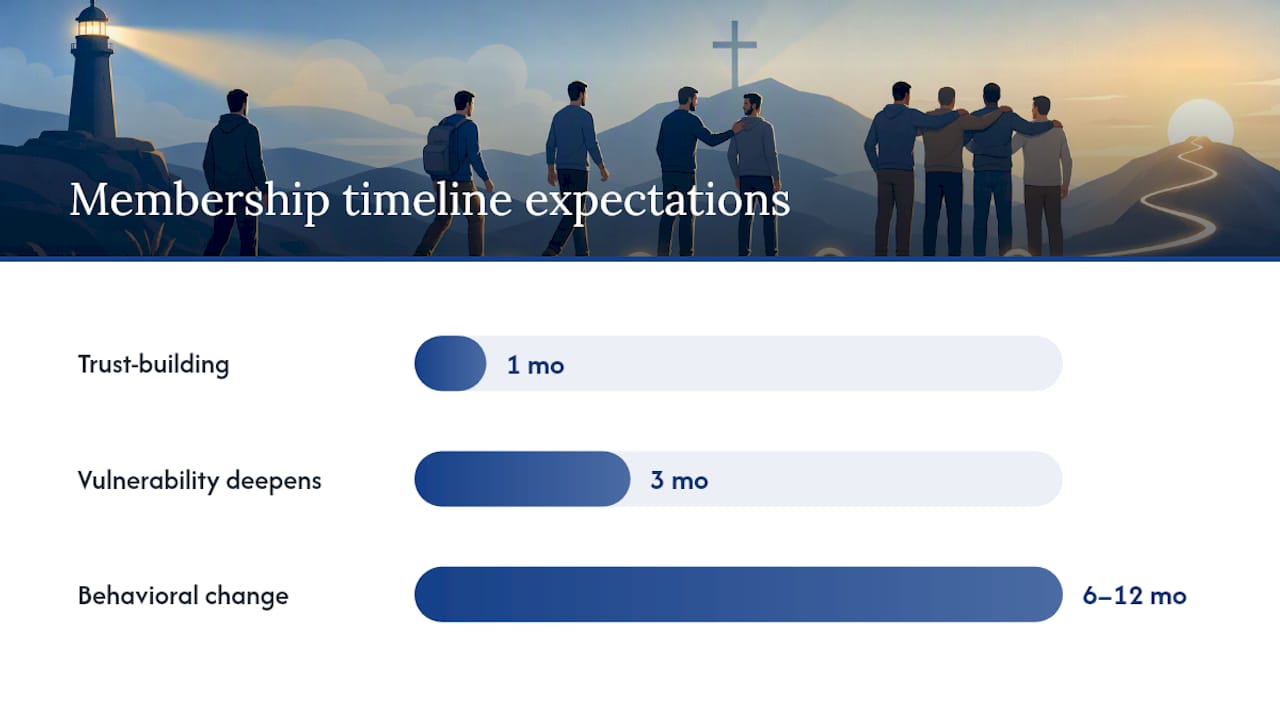
The first month is mostly trust-building. Answers are honest but surface-level. That is normal. By month three, if the group has held its cadence and honored its covenant, vulnerability deepens. Men start naming the real things: the marriage under strain, the business decision that keeps them up at night, the sin pattern they have carried alone for years. By months 6–12, behavioral change becomes visible, not just reported.
Time commitment is real. Plan for 60–90 minutes per meeting, weekly or biweekly, plus occasional one-on-one conversations between sessions. A quarterly group review adds another hour every three months. The Lifeway guidance on group size and frequency recommends a minimum 3-month trial to build enough trust for the group to function at depth, with 6–12 months needed to see measurable behavior change.
Signs you are getting real value:
- You are sharing things you have not told anyone else
- Other men's prayers are specific to your actual life
- You leave meetings with a named commitment, not just a good feeling
- Your wife, business partner, or close friend notices a change in you
Early warning signs that the group is drifting:
- Meetings start late and end early without anyone noticing
- The accountability round gets skipped "just this week"
- One man dominates every conversation
- No one has confessed anything vulnerable in the last month
- The group has not reviewed its covenant since it was signed
The reciprocal nature of these groups is what makes them different from therapy or pastoral counseling. You are not just receiving; you are also giving. That mutual investment is what Patrick Morley's small-group framework identifies as the engine of momentum: care creates value, value creates momentum, and momentum creates disciples.
How do you handle sensitive disclosures and protect everyone involved?
Every group will eventually face a disclosure that exceeds its scope. A man admits to an addiction that is destroying his marriage. Someone shares thoughts of self-harm. A confession involves potential abuse. How the group handles that moment determines whether it is a safe place or a dangerous one.
What leaders and members should do:
- Listen without immediately problem-solving or minimizing
- Affirm the man's courage in speaking
- Ask directly: "Are you safe right now? Is anyone else in danger?"
- Connect him to a pastor, licensed counselor, or crisis line before the meeting ends
- Follow up personally within 24 hours
What to avoid:
- Promising confidentiality you cannot legally keep
- Attempting to counsel serious mental health or addiction issues within the group
- Shaming or moralizing in the moment of disclosure
- Letting the group carry a burden that requires professional support
The escalation sequence matters. When a serious disclosure occurs: (1) address immediate safety, (2) refer to a pastor or licensed counselor, (3) report to authorities if mandated reporting applies (child abuse, credible threats of violence), and (4) support the brother through the professional help process without replacing it.
On privacy and communications: use encrypted messaging apps for group chats, avoid keeping written records of sensitive confessions, and store any shared documents (covenant, prayer lists) in password-protected files. The goal is to protect men's dignity even in digital spaces.
Removing shame from the group's culture is not just a pastoral nicety. It is the precondition for men to speak honestly enough that serious issues surface before they become crises. A man who fears judgment will manage his image until the situation is unmanageable.
How do you evaluate an existing group before you join or lead it?
Not every group that calls itself an accountability group is healthy. Before you commit, ask these questions:
- How often do you meet, and what happens when someone misses?
- Do you have a written covenant that members have signed?
- How do you handle confidentiality, and what are the stated exceptions?
- Who facilitates, and how are serious disclosures handled?
- Is the group connected to a pastor or elder who can receive referrals?
- What does a typical meeting look like from start to finish?
- How long has the group been meeting, and how many original members remain?
Red flags to watch for:
- The leader controls all conversation and rarely shares personally
- Confession is met with shame, correction, or unsolicited advice
- There is no written covenant or the covenant has never been reviewed
- Serious issues are handled entirely within the group with no outside referral
- Attendance is inconsistent and no one addresses it
- The group has no connection to a local church or pastoral authority
A simple pass/fail assessment: if a prospective group cannot answer questions 1, 2, and 3 clearly, observe before you commit. If it cannot answer question 4, decline. A group that has no plan for serious disclosures is not a safe container.
For church leaders evaluating their men's ministry: the healthiest programs integrate small accountability groups with pastoral oversight, provide facilitator training, and build in a referral pathway to licensed counseling. A shepherding facilitator model where the leader prioritizes care over curriculum consistently produces groups where men stay and grow.
What a structured mastermind model looks like: the Iron Sharpens Iron example
For men who want more than a self-organized church group, a structured mastermind model offers a different level of accountability and support. Iron Sharpens Iron (ISI) is one example worth examining closely.
The ISI model places every member into a Personal Board of Advisors: a small, curated group of Christian men who meet weekly in a mastermind format. The focus spans five areas of life: personal, spiritual, relational, professional, and financial. Unlike a DIY church group, ISI provides facilitator training, a placement process that matches men by life stage and professional context, and a year-round online community that keeps the connection active between meetings.
Practical differences between a DIY church group and a structured mastermind:
- Placement: ISI matches members rather than leaving recruitment to chance
- Facilitator training: Leaders are equipped, not just appointed
- Enforced cadence: The structure is built in, not dependent on one man's initiative
- Paid commitment: A membership fee creates skin in the game and filters for seriousness
- Breadth of support: Leadership events, a member directory, and a podcast extend the value beyond weekly meetings
This model fits best for business owners, executives, and professionals who want both spiritual depth and peer advisory accountability. The questions to ask when evaluating any paid mastermind are the same as those above, plus: What is the facilitator's training? How are members matched? What happens if the group is not a good fit?
Pro Tip: Before joining any paid mastermind, attend one meeting as a guest if the program allows it. The culture of a group is visible within the first 20 minutes: watch whether the facilitator protects air time, whether men answer honestly or perform, and whether the conversation moves between the personal and the professional or stays safely in one lane.
What accountability groups taught me that no one talks about
The conventional wisdom says accountability groups fail because men are not vulnerable enough. That is true, but it is only half the story. The other half is that the group's structure either creates the conditions for vulnerability or quietly prevents it.
Groups that survive long enough to matter share one counterintuitive quality: they are boring in the best possible way. The agenda is the same every week. The questions are the same. The facilitator does the same things. That predictability is not a failure of creativity; it is the container that makes honesty feel safe. When a man knows exactly what is coming, he has time to prepare his real answer instead of his managed one.
The failure I see most often is not a lack of commitment from the men. It is a lack of structure from the leader. A group that starts with energy and no covenant will drift within 90 days, not because the men stopped caring but because no one built the container that care requires. The covenant is not paperwork. It is the physical evidence that this group is serious.
Involving a pastor does not make a group punitive. It makes it pastoral. The distinction matters. A pastor in the referral chain is not a disciplinarian waiting to be called; he is a safety net that allows the group to hold harder conversations because everyone knows there is a next step if the conversation exceeds the group's capacity.
Isibrotherhood offers a proven path for men who want more
For men who have tried the self-organized route and found it dissolving by month four, or for those who want to start with a structure that is already proven, Isibrotherhood offers something the typical church group cannot: a managed, results-oriented accountability environment built specifically for Christian business owners, executives, and professionals.
Every ISI member is placed into a Personal Board of Advisors, a small group of vetted Christian men who meet weekly in a mastermind format covering the five areas that actually shape a man's life: personal, spiritual, relational, professional, and financial. The facilitator is trained. The cadence is enforced. The community extends beyond the weekly meeting through a year-round online platform, leadership events, and a member directory. This is not a drop-in group; it is a paid membership, which means every man in the room has made a real commitment. That filter alone changes the quality of conversation.
If you are ready to stop hoping a group will form around you and start building the accountability structure your life actually needs, explore ISI membership and request information about current cohort availability.
Sources
The following sources informed this guide and offer deeper reading on specific aspects of Christian men's accountability: