

Use these five mastermind-ready topic categories and the meeting agendas below to run your next men's small group meeting this week. Isibrotherhood built these prompts the same way Iron Sharpens Iron structures its Personal Board of Advisors sessions: hot seat first, accountability second, faith woven through rather than bolted on.
Here's what you need:
- Pick one life-area category (personal, spiritual, relational, professional, or financial)
- Choose one prompt from that category for your next hot seat
- Grab the 60, 80, or 2-hour agenda template that fits your group's rhythm
- Run it, log commitments, and revisit them next meeting
Key Takeaways
Men's mastermind groups sustain accountability when prompts stay specific, meetings run on a timeboxed hot-seat structure, and commitments get logged and reviewed monthly.
| Point | Details |
|---|---|
| Pick one category first | Choose personal, spiritual, relational, professional, or financial before your next meeting, not all five at once. |
| Use a timeboxed agenda | The 60, 80, or 2-hour templates above keep hot seats disciplined and prevent one member from dominating. |
| Track commitments, not just attendance | Commitment completion rate is a stronger progress signal than how many members show up. |
| Rotate hot seats, stabilize facilitation | Keep the facilitator role steady for a full 8-week cycle while rotating who presents each week. |
| Consider a managed cohort | Isibrotherhood's Personal Board of Advisors model offers a running weekly mastermind structure for leaders who'd rather join than build. |
Table of Contents
- Men's Small Group Topics by Life Area
- What Meeting Format Works Best for a Men's Group?
- Can an 8-Week Curriculum Sustain a Men's Group?
- How Do You Facilitate a Men's Small Group Well?
- How Do You Measure a Men's Group's Progress?
- How Do You Keep a Diverse Men's Group Engaged?
- Who Should Lead a Men's Small Group, and How Often Should That Rotate?
- How Do You Run a Virtual or Hybrid Men's Group?
- What Are the Most Common Problems in Men's Small Groups?
- What Running These Groups Actually Teaches You
- A Managed Alternative to Building Your Own Mastermind From Scratch
- Sources
Men's Small Group Topics by Life Area
A mastermind cohort loses its edge the moment prompts get generic. Iron Sharpens Iron organizes every conversation around five areas: personal, spiritual, relational, professional, and financial. Each demands its own questions, not a recycled version of last week's.
1. Personal growth prompts
- What habit is quietly costing you the most, and what would replacing it actually require?
- Where did you compromise your integrity this month, even in a small way?
- What's the gap between the man you present publicly and the man you are at home?
- If you had to name one fear driving your decisions right now, what would it be?
Month-long challenge: track one personal discipline daily (sleep, exercise, screen time) and report weekly variance to the group.
2. Spiritual formation prompts
- Where has business success made it easier to avoid dependence on God?
- How is your definition of "business as mission" showing up in how you actually run your company?
- What would it look like to treat your business as a calling rather than a career?
These questions borrow directly from marketplace-ministry frameworks that walk leaders through a model of business as mission, then test how that model shows up in daily decisions.
Month-long challenge: identify one marketplace ministry model and journal how your company embodies or resists it.
3. Relational prompts
- Who in your life deserves an apology you haven't given?
- What does your spouse or closest partner need from you this season that you haven't offered?
- Which relationship have you let atrophy because business consumed the bandwidth?
Month-long challenge: schedule one uninterrupted hour weekly with your spouse or closest relationship and report attendance.
4. Professional prompts
- What decision are you avoiding because the fallout scares you more than the mistake itself?
- Is your next hire, pivot, or pricing change driven by data or by fear?
- Where is your business exposed if you disappeared for 90 days?
Month-long challenge: draft a 90-day succession or delegation plan for one critical function you personally hold.
5. Financial prompts
- What's the honest state of your personal finances, separate from the business?
- Are you funding lifestyle or funding legacy right now?
- Where has generosity taken a back seat to accumulation?
Pro Tip: Rotate categories weekly rather than letting one dominate. A group that only discusses professional issues becomes a business roundtable, not a Personal Board of Advisors.
What Meeting Format Works Best for a Men's Group?
Structure beats spontaneity. Christian CEO peer groups that sustain momentum tend to run on a consistent monthly cadence with a hot-seat format, and the agenda below adapts that rhythm for weekly or biweekly cohorts.
60-minute agenda: 5 min check-in and prayer request collection, 10 min devotional tied to one prompt above, 30 min single hot seat, 10 min group feedback and commitment logging, 5 min closing prayer.
80-minute agenda: Mirrors the biweekly leadership cohort model with a scoreboard review added: 10 min scoreboard check against last meeting's commitments, 10 min devotional, 40 min hot seat, 15 min feedback, 5 min prayer.
2-hour agenda: Fits monthly groups needing depth: 15 min check-in, 15 min devotional and short scripture reflection, 60 min hot seat (potentially two members), 20 min feedback, 10 min commitment logging, 10 min closing prayer.
Ground rules every facilitator should read aloud:
- Confidentiality stays inside the room, no exceptions
- One member speaks per hot seat; others hold questions until invited
- Every hot seat ends with a written, dated commitment
Groups that pair hot-seat structure with defined 90-day action plans see sharper follow-through than groups that leave commitments verbal and unlogged.
Can an 8-Week Curriculum Sustain a Men's Group?
Eight weeks gives a cohort enough runway to build trust without losing urgency. Iron Sharpens Iron structures similar short cycles around rotating focus and shared accountability.
- Week 1: Founding session. Reflection format. Set ground rules, confidentiality, and each member's 90-day priority.
- Week 2: Personal hot seat. Member A presents a personal-growth challenge; pre-work is a one-page self-assessment.
- Week 3: Spiritual workshop. Group discusses one marketplace-ministry model together, no single hot seat.
- Week 4: Relational hot seat. Member B presents; pre-work is a conversation with a spouse or key relationship beforehand.
- Week 5: Professional hot seat. Member C presents a business decision; pre-work is a one-page decision brief.
- Week 6: Financial workshop. Group reviews giving, saving, and business risk exposure together.
- Week 7: Second-round hot seat. Rotate back to Member A or D for follow-up accountability.
- Week 8: Review and recommitment. Each member reports on their original 90-day priority and sets the next one.
Rotate hot-seat duty so no single member dominates airtime across the cycle. Track each member's 90-day commitment on a shared log everyone can see at the start of every session.
How Do You Facilitate a Men's Small Group Well?
The facilitator's real job is protecting the clock and the confidentiality line, not dominating the conversation.
- Timebox every hot seat visibly. A phone timer works; announce when five minutes remain.
- Redirect a dominant speaker with a direct line: "Let's hear from someone who hasn't spoken yet."
- Track commitment slippage by asking, at the top of each meeting, "What did you commit to last time, and did you do it?"
- Keep devotional and prayer brief and placed at the start or end, never in the middle of a hot seat.
Pro Tip: Script your redirect lines in advance. Saying "we need to make room for others" cold, in the moment, feels awkward. Rehearsed, it feels like leadership.
How Do You Measure a Men's Group's Progress?
Accountability without measurement is just conversation. Track a handful of indicators monthly rather than guessing whether the group is working.
| Indicator | What It Tracks |
|---|---|
| Commitment completion rate | Percentage of logged 90-day commitments actually completed by the next review |
| Net progress score | Self-reported 1 to 10 rating across the five life areas, compared month over month |
| Business KPI movement | One tracked metric per member (revenue, hires, pipeline) tied to hot-seat decisions |
| Spiritual practice consistency | Frequency of prayer, scripture engagement, or devotional habit reported weekly |
| Attendance and engagement | Meeting attendance plus voluntary participation in feedback rounds |
Follow-through, not attendance, is the leading indicator. A group with perfect attendance but a low commitment completion rate is a social club, not a Personal Board of Advisors.
How Do You Keep a Diverse Men's Group Engaged?
Christian business leaders come from wildly different industries, income brackets, and communication styles, and that mix is an asset if the facilitator manages it deliberately.
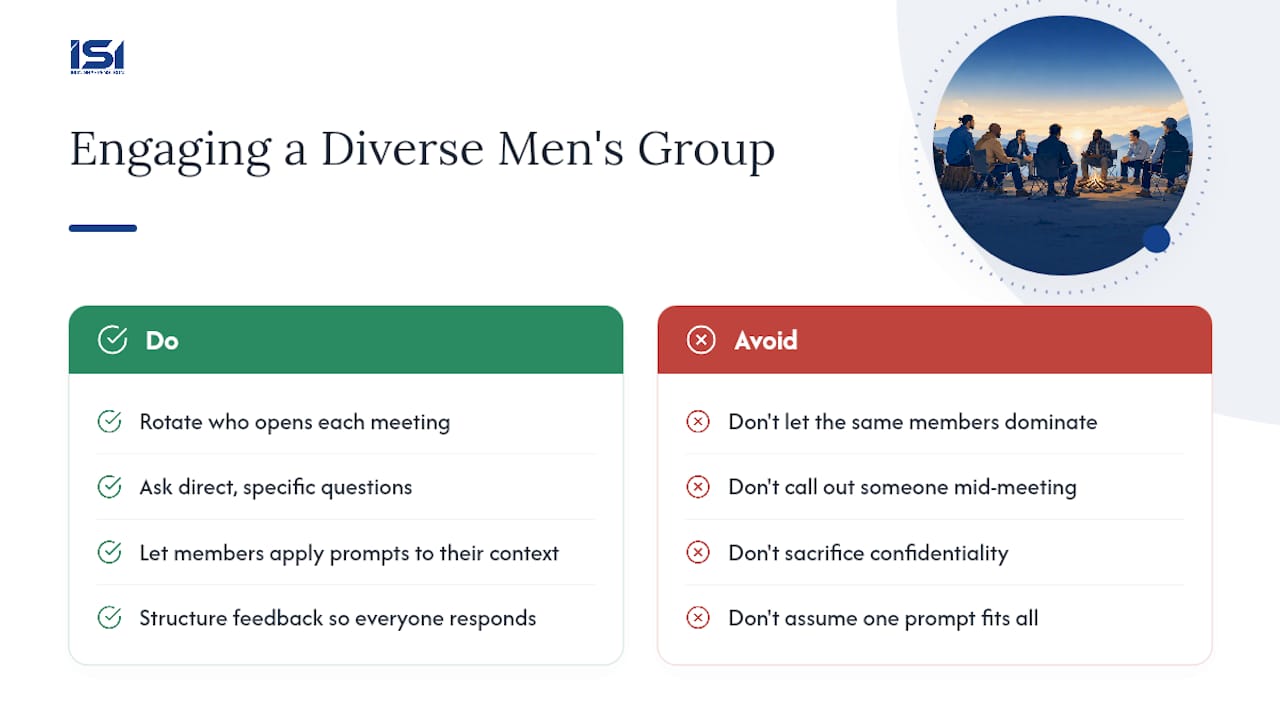
Rotate who opens each meeting so quieter members get first airtime before louder voices set the tone. Ask direct, specific questions rather than open-ended ones. "What's your revenue trend this quarter?" invites a real answer faster than "How's business?" A member running a construction company and a member running a software startup need different framing on the same prompt. Let each apply the question to his own context rather than forcing identical language.
Watch for members who dominate because they're more comfortable talking about money than faith, or vice versa. A facilitator who notices one member always skipping the spiritual prompts should ask about it privately, not call it out mid-meeting. Confidentiality and psychological safety matter more than forced participation.
Age and career stage gaps often produce the richest hot seats. A 60-year-old founder facing succession and a 35-year-old scaling his first hire bring different stakes to the same professional prompt, and hearing both perspectives sharpens everyone's thinking. Structure feedback rounds so every member responds, even briefly, rather than letting the two most vocal men carry the discussion.
Who Should Lead a Men's Small Group, and How Often Should That Rotate?
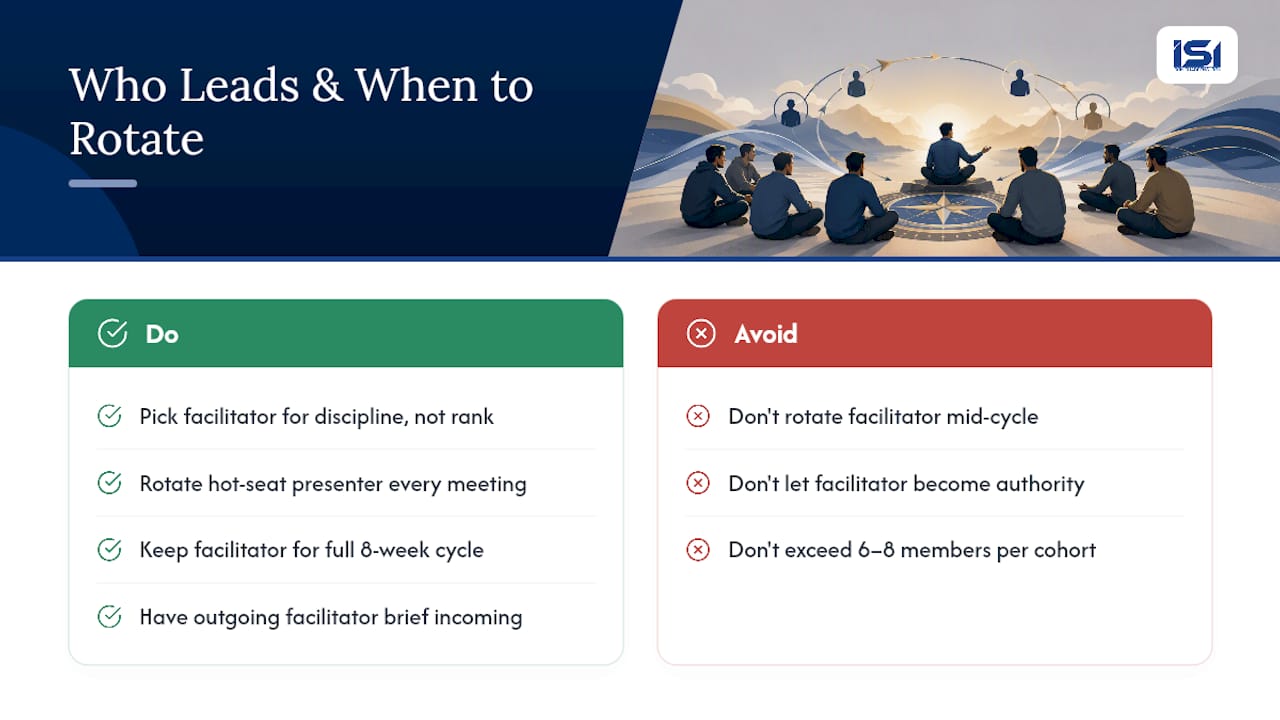
A permanent facilitator builds consistency, but a facilitator who never rotates duties risks becoming the de facto authority figure rather than a peer among equals.
Choose a facilitator based on organizational discipline, not seniority or business size. The role requires someone who tracks time, holds confidentiality, and follows up on commitments between meetings, not necessarily the most successful member in the room. Rotate the hot-seat presenter role every meeting, but keep the facilitator role stable for at least one full 8-week cycle before considering a change. Stability in facilitation protects the ground rules; rotation in hot-seat duty protects fairness.
If a group grows past six to eight members, consider splitting into two smaller cohorts rather than stretching one facilitator across too many voices. Smaller, disciplined cohorts capped around five to six members preserve the depth that a larger roundtable tends to dilute.
When rotating leadership after a cycle ends, have the outgoing facilitator brief the incoming one on unresolved commitments and any confidentiality concerns still in play. A clean handoff matters more than a dramatic changing of the guard. Never rotate mid-cycle unless the current facilitator has to step away entirely, since inconsistency during an active 8-week sequence undercuts the trust the group spent weeks building.
How Do You Run a Virtual or Hybrid Men's Group?
Remote members don't need a diluted version of the in-person format. They need the same structure delivered through a screen with slightly tighter discipline.
Keep hot seats on video, not audio-only. Body language during a hard business admission matters, and a black screen invites disengagement. Use a shared document, visible to everyone, where the presenting member's pre-work and the group's commitment log both live in real time. This replaces the physical whiteboard or notebook a hot seat would otherwise use.
For hybrid meetings mixing in-person and remote members, assign one in-person member as the remote liaison, responsible for making sure the camera angle, audio, and chat questions don't leave virtual participants guessing. Facilitators should call on remote members by name during feedback rounds since they're easiest to accidentally skip.
Shorten the 2-hour agenda to 90 minutes for fully virtual groups. Video fatigue sets in faster than in-person fatigue, and a shorter, tighter format protects engagement better than trying to preserve every minute of the in-person version. Confidentiality agreements matter even more virtually. State explicitly that no one records the session and that screen shares stay private to the group.
What Are the Most Common Problems in Men's Small Groups?
Every mastermind cohort hits the same handful of failure points eventually.
Uneven participation. One or two members talk in every meeting while others go silent for weeks. Fix it by assigning speaking order rather than leaving it open, and by directly inviting quieter members into feedback rounds.
Commitment drift. Members make commitments and quietly abandon them without consequence. Fix it with a visible commitment log reviewed at the start of every meeting, not just when convenient.
Surface-level sharing. Members discuss business wins but avoid the harder personal, relational, or financial admissions. Fix it by having the facilitator model vulnerability first, sharing his own struggle before asking others to.
Scheduling erosion. Attendance drops as business demands increase. Fix it by locking a recurring time slot treated with the same non-negotiable status as a client meeting, and by keeping cohorts small enough that one absence doesn't collapse the meeting.
Facilitator burnout. The same person carries every meeting's logistics indefinitely. Fix it by rotating administrative tasks like commitment tracking and devotional selection, even if the core facilitator role stays stable.
What Running These Groups Actually Teaches You
The gap between a good discussion prompt and a transformative one is specificity. Vague questions produce vague answers, and vague answers produce nothing a man can act on by next Tuesday. The prompts and formats above work because they force a decision, a number, or a named person into the room, not because they sound spiritual or sound strategic. Iron Sharpens Iron built its Personal Board of Advisors model around that same conviction: five life areas, weekly cadence, hot seat first. If you're weighing whether to build this yourself or lean on a structure already tested across hundreds of cohorts, start with the 8-week curriculum above and see what surfaces.
A Managed Alternative to Building Your Own Mastermind From Scratch
Running the agendas and curriculum above will get a self-formed group most of the way there, but building the structure, recruiting the right men, and sustaining facilitation quality month after month is a lot to carry alone. Isibrotherhood removes that burden entirely.
Every Isibrotherhood member gets placed into a Personal Board of Advisors, a small cohort of vetted Christian business leaders who meet weekly to work through the same five life areas covered in this article: personal, spiritual, relational, professional, and financial. Membership includes ongoing accountability tracking, a year-round online community, access to leadership events, and a facilitator model already refined across many cohorts rather than one you have to build and troubleshoot yourself. If the 8-week curriculum above sounds like the right direction but you'd rather join a running group than launch one, visit the Isibrotherhood membership page to see current cohort openings and start your application.