

The most effective morning routine for Christian leaders is a 15 to 20 minute Surrender, Identity, Execute alignment, completed before any email, news, or social media touches your hands. That sequence matters more than the minutes you spend on it. Guard it with one rule: nothing digital until alignment is done. Everything below gives you the templates and protections to run it starting tomorrow.
TL;DR:
- Leaders should prioritize a 15 to 20 minute morning routine of surrender, identity, and execution before engaging with any digital devices.
- The routine includes prayer, scripture declarations, a brief review of priorities, and gratitude, with a focus on maintaining sequence for better decision-making.
- Protect mornings by charging devices outside the bedroom, turning off notifications, and setting strict boundaries on phone access before completing the routine.
- Incorporate short threshold prayers before key moments of the day to maintain alignment and discernment amid high-pressure situations.
- Having a supportive community or a Personal Board of Advisors significantly increases the likelihood of sustaining this morning routine over time.
Table of Contents
- What Is the Surrender, Identity, Execute Framework?
- A Ready-to-Use 15 to 20 Minute Morning Routine
- How Do You Protect the Morning From Getting Hijacked?
- What Are Threshold Prayers and Why Do Leaders Need Them?
- How Should You Audit and Protect Your Week?
- Why This Framework Fits Leaders Who Run in Groups, Not Alone
- Find Your Own Personal Board of Advisors
- Sources
- FAQ
What Is the Surrender, Identity, Execute Framework?
Most leaders default to productivity first: they wake up, grab the phone, and start reacting before they have decided who they are or whose agenda they are serving. That order is backwards. The S-I-E cycle flips it, and the sequence itself is the point.
Surrender comes first: a short prayer of submission, no longer than a couple of minutes, that hands the day's outcomes to God before you touch a single task. This is not passive resignation. It is the leadership equivalent of clearing the deck before a meeting.
Identity follows: brief scripture-based declarations spoken aloud, not just read silently. Speaking truth about who you are in Christ resets the internal script before the market, your team, or a hard client conversation tries to write one for you.
Execute comes last, and only last: a fast review of your top two or three priorities, chosen against your long-term vision rather than whatever screamed loudest in your inbox overnight.
Leaders who run productivity-first mornings tend to confuse urgency with importance by 8 a.m. Leaders who run alignment-first mornings tend to make fewer reactive decisions by lunch. The difference is not motivation. It is sequencing.
- Surrender: submit control before you touch a task
- Identity: declare truth before circumstances declare it for you
- Execute: choose priorities from vision, not from noise
A Ready-to-Use 15 to 20 Minute Morning Routine
Here is a template you can run tomorrow morning without redesigning your whole life around it.
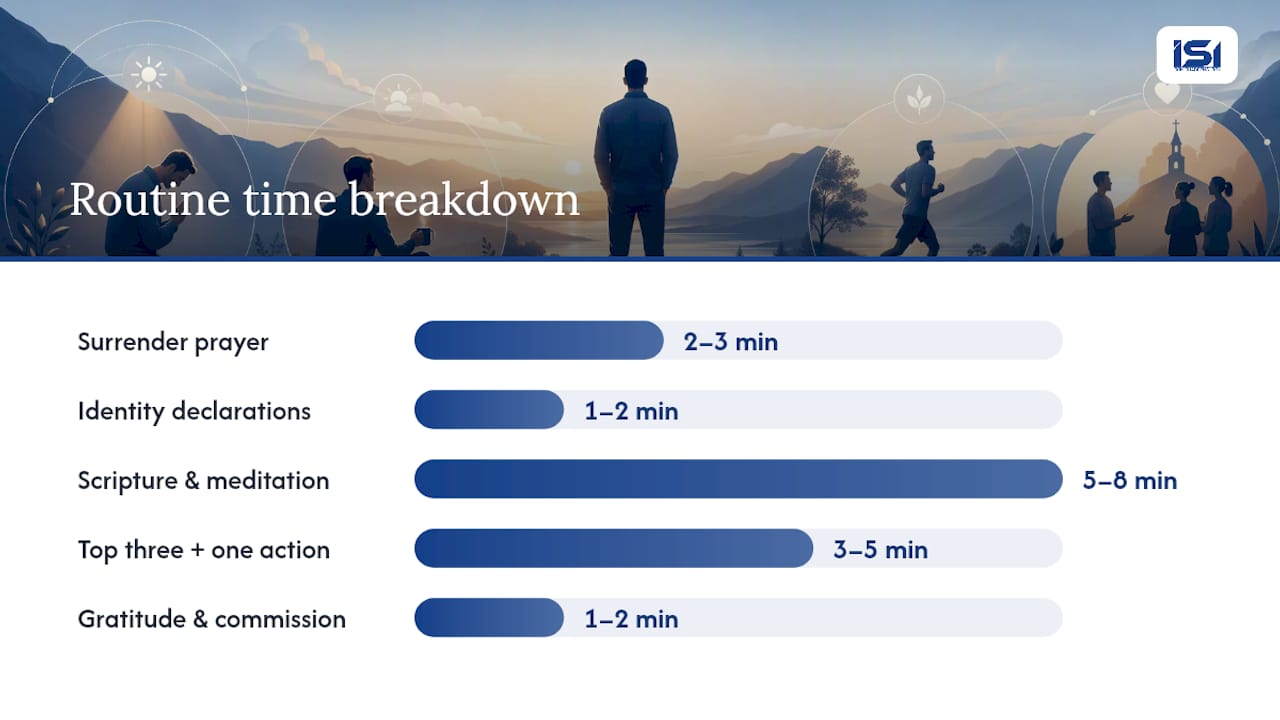
- Surrender prayer (2 to 3 minutes). A short, spoken prayer of submission. Something as simple as "Today is Yours, not mine" repeated with intention counts.
- Identity declarations (1 to 2 minutes). Speak two scripture-based statements about who you are in Christ. Pick ones tied to a current challenge, such as a truth about wisdom if you are facing a hard decision this week.
- Scripture and meditation (5 to 8 minutes). Read a short passage relevant to leadership, sit with it, and let one phrase settle rather than rushing to the next verse.
- Top three priorities and one next action (3 to 5 minutes). Write down your three priorities for the day and the single next physical action on the most important one.
- Gratitude and commission (1 to 2 minutes). Name one thing you are thankful for, confess anything sitting on your conscience, and ask to be sent into the day rather than just released into it.
If mornings get crushed, a structured five-minute version covering just surrender, identity, and alignment still beats skipping the routine entirely. On the other end, a 30 to 45 minute extended version adds journaling and a weekly vision review, useful on Mondays or before a big decision week.
Anchor the routine to something concrete: same alarm, same chair, Bible and journal already open on the table the night before. Journal with one question: "What must I do today that only I can do?"
Pro Tip: Don't judge the routine after one morning. Run it for 21 straight days before deciding whether it fits your life. The first week feels mechanical. By week three it starts running you instead of the other way around.
How Do You Protect the Morning From Getting Hijacked?
A great routine dies fast if your phone buzzes at 6:15 a.m. Practitioner guidance consistently points to removing easy digital access as the simplest, most reliable guard against a morning that gets swallowed by the inbox before it starts.
Do this the night before:
- Write tomorrow's top three priorities before you go to bed, not after you wake up
- Lay out your Bible and journal where you will actually sit
- Charge your phone outside the bedroom
- Set a real alarm clock so the first thing you touch in the morning is not a screen
During the window itself:
- Leave the phone in another room, not just face down on the nightstand
- Use airplane mode if the phone has to be nearby for a legitimate reason
- Auto-respond or schedule the first email send for after your window closes
- Turn off notifications entirely rather than trusting willpower to ignore them
Pro Tip: Tell your spouse or team one sentence: "Unless it's an emergency, I'm unreachable until 7 a.m." Define what counts as an emergency in advance so you are not negotiating the exception at 6:40 a.m. half awake.
What Are Threshold Prayers and Why Do Leaders Need Them?
Alignment does not survive on autopilot past 9 a.m. unless you build in reminders. Threshold prayers are one-sentence prayers said right before a specific moment, and they take five to ten seconds.
Use them right before you walk through a door, dial into a call, or open a hard email:
- "Lord, let me lead this room, not perform for it."
- "Give me discernment before I speak."
- "Let this decision serve people, not just the numbers."
- "Slow me down before I react."
- "Help me listen before I fix."
- "Let my next words build, not tear down."
Tie each one to a physical cue: walking through your office door, taking a sip of water before a call, standing up from your desk. The cue does the reminding so you do not have to rely on remembering.
How Should You Audit and Protect Your Week?
A daily routine without a weekly check drifts. Once a week, usually Sunday night or first thing Monday, run a 15-minute audit:
- Score the week from 1 to 10 on how well you actually protected the morning window.
- List your top two or three stressors from the week, named specifically rather than as vague overwhelm.
- Assign one scripture anchor to each stressor, something you can return to when that same pressure resurfaces.
Sabbath belongs in the same rhythm, not as an afterthought once everything else is handled. Define the actual scope of your rest ahead of time, turn off notifications for the block, and hand off anything urgent before it starts rather than mid-Sabbath. When a season gets heavy, extend the pattern into a quarterly focus day or a longer retreat rather than trying to cram a reset into one more busy morning.
Why This Framework Fits Leaders Who Run in Groups, Not Alone
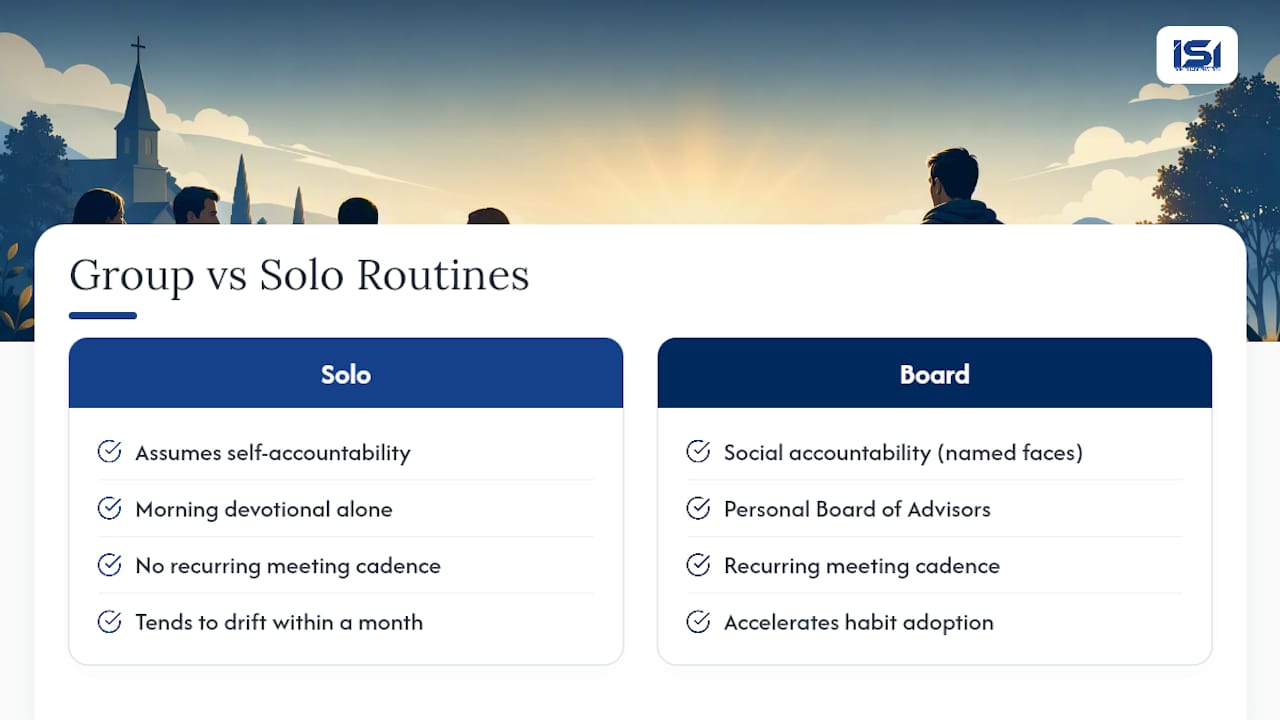
Most morning routine advice assumes you will hold yourself accountable. In practice, leaders who try to sustain a new rhythm solo tend to drift within a month. Supportive communities exist because we've watched that pattern repeat: intention is never the problem, isolation is.
Members sit inside a Personal Board of Advisors, a small group of men who meet regularly and ask real questions about the personal, spiritual, relational, professional, and financial areas of life. That structure does something a morning devotional alone cannot: it puts a name and a face on your follow-through. Small-group accountability paired with a recurring meeting cadence accelerates habit adoption because the obligation is social, not just personal.
Derek, who writes for ISI Brotherhood, built this piece around a simple conviction: alignment before output is not a nice idea, it is the actual leadership advantage. A routine you run alone stays fragile. A routine backed by a Personal Board of Advisors tends to hold.
Find Your Own Personal Board of Advisors
A morning routine gets you aligned. A room of men who ask about it next Tuesday is what keeps you aligned. That is the gap most solo habit trackers and devotional apps cannot close, and it is the exact gap ISI Brotherhood was built to fill.

ISI Community gives you access to the broader ISI Brotherhood network, resources, and events for $97 a month. It is the entry point for men who want the accountability structure without jumping straight to a weekly cohort. ISI Mastermind, at $650 a month, puts you inside a small Personal Board of Advisors with weekly meetings where surrender, identity, and execution get tested against real business decisions, not just journal entries. If you need a harder reset than a daily routine can provide, the Deep Dive ONE THING Retreat is built for that.
The right move today is simple: pick the level of accountability that matches where you actually are, not where you wish you were, and see which ISI option fits.
Sources
- The Morning Routine That Changes Everything | 10X Life Plan
- Leadership: How to integrate your faith with a high-pressure career — Layne McDonald
FAQ
How Long Should a Christian Leader's Morning Routine Be?
Fifteen to 20 minutes is enough when the routine follows Surrender, Identity, Execute in that order. A five-minute version covering the same three movements still works on crushed mornings.
What Order Should Surrender, Identity, and Execute Follow?
Surrender comes first, Identity second, Execute last, because handing over control and declaring who you are in Christ should shape your priorities, not the other way around. Reversing the order tends to turn the routine into another task list with a prayer attached.
What Is a Threshold Prayer?
A threshold prayer is a one-sentence prayer said right before a specific moment, like walking into a meeting or picking up a hard phone call. It takes seconds and keeps your morning alignment from fading by mid-morning.
How Do I Keep My Phone From Ruining My Morning Routine?
Charge your phone outside the bedroom, use a real alarm clock, and leave notifications off until your routine and top three priorities are set. This single habit removes the most common way mornings get hijacked before alignment even happens.
Does ISI Brotherhood Help With Morning Routine Accountability?
Yes. ISI Brotherhood places members into a Personal Board of Advisors with weekly meetings, which gives a daily routine the social accountability it needs to survive past the first few weeks. Current membership pricing is listed on the ISI Community and ISI Mastermind pages.