
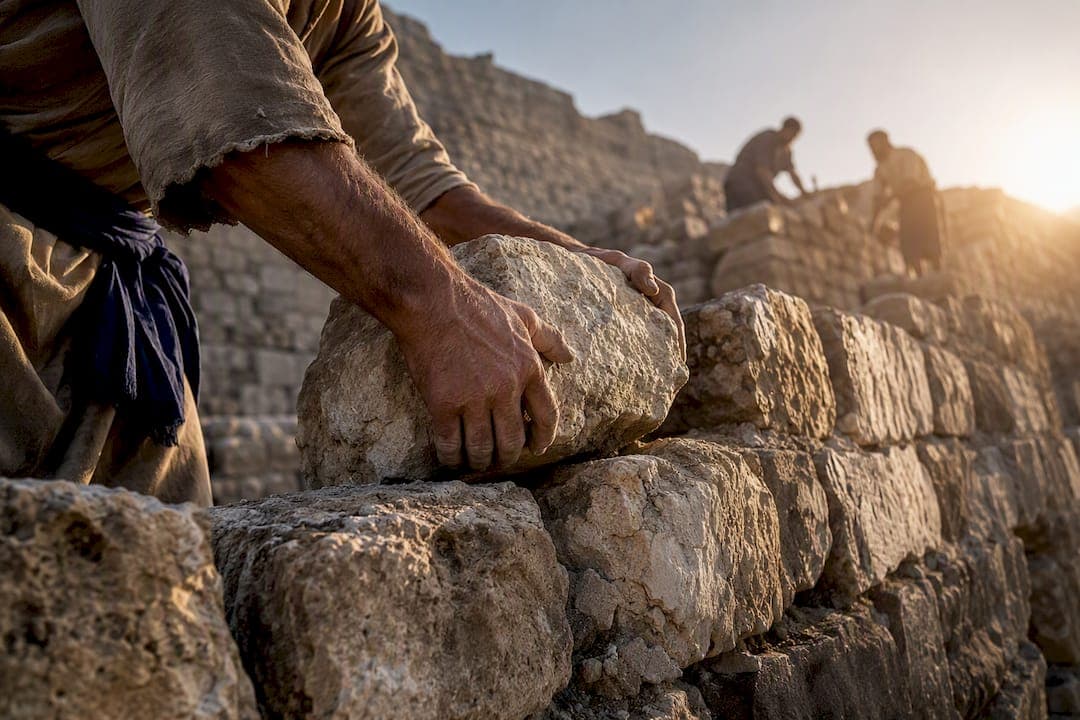
Nehemiah's leadership rests on four moves that still work today: he prayed before he planned, he built a plan before he built a team, he led that team through real opposition, and he protected the vulnerable even when it slowed him down. Every lesson below traces back to those four moves. Start with "pray before you plan," add "build influence before title," and finish with "protect the vulnerable," and you have a working model for leading a business, a family, or a small group.
TL;DR:
- Building influence before seeking authority requires earning trust in current roles, as Nehemiah did with King Artaxerxes before requesting resources.
- Address internal exploitation and external opposition simultaneously by confronting misuse of power within the camp and preparing for external threats.
- Developing a 30 to 90 day rhythm involves identifying a burden, running reconnaissance, assigning clear ownership, and preparing for pushback with outside accountability.
- Genuine leadership begins with a deep burden, followed by prayer and strategic planning, ensuring both spiritual dependence and practical action are balanced.
- Maintaining integrity in leadership means making personal sacrifices, like Nehemiah refusing a governor’s allowance, to build trust and set a moral example.
Table of Contents
- What Are the Core Nehemiah Leadership Lessons?
- How Nehemiah Paired Prayer With Practical Planning
- Preparing for Opposition Without Losing Internal Integrity
- A 30 to 90 Day Plan for Nehemiah-Style Leadership
- Nehemiah's Call, Burden, and Vision
- Leadership Humility and Dependence on God
- Personal Character and Ethics in Nehemiah's Leadership
- How ISI Brotherhood Puts These Lessons Into Practice
- Sources
What Are the Core Nehemiah Leadership Lessons?
Nehemiah rebuilt Jerusalem's wall in just over seven weeks after decades of failed attempts by other men with more resources and more authority. What he had instead was a burden he couldn't shake, a plan he built before he asked for permission, and a willingness to confront his own people when they hurt each other. The Journal of Applied Christian Leadership frames him as a transformational leader who fused prayer, vision, and management competence into a single leadership style, and that combination is exactly why his story keeps showing up in leadership training decades after most business books have been forgotten.
Here are ten lessons drawn straight from the text, each with a scripture pointer, a modern application, and a step you can take this week.
1. Start with a burden, not a strategy. Nehemiah wept for days when he heard Jerusalem's walls lay in ruins (Nehemiah 1:4). He didn't jump to solutions. He let the problem grieve him first. This week: name the one problem in your business, church, or family that genuinely bothers you, and sit with it before you try to fix it.
2. Pray before you act. Nehemiah's first move wasn't a memo to the king. It was four months of prayer (Nehemiah 1:4-11). This week: before your next big decision, block 20 minutes of silence and prayer instead of jumping straight to a spreadsheet.
3. Do your reconnaissance quietly. Nehemiah inspected the wall at night before announcing anything (Nehemiah 2:12-15). He gathered facts before he gathered followers. This week: walk your actual problem (the balance sheet, the strained relationship, the stalled project) before you talk about fixing it publicly.
4. Build influence before you're handed authority. As King Artaxerxes's cupbearer, Nehemiah had earned trust long before he asked for resources (Nehemiah 2:1-8). Leadership consultant Tim Paulson calls this "double-shift" leadership: excel at your current job while quietly building the vision for the next one. This week: identify one relationship where trust, not title, will open the door you need.
5. Cast a vision people can picture. Nehemiah's ask was specific: "Let us rise up and build" (Nehemiah 2:17-18). No vague mission statement. This week: write your goal in one sentence a fifth grader could repeat back to you.
6. Communicate face-to-face and let people own it. Nehemiah 3 lists families and individuals by name against specific wall sections. This week: assign one task to one named person, out loud, not by email.
7. Delegate with clear ownership. The chapter 3 pattern shows dozens of small teams, each responsible for a defined stretch of wall. This week: break your biggest project into pieces small enough that one person can be fully accountable for each.
8. Expect opposition and prepare for it. Nehemiah armed workers and posted guards while they built (Nehemiah 4:13-18). This week: name the specific resistance (a critic, a budget cut, a discouraged spouse) you're most likely to face, and decide now how you'll respond.
9. Protect the vulnerable inside your own camp. Nehemiah stopped construction to confront Jewish nobles who were charging their own people crushing interest (Nehemiah 5:1-13). This week: ask one accountability brother to read Nehemiah 5 with you and pray over any place in your own organization where someone might be getting exploited.
10. Finish well, then look for the next burden. The wall's completion in Nehemiah 6:15 wasn't the end of the book. Nehemiah kept working on reforms for years after. This week: when you hit a goal, give yourself one day to celebrate, then ask what still needs rebuilding.
These ten leadership principles from Nehemiah aren't a checklist you complete once. They're a rhythm you return to every time a new wall needs building.
How Nehemiah Paired Prayer With Practical Planning
The sequence in Nehemiah 1 and 2 is worth studying on its own: mourning and fasting, then sustained prayer, then a quiet night survey of the actual damage, then a specific, resourced petition to the one man who could say yes. Nehemiah didn't pray instead of planning. He prayed his way into a better plan.
You can copy this pattern directly. Build a spiritual rhythm around any major decision, run a real reconnaissance before you commit, and put the whole thing on one page with a timeline and a specific ask attached.
A simple reconnaissance checklist covers three things:
- Who are the two or three people who actually know what's broken, and have you talked to them directly?
- What facts have you confirmed with your own eyes, not secondhand reports?
- What is the one measurable goal that tells you the project succeeded?
Pro Tip: Protect the rhythm. It's tempting to let prayer slide once the planning gets exciting, but Nehemiah's four months of prayer came before any construction. Guard your first 15 minutes of the day before the calendar fills them for you.
Preparing for Opposition Without Losing Internal Integrity
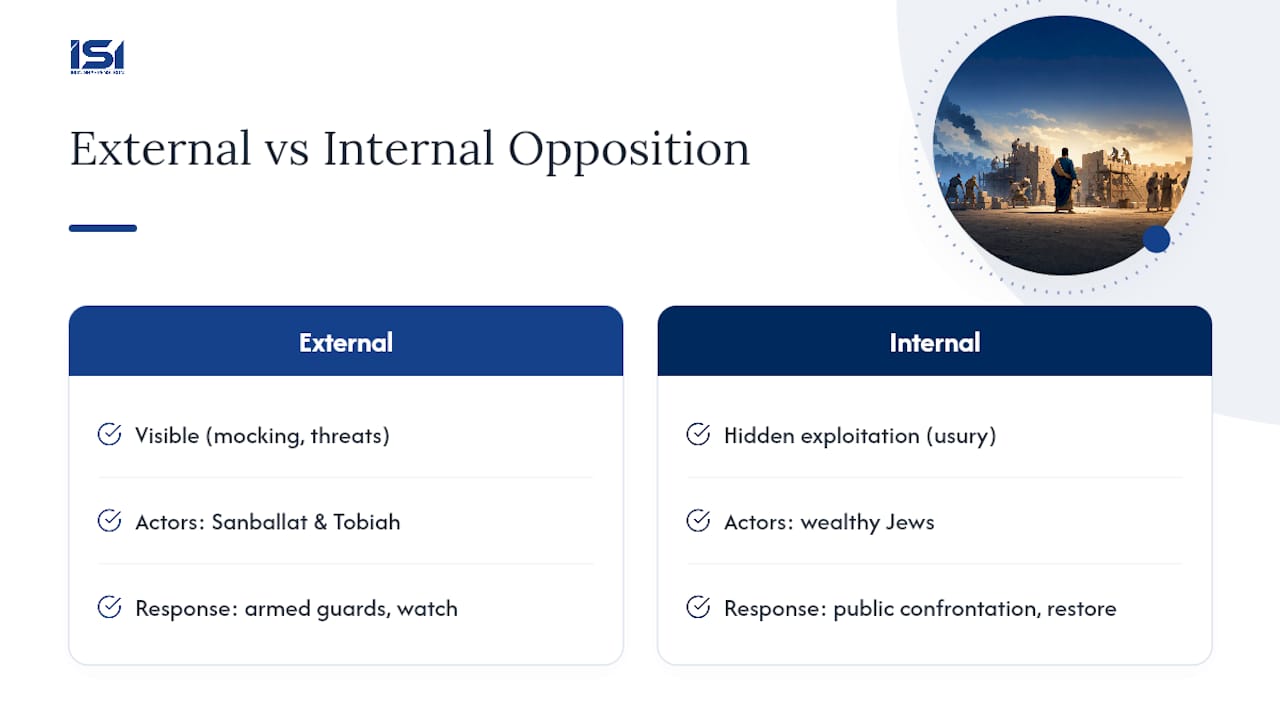
Nehemiah faced two different threats at once, and he treated them as equally urgent. Outside the wall, Sanballat and Tobiah mocked and threatened the project, so Nehemiah stationed armed guards and had half his men work while the other half kept watch (Nehemiah 4:13-18). Inside the camp, wealthy Jews were charging their own struggling neighbors ruinous interest, forcing some into debt slavery, and Nehemiah stopped everything to confront it publicly (Nehemiah 5:1-13).
That second threat is the one most leaders miss. External pressure is visible. Internal exploitation hides in plain sight until someone with authority decides to look.
Watch for three warning signs: unresolved debt or resentment among your own people, leaders who quietly profit while everyone else sacrifices, and no real process for someone to raise a grievance. Fix them by naming the abuse directly the way Nehemiah did, restoring what was taken, and building a standing way for complaints to reach you before they fester.
The purpose connection matters here too. Leadership commentary on Nehemiah's approach notes that connecting people to a redemptive purpose raises engagement and cuts the project failure that comes from people feeling like they're just laying bricks for someone else's glory.
A 30 to 90 Day Plan for Nehemiah-Style Leadership
Turning these lessons into habits takes a structure, not just good intentions.
-
Days 1 to 30: Identify your burden and run reconnaissance. Name the problem that won't let you go, then spend two weeks confirming facts on the ground before you tell anyone your plan. Success signal: a one-page plan with a specific, measurable goal. Enlist: your spouse, who sees blind spots you don't.
-
Days 31 to 60: Recruit your team and set the rhythm. Assign named owners to specific pieces of the work, the way Nehemiah 3 assigns families to wall sections, and set a weekly check-in that doesn't move. Success signal: every major task has one accountable name attached. Enlist: one accountability brother who will ask hard questions.
-
Days 61 to 90: Protect fairness and prepare for pushback. Build a simple way for people to raise concerns, and identify the specific opposition you're likely to face before it arrives. Success signal: you've had at least one direct conversation about a fairness issue before it became a crisis. Enlist: a mentor or Personal Board of Advisors who can see the project from outside it.
Pro Tip: A Personal Board of Advisors works exactly like Nehemiah's inner circle: a small group who knows your real numbers, asks about your marriage, and holds you to the plan you wrote on day one. Make confidentiality clear from day one, or the honesty you need won't show up when you need it most.
If you want a structured version of this rhythm rather than building it alone, a Christian men's mastermind gives you the weekly cadence and the outside accountability that Nehemiah, notably, never tried to build alone.
Nehemiah's Call, Burden, and Vision
Nehemiah wasn't looking for a leadership assignment. He was a cupbearer in a foreign palace, comfortable and secure, when his brother Hanani brought news that Jerusalem's wall lay in ruins and its gates were burned (Nehemiah 1:1-3). What happened next is the part most leadership summaries skip past too fast: Nehemiah sat down and wept, then mourned for days.
That grief is the actual origin of his leadership. He didn't manufacture a vision statement to sound inspiring. He let a real problem wreck his peace until he couldn't ignore it, and only then did he start moving toward a solution. The Journal of Applied Christian Leadership points out that this combination of genuine emotional weight and eventual strategic action is the hallmark of transformational leadership: it isn't cold calculation, and it isn't unmanaged emotion either.
For a Christian man weighing a leadership role today, this matters more than it seems. If you can't name the specific thing that grieves you about your business, your church, or your family, you probably haven't found your actual assignment yet. Burden comes first. Vision, planning, and action follow from it, not the other way around.
Leadership Humility and Dependence on God
Nehemiah had real authority, a royal appointment, letters of safe passage, and timber for the gates. He still treated every step as something he needed God's help to complete. When enemies plotted against him, his response wasn't a show of confidence in his own resources. It was prayer, followed by practical guards (Nehemiah 4:9).
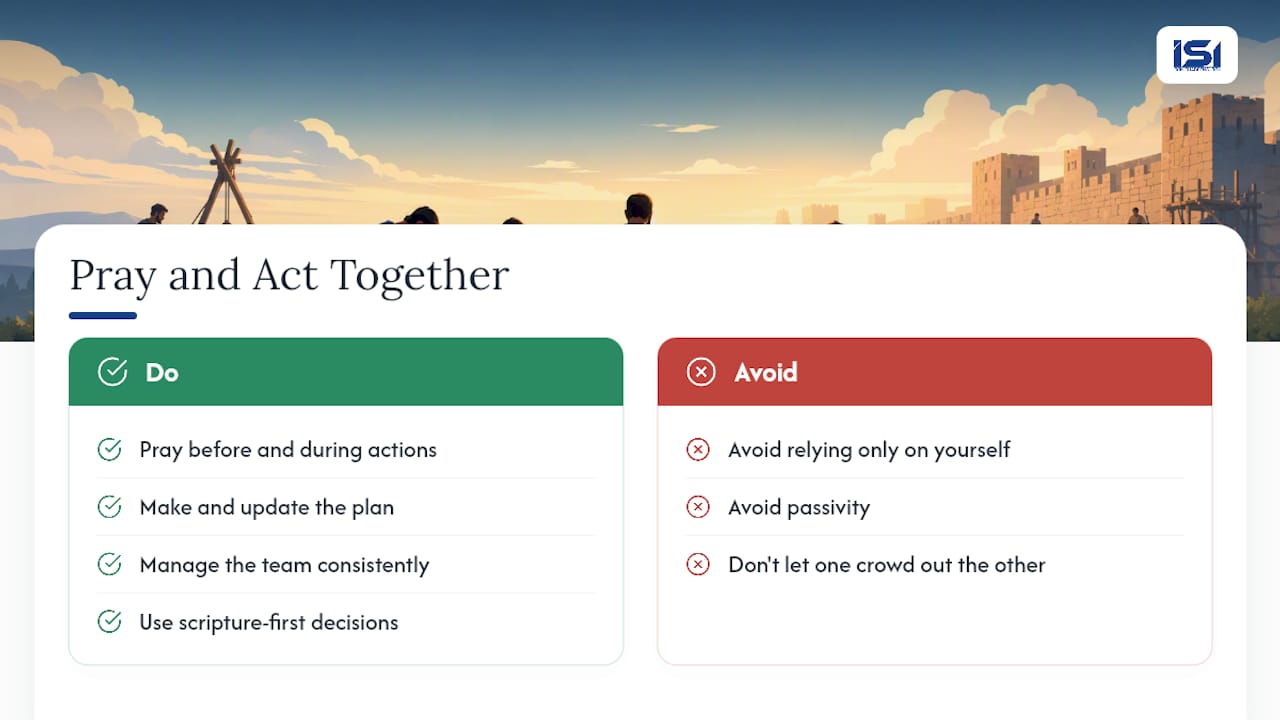
That pairing, prayer and action together rather than one instead of the other, is where a lot of driven men get it backward. Humility in Nehemiah's model isn't passivity. It's the recognition that competence and dependence on God aren't competitors. He worked like the wall's completion depended entirely on him, and he prayed like it depended entirely on God. Both were true at once.
The practical version of this for a modern leader is simple to state and hard to live: keep making the plan, keep managing the team, keep tracking the timeline, and keep praying like none of it works without help. A scripture-first approach to decision making gives you a framework for holding both halves without letting either one crowd out the other.
Personal Character and Ethics in Nehemiah's Leadership
Nehemiah's most striking ethical decision wasn't public. It happened in his own finances. As governor, he had every legal right to the food allowance previous governors had claimed, and he refused it, choosing instead to feed 150 people at his own table because he "was mindful of the fear of God" (Nehemiah 5:14-19).
That refusal is the quiet proof behind his public confrontation of the nobles exploiting the poor. He could demand integrity from others because he'd already paid its cost himself. Character in Nehemiah's leadership isn't a separate virtue from competence. It's the thing that makes competence trustworthy.
For a Christian man leading a company, a team, or a household, the application is direct: don't ask for a standard of integrity you haven't already applied to your own decisions about money, credit, and comfort. The insight that Nehemiah paused construction to confront economic abuse rather than pushing forward on schedule shows that character costs something real. Nehemiah lost building time to fix a justice problem, and he did it anyway.
How ISI Brotherhood Puts These Lessons Into Practice
Nehemiah didn't rebuild Jerusalem's wall by himself, and no man leads well in isolation either. What ISI Brotherhood does with weekly mastermind rhythms is try to recreate what Nehemiah had in his inner circle: men who help you get the right men in the room, protect the rhythm of accountability even when the calendar gets crowded, and make confidentiality clear from day the one so the truth actually gets said out loud. A Personal Board of Advisors exists for the same reason Nehemiah 3 names names against wall sections: real ownership requires someone watching.
— Derek
Ready to build your own version of Nehemiah's inner circle? Learn how a mastermind group actually functions and see how a Personal Board of Advisors can become the accountability structure your next 90 days needs.
Sources
- What Made Nehemiah an Effective Leader? – The Journal of Applied Christian Leadership
- Nehemiah: A Model of Leadership – GCI Equipper
- Vision
- 7 leadership principles from Nehemiah — Tim Paulson