

A personal board of advisors is a small, trusted circle of people, usually four to seven, who give you honest feedback, open doors, and hold you accountable across your career and your life. Start today by auditing your existing network: list who already fills a role like challenger, connector, or financial coach, and where you have a gap, understanding the importance of networking in marketing to boost growth effectively. That single audit tells you exactly who to recruit next.
TL;DR:
- Building a personal board of four to seven members provides diversified support across career, finances, wellbeing, and creativity, reducing reliance on a single mentor.
- Prioritize key roles such as Career Architect, Challenger, Connector, Domain Expert, Wellness Guide, Financial Coach, and Creative Mirror, especially during transition points in your career.
- Conduct a network audit using a roles matrix and warm outreach strategies to ensure each seat is filled by someone who can provide unique, actionable guidance.
- Maintain confidentiality, set a regular cadence, and clarify each advisor’s responsibilities to foster honest advice and prevent relationships from becoming transactional or stale.
- Formal programs like ISI Mastermind at $650 per month can accelerate board assembly, offering structured support grounded in biblical wisdom and proven relationship-building practices.
Table of Contents
- Why a Personal Board of Advisors Matters (and When to Build One)
- The Right Size and the Seats You Should Fill
- How to Audit Your Network and Recruit the Right People
- Setting Expectations: Confidentiality, Cadence, and Boundaries
- Keeping the Board Sharp: Audits, Rotation, and Turnover
- Benefits and Real Challenges of Running a Personal Board
- What to Actually Ask Each Advisor
- Turning Board Advice Into Actual Decisions
- How This Differs From Mentors and Formal Advisory Boards
- What This Looks Like in Practice
- How ISI Puts This Into Practice
- Where ISI Fits If You Want a Guided Path
- Sources
- FAQ
Why a Personal Board of Advisors Matters (and When to Build One)
Most professionals lean on one mentor for everything: career decisions, hard conversations, even personal struggles. That setup is fragile. Careers today rarely move in a straight line, and a single mentor cannot cover every turn your work and life will take. A California Management Review analysis of nomadic careers argues that shifting from one advisor to a small, stable board gives you broader, more structured support exactly when career paths stop being predictable.
A personal board of advisors earns its keep in a few specific ways:
- It stress-tests decisions before you commit, catching blind spots one advisor alone would miss.
- It widens your view of career moves you cannot see from inside your current role.
- It puts you in front of sponsors and connectors who can open doors a mentor relationship never will.
- It gives you somewhere honest to land when the pressure at work bleeds into everything else.
The right moment to formalize a board is usually a transition: a promotion into leadership, a pivot into a new industry, or the early, disorienting months of running your own company. If you are already feeling that pressure, you are late, not early.
The Right Size and the Seats You Should Fill
Bigger is not better here. Research on nomadic careers points to four to seven members as the sweet spot for a personal advisory group. Fewer than four and you lose perspective diversity. More than seven and you cannot maintain real relationships with all of them, which defeats the purpose entirely.
SUCCESS recommends building your board around named roles instead of vague "mentors." Here are seven seats worth copying:
- Career Architect. Someone senior enough to see the whole map of your industry and help you plot the next three moves, not just the next one.
- Challenger. The person who tells you when your plan is weak, not just when it is right. This seat is the one people skip and regret skipping.
- Connector. Someone with a wide, active network who makes warm introductions without being asked twice.
- Domain Expert. A specialist in the exact skill or industry gap holding you back right now.
- Wellness Guide / Emotional Anchor. Someone who checks in on you as a person, not just your output.
- Financial Coach. A voice on money decisions, whether that is business finances or your own household planning.
- Creative Mirror. Someone who reflects your ideas back at you honestly before you ship them into the world.
Pro Tip: Do not try to fill all seven seats at once. Early career, prioritize Career Architect and Domain Expert. Once you are leading others, Challenger and Wellness Guide matter more than any new industry contact.
How to Audit Your Network and Recruit the Right People
Building this board starts with a simple document, not a networking event. The Purpose, Network, Strategy framework from the California Management Review is a useful lens here: get clear on your purpose, map your existing network against it, then build a deliberate strategy to close the gaps.
- Build a roles matrix. Make four columns: Seat, Current Contacts, Gap, Priority. List all seven seats and be honest about who, if anyone, already fills each one.
- Rank the gaps. Warm leads beat cold ones every time. A former boss who already respects your work fills the Career Architect seat faster than a stranger from a conference.
- Reach out with a specific ask. Do not send "can I pick your brain." Ask for one thing: a 30-minute call about a specific decision, or their read on a single question you are wrestling with.
- Follow the warm path when one exists. SUCCESS's guide to personal boards is direct about this: prioritize introductions from people who already trust you over reaching strangers cold.
When no warm lead exists for a seat, do not force a cold pitch. Instead:
- Ask two or three people in your current network who they respect in that specific domain.
- Attend one event or group built around that exact gap, not a generic networking mixer.
- Treat weak ties, old colleagues, distant acquaintances, as real candidates. The research on nomadic careers is clear that weak ties often deliver opportunities that close friends cannot.
Setting Expectations: Confidentiality, Cadence, and Boundaries
Get the right people in the room, and the wrong ones will show themselves quickly through how they handle what you tell them. Make confidentiality clear from day one, before the first real conversation happens. That does not require a legal document. It requires a direct sentence: "What we talk about here stays between us unless you tell me otherwise." SUCCESS's guide on building a personal board treats this upfront clarity as the thing that makes candid feedback possible at all.
Cadence matters just as much as trust. Protect the rhythm you set, whether that is a quarterly check-in with your Financial Coach or a monthly call with your Challenger. Ad hoc requests only, with no rhythm at all, burn advisors out fast and turn the relationship transactional.
A few working rules keep the board healthy:
- Define what each seat is and is not responsible for, so nobody feels tapped for free consulting outside their lane.
- Offer something back, an introduction, a resource, public credit, so the relationship never runs one direction.
- Watch for advisors who only show up when they need something from you. That is a red flag worth acting on.
Pro Tip: Send a two line note before every meeting stating exactly what you want feedback on. It respects your advisor's time and gets you sharper answers.
Keeping the Board Sharp: Audits, Rotation, and Turnover
A board built once and never revisited goes stale. Every six to twelve months, run a quick check on each seat: Is this person still giving you new perspective, or repeating the same advice? Are they responsive when you reach out? Does their expertise still match where you are headed?
Seats change as your career changes. A Domain Expert who was essential during a product launch may not fit once you move into general management. Rotating that seat out gracefully, with a thank you and an honest explanation, keeps the relationship intact even after the formal role ends.
Temporary advisors have a place too. Bringing someone in for a defined stretch, a fundraising round, a specific negotiation, works well as long as everyone understands the arrangement is time-bound. The discipline that matters most: keep every member focused on their defined seat. A Challenger who starts trying to be your Financial Coach too is doing neither job well.
Benefits and Real Challenges of Running a Personal Board
The upside is straightforward: sharper decisions, faster access to opportunities, and a support system that does not collapse if one relationship fades. Members of a well-built board catch mistakes early, because seven sets of eyes see more than one.
The challenges are just as real. Coordinating seven busy people is genuinely hard, and calendars will not always cooperate. Some advisors will drift, showing up enthusiastically for the first quarter and going quiet by the second. Conflicts of interest can surface too, particularly when a Financial Coach or Domain Expert also has a stake in a deal you are considering. Confidentiality can leak if you have not made the ground rules explicit, which is exactly why setting expectations early matters more than most people assume going in.
The other underrated challenge is emotional: not every piece of feedback will feel good to hear. A Challenger doing their job well will tell you things a friend would soften. That discomfort is the point, not a sign something has gone wrong. Boards that only ever tell you what you want to hear are decorative, not functional.
What to Actually Ask Each Advisor
Generic questions get generic answers. Each seat on your board deserves a different kind of question, matched to what they actually see clearly.
Ask your Career Architect about the path, not the moment: "What role should I be preparing for two moves from now?" Ask your Challenger to poke holes directly: "What is the weakest part of this plan, and what would you cut first?" Your Connector responds best to a narrow request: "Who do you know who has solved this exact problem?" rather than a vague "who should I meet."
Your Domain Expert earns their seat on technical judgment calls: "Is this approach standard, or am I missing something the industry already knows?" Your Wellness Guide deserves a different register entirely, less strategy, more honesty: "Is the pace I'm keeping sustainable, and what am I not seeing about myself right now?" Your Financial Coach should get concrete numbers, not feelings: "Does this decision change my risk exposure over the next twelve months?" And your Creative Mirror works best early, before you have committed: "Does this idea actually land, or am I too close to see the gaps?"
The pattern across all seven: specific questions get specific, useful answers. Vague check ins produce vague encouragement, which is pleasant and mostly worthless.
Turning Board Advice Into Actual Decisions
Advice is only valuable once it changes what you do. The failure mode here is collecting input from four or five smart people and then freezing, unable to reconcile conflicting opinions.
A workable approach: after gathering input, write down the decision you are facing in one sentence, then list each advisor's take next to it, including where they disagree. Disagreement is not a problem to solve, it is data. If your Challenger and your Career Architect land in different places, that gap usually tells you which risk actually matters most.

Weight the input by seat, not by whoever spoke last or loudest. A financial decision should lean harder on your Financial Coach's read than your Creative Mirror's gut reaction, even if the Creative Mirror has more forceful opinions. Set a deadline for yourself, twenty four to forty eight hours after the last conversation, to make the call. Boards that never produce a decision just produce anxiety with extra steps.
How This Differs From Mentors and Formal Advisory Boards
A personal board of advisors is not the same thing as a corporate advisory board, and it is not the same as having one great mentor, even though people use these terms loosely.
A formal advisory board, the kind a company assembles, usually has defined governance, sometimes compensation, and a narrow mandate tied to the business itself. A personal board has none of that structure. It is informal, built on relationship rather than contract, and it covers far more ground than any business advisory board would, career, finances, wellbeing, creative work, all at once.
A single mentor relationship, meanwhile, concentrates all your trust and all your risk in one person. If that mentor moves companies, retires, or simply loses touch with your situation, you lose your entire support system at once. A board spreads that risk across several people with different specialties, which is precisely why the shift away from single mentor models has gained traction in career research. You are not replacing mentorship. You are making sure it never depends on one relationship surviving everything.
What This Looks Like in Practice
Picture a mid-level operations leader who gets promoted into an executive role with no real preparation for the politics that come with it. A single mentor from her old department cannot see the new terrain. A board built with intention can: a Career Architect two levels up who has navigated the same jump, a Challenger who tells her when her instincts are wrong, a Connector who introduces her to peers at the same level elsewhere, and a Wellness Guide who notices when the new pressure is costing her sleep.
Or consider a founder six months into a business, drowning in decisions with no one to sanity check them. A Financial Coach catches a pricing mistake before it compounds. A Domain Expert flags a compliance issue the founder did not know existed. Neither conversation takes more than thirty minutes, but each one prevents a mistake that would have taken months to unwind.
The pattern in both cases is the same: the value shows up in the moments a single advisor would have missed entirely, because no one person carries expertise in operations politics, personal finance, compliance, and wellbeing all at once.
How ISI Puts This Into Practice
Get the right people in the room. This concept reflects how some mastermind groups structure their cohorts, placing each member into a small Personal Board of Advisors—other Christian business owners and executives—who support growth in areas such as personal, spiritual, relational, professional, and financial.
Cadence and confidentiality are critical factors in successful mastermind groups. Protecting the rhythm with weekly meetings, rather than sporadic check-ins, helps keep relationships active. Confidentiality is made clear from the start to foster trust, enabling candid feedback.
The framework in this article, including defined roles, consistent meeting cadence, and clear confidentiality, reflects best practices in effective mastermind groups.
— Derek
Where ISI Fits If You Want a Guided Path
You could build all of this alone: audit your network, cold email strangers, draft your own confidentiality language, and hope the cadence holds once life gets busy. Plenty of people try that route. Some organizations provide a structured approach that places members into a Personal Board of Advisors from the start, rather than requiring individuals to assemble one on their own.
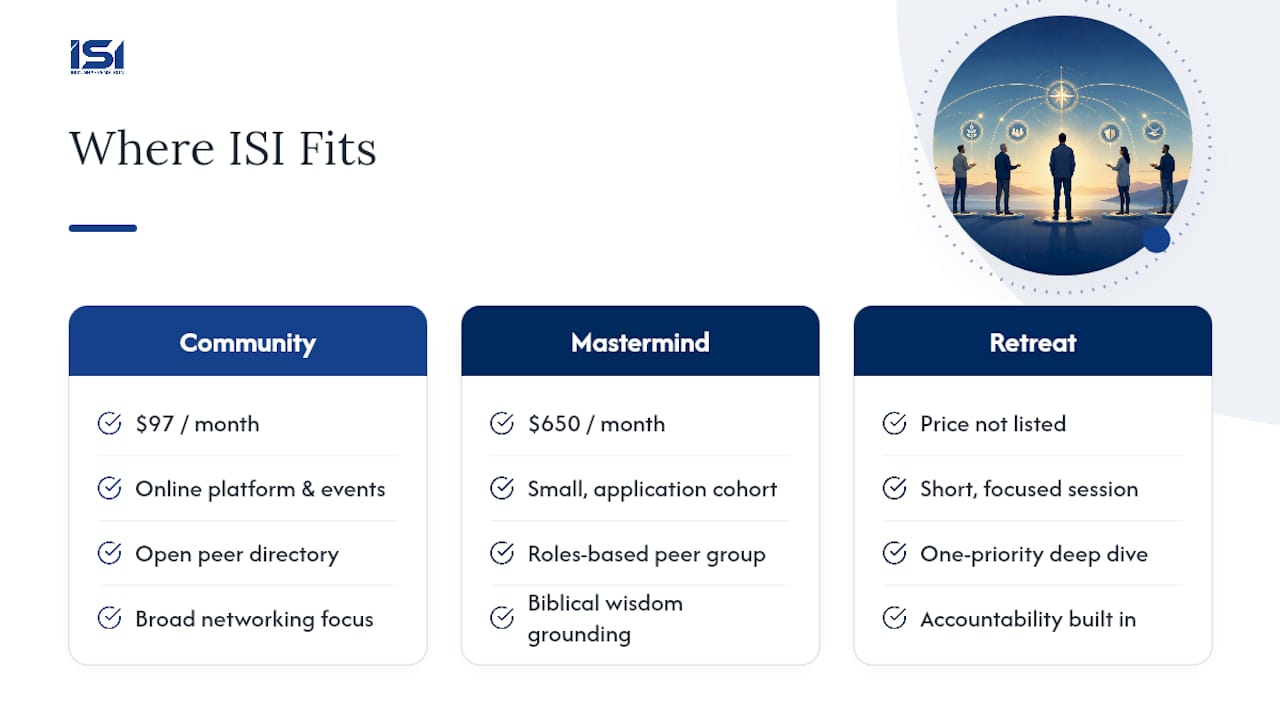
The ISI Community membership, at $97 per month, gives you access to a peer directory, events, and the online platform where these relationships form and stay active. For a more concentrated version of the same idea, the ISI Mastermind, at $650 per month, places you into a small, application-based cohort built specifically around the roles this article describes, Challenger, Connector, Domain Expert, and beyond, grounded in biblical wisdom rather than generic networking advice. If you need to move faster than a weekly cadence allows, the Deep Dive ONE THING Retreat offers a short, focused format for tackling one priority decision with real accountability behind it.
If any of that sounds like the board you have been trying to build on your own, start by applying to the ISI Mastermind and see which cohort fits where you are right now.
Sources
The California Management Review's piece on nomadic careers grounds the board size and network research cited throughout. SUCCESS's guides on building a personal board and the five essential roles informed the role definitions and outreach guidance above.
- Building a Personal Board of Directors in an Era of Nomadic Careers | California Management Review
- How To Build Your Personal Board of Advisers | SUCCESS
FAQ
How Much Does an Advisory Board Cost?
An informal personal board of advisors typically costs nothing beyond your time, since it runs on reciprocity rather than fees. Structured programs that place you into a mastermind or advisory cohort do charge for the format and facilitation. Isibrotherhood's ISI Community runs $97 per month, and the ISI Mastermind runs $650 per month for guided cohort placement.
Is It Worth Being on a Personal Board of Advisors?
Yes, for most professionals navigating a non-linear career, the trade-off favors having one. A board of four to seven trusted advisors spreads out the risk of relying on a single mentor and gives you access to a wider range of expertise than one person can offer alone.
What Does a Personal Board of Advisors Do?
A personal board of advisors tests your decisions, opens doors through introductions, and gives you honest feedback across specific areas like career strategy, finances, and wellbeing. Each member typically fills a defined seat, such as Career Architect, Challenger, or Financial Coach, rather than offering vague general advice.
Can My LLC Have a Board of Advisors?
Yes, an LLC can create a formal advisory board with defined governance and, in some cases, compensation for members, separate from any personal board an owner builds for themselves. A personal board of advisors, by contrast, is informal and covers the owner's whole life, not just business decisions tied to the LLC.