

You can start using these prayers at your desk right now, before you even finish reading this sentence. This page gives you what you need to bring prayer at work into the middle of a stressful morning, a hard conversation, or a first day at a new job.
Here's what you'll find below:
- Short, labeled prayers for common workplace moments
- Ten to thirty second micro-prayer versions you can memorize
- Scripture anchors to ground each prayer
- A simple daily routine with desk cues and pause points
- A quick note on your legal right to pray at work, sourced from the EEOC
Pick one prayer that matches what you're facing today. Read it once, then say a shorter version in your own words. That's it. You've started.
Key Takeaways
Short, specific prayers paired with a consistent daily routine and basic knowledge of your legal protections make prayer at work sustainable rather than sporadic.
| Point | Details |
|---|---|
| Use labeled, short prayers | Match a prayer to the specific moment, stress, a hard coworker, a decision, rather than praying generically. |
| Build a micro-prayer habit | Memorize a short version so you can pray discreetly before calls or tense conversations. |
| Anchor three daily pauses | Morning, midday, and end of day, tied to a physical cue like a sticky note or screensaver. |
| Know your accommodation rights | Title VII requires employers to reasonably accommodate sincere religious practice absent undue hardship. |
| Choose quiet witness over pressure | Consistent, calm work and silent intercession usually build more trust than public proselytizing. |
Table of Contents
- Short Prayers for Prayer at Work Moments
- What Praying at Work Actually Changes
- How to Build Prayer Into Your Workday
- Do You Have the Right to Pray at Work?
- Why Community Outside Work Sustains This Practice
- What Most Advice on Prayer at Work Gets Wrong
- Frequently Asked Questions
- Sources
Short Prayers for Prayer at Work Moments
These are written to be prayed in under a minute, whether you're at a desk, in a car before a shift, or standing in a break room. Say them as written or shrink them into a phrase you can repeat silently.
-
Before the day begins. "Lord, order my hours today. Give me focus for the work in front of me and patience for the people I'll meet. Let my work honor You." Micro-prayer: "Lord, order this day." Anchor: Psalm 90:17.
-
When stress hits. "God, my mind is racing and my chest is tight. Slow me down. Remind me You are steady even when my schedule isn't." Micro-prayer: "Peace, Lord, right now." Anchor: Philippians 4:6-7.
-
For wisdom in a decision. "Father, I don't see the full picture here. Give me clarity, not just confidence. Help me choose well." Micro-prayer: "Give me Your wisdom." Anchor: James 1:5.
-
For a difficult coworker. "Lord, soften my heart toward this person. I don't need to win the argument. Help me respond instead of react." Micro-prayer: "Soften my heart, God." Anchor: Romans 12:18.
-
For confidence before a meeting or presentation. "God, You know I feel unsure right now. Steady my voice and remind me I don't have to prove myself. You already know my worth." Micro-prayer: "Steady me, Lord." Anchor: 2 Timothy 1:7.
-
First day, new job. "Father, this is unfamiliar ground. Help me learn quickly, listen well, and represent You honestly from day one." Micro-prayer: "Lord, walk in with me." Anchor: Joshua 1:9.
-
When you made a mistake. "Lord, I got this wrong. Help me own it without spiraling, fix what I can, and move forward with humility." Micro-prayer: "Forgive and steady me." Anchor: Proverbs 24:16.
-
Before a hard conversation. "God, give me the right words and the courage to say them with grace, not fear." Micro-prayer: "Words of grace, Lord." Anchor: Colossians 4:6.
-
At the end of the workday. "Father, thank You for today's work, even the hard parts. Release me from what I couldn't finish and let me rest." Micro-prayer: "It's finished for today, Lord." Anchor: Matthew 11:28.
Keep a couple of these somewhere you'll actually see them: a phone note, a sticky note inside a desk drawer, or a card tucked in your planner. The point isn't the wording. It's having something ready before you need it.
What Praying at Work Actually Changes
A short prayer before a meeting doesn't just calm your nerves. It changes how you show up for the rest of the day.
- Peace under pressure. Praying before a stressful task interrupts the spiral of anxious thinking before it takes over.
- Clearer decisions. A ten-second pause for wisdom often catches a bad reaction before you send it.
- Stronger witness through the quality of your work. People notice consistency and calm more than they notice words. Faith-at-work leaders point out that ordinary tasks become acts of worship when they're offered to God rather than treated as separate from faith.
- Less reactivity. One practical shift shows up in something small: fewer sharp emails sent in frustration, because you paused first.
Say a version of "For wisdom in a decision" before you hit send on a tense reply, and see how much of that message you rewrite.
How to Build Prayer Into Your Workday
Consistency beats intensity here. Three short pauses done daily will change your workweek more than one long prayer done occasionally.
- Pick three fixed moments. Morning, before one specific meeting, and end of day work well because they're predictable.
- Set a discreet cue. A sticky note on your monitor, a phone screensaver with a single word, or a recurring calendar block labeled something neutral all work. The cue triggers the pause; you don't need to explain it to anyone.
- Use a micro-prayer before calls or hard conversations. Ten to twenty seconds is enough. Try: "Lord, give me clarity" before a call, "Steady me, God" before a tense one, or simply "Peace now" when you feel your shoulders tighten.
- Pray silently for a coworker while doing something routine, like opening your inbox. This shifts your posture toward that person before you've even spoken to them.
Pro Tip: If you work in a visible or customer-facing role, keep your prayer internal and brief rather than announced. Quiet consistency, doing excellent work, staying calm under pressure, protects your witness far better than a public display ever could.
Remote workers have more freedom to pray aloud between calls. In open offices or team environments, silent intercession and a private moment before stepping into a shared space usually work better than anything spoken.
Do You Have the Right to Pray at Work?
Yes, generally, and the law backs you up. Under Title VII of the Civil Rights Act, employers must reasonably accommodate an employee's sincerely held religious beliefs, including prayer, unless doing so causes undue hardship for the business.
- Tell your supervisor or HR directly. Name the specific accommodation you need, whether that's a quiet space or a short break at a set time.
- Suggest something reasonable. The EEOC fact sheet lists schedule adjustments and use of a private space as standard examples.
- Expect engagement, not automatic denial. The EEOC advises managers to assess actual disruption rather than assume conflict before saying no.
One caution: your legal right to pray doesn't mean every moment calls for open proselytizing. Silent prayer and a consistent, gracious presence often carry more weight with coworkers than repeated verbal invitations.
Why Community Outside Work Sustains This Practice
Prayer at your desk gets you through the day. Community gets you through the years. Isolation quietly wears down even disciplined believers, and most men who let their workplace faith slide didn't lose it in one bad week. They lost it slowly, with nobody checking in.
Iron Sharpens Iron exists for that gap. Every member gets placed in a Personal Board of Advisors, a small group of Christian men meeting regularly around five areas: personal, spiritual, relational, professional, and financial. That structure runs through:
- Weekly mastermind meetings
- A year-round online community
- Leadership events, both virtual and in-person
A church small group works too, and so does a resource like this guide to biblical community living if you're building one from scratch. What matters is having people who ask how the prayer, and the work, are actually going.
What Most Advice on Prayer at Work Gets Wrong
Most articles on this topic either overload readers with long devotionals nobody has time for during a workday, or they stay so vague on legal protections that readers feel nervous about praying at all. Neither serves the person trying to get through a Tuesday.
What actually works is smaller than people expect. A fifteen-second prayer said before a hard email does more for your day than a paragraph-long prayer you never get around to praying because it feels like too much. The habit matters more than the eloquence.
The other gap is isolation. You can memorize every prayer in this list and still lose your footing if nobody around you knows what you're carrying. That's the piece a podcast conversation on building real relationships in business gets at that most prayer guides skip entirely: the workday prayer holds up far better when a Personal Board of Advisors is asking about it a week later.
Frequently Asked Questions
Can you pray at work legally? Yes. Under Title VII, employers must reasonably accommodate sincerely held religious practices, including individual prayer, unless it creates undue hardship for the business.
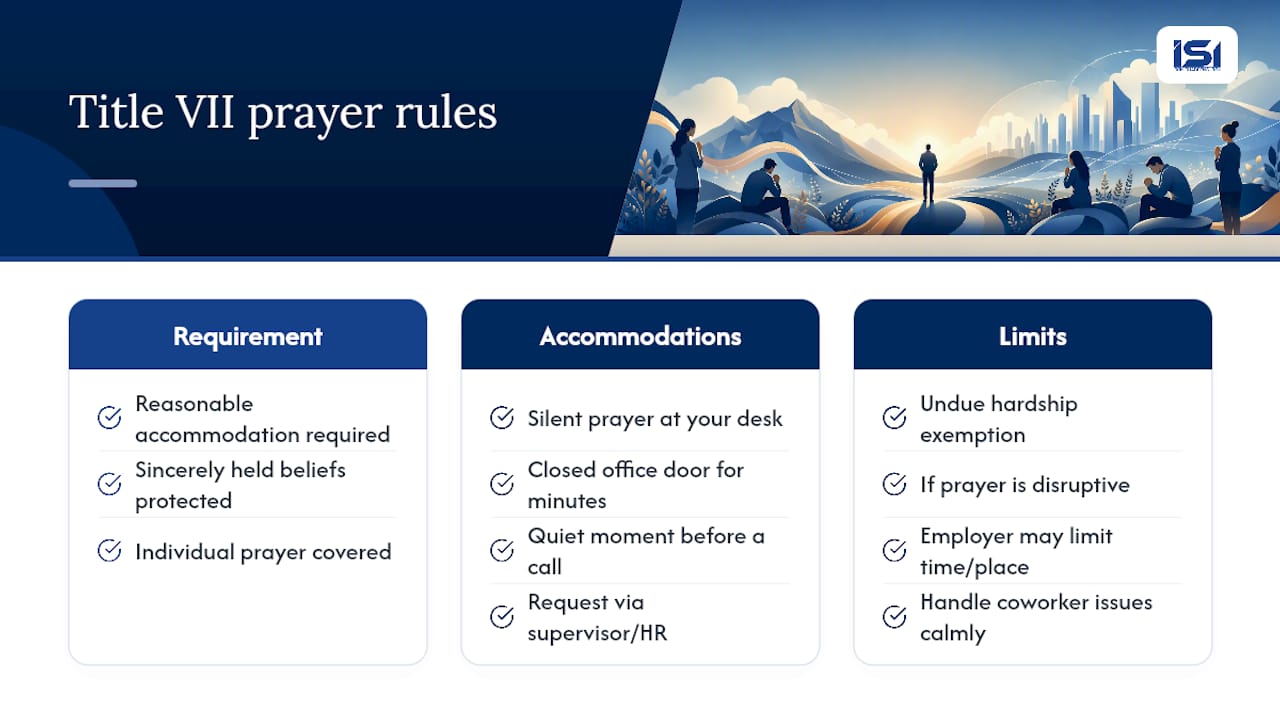
How do I pray at work without being disruptive? Keep it brief and private. Silent prayer at your desk, a closed office door for a few minutes, or a quiet moment before a call all work without drawing attention.
What if a coworker reacts negatively to my faith? Respond with calm, not defensiveness. Let your consistency and character speak louder than an argument, and reserve direct spiritual conversations for moments when someone genuinely asks.
What's a good prayer for a stressful workday? Try: "God, my mind is racing and my chest is tight. Slow me down. Remind me You are steady even when my schedule isn't." The micro-version, "Peace, Lord, right now," works in ten seconds.
How do I request prayer time or space from my employer? Speak directly with your supervisor or HR, name a specific accommodation like a private space or a short scheduled break, and reference the EEOC's guidance if you need to.
Sources
- Questions and answers: Religious discrimination in the workplace — EEOC
- Best practices for eradicating religious discrimination in the workplace — EEOC
- Religious accommodations in the workplace — EEOC fact sheet
- The importance of honoring God & bringing your faith to the workplace — Institute for Faith & Culture