

Servant leadership in business is a model built on Robert K. Greenleaf's 1970 essay and later refined by Larry C. Spears, resting on one core idea: the leader's job is to serve the growth of the people they lead, not the other way around. Businesses that practice it often report positive outcomes such as increased employee engagement, improved retention, and enhanced team performance. If you want a fast entry point, try focusing on a specific behavior this week.
- Restructure your next one-on-one around the employee's development goals, not status updates.
- Track an initial metric related to engagement or turnover.
- Review that metric after a few months before deciding whether the change is effective.
Key Takeaways
Servant leadership in business works when leaders combine Greenleaf's people-first principles with institutional safeguards like written delegation rules, negative-feedback routines, and measurement tied to promotion criteria.
| Point | Details |
|---|---|
| Definition anchors the model | Greenleaf's 1970 essay and Spears' ten attributes define servant leadership as prioritizing follower growth over command. |
| Highest-leverage attributes | Stewardship, commitment to growth, and persuasion drive the strongest business outcomes among the ten traits. |
| Benefits require institutionalization | Engagement and retention gains scale only when hiring and promotion criteria reinforce servant behaviors. |
| Boundaries prevent the dark side | Negative feedback routines and organizational culture buffer against follower entitlement and leader burnout. |
| Peer accountability sustains the habit | Isibrotherhood's mastermind cohorts give Christian business leaders weekly accountability to make servant leadership stick. |
Table of Contents
- Where Servant Leadership Came From and What It Means
- What Are the Ten Core Attributes of Servant Leadership?
- Does Servant Leadership Actually Improve Business Results?
- What Are the Criticisms and Limits of Servant Leadership?
- How to Practice Servant Leadership: A Roadmap
- How Do You Measure the Impact of Servant Leadership?
- Real Companies Practicing Servant Leadership
- Common Pitfalls and How to Safeguard Against Them
- Adapting Servant Leadership Across Company Cultures and Sizes
- How Servant Leadership Drives Innovation and Change
- Frequently Asked Questions
- Sources
Where Servant Leadership Came From and What It Means
Greenleaf coined the term in a 1970 essay titled "The Servant as Leader," arguing that the best leaders start as servants, and the desire to lead comes second. Spears later distilled Greenleaf's writing into a working list of attributes that scholars and practitioners still cite today, cataloged in detail by Regent University's review of Greenleaf's core characteristics.
In business terms, servant leadership involves prioritizing employee growth and well-being and managing organizational resources responsibly. Sendjaya and Sarros describe it as leading to business results indirectly through developing and trusting people rather than direct command. That is a sharp contrast to traditional business leadership styles built on top-down directives, where compliance, not growth, is the currency.
What Are the Ten Core Attributes of Servant Leadership?
Spears organized Greenleaf's ideas into several key servant leader traits, each representing practical behaviors leaders can adopt.
- Listening: End your next meeting five minutes early and ask one open question instead of giving one more instruction.
- Empathy: Name the pressure someone is under before you name the task.
- Healing: Address a team conflict directly instead of letting it fester into passive-aggressive Slack threads.
- Awareness: Ask a peer for blind-spot feedback on how your last decision landed.
- Persuasion: Replace one directive this week with a case you make and let the team decide.
- Conceptualization: Connect this quarter's task list to the three-year vision out loud, in a meeting.
- Foresight: Ask "what breaks if we ship this in six months" before you approve the roadmap.
- Stewardship: Treat the budget and the team's time as something held in trust, not owned.
- Commitment to growth: Put a development goal, not just a performance goal, in every review.
- Building community: Create one recurring, informal touchpoint that has nothing to do with deliverables.
Among the servant leadership attributes, stewardship, commitment to growth, and persuasion are often considered particularly influential in shaping how decisions and authority flow within an organization.
Pro Tip: Pick one attribute per month rather than trying to embody all ten at once. Servant leadership principles compound; they don't install overnight.
Does Servant Leadership Actually Improve Business Results?
The evidence points toward real, measurable gains, with a caveat leaders often skip. Companies practicing servant leadership at work tend to see stronger employee engagement, lower voluntary turnover, and better cross-team collaboration, according to practitioner research summarized by IMD's executive education program. Some organizations also report tighter links to customer satisfaction, since engaged employees tend to treat customers the way they themselves are treated.
Here is what that looks like in practice:
- A support team given real decision authority resolves customer issues faster because they no longer escalate every judgment call.
- A manager who defends delegated authority in front of executives sees fewer employees quietly circumventing their own team's decisions.
- A leader who tracks development goals in reviews, not just output goals, tends to retain higher performers longer.
The caveat matters: these benefits rarely show up from one inspired leader alone. They scale only when hiring, promotion, and policy reinforce the same behaviors across the organization.
What Are the Criticisms and Limits of Servant Leadership?
Servant leadership is not without real, documented weaknesses, and pretending otherwise sets leaders up to be blindsided. Academic critics point to genuine measurement problems: researchers still argue about whether servant leadership is one unified trait or several separate behaviors that get incorrectly averaged into a single score, a concern detailed in a recent scholarly exchange on servant leadership measurement.
There are behavioral risks too. Research on the negative effects of servant leadership shows that some followers, particularly those with high Machiavellian tendencies, can develop psychological entitlement when a leader gives without setting boundaries. Leaders themselves face ego depletion and burnout when they pour into others without institutional support.
Servant leadership also fits poorly in a few specific situations:
- An active crisis requiring split-second, unilateral decisions.
- A team with weak discipline that needs firm direction before it can handle real autonomy.
- Any setting where "service" gets used as an excuse to avoid hard, direct feedback.
How to Practice Servant Leadership: A Roadmap
Rolling out servant leadership principles works best as a phased build, not a company-wide announcement.
- Pilot with one team. Change one-on-one structure toward development conversations and hand over one real decision, per guidance from Berkeley Executive Education's case for servant leadership.
- Embed through role design and policy. Write down what authority actually transfers, so delegation isn't just a talking point.
- Scale by rewriting hiring and promotion criteria to reward servant behaviors, not just output.
Manager habits worth building into a weekly rhythm:
- Structure one-on-ones around growth and blockers, not status updates.
- Defend delegated authority publicly, even when a decision you'd have made differently gets made.
- Remove obstacles before someone has to ask twice.
- Credit team members by name in front of leadership; give corrective feedback privately.
On the policy side, daily servant leadership behaviors that hold up under pressure require written delegation rules, explicit decision thresholds, and performance criteria that actually measure growth, not just niceness.
Pro Tip: Write delegation rules down. A verbal "you own this" evaporates the first time a senior executive disagrees with the outcome.
How Do You Measure the Impact of Servant Leadership?
Servant leadership principles only earn their keep in business when you attach numbers to them. Track a compact set of metrics before and after any change:
- Engagement survey scores, tracked quarterly.
- Voluntary turnover rate by team.
- Manager Net Promoter Score, gathered from direct reports.
- Time-to-decision on delegated matters.
- Customer satisfaction scores where a team touches customers directly.
Run it like a phased experiment, not a mandate:
- Change one variable, such as one-on-one format, with a single team.
- Hold everything else constant for 90 days.
- Compare the metrics above against a control team that hasn't changed.
- Report results to leadership before deciding whether to scale.
Tie the results directly into performance reviews and promotion criteria, or the whole exercise stays a well-intentioned experiment that never becomes culture.
Real Companies Practicing Servant Leadership
Three examples show what this looks like once it moves past theory:
- Herb Kelleher at Southwest Airlines put employees ahead of customers on the org chart's priority list, reasoning that engaged employees produce better customer service on their own. Practitioner accounts still cite Kelleher as a model of people-first outcomes translating into business performance.
- The Container Store built its retention record on above-market pay and heavy investment in employee training, treating frontline staff as a resource to develop rather than a cost to minimize.
- Mayo Clinic structured physician leadership around service to patients and staff alike, reinforcing collaborative decision-making instead of pure hierarchy.
One caveat: these are illustrative, not replicable formulas. A hospital system and an airline scale servant leadership through very different policies, so borrow the principle, not the playbook.
Common Pitfalls and How to Safeguard Against Them
The most common failure mode is confusing service with softness. Leaders who avoid hard feedback because it feels unkind aren't practicing servant leadership models; they're avoiding accountability.
Watch for these traps:
- Delegating responsibility without the authority to back it up.
- Skipping negative feedback because it feels at odds with "serving" the team.
- Scaling the philosophy without any policy behind it.
- Ignoring your own burnout while pouring into everyone else's growth.
Safeguards worth building into a monthly leadership review: a peer-support check-in for managers, a standing negative-feedback routine, and an explicit audit of whether delegated authority is real or just a word. Leaders under high-Machiavellian follower pressure specifically need consistent negative feedback as an intervention mechanism to prevent entitlement from taking root.
Pro Tip: If you can't remember the last time you gave a direct report hard feedback, that's not evidence of good servant leadership. It's evidence you're avoiding it.
Adapting Servant Leadership Across Company Cultures and Sizes
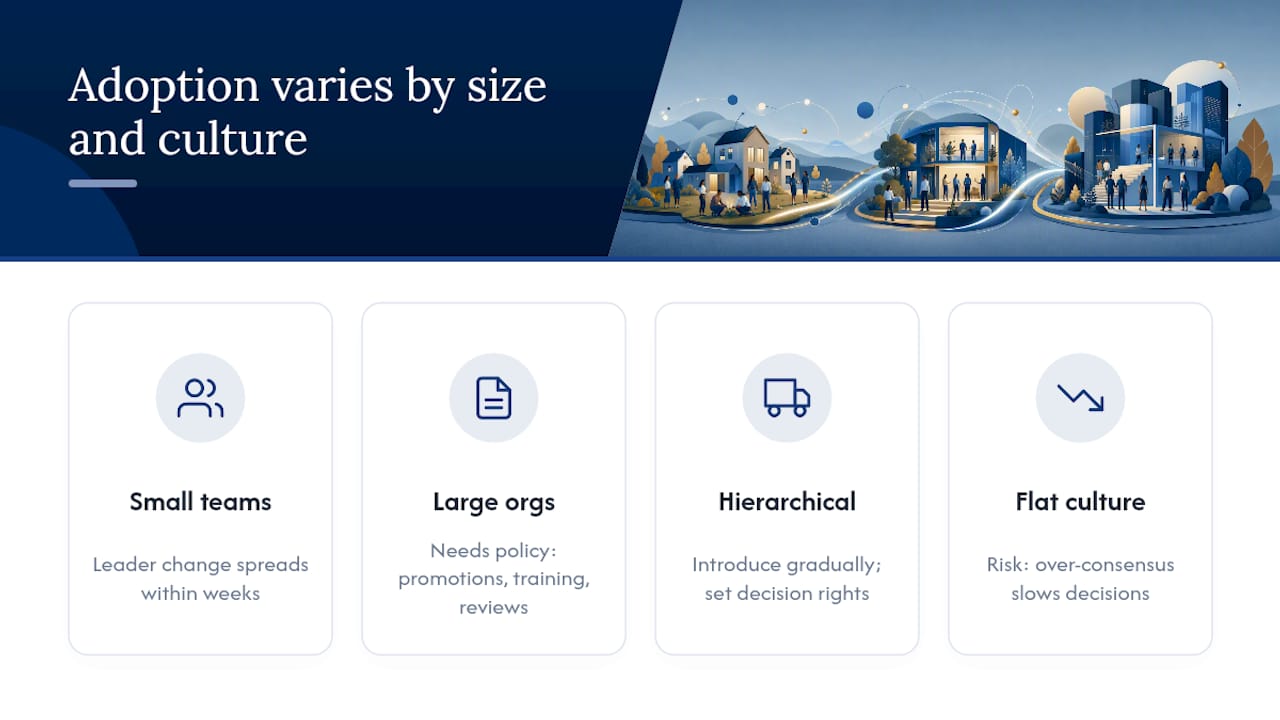
Servant leadership doesn't install the same way in a 12-person startup as it does in a 5,000-employee enterprise. Small teams can move fast, since one leader changing their own habits ripples through the whole group within weeks. The risk there is informality outrunning structure: without any written delegation rules, "servant leadership" becomes whatever the founder feels like that day, which is fragile the moment that founder leaves or scales up hiring.
Larger organizations face the opposite problem. A single leader's behavior change barely registers against entrenched middle-management habits, so servant leadership at work only spreads through deliberate policy: revised promotion criteria, training programs, and performance reviews that reward development-focused management. Sendjaya and Sarros's framing is useful here: since servant leadership requires courage, not passivity, it needs institutional backing to survive contact with a large bureaucracy.
Culture matters as much as size. In hierarchical or command-driven industries, such as manufacturing or logistics, servant leadership often needs to be introduced gradually, paired with clear decision rights, so it doesn't read as abdication of authority. In flatter, knowledge-work cultures, the risk runs the other direction: too much consensus-seeking can slow decisions that need a single owner. There's no universal template. The Greenleaf model asks a leader to know their own organization's risk tolerance and adapt the pace of delegation to match it, not the reverse.
How Servant Leadership Drives Innovation and Change
Innovation depends on people willing to raise unproven ideas without fear of being shut down, and that's precisely the condition servant leadership creates. When a manager consistently rewards honest input over blind agreement, employees closer to the customer or the production line start surfacing problems and ideas that never would have reached a command-driven leader's desk.

Change management benefits in a more direct way. Organizational change usually fails not from a bad strategy but from employees quietly resisting it, and servant leaders reduce that friction by involving people in decisions early rather than announcing change from above. A team that helped shape a new process defends it during rollout instead of undermining it.
This does not mean servant leaders avoid making hard calls during a transition. Foresight, one of Greenleaf's ten attributes, requires anticipating where a change will create friction and addressing it before it becomes resistance, not after. Leaders who conceptualize the "why" behind a change and communicate it persuasively, rather than mandate it, tend to see faster adoption curves. The tradeoff is speed at the outset: building buy-in takes longer than issuing an order, but it usually costs less in reversed decisions and quiet sabotage down the line.
A Practitioner's View on What Actually Changes First
A leader who refocused one team's weekly one-on-ones on growth conversations reported a decline in voluntary turnover over several months, prior to other policy changes. The replicable practice: ask one development question before any status question, every single time, and track a baseline metric so the change isn't just a feeling. Peer accountability groups, like the small mastermind cohorts Isibrotherhood builds for Christian business leaders, make this kind of consistency far easier to sustain than trying to change alone.
A Faster Path to Embedding Servant Leadership
Reading about servant leadership principles is one thing. Sustaining the habit change under real business pressure, without a peer group holding you to it, is where most leaders quietly slide back into old patterns. Isibrotherhood exists for exactly that gap: instead of a book club or a networking event, you get placed into a small Personal Board of Advisors, a group of Christian business leaders who meet weekly to hold each other accountable on the professional habits that actually stick, servant leadership included.
The mastermind cohorts combine weekly meetings, a year-round online community, and leadership events built around five areas of life, professional practice being just one. If you're serious about not just understanding servant leadership but embedding it with people who will actually check in on your progress, explore an Isibrotherhood membership and see which cohort fits where you are right now.
Frequently Asked Questions
Is servant leadership the same as being a soft or permissive manager? No. Servant leadership requires firm private feedback and defended delegation, not avoidance of hard conversations. Confusing the two is one of the most common pitfalls leaders run into.
How is servant leadership different from transformational leadership? Transformational leadership focuses on inspiring people toward a shared vision; servant leadership focuses on serving people's growth first, with organizational results following indirectly. The two overlap but start from different priorities.
Can servant leadership work in a fast-moving crisis? It's a poor fit for split-second, high-stakes decisions that need unilateral action. Most leaders reserve directive styles for genuine emergencies and return to servant approaches once the crisis passes.
What's the fastest way to start practicing servant leadership at work? Change the structure of your one-on-ones toward development conversations and track a baseline engagement or retention metric before you scale the change further.
Does servant leadership have measurable financial benefits? Practitioner research links it to stronger engagement, retention, and customer satisfaction, though rigorous financial-outcome data remains harder to isolate than culture-level results.
Sources
- Character and servant leadership: ten characteristics of effective caring leaders
- Case for servant leadership (Berkeley Executive Education)
- The negative effects of servant leadership and its buffer mechanism
- Servant Leadership Theory (Program on Negotiation, Harvard)
- Debate on servant leadership measurement and theory (GOM 2025 exchange)