

Steward leadership centers on managing resources and mission for God as Owner; servant leadership centers on serving followers to help them grow. Favor a servant posture when developing people is your bottleneck. Favor a steward posture when resources, risk, and accountability to a higher authority are on the line, a distinction Kent R. Wilson has written about at length for ISI Brotherhood's audience of Christian executives.
TL;DR:
- Steward leadership emphasizes faithfulness to the Owner’s mission and resources, requiring active risk-taking and decision-making that may be less participative.
- Servant leadership prioritizes follower growth through participative, relational practices that focus on developing people and their capabilities.
- In situations involving complex resources, high stakes, or organizational turnarounds, steward leadership becomes essential to ensure accountability and mission success.
- Leaders who confuse or switch between models without awareness risk eroding trust, as inconsistent application damages credibility and clarity.
- Effective leaders practice both postures by setting clear delegation, regular accountability routines, and understanding when to prioritize resource stewardship versus follower development.
Table of Contents
- Steward Leadership vs Servant Leadership: What Each Term Actually Means
- What the Bible Actually Says About Stewards, Servants, and Shepherds
- Core Practical Differences: Focus, Accountability, and Risk
- When Should You Use Steward Leadership Instead of Servant Leadership?
- How to Practice Steward and Servant Leadership Every Day
- How a Christian Mastermind Trains Both Leadership Postures
- What I've Learned Watching Leaders Confuse These Two Models
- A Guided Path to Practicing Both Postures Well
- Where to Read More on Steward and Servant Leadership
- Sources
- FAQ
Steward Leadership vs Servant Leadership: What Each Term Actually Means
Servant leadership starts with a simple, radical claim: the leader exists to serve the follower's growth first. The identity is "servant," the style leans participative, and success gets measured by whether people under your care are becoming more capable, more whole, more themselves.
Steward leadership starts somewhere different. The identity is "steward," a manager entrusted with someone else's resources, and the primary goal is fulfilling the Owner's objectives, not just meeting the felt needs of followers. According to Kent R. Wilson, the steward's authority sits between authoritarian and participative, because a steward answers upward before answering to the team.
Both frameworks get serious theological treatment from organizations like the Christian Leadership Alliance and the Association for Biblical Higher Education. The practical split:
- Servant leadership: identity is servant; primary goal is follower development; accountability flows toward the people led.
- Steward leadership: identity is steward; primary goal is mission and resource stewardship; accountability flows toward the Owner, God, first.
What the Bible Actually Says About Stewards, Servants, and Shepherds
Scripture does not use one word for leadership. It uses several, and each carries weight the English translation flattens. Oikonomos is the household manager, the steward entrusted with someone else's estate and judged by how well he handled it. Doulos is the servant or bondservant, defined by submission and posture rather than portfolio. Poimēn is the shepherd, the one who leads by feeding, protecting, and going ahead of the flock.
The Association for Biblical Higher Education treats these as complementary metaphors rather than competing ones. Steward language carries delegated authority; servant language carries humility and service. A leader who only absorbs the servant metaphor can struggle to exercise necessary authority without guilt. A leader who only absorbs the steward metaphor can drift into managing people like assets.
The steward operates under delegated authority, entrusted with another's resources, and answers to the owner for how those resources were used. The servant's success, by contrast, is measured by the growth and flourishing of those served.
That distinction shapes everything downstream, from how a leader handles a hard personnel decision to how a board evaluates a CEO.
Core Practical Differences: Focus, Accountability, and Risk
The two models diverge in ways that show up on a Tuesday morning, not just in a seminary classroom. Steward leadership adds accountability, resource management, and mission focus on top of the servant model's relational priorities, according to Kent R. Wilson, which is why some scholars argue stewardship functionally subsumes service rather than replacing it.
Here is where the two models split on the ground:
- Focus: Servant leadership focuses on the people in front of you; steward leadership focuses on the mission and resources entrusted to you.
- Success metric: Servant leadership succeeds when followers grow; steward leadership succeeds when the Owner is satisfied with how the estate was managed.
- Authority style: Servant leadership leans participative; steward leadership sits between authoritarian and participative, willing to make calls the group would not vote for.
- Risk posture: Stewardship is active and entrepreneurial. Practitioner research from Gonzaga University describes it as growth oriented rather than merely custodial, meaning a good steward takes managed risk to grow what was entrusted to him.
- Governance: A useful pattern places the board as chief steward and the executive as understeward, which clarifies fiduciary accountability and keeps vision oversight separate from day to day execution.
Picture a nonprofit facing a budget shortfall. A servant-first leader asks, "How do I protect my team through this?" A steward-first leader asks, "What does faithful management of these resources require, even if it costs me relationally in the short term?" Good leaders eventually need both questions. Few ask them in the right order.
When Should You Use Steward Leadership Instead of Servant Leadership?
Neither model wins outright. The situation decides which posture leads. Run through mission urgency, resource complexity, stakeholder expectations, and where your organization sits in its lifecycle, and the right posture usually becomes obvious.
- Check mission urgency. If the mission is at risk, financially, legally, or reputationally, steward leadership takes the lead because someone has to answer for the resources now, not eventually.
- Check resource complexity. The more capital, staff, and assets you manage, the more the steward posture matters, since governance literature ties clearer decision rights directly to mission sustainability.
- Check organizational lifecycle. Startups and turnarounds often need steward instincts first; mature, stable teams often need servant investment to retain and grow people.
Three fast diagnostic questions cut through the noise: Who am I ultimately accountable to on this decision? What happens to the mission if I get this wrong? And am I protecting people or protecting my own comfort by avoiding a hard call?
Watch the failure modes on both ends. Over-applying servant leadership produces leaders who cannot make an unpopular decision even when the mission demands it. Over-applying steward leadership produces leaders who treat people as line items on a resource sheet.
Pro Tip: When stakeholder interests genuinely conflict, steward leadership resolves the tie. Leaders accountable to God as Owner have a clear tiebreaker that pure servant leadership does not supply.
How to Practice Steward and Servant Leadership Every Day
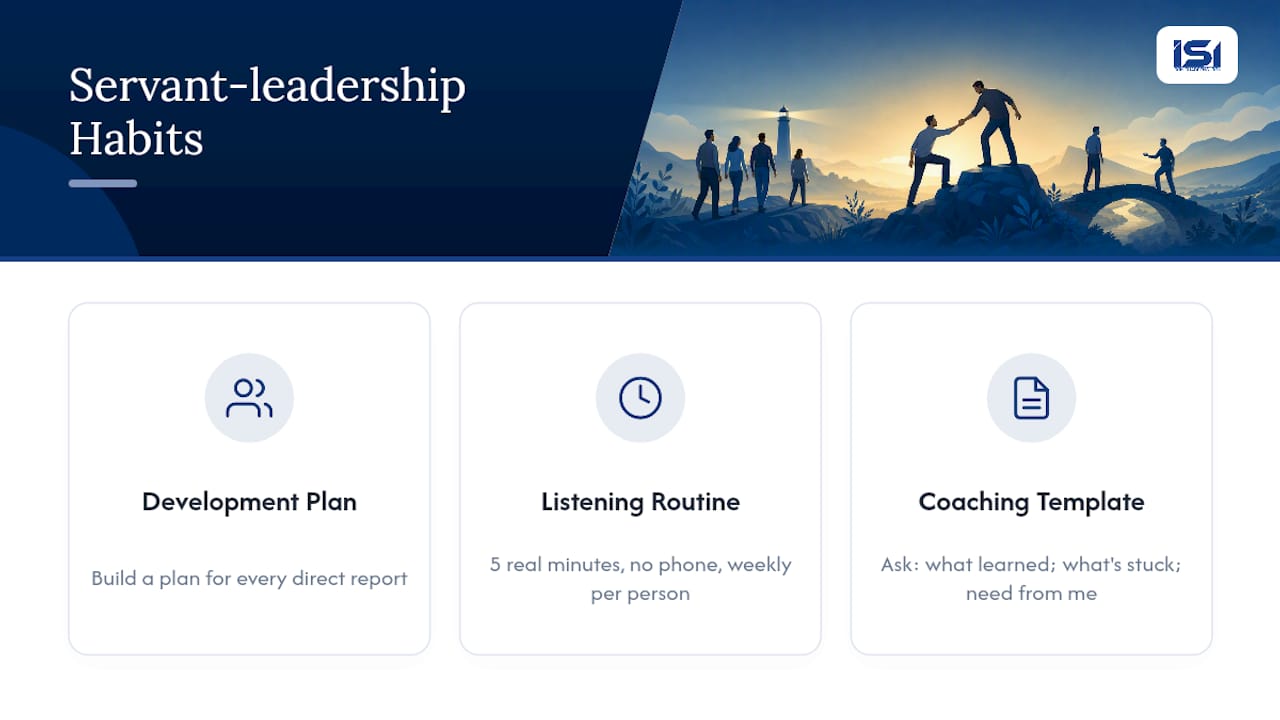
Servant leadership shows up in the small, repeatable habits. Build a development plan for every direct report, not just your favorites. Run a listening routine, five real minutes, no phone, once a week, with each person on your team. Use a simple coaching template: what did you learn, what's stuck, what do you need from me.
Steward leadership shows up in structure. Set mission KPIs that measure resource health, not just morale. Write delegation agreements that spell out exactly what authority someone holds and what they answer for, an idea explored further in ISI Brotherhood's guide to biblical decision making. Build an asset-growth plan reviewed quarterly. Script your board alignment conversations so vision oversight and daily execution stay separate.
Two habits carry both postures at once: a monthly accountability check-in that asks both "how are you growing?" and "how are the resources doing?" and a quarterly mission review that measures people and stewardship side by side, a rhythm explained further in ISI Brotherhood's piece on Christian financial stewardship.
How a Christian Mastermind Trains Both Leadership Postures
A weekly mastermind meeting forces both disciplines at once. Servant leadership shows up when a member asks what you actually need this week. Steward leadership shows up when the group holds you accountable for a decision you have been avoiding. That combination, structured around a Personal Board of Advisors and built into a consistent rhythm, is exactly what ISI Brotherhood exists to build in Christian business leaders.
What I've Learned Watching Leaders Confuse These Two Models
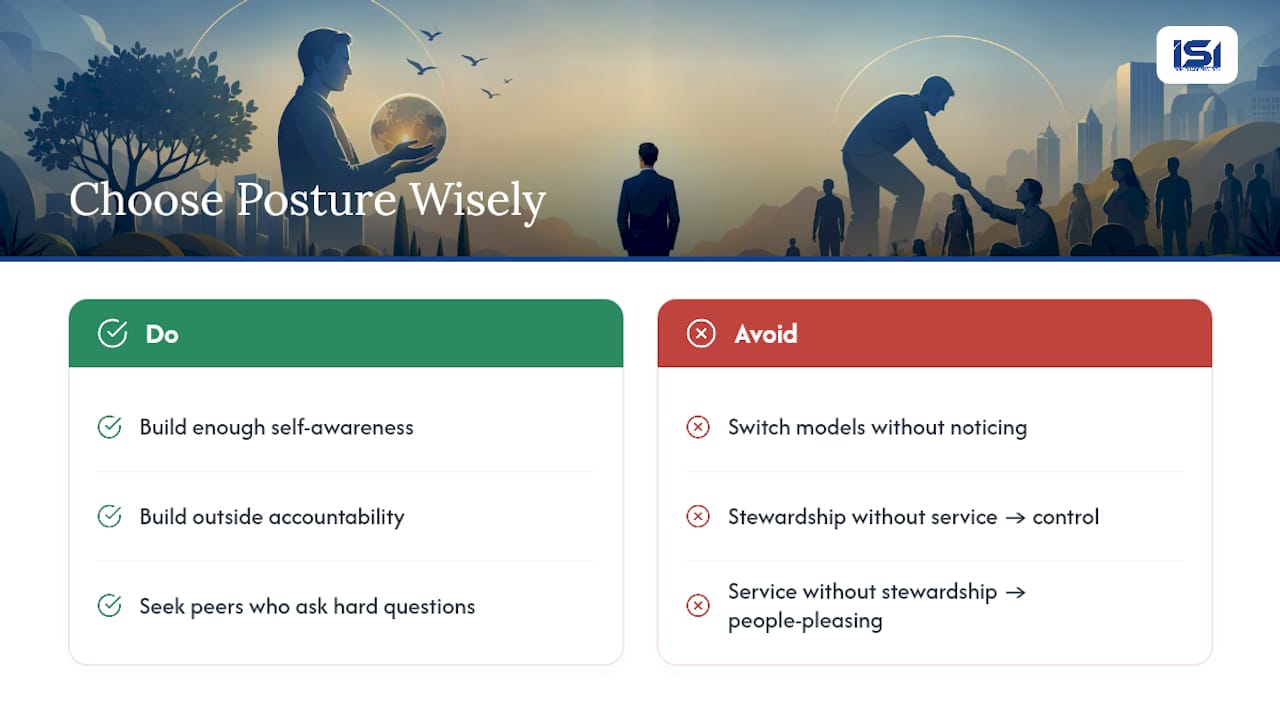
The leaders who struggle most are not the ones who pick the wrong model. They are the ones who never realize they are switching between models without noticing. A founder will run their team meeting like a servant, gathering input on every decision, then turn around and manage the company's finances like an autocrat with zero accountability to anyone. That inconsistency is what erodes trust faster than either model applied poorly on its own.
The uncomfortable truth is that stewardship without service curdles into control, and service without stewardship curdles into people-pleasing dressed up as humility. The fix isn't picking a side. It's building enough self-awareness, and enough outside accountability, to know which posture the moment actually requires. That kind of clarity rarely comes from reading about leadership alone. It comes from men who will ask you the hard question in a room where you cannot hide, a resource ISI Brotherhood's take on faith-forward leadership explores in more depth.
— Derek
A Guided Path to Practicing Both Postures Well
Reading about steward leadership and servant leadership is one thing. Practicing both under real accountability, with men who will call out the difference in you before you see it yourself, is another. ISI Brotherhood offers several paths, including community membership, mastermind groups, and retreats, aiming to place men with trusted peers rather than a generic networking crowd.
Joining these paths provides access to a Personal Board of Advisors, a consistent weekly rhythm, and clearly communicated confidentiality to foster a trustworthy environment. Participants receive biblical teaching that emphasizes leadership as stewardship prior to discussing leadership as strategy. If you're ready to stop switching leadership models without noticing, explore ISI Community or look into ISI Mastermind and see which fits where you are right now.
Where to Read More on Steward and Servant Leadership
- Kent R. Wilson's foundational comparison for the Christian Leadership Alliance, the source most cited in this article.
- The Bible's Leadership Vocabulary, Part 1 from the Association for Biblical Higher Education, for the Hebrew and Greek terms behind steward and servant.
- Gonzaga University's practitioner article on the entrepreneurial, risk-taking nature of stewardship.
- A peer-reviewed analysis arguing steward leadership better accounts for authority and accountability across organizations.
- A theological critique contrasting servant and steward models with an emphasis on service to God.
Sources
- Is Steward Leadership Different than Servant Leadership? By Dr. Kent R. Wilson
- The Bible's Leadership Vocabulary - Part 1 - Association for Biblical Higher Education
- Gonzaga University repository article on steward leadership (practitioner insights)
- Peer-reviewed article arguing for steward leadership as a complement to servant leadership (DOI)
FAQ
What Is the Difference Between Steward and Servant Leadership?
Servant leadership centers on serving followers to help them grow, while steward leadership centers on managing resources and mission on behalf of an Owner. Kent R. Wilson argues steward leadership actually builds on servant leadership by adding accountability and resource management rather than replacing it.
What Are the Four Types of Leadership Styles Commonly Compared to Steward and Servant?
Leadership literature commonly discusses servant, steward, transformational, and transactional leadership as distinct styles. Servant and steward both emphasize humility and mission, but differ in who the leader answers to first, the follower or the Owner.
What Are Five Qualities of a Good Steward Leader?
A good steward leader shows accountability, delegated authority handled responsibly, mission focus, entrepreneurial risk taking, and clear reporting to whoever they answer to. Practitioner research describes stewardship as active and growth oriented rather than merely custodial.
What Are the Seven Pillars Often Associated With Servant Leadership?
Definitions of servant leadership's core pillars vary by author, but common versions include listening, empathy, healing, awareness, persuasion, foresight, and stewardship of community. The exact list shifts depending on which servant leadership framework a given writer follows.
How Can I Practice Both Steward and Servant Leadership Without Confusing My Team?
Set clear delegation agreements so your team knows when you are exercising steward authority versus servant listening, and communicate the difference openly. A structured environment like ISI Brotherhood's community helps leaders build this consistency through weekly accountability rather than trial and error alone.