

An unequally yoked business partnership, a binding alliance where a believer shares ownership, liability, or control with someone who does not share his convictions, is not automatically forbidden, but it is rarely wise. The safe path runs through three checks: does the partner's character and values align closely enough to survive pressure, will the contract include real exit and veto safeguards, and has a pastor or trusted counsel has weighed in before signing anything. Ordinary trade with nonbelievers is fine. Binding co-ownership is a different animal.
TL;DR:
- Binding business partnerships involve shared liability and control, which increase the risk of compromising core convictions under pressure.
- Employment, vendor, or minor investment relationships are generally safe, as they do not entail shared ownership or legal responsibility.
- Building formal contracts with exit clauses, veto rights, and decision thresholds helps protect a believer’s testimony and values in partnerships.
- Character assessments and consulting trusted advisors are essential before formalizing a partnership, especially to identify potential ethical or moral conflicts.
- Resisting or avoiding a partnership is advisable if a partner refuses to include clear safeguards or asks for compromises that threaten spiritual or moral principles.
Table of Contents
- What Does the Bible Say About an Unequally Yoked Business?
- Employment, Trade, or Partnership: Where Does the Yoke Begin?
- Building Contracts and Governance That Protect Your Testimony
- How Do You Evaluate a Potential Business Partner?
- When Should You Walk Away From a Deal?
- What Actually Goes Wrong in These Partnerships
- How Differing Values Reshape Daily Operations
- Resolving Conflict When You're Unequally Yoked
- What This Means for Your Family and Faith Long Term
- What ISI Brotherhood Has Seen in the Room
- A Personal Board of Advisors Before You Sign Anything
- Sources
- FAQ
What Does the Bible Say About an Unequally Yoked Business?
Paul's warning in 2 Corinthians 6:14, "Do not be unequally yoked with unbelievers," borrows a farming image. A yoke bound two animals to the same plow, and Jewish law forbade pairing an ox with a donkey because their strength, gait, and temperament didn't match. Force two mismatched animals to pull together and one strains while the other drags. Theology of Work points out that Paul is drawing a contrast between light and darkness, righteousness and lawlessness, not banning every interaction with people outside the faith.
Related passages sharpen the point rather than soften it. Matthew 11:29 uses the same yoke image for discipleship itself, a relationship of shared direction and submission to Christ. Amos 3:3 asks, "Can two walk together, except they be agreed?" The common thread is agreement of direction, not mere proximity.
That distinction matters for business owners weighing a partnership:
- The verse targets binding, compromising unions, not casual commerce or friendly transactions.
- A partner's differing ultimate authority, God versus profit, tends to surface exactly when money gets tight.
- Selecting a partner is a moral decision as much as a financial one, since shared ownership means shared accountability for how the business behaves.
Employment, Trade, or Partnership: Where Does the Yoke Begin?
Not every business relationship with a nonbeliever carries the same risk. Scholarship on this passage generally treats it as a warning against binding relationships like co-ownership, not a blanket rule against commercial contact, according to Between Two Cultures. The dividing line is shared liability and shared governance. Once you're both legally responsible for the same debts, or both able to bind the company to a decision, you're yoked.
Three categories help sort this out:
- Employment and vendor relationships. Hiring a nonbeliever, or buying supplies from one, creates no shared ownership and no mutual liability. Paul himself worked alongside people of every background as a tentmaker.
- Casual commerce and minority investing. Selling a product, signing a service contract, or holding a small non-controlling stake in someone else's company keeps decision-making and legal exposure separate.
- Co-ownership and equal-control partnerships. Two names on the LLC, shared signing authority on the bank account, and joint liability for lawsuits or debt. This is the yoke Paul had in mind, according to Theology of Work.
A landlord renting office space to a nonbeliever isn't yoked to him. Two men co-signing a business loan together are.
Building Contracts and Governance That Protect Your Testimony
If you decide to move forward, the contract does most of the spiritual heavy lifting. The Orthodox Presbyterian Church advises putting a clear exit process in writing before you need one, and Focus on the Family recommends a formal buy-sell agreement as the standard tool for preventing a partnership from calcifying into an unequal yoke.
Specific clauses worth requesting:
- A buy-sell agreement that sets a fair valuation method and a timeline for either partner to exit.
- A written veto right on ethics issues, so no single vote can push the company into deceptive or exploitative practices.
- Capital and spending limits that require joint sign off past a defined threshold.
- Clearly defined roles so authority isn't ambiguous when a hard call has to be made under pressure.
Governance matters as much as the paperwork. Bringing in independent advisors, setting decision thresholds that require more than one signature, and giving a minority partner real protections all reduce the odds that one person's convictions get steamrolled. Operational habits count too: adequate insurance, cash reserves that buy you time instead of forcing panic decisions, and separation of duties so no one person controls both the books and the bank account.
Pro Tip: Make sure all key agreements are in writing. Handshake understandings about what stays private evaporate the moment a dispute starts, so put it in the operating agreement before you ever need it.
Financial boundaries deserve the same rigor you'd apply to personal stewardship, and for good reason. A business without clear capital limits is a business one bad quarter away from a moral compromise nobody planned for.
How Do You Evaluate a Potential Business Partner?
Character shows up in the small stuff long before it shows up in a contract. Talk to past business partners, employees, and vendors before you sign anything. How someone treats a struggling employee or a slow-paying vendor tells you more than any pitch deck.
Look for alignment on the things that actually run a company day to day: how they think about stewardship, whether they give generously, how they hire and fire, and what their reputation is among people who've worked with them longest. The OPC frames this as asking whether the person has demonstrated ethical stability, particularly under stress, since that's the condition most likely to expose a values gap.
A few signals should end the conversation quickly:
- Secrecy about finances, ownership structure, or existing legal disputes.
- Any pressure, even subtle, to cut corners on taxes, contracts, or quality to hit a number.
- Refusal to formalize an exit plan or buy-sell agreement before signing.
- A pattern of burned relationships with former partners or employees who describe the same complaint independently.
Get ample room and time before you get the right paperwork signed. Character checks aren't a formality to rush through on the way to a deal.
When Should You Walk Away From a Deal?
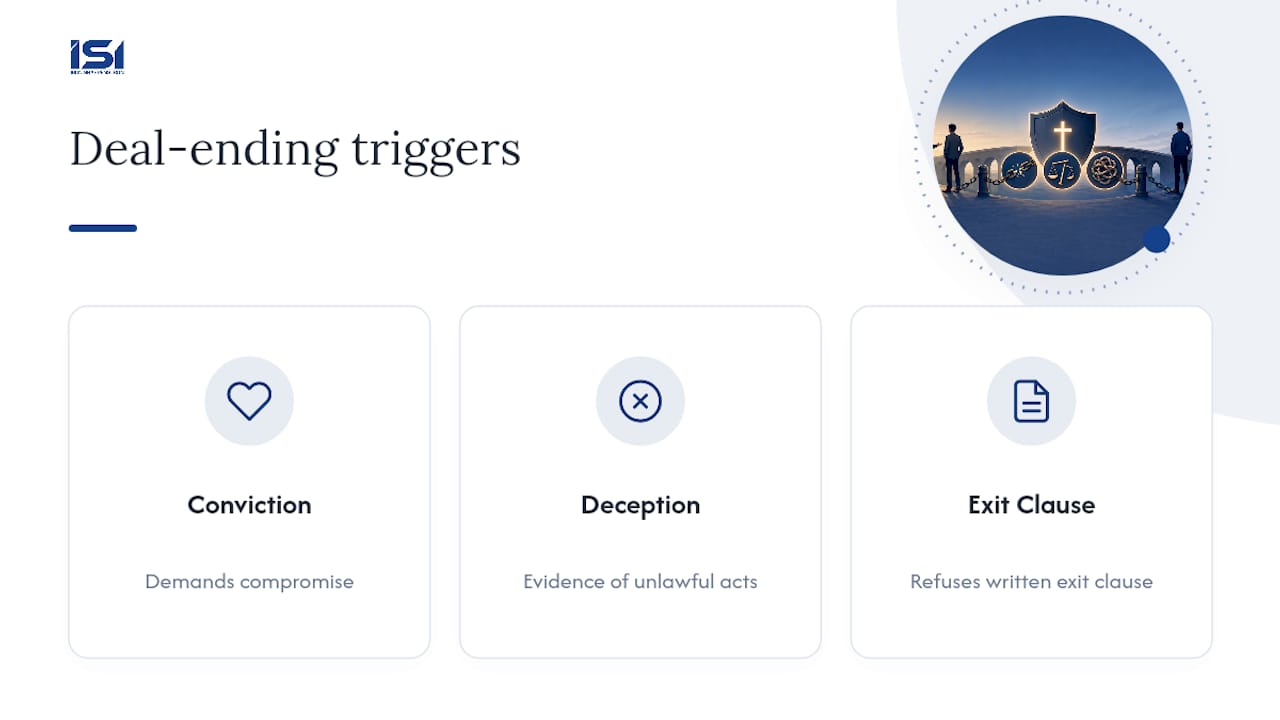
Three triggers should end negotiations, regardless of how good the numbers look: a partner asking you to compromise a core conviction, evidence of unlawful or deceptive practices, or resistance to the contractual safeguards described above. A partner who won't put an exit clause in writing is telling you something about how he plans to behave once the business is stressed.
Before you sign, or before you walk, talk to people who can see what you can't. A pastor can weigh the spiritual dimension. Mature Christian business peers, ideally in a structured accountability setting, can pressure-test your reasoning. An attorney can catch contract gaps you'd never spot alone. Prayer and a deliberate pause, rather than a rushed signature, tend to surface concerns that excitement about the deal was covering up.
What Actually Goes Wrong in These Partnerships
The theory sounds tidy. The reality gets messy in a handful of predictable ways.
Money problems expose the gap first. A business partner who has no framework beyond "whatever grows revenue" will suggest the workaround, the gray-area deduction, or the quiet layoff that a values-driven owner can't stomach, usually right when cash is tightest and the pressure to agree is highest.
Hiring philosophy is another common flashpoint. One partner wants to develop people and build a culture; the other treats staff as interchangeable and disposable. That disagreement rarely gets resolved with a memo. It gets relitigated every time someone underperforms.
Decision paralysis shows up when neither partner has final say on values questions. A 50/50 split with no tiebreaker means every ethical disagreement becomes a standoff, and standoffs are expensive in both time and morale.
And reputational exposure cuts both ways. A partner's ethical shortcut becomes your problem the moment your name is on the same door, the same contracts, and the same lawsuits. Customers, vendors, and employees rarely distinguish between partners when a company's integrity comes into question.
How Differing Values Reshape Daily Operations
Culture isn't a mission statement on the wall. It's a hundred small decisions made every week, and an unequally yoked partnership means those decisions get made from two different playbooks.
Hiring and firing show it fastest. A leader anchored in biblical stewardship tends to weigh a struggling employee's situation, offer grace where it's warranted, and think about long-term development. A partner without that anchor may optimize purely for output, and the resulting inconsistency confuses the whole team about what the company actually values.
Financial decisions carry the same tension. Generosity, tithing commitments, and a willingness to absorb short-term cost for long-term integrity look irrational to a partner who measures everything against quarterly margin. Neither side is necessarily acting in bad faith. They're operating from different definitions of success, and that gap widens under pressure rather than closing.
Vendor and client selection is a quieter version of the same issue. Whether to work with a client whose business practices trouble your conscience is a decision that gets litigated fresh every time it comes up, unless the partnership already agrees on where the lines are. Building a company on kingdom-centered principles only works if both people at the top are pulling toward the same definition of success.
Resolving Conflict When You're Unequally Yoked
Standard conflict resolution advice, listen actively, find common ground, compromise, assumes both parties are negotiating from a shared foundation. That assumption breaks down fast in an unequally yoked partnership, because the disagreement often isn't tactical. It's about what's right.
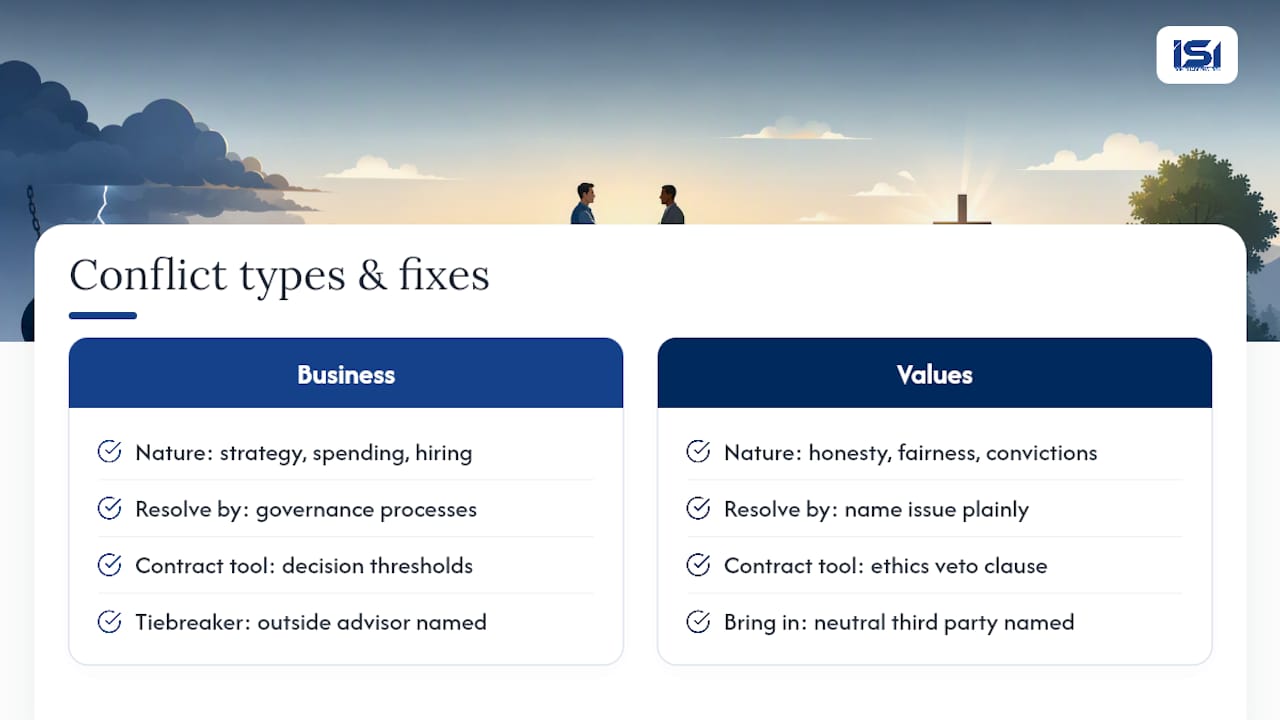
Start by separating the two kinds of conflict you'll actually face. Business disagreements, over strategy, spending, or hiring, can usually be resolved through the governance structures built into the contract: defined decision thresholds, a tiebreaker mechanism, or an outside advisor brought in specifically for that purpose. Values disagreements, over honesty, fairness, or what the company should stand for, need a different approach entirely.
For values conflicts, don't negotiate away a conviction to keep the peace. Name the specific issue plainly, point back to whatever the partnership agreement already says about ethical conduct, and bring in a neutral third party, ideally someone named in the governance structure ahead of time, rather than litigating it in the moment. This is exactly why a written ethics veto clause matters: it turns an emotional standoff into a procedural one, with a predetermined outcome instead of a fresh argument every time.
If the same conflict keeps recurring, that's not a communication problem. It's a sign the underlying values gap was underestimated at the start, and it's a strong signal to revisit the exit clause rather than the communication style.
What This Means for Your Family and Faith Long Term
A strained business partnership rarely stays contained to the office. The stress of an ongoing values conflict follows a man home, shows up in how he treats his spouse and kids, and shapes how present he is in his own church community.
Financial entanglement makes an exit costly precisely when you most need to leave, which is its own kind of trap. A partner who resists an exit clause today is often the same partner who'll make an exit painful five years from now, once real money and real relationships are on the line.
There's a spiritual cost too, one that's harder to quantify but easier to feel. Constant compromise, even in small decisions, has a way of dulling conviction over time. Few men wake up one morning and abandon their values outright. It happens gradually, one rationalized exception at a time, usually inside a relationship that started with good intentions and no real safeguards.
What ISI Brotherhood Has Seen in the Room
Across mastermind cohorts, one pattern shows up again and again: the men who avoid a costly partnership mistake are almost never the ones who figured it out alone. One member, weighing a promising equity deal, brought it to his Personal Board of Advisors before signing anything. The group's pointed questions about exit terms and decision authority surfaced a governance gap he'd missed entirely, and he renegotiated the deal before it became a problem. That's the value of a small, trusted circle asking the questions you're too close to see.
— Derek
A Personal Board of Advisors Before You Sign Anything
Every partnership decision gets clearer with the right men in the room asking hard questions before the ink dries, not after. Members are placed into a Personal Board of Advisors, a small group of Christian business leaders who meet regularly to pressure-test exactly this kind of decision, alongside weekly mastermind meetings built to protect the rhythm of real accountability rather than let it slip once life gets busy.
If you're weighing a partnership right now, or trying to figure out what safeguards to insist on, that's precisely the conversation a Personal Board exists for. Start with 7 practical relationship tips for a successful business for a quick gut check, then look into what a mastermind cohort actually looks like week to week. Bring your next partnership decision to a group built to ask the questions you might be avoiding.
Sources
- Working with nonbelievers (2 Corinthians 6:14–18) | Theology of Work
- Unequally yoked in business? | Between Two Cultures
- Question & Answer: The Orthodox Presbyterian Church (OPC)
FAQ
What Does the Bible Say About Doing Business With Unbelievers?
Scripture permits ordinary commerce and employment with nonbelievers, but 2 Corinthians 6:14 warns against binding partnerships that could force a believer to compromise core convictions, especially under financial pressure.
Can Two Christians Be Unequally Yoked in Business?
Yes. The core issue is values alignment and shared moral accountability, not religious labels alone, so two professing Christians with sharply different ethics or priorities can still create a mismatched, high-risk partnership.
Is It a Sin to Marry Someone Unequally Yoked?
The unequal yoke principle applies most directly to marriage in its original context, and most interpreters treat marrying someone who doesn't share your faith as a serious risk to spiritual unity, though the passage itself doesn't spell out marriage explicitly.
Which Generation Will Not Pass Away?
That question refers to a separate passage about the end times, and it isn't connected to the unequal yoke teaching in 2 Corinthians 6:14.
How Can I Tell if a Business Partnership Has Become a Binding Yoke?
Shared liability, joint control over major decisions, and mutual legal exposure are the clearest markers. A tool like a Personal Board of Advisors can help you evaluate this before you sign, not after.