

The path to work life balance for Christian men isn't balance at all. It's alignment: work as worship, family as mission, both under one calling. Start this week by protecting a weekly Sabbath, naming one family non-negotiable you will not miss, and inviting a small group of men to hold you to it. The scripture, routines, boundary scripts, and accountability structure that make this stick follow below.
TL;DR:
- Protect a weekly Sabbath day and communicate it clearly to clients and colleagues, expecting initial resistance that usually fades with consistency.
- Establish non-negotiable rhythms such as date nights, one-on-one time with children, and daily morning devotions to build sustainable habits.
- Use process tools like batching emails, setting meeting-light days, and auto-declining outside-hour meetings to maintain boundaries without relying solely on willpower.
- Cultivate accountability through a small group of men who meet regularly to review rhythms, goals, and spiritual health, ensuring sustained progress.
- Recognize biblical figures like Jesus, Nehemiah, and Boaz as models for balancing calling and family through intentional rhythm, presence, and boundaries.
Table of Contents
- What Does Work Life Balance Mean for Christian Men?
- Which Rhythms Should You Protect First?
- How Do You Build a Weekly Rhythm That Sticks?
- What Boundaries Protect Your Presence at Work?
- Why Does Accountability Matter More Than Willpower?
- How Do You Know Your Balance Is Actually Improving?
- What Gets in the Way, and How Do You Push Through It?
- How Do You Weave Prayer Into a Working Day?
- How Does This Actually Affect Your Family?
- How Do You Handle the Guilt When You Rest?
- Which Biblical Figures Modeled This Kind of Alignment?
- A Boundary I Set, and What It Actually Cost Me
- A Faith-Aligned Place to Protect These Rhythms
- Sources
- FAQ
What Does Work Life Balance Mean for Christian Men?
Most work life balance advice treats work and family as competitors fighting over the same 24 hours. Scripture treats them as two expressions of the same calling. That distinction changes everything about how you plan a week.
Work isn't a necessary evil you tolerate until retirement. Colossians 3:23 tells you to work "with all your heart, as working for the Lord." The creation mandate in Genesis puts man to work in the garden before sin ever entered the picture. Work is part of the design, not a punishment for it.
Rest carries equal weight. God rested on the seventh day in Genesis 2, and He commanded Israel to do the same in Exodus 20. Jesus modeled withdrawal from crowds to pray and recover. Rest isn't laziness. It's obedience.
And provision alone doesn't fulfill your calling as a husband and father. 1 Timothy 5:8 ties provision to family responsibility, but Manhood Journey's guidance on work and family makes the sharper point: presence matters beyond the paycheck. A man who provides everything financially but shows up nowhere else has only done half the job.
This is why "balance" is the wrong word. Balance implies a scale where work and family sit on opposite sides, and one side's gain is the other's loss. Alignment means both flow from the same source. Once you stop scoring your week by hours split fifty-fifty, you start protecting what actually matters:
- Work done with excellence because it's an act of worship, not a means to escape family.
- Rest taken without guilt because God commanded it, not because you earned it.
- Presence prioritized because provision was never meant to stand alone.
Which Rhythms Should You Protect First?
Before you optimize anything else, lock in the habits that carry the most weight. Get the right rhythms in the room before you let anything else compete for your calendar.
- A weekly Sabbath day. One full day off from work, devices largely off, dedicated to rest, worship, and family. This is the single highest-leverage rhythm you can protect.
- A weekly date night. Non-negotiable time with your wife, scheduled with the same seriousness as a client meeting.
- A weekly one-on-one with each child. Even 30 minutes of undivided attention per child, per week, tells them where they rank.
- A daily morning devotion. Five to fifteen minutes before the day starts, setting your posture toward God before anyone else makes a claim on your attention.
According to 10X Life Plan's framework for balancing work and family, a Sabbath day plus these weekly reps cost a small number of hours a week. That's a small tax against real, felt priority in your family.
Setting the boundary with your team matters as much as setting it with yourself. Tell clients and coworkers your Sabbath window up front. Use an auto-responder that states clearly when you're offline and who to contact for real emergencies, then delegate that emergency contact to someone you trust so you're not the bottleneck.
Expect pushback, especially in the first month. Test the boundary for four to twelve weeks before you judge whether it's working. Most resistance fades once people see you're consistent, not flaky.
Pro Tip: Write your non-negotiables on a card and put it where you plan your week. If it's not written down, it competes with everything else that shows up on Monday morning.
How Do You Build a Weekly Rhythm That Sticks?
A principle without a schedule is just a good intention. Here's how to translate alignment into an actual week.
A sample daily rhythm:
- Wake and spend 10 to 15 minutes in morning devotion before checking your phone.
- Block your first 90 minutes of work for the task that moves the needle most, before email or meetings touch your calendar.
- Protect evenings for family: phones down at the dinner table, full attention for at least one meal.
- Close the day with a short reflection or prayer, naming one thing you're grateful for and one thing you need to release.
A sample weekly template:
- Monday through Friday: deep work blocks in the morning, meetings clustered in the afternoon, one evening set aside for date night.
- Wednesday or Thursday evening: one-on-one time with each child, rotating if you have more than one.
- Saturday: flexible for errands, projects, or rest, depending on your season.
- Sunday: full Sabbath. Worship, family, rest. No planning the coming week until sundown or Monday morning.
Every 90 days, run a vision check. Rachel Ngom's guidance on building without burning out recommends picking three needle-movers for the next quarter rather than a long list of goals competing for attention. Ask what actually moved your business, your marriage, and your walk with God forward, then choose three things to focus on for the next 90 days instead of scattering effort across a dozen priorities.
What Boundaries Protect Your Presence at Work?
Boundaries aren't about working less. They're about making sure work doesn't quietly consume everything else because nobody told it no.
A few tactics work better than willpower alone:
- Batch your email. Check it two or three set times a day instead of reacting to every notification.
- Keep meeting-light days. Cluster meetings into two or three days so the rest stays open for deep work and family.
- Set a phone-off window. Pick an evening hour when the phone goes in a drawer, not just on silent.
- Delegate an emergency contact. Someone on your team who can field the actual emergencies so you're not the single point of failure.
If you need language for the conversation with your boss or client, try something direct: "I'm not reachable after 6 p.m. on weekdays or on Sundays. If something urgent comes up, [name] can reach me." Most professional relationships respect a boundary stated once, calmly, and held consistently.
Small process changes make the boundary easier to keep. Calendar rules that auto-decline meetings outside work hours, an auto-responder that states your Sabbath window, and a focus app that blocks notifications during deep work all remove the moment-by-moment willpower cost.
Pro Tip: State your boundary before you need it, not in the middle of a crisis. A boundary announced calmly on a normal Tuesday lands very differently than one announced while you're already overwhelmed.
Why Does Accountability Matter More Than Willpower?
Willpower fades by Wednesday. Accountability holds when motivation doesn't. A man who tells no one his plan has given himself permission to quietly abandon it the first hard week.
This is where a small group changes the outcome. Not networking. Not a Bible study you attend when convenient. A structured group that meets on a cadence, keeps confidentiality clear from day one, and has permission to ask hard questions.
A Personal Board of Advisors works well here: four to six men meeting weekly or biweekly, covering personal, spiritual, relational, professional, and financial ground, not just business talk. Protect the rhythm of that meeting the same way you protect your Sabbath. A group that meets "when everyone's free" dissolves within two months.
Starting or finding one takes discipline before it takes chemistry:
- Get the right men in the room before you worry about polish. Character and consistency matter more than credentials.
- Ask directly: "Will you actually show up every week?" and "Can I trust you with what I say here?"
- Make confidentiality clear from day one, before the first hard conversation happens, not after.
How Do You Know Your Balance Is Actually Improving?
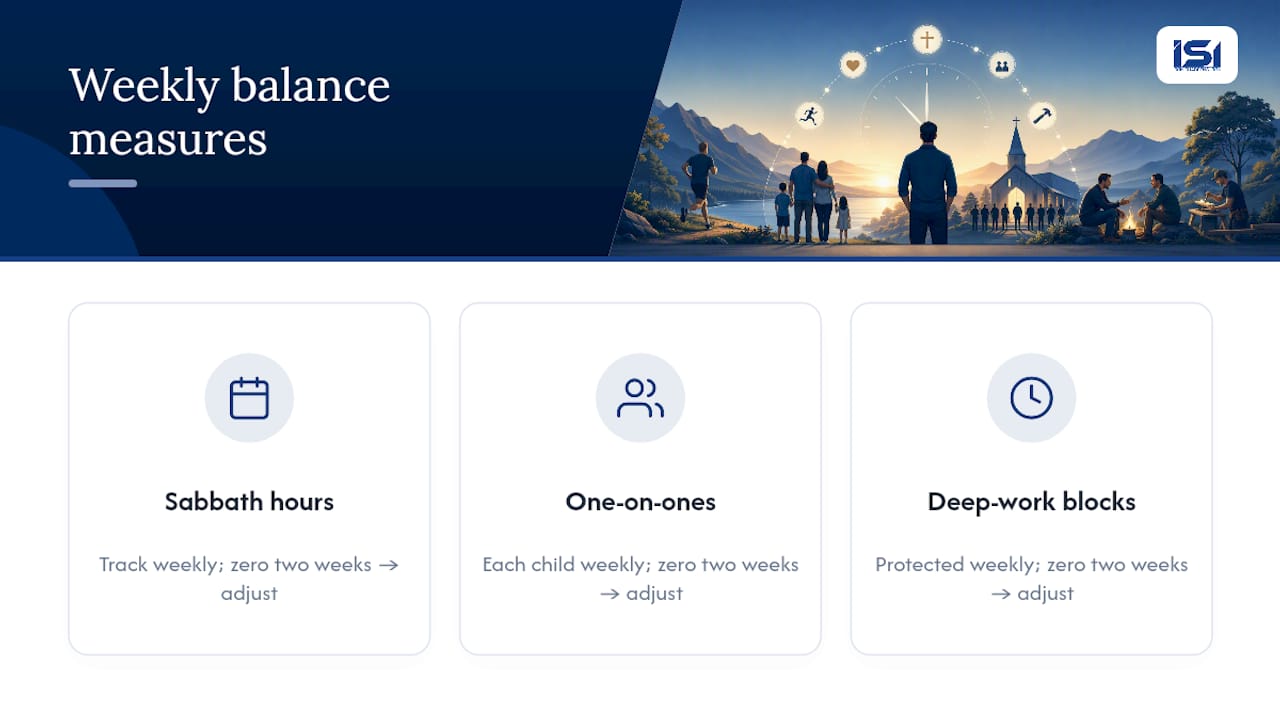
Track a few numbers weekly: Sabbath hours actually held, one-on-ones completed with each child, and deep-work blocks protected without interruption. If any of these drop to zero for two weeks running, that's your signal to adjust, not wait.
Qualitative signals matter just as much. Does your wife say she feels prioritized, or does she say she's competing with your phone? Is your energy steady through the week, or are you crashing by Wednesday? Are your decisions getting clearer or more reactive?
Review every four to twelve weeks. Involve your wife and your Personal Board of Advisors in that review. They'll see blind spots you can't see in yourself.
What Gets in the Way, and How Do You Push Through It?
The obstacles are predictable, which is actually good news. You can plan for them instead of being blindsided.
Client and boss expectations that assume constant availability. Many men assume this can't be renegotiated. It usually can, once you state your boundary clearly and hold it consistently for a full quarter. Clients adjust to what you model, not what you apologize for.
Seasons of genuine crisis. A launch, a layoff, a sick child. These will break your normal rhythm, and that's fine for a week or two. The danger is letting a two-week crisis become a permanent new normal because you never rebuilt the rhythm after.
Comparison with other men who seem to have it figured out. Social media and even church culture can make it look like some men run thriving businesses and picture-perfect families without friction. What you're seeing is a highlight reel, not their Tuesday. Comparison steals the energy you need for your own week.
A spouse who's skeptical the new boundaries will last. This is fair, especially if you've announced changes before and abandoned them within a month. Rebuild trust through consistency, not promises. Four to twelve weeks of held boundaries speaks louder than any conversation.
Ambition that quietly outranks calling. This is the subtlest obstacle. You tell yourself the next deal, the next quarter, the next milestone justifies skipping the Sabbath just this once. Manhood Journey's guidance on family priorities puts it plainly: presence is a priority, not a reward you unlock after success. If you wait for "arrival" to protect your family's time, you'll wait forever, because ambition never runs out of next milestones.
Naming these obstacles ahead of time takes their power away. You expect the pushback, so it doesn't derail you when it shows up.
How Do You Weave Prayer Into a Working Day?
Prayer that only happens at church on Sunday can't sustain a Tuesday afternoon crisis. The men who hold their rhythms longest tend to be the ones who've built prayer into the texture of an ordinary workday, not just the calendar's edges.
Start with the morning devotion already in your daily rhythm, but don't stop there. A short prayer before a hard meeting. A silent moment of gratitude after closing a deal, win or lose. A brief confession when you catch yourself resenting your family for interrupting "important" work.
Some men build a rhythm around the workday's natural transitions: a prayer in the car before walking into the office, a moment of quiet before opening the laptop, a closing prayer at the end of the workday that hands off whatever's unfinished. These transition points cost thirty seconds and change your posture for hours.

Spiritual warfare doesn't stay outside the office, and the pressure to compromise, cut corners, or resent your family for competing with work is real and constant. Prayer woven through the day is less about asking for outcomes and more about staying aligned with the calling you started the day with. A man who prays only in crisis has waited too long to build the habit.
How Does This Actually Affect Your Family?
The math is simple, even if living it isn't. A father who's present tends to raise children who feel secure; a father who's perpetually elsewhere, even while living under the same roof, tends to raise children who compete for scraps of his attention.
Presence compounds. A weekly one-on-one with your son or daughter, held consistently for a year, builds a different relationship than the same 26 hours spent in scattered five-minute check-ins between meetings. Consistency, not volume, is what a child actually remembers.
Marriage responds the same way. A wife who watches her husband guard a Sabbath day and a date night learns something her husband's words alone can't teach her: she's not competing with his career for his attention. That security shows up in the relationship in ways far beyond the specific hours protected.
The reverse is also true, and worth saying plainly. A family that watches provision consistently outrank presence learns to stop expecting presence at all. Kids stop asking Dad to their games. Wives stop mentioning the vacation they wanted. Not because they stopped caring, but because they adjusted their expectations downward to match reality. Rebuilding that trust after years of absence takes far longer than building it would have taken in the first place.
How Do You Handle the Guilt When You Rest?
Guilt shows up in two directions for Christian men, and both are worth naming honestly. Some men feel guilty resting because they equate rest with laziness. Others feel guilty working because they equate ambition with neglecting family. Both versions of guilt miss the same point: God commanded rest, which means resting is obedience, not indulgence.
Perfectionism compounds the problem. A man who believes he must execute every rhythm flawlessly, every week, without fail, will burn out on the standard before he burns out on the actual work. Missing a one-on-one because of a genuine crisis isn't failure. Treating every missed rhythm as proof you're a fraud is the actual danger.
The fix isn't lowering your standards. It's separating identity from performance. Your calling as a husband, father, and worker flows from who you are in Christ, not from a perfect scorecard of habits held every single week. When you miss a rhythm, name it, adjust, and pick it back up the following week rather than spiraling into self-punishment that costs you two more weeks of momentum.
Grace applies here the same way it applies everywhere else in the Christian life. You're not earning your place with God through a flawless Sabbath streak. You're stewarding a calling He's already given you, imperfectly, like every man before you has.
Which Biblical Figures Modeled This Kind of Alignment?
Scripture doesn't hide the tension between calling and family. It shows men wrestling with it, sometimes successfully, sometimes not, which makes the examples more useful than a sanitized ideal would be.
Nehemiah rebuilt Jerusalem's walls while holding a demanding government post, and he did it with intense focus without abandoning his responsibility to lead his people well. His example shows what a defined 90-day mission with clear priorities looks like in practice.
Boaz ran a substantial agricultural operation and still made time to personally notice and provide for Ruth, a vulnerable foreigner working his fields. Presence and productivity weren't competing values for him. They were the same value expressed in two directions.
Jesus himself models the clearest pattern. He carried the weight of a mission larger than any man has ever carried, and He still withdrew regularly to pray, rested when His body needed it, and made time for individual people even during his busiest ministry seasons. If the Son of God needed rhythm and rest to sustain His calling, no man today is exempt from needing the same.
These aren't men who achieved effortless balance. They're men who protected what mattered under real pressure, which is a more honest and more useful model than pretending the tension disappears once you're faithful enough.
A Boundary I Set, and What It Actually Cost Me
Setting one Sabbath boundary taught me more than any productivity system ever did. The hardest part wasn't the boundary itself. It was believing my business would survive a full day of silence.
It did. Clients adjusted. The work waited. What didn't wait was my family, who noticed the difference within a month.
If you try one thing this week, try this: pick a single non-negotiable, tell someone about it, and protect it for four weeks before you judge whether it works.
— Derek
A Faith-Aligned Place to Protect These Rhythms
Protecting a Sabbath and a few weekly non-negotiables is a decision you can make alone on a Monday morning. Keeping them for a year is much harder without men who ask you about it on purpose. That's the gap ISI Brotherhood exists to close.

A Personal Board of Advisors is a small group of Christian men who meet on a regular cadence to cover the same five areas this article walks through: personal, spiritual, relational, professional, and financial. Add regular meetings, an online community, and leadership events, and you get structured accountability instead of good intentions that quietly erode over time. Members get counsel from men who are protecting rhythms in their own businesses and families, not theory from someone who's never tested it under real deadline pressure.
If you're ready to stop holding your calendar accountable to yourself alone, read what it means to lead your family as a patriarch and consider applying for a Personal Board of Advisors built around alignment like this.
Sources
Grounded in Genesis, Exodus 20, Colossians 3:23, 1 Timothy 5:8, and Ephesians, plus Gotquestions, 10X Life Plan, Manhood Journey, and Rachel Ngom.
- What the Bible Says About Balancing Work and Family - Manhood Journey
- Faith, Boundaries, and Business: Build Without Burning Out - Rachel Ngom
FAQ
What Is the Biblical View of Work-Life Balance?
Scripture frames work as worship (Colossians 3:23) and rest as command (Exodus 20), so the goal isn't splitting time evenly but aligning both under the same calling.
How Many Hours Does Protecting a Sabbath Actually Cost?
A weekly Sabbath plus a few core rhythms like date night and one-on-ones with your kids costs roughly ten hours a week, a small trade for consistent presence.
How Long Should I Test a New Boundary Before Judging It?
Give any new work boundary four to twelve weeks before deciding whether it's working, since initial pushback usually fades once people see you're consistent.
What Does a Personal Board of Advisors Actually Do?
A Personal Board of Advisors is a small group of Christian men meeting weekly or biweekly to hold each other accountable across personal, spiritual, relational, professional, and financial life, a structure ISI Brotherhood builds into every membership.
How Do I Handle Guilt When I Take a Full Day Off?
Remember that Sabbath is a command, not an indulgence. Resting in obedience to that command is faithfulness, not laziness.