

Workplace discipleship means practicing your faith as a working professional, not compartmentalizing it into evenings and Sundays. It runs on four daily habits: a morning anchor, a decision filter, a relationship lens, and an evening reflection. Start with just the first one. A 15-minute morning anchor, done before your inbox opens, changes how the rest of your day gets framed.
TL;DR:
- Starting with a 10-15 minute morning Scripture reading and prayer before work significantly sets a faithful tone for the day.
- Practicing a decision filter of asking if actions reflect God's character only takes 10-30 seconds but greatly reduces regrets.
- Building a small, voluntary faith community outside work hours helps sustain daily discipline habits and deepen accountability.
- Combining personal routines with peer accountability, such as weekly check-ins, improves long-term habit adherence.
- Integrating faith practices into career goals enhances both spiritual growth and professional development, reinforcing one another.
Table of Contents
- The Four-Discipline Framework for Workplace Discipleship
- What Does Your Workplace's Faith Posture Allow?
- Vocation as Mission: What This Looks Like in Practice
- Obstacles That Derail Workplace Discipleship
- A One-Week Starter Plan You Can Actually Follow
- The Research Behind Daily Discipleship Habits
- Why You Need a Workplace Faith Community
- Mentoring and Accountability That Actually Change Behavior
- Making Discipleship Part of Your Career Growth
- What I've Seen Work Inside a Mastermind Cohort
- A Structured Path for Men Who Want This to Stick
- Sources
The Four-Discipline Framework for Workplace Discipleship
Colossians 3:17 sets the standard most professionals quietly ignore: "whatever you do, in word or deed, do everything in the name of the Lord Jesus." That verse is not a decoration for your desk. It is a daily operating instruction, and it breaks down into four disciplines you can actually practice between meetings.
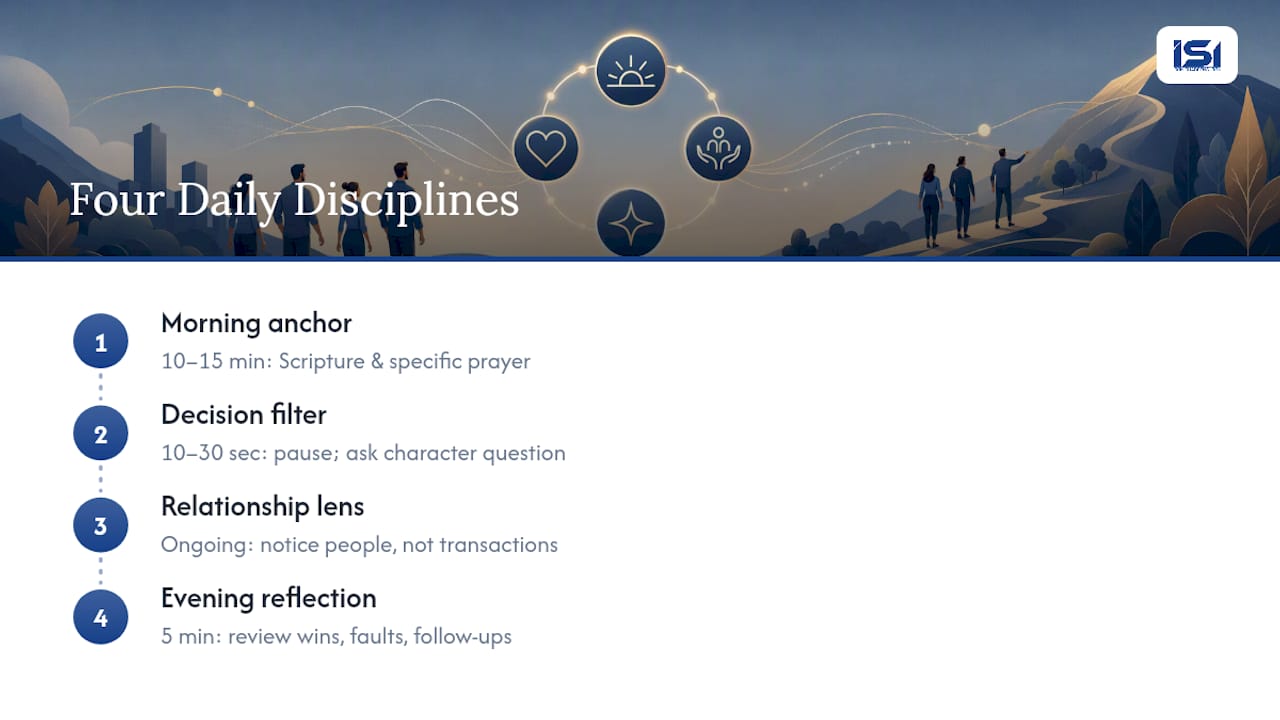
1. Morning anchor (10-15 minutes). Before opening email or Slack, read a short passage of Scripture and pray specifically about the day ahead: a hard conversation, a decision, a colleague who is struggling. This is the single habit worth starting first, because everything else in the framework assumes you have already oriented yourself before the workday hijacks your attention.
2. Decision filter (10-30 seconds). Before a meeting, negotiation, or tough email, pause and ask one question: "Does this reflect God's character?" This micro-pause is the discipline most professionals skip, and it is also the one that prevents the most regret.
3. Relationship lens (ongoing). Treat every colleague, vendor, and client interaction as an opportunity to notice a real person rather than a transaction. This does not require new time on your calendar. It requires a shift in how you see the person already in front of you.

4. Evening reflection (5 minutes). Before you close your laptop, ask what went well, where you fell short, and who you should follow up with tomorrow. Ministry resources describe this kind of four-part daily framework as one of the more practical ways to integrate faith and work without treating them as separate categories.
The trick to making these stick is habit stacking: attach the morning anchor to something you already do without fail, like brewing coffee or your commute. Attach the evening reflection to shutting down your computer. Short, time-boxed practices survive busy seasons; ambitious hour-long programs rarely do.
Pro Tip: Set a recurring 10-minute calendar block labeled "anchor" at the very top of your day. If it is not on the calendar, your first Slack notification will win.
What Does Your Workplace's Faith Posture Allow?
Not every office tolerates the same conversations, and pretending otherwise is how well-meaning Christians create friction they did not need to create. Jeff Haanen's framework identifies four workplace postures, and reading yours correctly matters more than your good intentions.
- Faith-avoiding: religious expression is actively discouraged or restricted by policy. Live your convictions through visible character and quality of work; save direct language for outside the office.
- Faith-tolerant: faith talk is permitted but not encouraged. Let curiosity from colleagues open the door rather than initiating unprompted.
- Faith-friendly: open expression is welcomed informally. You can mention church, prayer, or values naturally in conversation without it feeling forced.
- Faith-based: the organization is explicitly Christian in mission or ownership. Deeper discipleship practices, like group prayer or Bible study, fit the culture already.
In faith-avoiding or faith-tolerant settings, look for a "person of peace," a colleague who is open, curious, or already going through something hard, and let that relationship set the pace. Bridging language that talks about flourishing, character, or service tends to open more doors than explicitly religious vocabulary, especially early in a relationship. Save theological terms for once trust is established.
Vocation as Mission: What This Looks Like in Practice
Workplace discipleship works best when you stop treating your job as a stage for evangelism and start treating it as a genuine calling. Scholarship on vocational-missional frameworks describes this as a triadic relationship between your standing with God, your own character, and your posture toward the people around you. Excellence, integrity, and service are not separate from the mission. They are the mission.
Some organizations have built structures that make this easier for their people:
- Voluntary, opt-in Bible study or prayer groups that meet before or after hours, never during paid time or under management pressure.
- Chaplain-like support roles, common in larger companies, that offer confidential counsel during layoffs, grief, or personal crisis.
- A visible standard of excellence in deliverables, treated as an act of worship rather than just a performance metric.
Church leaders have a role here too. Rather than adding new programs, congregations can shift existing pastoral attention toward equipping members for missional competencies at work: short classes on storytelling, ethical decision making under pressure, or how to have a spiritual conversation without derailing a business relationship. A church does not need a bigger budget to do this. It needs to redirect the attention it already spends on Sunday programming toward Monday realities.
Obstacles That Derail Workplace Discipleship
Three failure patterns show up more than any others. The first is compartmentalization: treating faith as a private hobby that stays home. The second is fear, staying so quiet about your convictions that nobody at work ever learns what actually drives you. The third is overreach, pushing religious conversation on people who did not ask for it and creating a legal or relational problem in the process.
Guardrails keep you faithful without making you reckless:
- Ask the HR test question first: would this be appropriate coming from any colleague, regardless of their beliefs? If not, adjust the delivery, not necessarily the conviction.
- Never use your position to pressure a subordinate. Power differences make spiritual conversations coercive even when your intent is kind.
- Keep company time and company resources for company work. Save Bible studies and prayer groups for breaks, lunch, or before and after hours.
- Redirect gracefully when a conversation turns unwelcome. A simple line works: "I appreciate you asking. I'd love to grab coffee sometime and talk more if you're interested."
Pro Tip: If you are ever unsure whether something crosses a line, ask yourself if you would be comfortable explaining your exact words to your manager and to a non-Christian colleague in the same breath. If the answer is no, rework the approach before you speak.
A One-Week Starter Plan You Can Actually Follow
Reading about the four disciplines is easy. Running them for seven straight days is where the habit actually forms. Here is a simple week to build the muscle.
- Monday: Install the morning anchor only. Ten minutes, one passage, one prayer.
- Tuesday: Add the decision filter before your first meeting of the day.
- Wednesday: Practice the relationship lens with one specific colleague you tend to overlook.
- Thursday: Add the evening reflection before closing your laptop.
- Friday: Run all four disciplines together and note which one felt hardest.
- Saturday: Review your week. What surprised you?
- Sunday: Set an intention for one relationship you want to invest in next week.
A short, curiosity-driven opener works better than a rehearsed pitch: "How are you holding up, really?" or "What's been the hardest part of this project for you?" Follow the answer with genuine listening before you say anything about your own faith.
| Discipline | Daily Time | Simple Metric |
|---|---|---|
| Morning anchor | 10-15 minutes | Did I do it before checking email? |
| Decision filter | 10-30 seconds | How many times did I pause today? |
| Relationship lens | Ongoing | One meaningful conversation logged |
| Evening reflection | 5 minutes | One honest sentence written down |
The Research Behind Daily Discipleship Habits
Ministry research and practitioner writing converge on the same conclusion: short, repeatable routines outperform ambitious programs that collapse under a busy quarter. That is not a guess. It is the consistent pattern across the sources professionals actually use to sustain faith at work.
- The four-discipline framework works because it is time-boxed. A 15-minute anchor survives a chaotic Monday; a 90-minute devotional program usually does not.
- A journal article on spiritual sowing at work finds that blending group formation (Bible studies, mastermind-style accountability) with individual daily practice produces deeper, more durable discipleship than either alone.
- Practitioner reflection from One Way Ministries argues that the office, the shop floor, and the boardroom function as genuine formation environments, not just mission fields you pass through on your way home.
The practical takeaway: pair a personal daily rhythm with some form of group accountability. Neither alone tends to hold up for long.
Why You Need a Workplace Faith Community
Individual discipline gets you started, but it rarely survives alone. A small group, whether a voluntary lunchtime Bible study, an informal prayer huddle with two colleagues, or a mastermind cohort outside the office, gives your daily disciplines a place to be tested and refined out loud.
The healthiest workplace groups share a few traits. They meet on a fixed rhythm, weekly or biweekly, rather than "whenever things line up." They stay small enough that everyone actually talks, usually four to eight people. And they operate outside paid work hours or during clearly voluntary breaks, which keeps the legal and cultural boundaries clean.
If your workplace has no existing group, you often do not need permission to start one. A short message to two or three trusted colleagues, "I'm doing a 15-minute Bible reading over lunch on Thursdays if anyone wants to join," is usually enough. Some of the strongest workplace faith communities started exactly that small and simply kept meeting.
If your office culture makes an on-site group impractical, look outside it. Cross-company groups, church-based marketplace ministries, and structured masterminds like Iron Sharpens Iron (ISI) give you the same rhythm and accountability without needing your employer's blessing at all.
Mentoring and Accountability That Actually Change Behavior
Discipleship habits fade fast without someone checking in on them. This is not a character flaw. It is how habit formation works for almost everyone, which is exactly why the four disciplines need a second layer: a mentor or accountability partner who asks about them regularly.
A workplace mentor for this purpose does not need a seminary degree. You need someone slightly further along, in career stage or in faith maturity, who will ask direct questions and actually wait for honest answers. "Did you do your morning anchor this week?" is a more useful question than "How's your walk with God?" because it is specific and checkable.
Structured accountability tends to outperform informal check-ins. A recurring weekly call, a shared tracking document, or a standing coffee slot works better than "let's catch up sometime." The commitment device matters as much as the content of the conversation.
This is where formal peer groups add real value over solo effort. A Personal Board of Advisors model, where a small group of men meet on a fixed schedule to challenge each other across spiritual, professional, and relational dimensions, builds in the exact structure that ad hoc accountability usually lacks. The mentor relationship and the group relationship are not competitors. The strongest discipleship habits usually run on both at once.
Making Discipleship Part of Your Career Growth
Workplace discipleship and career development are not separate tracks running in parallel. Treated well, they reinforce each other. The same discipline that makes you a more reflective Christian, pausing before decisions, noticing people, reviewing your day, also makes you a sharper professional.
When you set career goals for the next year, add spiritual growth markers alongside the usual performance ones. If your professional goal is to lead a team more effectively, pair it with a discipleship goal: practicing the relationship lens specifically with direct reports, or using the decision filter before performance reviews. The two goals sharpen each other instead of competing for your attention.
Mentorship works the same way. A mentor who understands both your career trajectory and your faith commitments can spot patterns you cannot see from inside your own week, like ambition quietly crowding out character, or fear of conflict disguising itself as diplomacy. Career development plans that ignore this dimension tend to produce competent professionals who feel spiritually flat by year three.
The goal is not balance in the sense of splitting your attention. It is integration: using the same disciplined attention that builds a good career to also build a faithful one.
What I've Seen Work Inside a Mastermind Cohort
Watching men run these four disciplines inside an Iron Sharpens Iron cohort taught me something the frameworks alone do not capture: the habit that sticks is the one someone else asks about. A member installs the morning anchor on his own for maybe two weeks. Add a weekly mastermind meeting where a trusted peer asks "did you do it?" and that same habit runs for a year.
The relationship lens discipline changes the most inside a group setting, because members practice naming specific colleagues by name in front of each other, which makes the habit concrete instead of vague. Accountability does not replace conviction. It just keeps conviction from quietly evaporating under deadline pressure.
— Derek
A Structured Path for Men Who Want This to Stick
Reading about the four disciplines is one thing. Running them for a year without a peer group checking in is another matter entirely, and it is where most well-intentioned professionals quietly drift. Isibrotherhood exists for exactly that gap: instead of leaving workplace discipleship to willpower alone, it places you in a Personal Board of Advisors, a small group of Christian men who meet weekly to challenge you across the personal, spiritual, relational, professional, and financial dimensions of your life.
The ideal member is a business owner, executive, or professional who already senses that Sunday and Monday should not be two different lives, but has not found a structure to hold him to it. Between weekly mastermind meetings, a year-round online community, and leadership events, ISI gives the morning anchor and the decision filter something individual effort rarely provides: a group of men who will ask if you actually did it. If that is the missing piece in your own habits, visit the Isibrotherhood membership page to learn how a cohort gets matched and what applying looks like.