
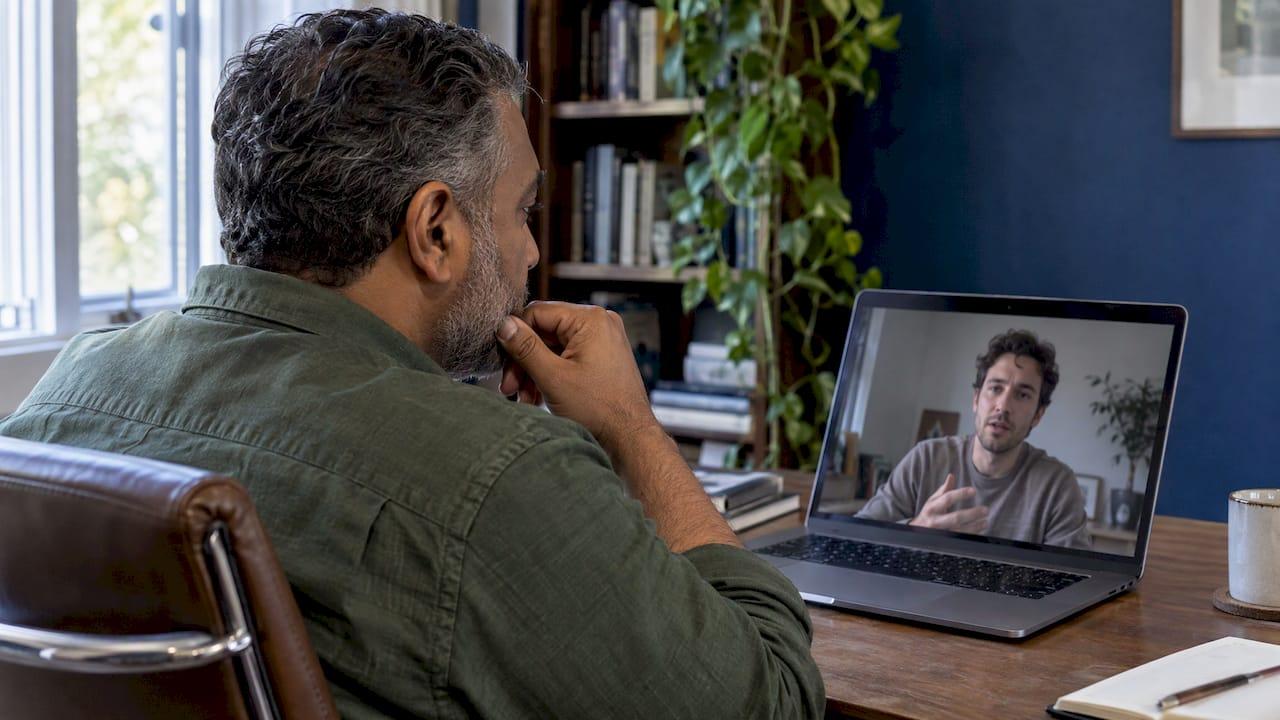
Accountability for remote leaders comes down to two things: a system your team can see, and a circle of people who can see you. The system is clear ownership, written expectations and a steady weekly rhythm. The circle is a small group of peers who ask you the questions your team never will. Most advice covers only the first. Leading from a home office, with no one watching you lead, makes the second just as important.
If you run a business or a division from a distance, you know the quiet pressure. You are the one setting the standard, and nobody in the room notices when you slip. This guide covers both sides, and it does so from a Christian perspective for men who want their faith to show up in how they lead.
TL;DR
- Accountability is ownership, not surveillance. Define deliverables, quality standards and deadlines in writing, then review them with each person.
- Keep one steady rhythm: goals written at the start of the week, a light midweek check-in, and an outcome-based close.
- Measure results, not screen time. Trust grows when you assign end-to-end responsibility instead of fragmented tasks.
- You set the culture. Your team will mirror your clarity, your consistency and your follow-through.
- Leaders need accountability too. A small group of trusted peers keeps you honest when no one else can.
Table of Contents
- What accountability means when your team is spread out
- Start with clear roles and written expectations
- Measure outcomes, not activity
- Protect the rhythm
- Hold people accountable without micromanaging
- Balance trust, flexibility and accountability
- You set the tone from a distance
- Faith-based accountability: honesty, stewardship and service
- Perspective: Why leaders need a Personal Board
- How to build your own accountability circle
- Join an ISI Brotherhood group
- FAQ
- Sources
What accountability means when your team is spread out
The Open University describes accountable leaders as people who are answerable for business performance, company culture and the workforce itself. They communicate goals and key results, accept responsibility when things go wrong, and give credit when things go well.
Notice what is missing from that list: monitoring. Remote accountability, as HiveDesk puts it, goes beyond checking off tasks. It is about a team member owning their responsibilities, committing to quality work and understanding how their contribution affects the team's goals.
The same Open University material draws on McGrath and Whitty (2018) to point out that responsibility and accountability get confused. Responsibility is doing the work. Accountability is being answerable that it was done well. It also cites Pechan (2021) on a point many leaders skip: owning your own mistakes helps build accountability across a team, not just at the top.
That last point matters most for a remote leader. When you cannot walk the floor, your team learns what accountability looks like from how you handle your own misses.
Start with clear roles and written expectations
Vague expectations are the most common reason accountability breaks down at a distance. In an office, people fill gaps by observing each other. At home, the gaps stay open.
The American Employers Alliance advises defining, for each role and project, the deliverables, quality standards, deadlines, communication expectations and availability expectations. Then document them and review them with the employee, rather than assuming everyone shares the same picture.
The University of Northern Iowa recommends putting these in writing at the start of a remote arrangement: how work will be performed, delivered and reviewed, what presence is required, how the team will communicate, and how to manage distractions at home.
A simple one-page agreement per person can cover:
- Outcomes: what "done well" looks like, in measurable terms.
- Who receives it: the person who reviews or depends on the work.
- Checkpoints: interim dates, not just the final deadline.
- Availability: core hours and expected response times.
- Escalation: how and when someone raises a blocker.
The OPM telework guidance adds a useful discipline: use language that avoids subjectivity, link each outcome to an organizational goal, and schedule ongoing evaluation. If a goal cannot be checked, rewrite it until it can.
We also like the simple clarity in our own piece on clear expectations in communication.
Apply the same standard to everyone
Mark Mortensen of INSEAD, quoted in Harvard Business Review, says managers should make clear they are applying the same metrics to the rest of the team, so remote workers know they are not treated differently. Fairness is part of accountability. If your remote staff feel measured by a stricter yardstick, they will stop volunteering information.
Measure outcomes, not activity
The human resources team at UC Santa Barbara puts it bluntly: sitting in front of a computer is attendance, not performance. Remote performance should be measured by outcome-based parameters that reflect business contribution.
The American Employers Alliance suggests replacing subjective judgments about "effort" and "dedication" with output, quality, timeliness and collaboration indicators, and warns against leaning on login times, keystrokes or emails sent.

A quick test: if a team member could hit every number you track while delivering nothing your customers value, you are tracking the wrong numbers.
Protect the rhythm
Clear expectations are the foundation. A rhythm is what keeps them alive. Without a steady cadence, even good agreements fade by the third week.
Keith Ferrazzi, quoted in Harvard Business Review, warns that without deliberate expectations and ground rules for interaction, things will break down quickly. He stresses an appropriate cadence of communication, including response times and check-in schedules.
KinetIQ describes a weekly pattern with four elements:
- Commitments written down and shared at the start of each week.
- Lightweight midweek check-ins to surface blockers.
- An outcome-based close at the end of the week.
- Manager restraint once the rhythm is in place.
Gallup recommends one meaningful conversation per week with each direct report, covering progress toward goals, barriers and support needed, wellbeing, and collaboration and customer impact.
Choose the right channel for the right message
The Harvard Business School Online article on distributed teams quotes Upwork CEO Hayden Brown: written communication becomes extremely important for direction and clarity across time zones. It also recommends collaboration norms covering meetings, response times, documentation and channel use.
For daily touchpoints, Rcademy suggests three questions, ideally answered asynchronously: What did I complete yesterday? What will I focus on today? What is blocking me?
Rcademy also names the "availability fallacy," the habit of equating a fast reply with responsibility. Set expected response times by channel and message type, and let people do deep work without feeling they must be online every minute.
Address misses early
Harvard's Division of Continuing Education advises addressing missed deliverables proactively instead of waiting for a review cycle. A short, private conversation in week two is kinder than a formal one in month six. Start with curiosity: what got in the way, and what do you need from me?
Hold people accountable without micromanaging
Most leaders who micromanage do not enjoy it. They do it because they cannot see what is happening. Forbes makes this point: the fix is rarely more meetings. It is better shared visibility through written progress updates, shared project boards and milestone tracking, so you can see movement without interrupting anyone's focus.
KinetIQ adds a warning worth remembering. If you build a system and then layer surveillance on top, you tell your team their word is not enough. When the rhythm is trusted, people begin flagging risks before the scheduled check-in because that has become the norm.
The same Forbes piece describes "structured autonomy": ownership of outcomes, within clear expectations and communication norms. Autonomy without structure drifts, and structure without autonomy turns into micromanagement. It also says trust in remote settings is built through ownership rather than proximity, and that assigning end-to-end responsibility encourages initiative and reduces the need for oversight.
Delegation is where many of us struggle, which is why we devoted a podcast episode to the dilemma of delegating.

Balance trust, flexibility and accountability
Trust is not automatic in remote work. Gallup reports that only 54% of managers of remote employees strongly agree they trust their teams to be productive remotely, and only 57% of employees strongly agree they feel trusted by their manager. It also finds that strengthening communication, accountability and development practices can raise employee trust by nearly 30 percentage points.
Nicole Lipkin, writing in Forbes, argues that accountability comes before flexibility, and that flexible policies only work when real consequences stand behind them. She also notes it is a two-way street: employees share responsibility for earning flexibility.
Research in Frontiers in Organizational Psychology finds remote and hybrid work needs a high level of trust between managers and employees, and that trust and frequent communication strengthen commitment and engagement. Managers in that study called for structured feedback and trust-based performance monitoring.
If trust is an area you want to grow, two of our articles go deeper: three ways to maintain a high level of trust and gaining trust with employees, colleagues and bosses.
You set the tone from a distance
Gallup reports that managers account for 70% of the variance in team-level engagement, so leadership matters more than location. It also finds teams with a formal hybrid collaboration plan are 66% more likely to be engaged and 29% less likely to be burned out.
HiveDesk observes that a remote team's culture largely reflects its leadership. If you are vague, inconsistent or slow with feedback, your team will be too. The Open University says leaders must be role models in the virtual world, demonstrating the behaviors and values they want to see.
So the real question is not only "how do I hold my team accountable?" It is also "who holds me accountable?"
Faith-based accountability: honesty, stewardship and service
For Christian leaders, accountability is not just a management technique. It is part of how we live out our calling. Three principles shape how we think about it.
Honesty. Say what is true, including about your own misses. A team learns candor when the leader models it. Our piece on taking personal responsibility speaks to that.
Stewardship. The people, resources and trust placed in your care are not yours to waste. Clear expectations and fair measures are a form of stewardship: they protect your team from confusion and your company from drift.
Service. Leading a team means serving it. Asking "what do you need from me to succeed?" is accountability that points in both directions.
The verse our name comes from, Proverbs 27:17, is read by Christianity.com as a principle of accountability: one blade sharpening another until both work better. That picture is a good one for a leader who works alone at a desk most of the week.
Perspective: Why leaders need a Personal Board
Here is what we see over and over. A remote leader builds a careful system for the team, then has no one holding the same standard over him. He is the last person to be asked a hard question.
That is why every ISI member is placed in a Personal Board of Advisors: a small, trusted group of Christian men who meet regularly to challenge, encourage and support one another. We built it around five areas of life: personal, spiritual, relational, professional and financial. Business results rarely fall apart in isolation from the rest.
Authentic relationships do what a dashboard cannot. A man will tell his board the thing he is avoiding, and his board will ask what he is going to do about it next week. We would rather you grow through brotherhood than hustle alone.
Confidentiality matters here. Make confidentiality clear from day one, so every man can speak freely. Get the right men in the room, and protect the rhythm of meeting week after week. That is where accountability becomes a habit and not just a good intention.
Derek
How to build your own accountability circle
Whether you join a group or build one yourself, a few practices make it work. Our articles on the accountability effect and Christian leadership accountability with Personal Boards lay out a 30 to 90 day approach.
- Get the right men in the room. Look for peers who share your faith, are willing to be honest and are in a similar season of leadership.
- Protect the rhythm. Meet on a fixed schedule. Weekly beats occasional.
- Make confidentiality clear from day one. Agree that what is said stays in the group.
- Bring a specific commitment. Name one action before you leave, and report on it next time.
- Cover the whole man. Include family, faith and finances, not just revenue.
If you are weighing a partner versus a group, our guide to testing a CEO accountability partner shows how to run a short trial.
Join an ISI Brotherhood group
ISI Brotherhood is a Christian business mastermind for men: business owners, executives, entrepreneurs and professionals. Every member is placed in a Personal Board of Advisors and meets in weekly mastermind meetings, supported by a year-round online community and leadership events.
There are two ways in. The ISI Community is $97 per month. The ISI Mastermind is $650 per month. If you are unsure which fits, this comparison of mastermind groups can help you choose.
When you are ready, you can apply to the ISI Community or apply to the ISI Mastermind.
FAQ
What is accountability for remote leaders?
It is being answerable for results, culture and your people while working at a distance. In practice that means written expectations, a regular check-in rhythm, outcome-based measures and modeling the ownership you expect. It also includes having someone who holds you to your own commitments.
How often should a remote leader check in with their team?
Gallup recommends one meaningful conversation per week with each direct report. Many teams add short asynchronous updates during the week for priorities and blockers. Set the cadence early and keep it steady.
How do I hold remote employees accountable without micromanaging?
Write down outcomes and deadlines, then make progress visible through shared boards and written updates instead of constant meetings. Measure results, not login times. Once the rhythm is in place, trust it and step back.
Who holds the leader accountable?
Ideally a small group of trusted peers who know your goals and will ask direct questions. For Christian men, a faith-based group like a Personal Board of Advisors adds spiritual, family and financial accountability to the business side.
Sources
- Hybrid working: skills for leadership, Accountability (Open University)
- Remote Work Accountability: 7 Strategies That Actually Work (HiveDesk)
- Performance Management for Remote and Hybrid Teams (American Employers Alliance)
- Managing Remote Employees and Teams (University of Northern Iowa)
- How to Manage Remote Direct Reports (Harvard Business Review)
- Performance Management (UC Santa Barbara HR)
- Accountability Without Micromanaging: A Weekly Rhythm (KinetIQ)
- A Strategic Guide for Managing Hybrid and Remote Teams (Gallup)
- How to Build & Manage High-Performing Distributed Teams (Harvard Business School Online)
- How to Foster Accountability in Remote or Hybrid Teams (Rcademy)
- How to Better Manage Your Remote Team (Harvard DCE)
- How To Manage Remote Teams Without Micromanaging (Forbes)
- The Hidden Trap In Flexible Work Cultures (Forbes)
- Balancing autonomy and accountability (Frontiers in Organizational Psychology)
- What Is the Meaning of Iron Sharpens Iron in Proverbs 27:17? (Christianity.com)