
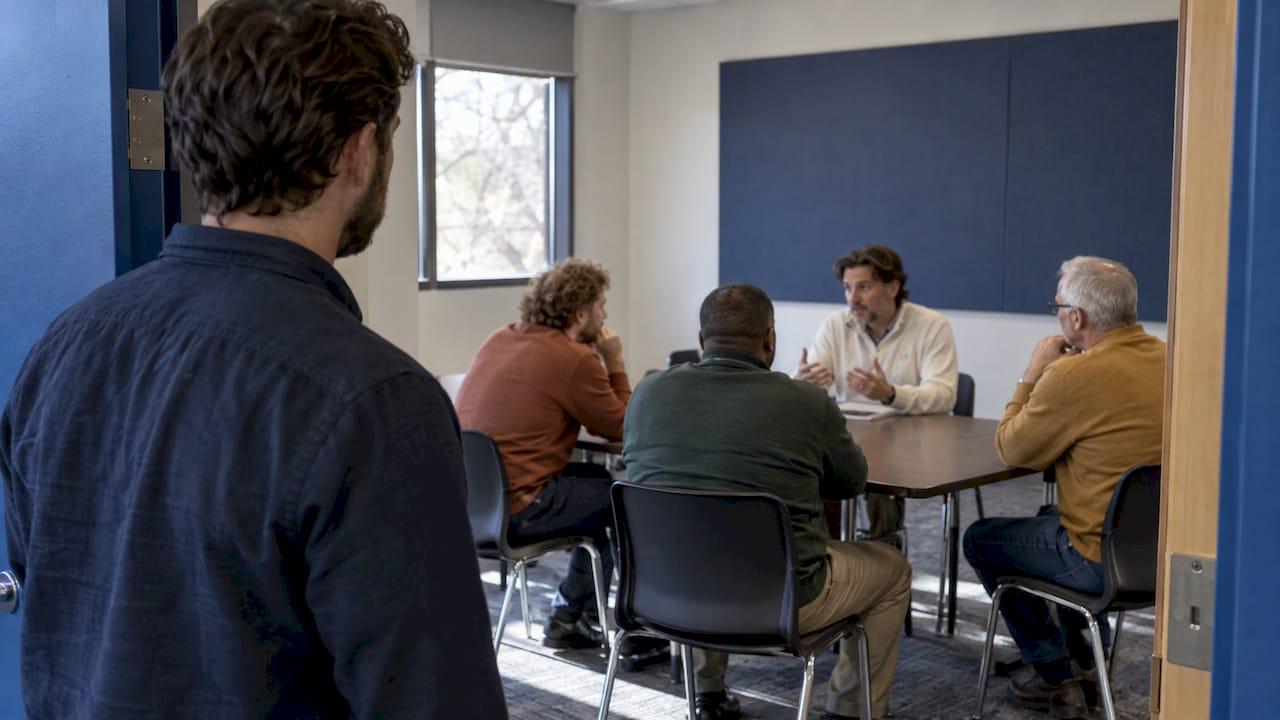
Choose a mastermind by judging five things: the men in the room, the rhythm of the meetings, the way confidentiality is handled, how accountability actually works, and whether the group shares your convictions. A good mastermind is a small, steady circle of peers who challenge you, not an audience or a lecture. At ISI Brotherhood, every member is placed in a Personal Board of Advisors, a small group of Christian men who meet regularly. The rest of this guide shows you how to evaluate any group, ours included, before you give it your time and money.
TL;DR
- A mastermind is a small peer group where the members, not one expert, hold the answers. It is not a networking mixer and not a class.
- The men matter more than the brand. Look at business stage, decision size, competitor overlap and shared faith.
- Check four things in the structure: who facilitates, how often the group meets, how confidentiality is set, and how accountability follows up.
- Count the cost in hours as well as dollars, then ask whether the group will change what you do between meetings.
- If you want biblical wisdom and business challenge in one circle, look for a group built around personal, spiritual, relational, professional and financial life.
Table of Contents
- What a mastermind is, and what it is not
- Start with why you want a group
- Get the right men in the room
- Look at the structure before you look at the pitch
- A quick scorecard
- Questions to ask before you join
- Warning signs that a group is not the right fit
- Count the cost in time and in dollars
- Where ISI Brotherhood fits
- Ready to take the next step
- Our perspective
- FAQ
- Sources
What a mastermind is, and what it is not
The word gets stretched. Before you compare groups, get clear on the category.
A mastermind is a small group of peers who meet on a regular schedule to bring real problems, give honest feedback and keep each other accountable to goals. The Maine Center for Entrepreneurial Studies, in its 2026 program brochure, says mastermind groups are not networking events, one-on-one executive coaching or group coaching. The leader builds community while the members stimulate and sharpen one another's thinking through brainstorming, feedback and accountability.
That difference shapes everything you look for:
- Networking is about wide contact. You collect cards and make introductions. A mastermind is narrow and deep: the same few men, month after month.
- Coaching puts one person at the front with the answers. In a mastermind, the group is the resource.
- A formal peer advisory board is a larger structure. A 2022 doctoral study of members of three well-known executive peer groups describes these forums as six to 16 members who typically meet monthly and serve as each other's personal advisory boards.
That last description is close to what we mean by a Personal Board of Advisors, with one addition that matters to many of the men we serve: the board is made of Christian men, and the conversation is open to scripture and prayer as well as profit and loss.
Start with why you want a group
Men who choose well usually know what is missing before they start looking. The same 2022 study found that executives joined peer groups mainly to remedy isolation, to learn and grow as leaders, and to expand their network. Those are honest reasons, and they point to three different needs.
Ask yourself which sounds most like you:
- I carry decisions nobody around me can weigh in on. You need peers who run something similar and will tell you the truth.
- I am growing as a leader and want to be stretched. You need men a step or two ahead of you, and a format that rewards preparation.
- I want my faith and my work to stop living in separate rooms. You need a group where spiritual life is on the agenda, not a topic you have to smuggle in.
The provider's prison is a real thing: the man who supplies for everyone and has nobody to ask. If that is you, the first criterion is not price or prestige. It is whether the group will let you say what is actually going on.
Get the right men in the room
The single biggest factor in whether a mastermind helps you is who sits at the table. A great format with the wrong members produces polite meetings and no change. Look at these points in turn.
Business stage and decision size
A man running a four-person firm and a man managing 200 employees can respect each other and still waste each other's time. Ask what range of revenue, headcount and responsibility the group holds. You want enough overlap that your problems make sense to them, and enough difference that they can see what you cannot.
Competitors and conflicts
If two members compete for the same customers, suppliers or hires, candor suffers. Ask how the group handles overlap before you share your pricing or your pipeline.
Shared convictions
For a Christian business leader, this is the point most guides skip. Ask plainly: do the members share a Christian faith, and is it practiced in the meetings or only mentioned in a mission statement? Do they pray together, open scripture, or ask how your marriage and your walk are doing? Decide which you want, then look for a group that does it on purpose.

Commitment level
A room of men who show up, prepare and follow through beats a room of impressive names. Ask what members are expected to do between meetings and what happens when someone drifts. Our article on who your ideal mastermind group member is goes deeper on the traits to look for.
Group size
Too large and quiet men never speak. Too small and one absence breaks the meeting. We wrote up the thinking in mastermind group size for entrepreneurs, with a recommended range of four to six members.
Look at the structure before you look at the pitch
People join a mastermind because of the conversation they hope to have. The structure decides whether that conversation happens.
Who facilitates, and how
In a mastermind, the facilitator keeps the room healthy and does not act as the expert. Watch for a leader who guards time, draws out the quiet man, redirects a long story and asks the next question instead of delivering a lecture. If the leader does most of the talking, you have joined a class.
Our piece on how facilitators teach members to collaborate describes what good facilitation looks like from the inside.
Protect the rhythm
A group that meets when everyone happens to be free soon stops meeting. Ask how often the group gathers, how long each session runs, and what the attendance expectations are. Weekly, biweekly and monthly all work, but the schedule must be set and kept. Our members meet in weekly mastermind meetings, and that steady rhythm is a large part of why the relationships go deep.
Also ask what a typical meeting looks like. Good agendas are simple: a check-in, a review of what each man committed to last time, focused time on one member's real issue, new commitments and a close. You can see sample formats in our guide to mastermind meeting agendas that actually work.
Make confidentiality clear from day one
You will share numbers, family strain, a failing partnership, a sin you are wrestling with. None of that should leave the room. Do not rely on an assumption. Ask whether the expectation is stated in writing or spoken at the first meeting, what it covers, and what happens if someone breaks it. A group that has thought this through will answer without hesitation.
Accountability that follows you home
A good conversation is not the goal. A changed week is. Ask how the group tracks what you said you would do and how it follows up. For a Christian man, accountability reaches beyond tasks. It includes the questions friends ask about your time with your family, your integrity at work and your spiritual life. Look for a group that asks them.
A quick scorecard
Use this table as you talk with any group. Give each line a score from 1 to 5.
| What to evaluate | What a strong answer sounds like |
|---|---|
| Member fit | Similar scale of responsibility, little competitor overlap, clear expectations |
| Shared faith | Faith is practiced in meetings and named in the purpose |
| Facilitation | The leader guides and protects time, and does not lecture |
| Rhythm | A fixed schedule with stated attendance expectations |
| Confidentiality | Stated clearly, from the first meeting |
| Accountability | Commitments are reviewed at the next meeting |
| Cost and time | Fees and hours are stated plainly up front |
A group that scores four or five on most lines deserves a serious look. One that cannot answer a line has told you something.
Questions to ask before you join
The best preparation is a short list of direct questions. Bring these to your first conversation:
- Who are the current members, in terms of industry, size and stage?
- How long do men usually stay, and why do they leave?
- What does a meeting look like from start to finish?
- What is expected of me between meetings?
- How is confidentiality set and honored?
- How do you handle a member who stops showing up?
- How does faith enter the conversation, in practice?
- What is the full cost, and what does it include?
If you can, talk with a current member, not only the person recruiting you. Ask what the group is like in a hard week, not just a good one.
Warning signs that a group is not the right fit
Some signs are plain once you know them:
- The leader is the star. If every meeting orbits one personality, it is closer to a seminar than a mastermind.
- Nobody can describe the format. Vague answers about "great conversations" usually mean no agenda and no follow-through.
- Confidentiality is assumed, never stated. Trust built on guesswork breaks at the worst moment.
- Members are unevenly committed. If half the room is regularly absent, you will be sharing with an empty chair.
- Everything is business. If you want your faith, marriage and finances in the conversation and they are off the table, the group is too narrow for your need.
- The pitch leans on pressure. A good group lets you take time to decide.
Trust your reaction to the first call. If you feel you must perform to belong, that is information.
Count the cost in time and in dollars
Treat a mastermind as an investment of both. The 2022 study of executive peer groups noted that members faced steep fees and substantial time commitments and still largely reported substantial return on investment and an intention to stay indefinitely. That finding applies to a particular set of formal executive groups in the United States, but it is a useful reminder that the real question is not the monthly number. It is whether the group changes how you lead.
Here is how to weigh it:
- List the hours. Add the meetings, the preparation and any travel or events.
- List the money. Include membership fees and any extra costs for retreats or events.
- Name the outcome you want. A decision you have been avoiding, a team you need to build, a marriage that needs more of you, a business that has plateaued.
- Set a review date. After a season of meetings, ask whether you made better decisions and kept more of your commitments.
Where ISI Brotherhood fits
ISI Brotherhood is a Christian business mastermind for men: business owners, entrepreneurs, executives and professionals. Every member is placed in a Personal Board of Advisors, a small, trusted group of Christian men who meet regularly to challenge, encourage and support one another in five areas of life: personal, spiritual, relational, professional and financial. Members also get a year-round online community and leadership events, and the ISI Brotherhood Foundation extends the work into communities.
There are two ways in:
- ISI Community is $97 per month. It is built for men who want the brotherhood, the online community and the resources.
- ISI Mastermind is $650 per month. It is the higher tier, with small-group mastermind cohorts built around the Personal Board of Advisors.
There is also the Deep Dive ONE THING Retreat for men who want a focused stretch of time with one decision. Details are on the retreat page.
Not sure which fits? Read our guide, which mastermind group should you choose, or listen to the podcast episode on the same question.
Ready to take the next step
If this guide has you thinking about the kind of men you want around you, the next move is a conversation, not a leap. You can start with the ISI Community free trial page, apply for the ISI Community, or apply for the ISI Mastermind.
If you are still searching, our post on how to find a mastermind group for entrepreneurs walks through the search step by step.
Our perspective
Most men come to us after years of doing it alone. They are good at their work, loyal to their families and quietly tired. What they are missing is rarely another tactic. It is a few men who know them well enough to ask the hard question and care enough to stay in the room for the answer.
That is why we place every member in a Personal Board of Advisors. We built it around five areas of life, personal, spiritual, relational, professional and financial, because a business does not run apart from the man who leads it. Your marriage, your faith and your finances all show up in the boardroom whether you invite them or not.
When you evaluate a mastermind, ask whether it will hold all of you. Ask whether the men are committed, whether the rhythm is protected, and whether confidentiality is clear from day one. Then ask whether the Word of God has a seat at the table. Iron sharpens iron, and it does so in close, regular contact.
Derek
FAQ
How many people should be in a mastermind group?
Small enough that everyone speaks every meeting. Formal executive peer groups studied in a 2022 dissertation ran six to 16 members, and many masterminds run smaller. Our own guidance for entrepreneurs is four to six, which you can read about in our group size article.
How often should a mastermind meet?
Often enough to keep momentum and follow up on commitments. Formal executive peer groups typically meet monthly. At ISI Brotherhood, mastermind groups meet weekly, which keeps accountability close and relationships strong.
Is a mastermind the same as coaching or networking?
No. A mastermind is a peer group where the members supply the insight and the leader facilitates. Networking is about broad contacts, and coaching centers on one expert teaching. Maine's 2026 program materials draw the same line.
What should I look for in a Christian mastermind?
Look for members at a comparable stage, a facilitator who guides rather than lectures, a firm schedule, clear confidentiality and accountability that reaches your family and faith as well as your business. The five areas of personal, spiritual, relational, professional and financial life are a useful checklist.
How do I know if a group is right for me?
Talk to a current member and sit with how the first conversation felt. If the men are candid, the structure is clear and you leave wanting to prepare for the next meeting, that is a good sign. If you feel pressured or unclear about the format, take that seriously.
Sources
- 2026 Build a Better Maine Program Brochure, Maine Center for Entrepreneurial Studies
- Executive Peer Advisory Groups: Who They Are, What Are They Doing (2022 dissertation, University of San Diego)