
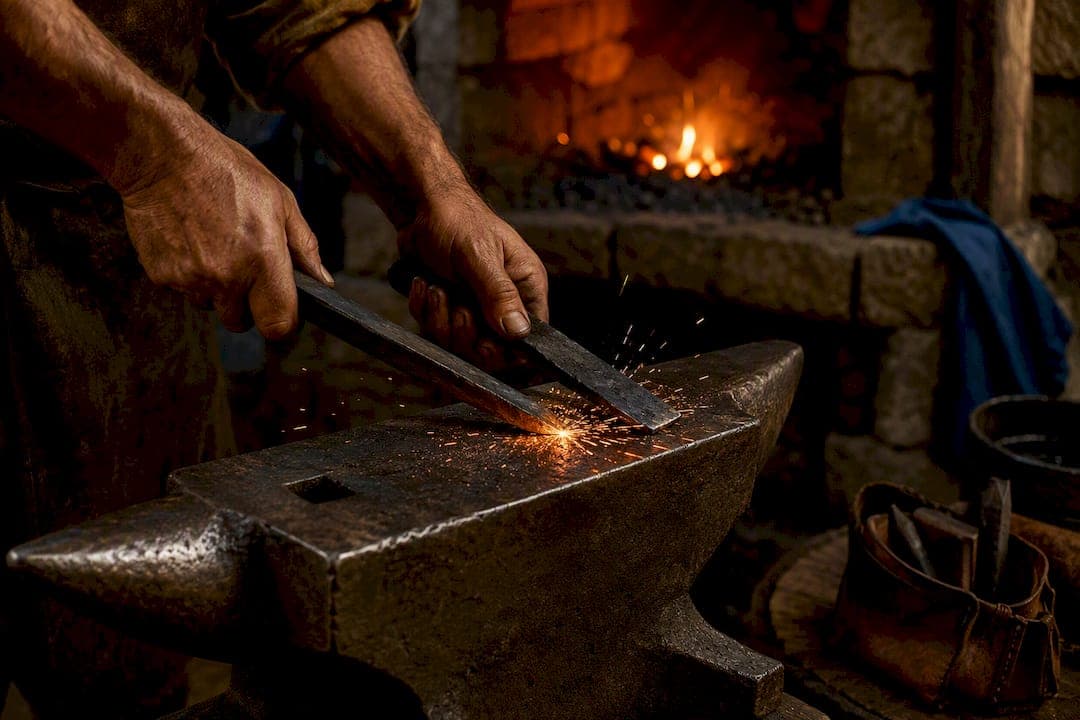
Iron sharpens iron means that one person's honest presence, correction, and challenge make another person sharper, wiser, and more useful to God, just as two blades whet each other's edge through friction. The verse (Proverbs 27:17) teaches that spiritual growth rarely happens in isolation. It happens through committed, face-to-face relationships where men tell each other the truth. What follows unpacks the text, the theology, and exactly how to build that kind of relationship in your own life.
TL;DR:
- Mutual sharpening often involves uncomfortable friction that costs both parties, but it leads to stronger spiritual and personal growth.
- Effective accountability groups should be small, meet regularly in person, and focus on consistent, hard questions that foster real vulnerability.
- Choosing the right men for sharpening relationships requires alignment with core values, demonstrated humility, and proven trustworthiness.
- The process of iron sharpening iron historically involved deliberate, abrasive contact, reflecting the costly effort necessary for genuine character development.
- Structured groups like church small groups, leadership teams, or mastermind cohorts effectively implement the sharpening principle across various settings and roles.
Table of Contents
- What Does Iron Sharpens Iron Mean in Proverbs 27:17?
- How Do Bible Scholars Interpret the Sharpening Metaphor?
- How Do You Sharpen One Another? Practical Rhythms That Work
- Who Should Sharpen You? Choosing Wisely and Avoiding Bad Fits
- How ISI Brotherhood Puts This Proverb Into Practice
- The Ancient Craft Behind the Metaphor
- Why This Proverb Points to Sanctification, Not Just Self-Help
- Ancient Wisdom Literature Beyond Proverbs
- From Small Groups to Churches: Where This Proverb Applies Today
- A Personal Word on What This Verse Actually Costs
- Ready to Put Iron Sharpens Iron Into Practice?
- Sources
- FAQ
What Does Iron Sharpens Iron Mean in Proverbs 27:17?
Proverbs 27:17 reads: "Iron sharpens iron, and one man sharpens another." That's the whole verse. No qualifiers, no exceptions, no fine print. Solomon wrote it as one line in a book built to hand down practical wisdom for daily living, and the placement matters. Proverbs 27 sits in a cluster of sayings about friendship, honesty, and the cost of isolation. Verse 5 says open rebuke is better than hidden love. Verse 6 says the wounds of a friend are trustworthy while an enemy's kisses are deceitful. Verse 9 compares the sweetness of a friend's counsel to perfume and incense. Verse 10 warns against abandoning a friend in a crisis. By the time you reach verse 17, the pattern is obvious: Proverbs treats friendship as a tool of formation, not just comfort.
The Hebrew verb behind "sharpens" carries a physical, almost violent image. It describes the literal act of grinding one blade against another until both edges bite harder. Some commentators point out this isn't a soft or passive picture. It's abrasive by design. The Gospel Coalition's commentary on Proverbs frames the book's larger purpose as shaping wise, godly character through repeated, concrete instruction rather than abstract theory, and 27:17 is a prime example of that method.
A few textual threads worth holding onto:
- Proverbs 27:5-6 sets up the value of honest confrontation over silent flattery.
- Proverbs 27:9-10 links good counsel to loyal, present friendship.
- Proverbs 27:19 ("as in water face reflects face, so the heart of man reflects the man") reinforces that other people show us who we really are.
How Do Bible Scholars Interpret the Sharpening Metaphor?
Most classical and contemporary commentators land on the same core reading: mutual improvement through honest relationship. But there's a real nuance worth knowing before you assume "sharpening" always feels pleasant.
Matthew Henry's commentary on Proverbs 27 describes the verse as picturing believers who "quicken and rouse" one another, sharpening wit, knowledge, and grace so both parties become more effective for godly living. That's the dominant, encouraging strand of interpretation, and it's the one you'll hear most often from the pulpit. Matthew Henry's full commentary frames this as restoration as much as improvement, men correcting each other back onto a better path.
Pastoral voices build on that same foundation but push it further. Desiring God's writing on friendship argues the verse calls Christians into face-to-face, disciplined accountability specifically so they don't drift into isolation or spiritual complacency. Kevin DeYoung, writing for The Gospel Coalition, makes a similar point: real friends aren't just agreeable companions. They're the ones who shape your character through faithful, sometimes uncomfortable, counsel.
Statistic Callout: There's no polling data on how many Christian men have a friend who regularly challenges them, but the pattern across pastoral writing is consistent: isolation, not opposition, is named as the more common threat to spiritual growth among believers.
Here's the nuance most sermons skip. Some scholarly discussion of the underlying Hebrew verb suggests it can imply a sharper, more forceful sharpening image than the gentle "encouragement" reading most people default to. A scholarly summary published through Project MUSE notes this potential for a harsher connotation. That doesn't mean the verse endorses harshness for its own sake. It means real sharpening sometimes involves friction that doesn't feel good in the moment, and pastors who only preach the comfortable version leave men unprepared for the actual experience of being corrected.

How Do You Sharpen One Another? Practical Rhythms That Work
Sharpening isn't a feeling. It's a structure. Without a rhythm, even the best-intentioned friendships drift into small talk and status updates. Here's a workable framework drawn from how effective accountability actually functions.
- Keep the group small. Three to seven men is the range most accountability structures use, small enough for real vulnerability, large enough to cover life's five domains (personal, spiritual, relational, professional, financial).
- Meet weekly or biweekly, in person when possible. Video calls work in a pinch, but presence changes what men are willing to say out loud.
- Use the same core questions every time. Consistency builds trust faster than novelty does. Ask about a spiritual discipline, a marriage or family tension, and a business decision each meeting.
- Confess before you're asked. The men who grow fastest bring up their own struggle before someone has to pry it out.
- Follow up on last week's answers. Accountability without follow-through is just conversation.
A sample agenda: open in short prayer, review the prior week's commitments, ask three to five direct questions ("Where did you compromise this week? Where is pride showing up in how you lead? What are you avoiding telling your spouse?"), then close by naming one specific commitment for the next meeting. ISI Brotherhood's guide to accountability questions for men has a more complete list organized by domain.
Boundaries matter as much as the questions. Make confidentiality clear from day one, before the first real disclosure happens, not after something goes wrong. Protect the rhythm. A group that meets "whenever" quietly becomes a group that meets never.
Pro Tip: Write down your group's three or four standard questions on a card or shared doc. Groups that improvise their questions every week tend to stay shallow far longer than groups that repeat the same hard questions on purpose.

Who Should Sharpen You? Choosing Wisely and Avoiding Bad Fits
Iron sharpens iron, but iron can also damage iron if the metal is bad or the pressure is wrong. Proverbs itself is honest about this risk, warning repeatedly about the company a person keeps. Choosing who gets to speak into your life matters as much as being willing to listen.
Look for these markers before you let someone into that role:
- Alignment with the gospel, not just shared business interests or personality fit.
- Demonstrated humility, someone who takes correction as well as gives it.
- A track record of faithfulness over time, not just a good first impression.
- Basic competence in the areas you need input on (spiritual maturity, business judgment, or both).
- A proven ability to keep confidence.
Watch for red flags too: correction that feels like control, a pattern of unrepentant behavior, or a group dynamic that's turned gossip into "accountability." If a sharpening relationship has already gone bad, get the right men in the room to help you sort it out. Sometimes that means direct reconciliation. Sometimes it means resetting boundaries. Occasionally it means walking away entirely, and that's not a failure of the proverb. It's the proverb working correctly, protecting you from iron that was never sound to begin with.
How ISI Brotherhood Puts This Proverb Into Practice
ISI Brotherhood builds its entire model around this one verse. Every member gets placed into a Personal Board of Advisors, a small group of Christian men who meet on a consistent rhythm to challenge and support one another across five areas: personal, spiritual, relational, professional, and financial. Weekly mastermind meetings, a year-round online community, and leadership retreats round out the structure.
The mapping to the practices above isn't accidental:
- Small group size mirrors the three to seven range recommended for real accountability.
- A committed, protected weekly rhythm replaces the sporadic "let's grab coffee sometime" pattern most friendships fall into.
- Confidentiality expectations are made clear from day one, not left to assumption.
This model tends to fit best for men already leading something, a business, a team, a household, who feel the isolation that often comes with responsibility. ISI Brotherhood's leadership accountability guide walks through how these boards typically function over a 30 to 90 day window.
Pro Tip: If you're not sure whether a structured board or an informal friendship group fits your season, ask yourself who currently has permission to tell you something you don't want to hear. If no one does, that's your answer.
The Ancient Craft Behind the Metaphor
Iron sharpening in the ancient Near East wasn't a quick trick. Iron tools, blades, plow points, and weapons, dulled with heavy agricultural and military use, and sharpening them required deliberate, repeated friction, often blade against blade or blade against a whetstone. The image Solomon reached for wasn't decorative. It was a scene his original readers watched happen regularly in fields and workshops.
Iron itself carried weight as a material in this period. It represented a step up in strength and durability from bronze, and the Iron Age brought tools and weapons that held an edge longer but also required more effort to maintain that edge. The process wasn't gentle. Metal against metal produced sparks, noise, and visible wear on both pieces before either one got sharper. That's the physical reality standing behind the spiritual claim: sharpening cost something to both blades.
This is likely why the proverb pairs "iron" with "iron" instead of a softer material. A whetstone sharpens a blade without being changed itself. Iron on iron changes both. That detail carries the theological weight of the verse: mutual sharpening isn't one person fixing another from a position of superiority. It's two people, equally exposed to friction, both walking away different than they started. Solomon's audience would have pictured a blacksmith's shop or a farmer working his tools before harvest, not an abstract idea about self-improvement.
Why This Proverb Points to Sanctification, Not Just Self-Help
Iron sharpens iron describes sanctification, the ongoing process of becoming more like Christ, not personal optimization. That distinction shapes how a Christian should actually use this verse. Self-help culture treats growth as an individual project: better habits, better discipline, better outcomes, achieved largely alone. Proverbs 27:17 assumes the opposite. Growth in godliness happens through other people, often through discomfort those people introduce.
Hebrews 3:13 reinforces the same logic from a different angle: "exhort one another every day, as long as it is called 'today,' that none of you may be hardened by the deceitfulness of sin." Sin hardens gradually and often invisibly. The remedy Scripture prescribes isn't more willpower. It's other believers, speaking honestly, on a regular basis, before hardness sets in unnoticed.
This is why isolation shows up so often in pastoral writing as a spiritual danger rather than just a social inconvenience. Desiring God's reflection on rebuke and accountability argues that leaders in particular need peers willing to correct them, since position and success tend to insulate people from honest feedback exactly when they need it most. Sanctification, in this framing, isn't something that happens to you in private devotion alone. It happens in rooms with other men who know your actual life, not just your public one.
Ancient Wisdom Literature Beyond Proverbs
The instinct to compare a person's character to a sharpened tool or a refined metal wasn't unique to Israel. Ancient Near Eastern wisdom traditions, including Egyptian instructional literature that predates and parallels parts of Proverbs, frequently used craft and metallurgy imagery to describe moral formation. The broader wisdom genre across the region shared a habit: reach for something physical and skilled, a trained scribe, a well built house, a sharpened blade, to describe something invisible, like character or discernment.
What sets Proverbs 27:17 apart within that shared literary world isn't the metaphor itself but its relational framing. Many ancient wisdom texts focus on an individual's private discipline: the wise man controls his tongue, manages his household, avoids folly on his own initiative. Proverbs certainly includes plenty of that individual instruction elsewhere. But 27:17 specifically locates growth inside a relationship between two people. It's not "sharpen yourself." It's "iron sharpens iron," a mutual, reciprocal action requiring another person's presence.
That relational emphasis lines up with the rest of Proverbs' treatment of friendship, seen in the surrounding verses about honest rebuke, loyal presence, and trustworthy counsel. Wisdom literature across the ancient world valued skill and refinement. Proverbs adds something distinct: refinement that requires companionship, not solitude, and that costs both parties something in the process.
From Small Groups to Churches: Where This Proverb Applies Today
Iron sharpens iron scales beyond one on one friendship. Churches, businesses, and leadership teams all run on the same principle, whether they name it or not. A church staff that never challenges its own decisions, a board that rubber stamps every proposal, a leadership team where no one disagrees out loud, these are organizations missing the friction the proverb describes as necessary.
Church communities apply this most visibly through small groups, elder boards, and mentorship pairings, structures built specifically so members don't practice their faith in isolation. Leadership development programs increasingly build in structured peer accountability for the same reason individual Christians need it: authority tends to reduce the honest feedback a person receives, right when the stakes of bad decisions go up. Desiring God's writing on leadership makes the point directly, arguing that leaders who avoid correction put the people they lead at risk.
Business mastermind groups, executive coaching cohorts, and pastoral peer networks are all secular or semi-secular versions of the same instinct Solomon captured three thousand years ago. Get the right men in the room, protect a consistent meeting rhythm, and ask questions with enough weight to matter, and the structure will do what Proverbs 27:17 describes regardless of whether anyone quotes the verse out loud. The application isn't limited to personal devotion. It's a design principle for any group of people trying to grow together instead of apart.
A Personal Word on What This Verse Actually Costs
The men who've grown the most from a sharpening relationship rarely describe it as pleasant in the moment. They describe a friend who said the hard thing, on time, without softening it past usefulness. Before you build or join a group around this proverb, ask yourself three questions: Who currently has permission to correct me? When did I last change a decision because a friend pushed back? Am I willing to be the iron that costs someone else something, too?
— Derek
Ready to Put Iron Sharpens Iron Into Practice?
Reading about accountability and actually having it are two different things, and most Christian men default to isolation simply because no structure exists to pull them out of it. ISI Brotherhood is built specifically to solve that gap: instead of loose networking or the occasional accountability lunch, every member gets placed into a Personal Board of Advisors, a small group of Christian men committed to a protected weekly rhythm across personal, spiritual, relational, professional, and financial life.

The ISI Community plan offers monthly membership giving access to the online community, resources, and events built around this model. The ISI Mastermind adds the full small-cohort mastermind experience for business owners and executives who want deeper, weekly accountability. For men wanting a concentrated, intensive experience, the Deep Dive ONE THING Retreat offers a focused format outside the weekly cadence. These memberships fit Christian leaders who want the kind of honest, ongoing friendship Proverbs 27:17 describes. Visit the ISI Community or ISI Mastermind page to see which format fits your season and apply.
Sources
- Take the first steps toward deep friendship — Desiring God
- Matthew Henry commentary on Proverbs 27 — BibleStudyTools
- What does it mean that iron sharpens iron? — GotQuestions
FAQ
What Does Iron Sharpens Iron Mean Spiritually?
Spiritually, it means God grows Christians through relationship, not isolation. One believer's honesty, encouragement, and correction sharpen another's character, faith, and discernment, the way two blades sharpen each other through friction.
What Is the Deeper Meaning of Proverbs 27:17?
Beyond the surface picture of two blades, the verse teaches that godly growth requires face-to-face, honest relationships willing to correct as well as encourage. Matthew Henry's commentary reads it as mutual restoration, believers sharpening each other's grace and effectiveness for godly living.
How Do We Sharpen One Another as Believers?
Practically, through regular, structured time together, weekly or biweekly meetings, honest questions across spiritual, relational, and professional life, and a willingness to confess struggle before being asked. GotQuestions points to fellowship, teaching, and prayer as the contexts where this sharpening happens naturally. Structured options like ISI Brotherhood's mastermind groups build this rhythm intentionally for Christian leaders.
Is Iron Sharpens Iron an Analogy?
Yes. It's a metaphor comparing the physical process of sharpening metal to the relational process of one person shaping another's character. The comparison works because both processes involve friction, contact, and a change that neither party could produce alone.
Does the Verse Only Apply to Close Friends?
No. While friendship is the clearest application, the same principle applies to church small groups, leadership teams, and business peer groups. Any relationship built on consistent presence and honest correction can function as the "iron" the proverb describes.