
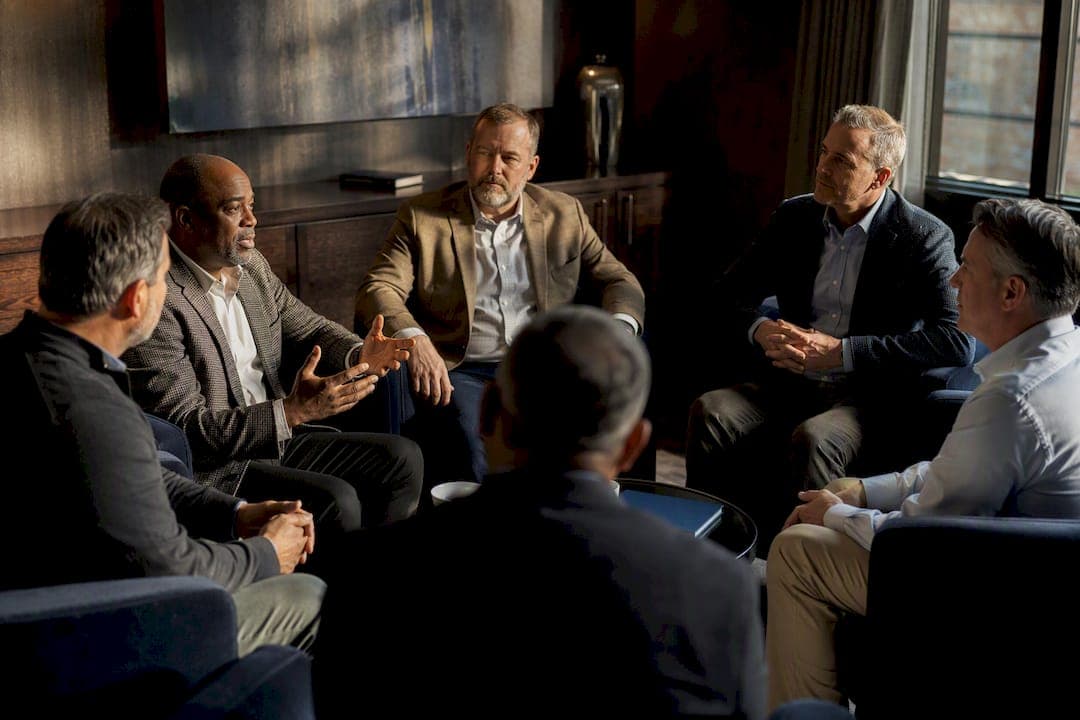
Authentic relationships at work, for the Christian business leader, are not built through happy hours or LinkedIn connections. They are built inside a Personal Board of Advisors: a small, trusted circle of Christian men who meet on a set rhythm to speak honestly into your personal, spiritual, relational, professional, and financial life. Structured peer groups like this outperform informal networking because they force candor and accountability where casual relationships never go. ISI Brotherhood is one working example of this model in practice.
TL;DR:
- Structured Christian peer groups outperformed informal networks in growth and retention, with regular meetings, feedback, and goal setting being key drivers.
- Optimal group size is six to ten men, with consistent meeting rhythms, clear confidentiality, and roles assigned to maintain trust and accountability.
- Intergenerational groups tend to improve relational satisfaction in marriage and fatherhood, reinforcing the benefit of diverse life-stage perspectives.
- Joining or starting a faith-based mastermind involves assessing fit, structure, safety, cost, and expected outcomes, with Trust building typically happening within 90 days.
- Membership programs like ISI Brotherhood extend relationships through online communities and retreats, emphasizing honest conversations over casual networking.
Table of Contents
- Why this model works: the case for structured Christian peer groups
- Core elements that generate authentic, accountable relationships
- How to evaluate or start a faith-based men's mastermind
- What membership looks like: the member experience
- First practical steps: a 30 to 90 day starter plan
- A reflection on what a Personal Board of Advisors actually does
- How ISI Brotherhood puts this model into practice
- Sources
- FAQ
Why this model works: the case for structured Christian peer groups
The hustle of running a business can leave a man surrounded by people yet fundamentally alone. Structured peer groups exist to close that gap, and the evidence behind them is not soft.
Harvard Business School research found that entrepreneurs who received structured, formal peer advice, meaning regular meetings, consistent goal setting, and frequent feedback, grew larger and failed less often than those who relied on informal advice. That is the difference between a casual coffee chat and a Personal Board of Advisors that actually holds you to something.
The relational payoff runs deeper than business metrics. Barna's research on friendship and fatherhood found that practicing Christian men with intergenerational friendships tend to report higher satisfaction in both fatherhood and marriage than men without them. A board that spans generations does not just sharpen your business instincts. It steadies your home.
Here is what a well-built board delivers, in plain terms:
- A place to be known honestly, not performed for
- Faster, clearer decisions because someone outside your head is weighing in
- Lower loneliness and higher resilience during hard seasons
- A structure that keeps spiritual growth from becoming an afterthought
Peer groups built on structure, not just fellowship, tend to outperform casual networks. The Harvard Business School study is one of the clearest signals that formal cadence and feedback change outcomes, not just feelings.
Core elements that generate authentic, accountable relationships
A mastermind only produces depth when it is built with intention. The following elements separate a group that transforms men from one that simply meets for coffee.
- Keep the group small. Six to ten men is the range most peer advisory research points to, small enough for candor, large enough for varied perspective.
- Protect the rhythm. Consistency of meetings, not intensity of any single session, is what research and practitioners alike point to as the real driver of trust over time.
- Assign real facilitation roles. A moderator to guide the conversation and a timekeeper to protect every man's turn keep the group from drifting into venting sessions.
- Make confidentiality clear from day one. A short written covenant spelling out what stays in the room, attendance expectations, and what happens if someone breaks trust accelerates the psychological safety a group needs.
- Get the right men in the room. Screen for spiritual alignment, honesty under pressure, and complementary expertise rather than simply inviting friends.
- Set commitment expectations up front. Attendance, preparation, and follow-through on action items should be spoken agreements, not assumptions.
Pro Tip: Write your group's confidentiality covenant before your first meeting, not after your first hard conversation.
How to evaluate or start a faith-based men's mastermind
Whether you are joining an existing group or building one from scratch, a few questions separate a group that will change you from one that will waste your Tuesday mornings.
Weigh any group against five things: fit (do the men share your season and calling), structure (is there a real agenda and cadence), safety (is confidentiality enforced, not just mentioned), cost (does the investment match the depth promised), and outcomes (do members report actual change).
Before you commit, ask the organizer or existing members:
- How are new members selected, and who says no?
- What does a typical meeting agenda actually look like?
- How is confidentiality enforced when someone breaks it?
- How long have current members stayed, and why?
Watch for red flags: inconsistent attendance nobody addresses, no written norms anywhere, or a culture that punishes honesty instead of rewarding it.
A simple 90-day framework helps you gauge whether a group is working. In the first 30 days, expect introductions and the setting of norms. Between 30 and 60 days, look for early vulnerability and honest feedback. By 60 to 90 days, mutual accountability and deeper spiritual conversation should be showing up on their own. For a fuller walkthrough of forming a confidential board, see this guide to structured peer groups.

What membership looks like: the member experience
Numbers on a page rarely capture what it feels like to sit inside a group like this week after week. A typical meeting moves through a check-in, an accountability review of commitments made last time, a hot seat where one man brings his hardest current issue, and a closing prayer or short devotional.
Between meetings, the relationship does not go quiet.
- A year-round online community keeps conversations going beyond the weekly meeting
- Members lean on each other for quick counsel between sessions
- Retreats or deep dive events create space for the kind of breakthrough a one-hour meeting cannot hold
- Time investment runs from a weekly meeting to periodic retreats, with financial commitment scaled to the depth of the group
Retreat-style events matter because they compress months of trust-building into a few focused days, the kind of intensity that ordinary meetings cannot replicate. For more on how faith and business practice intersect day to day, this piece on guiding your business with purpose is worth a look.
First practical steps: a 30 to 90 day starter plan
Reading about a Personal Board of Advisors and joining one are different acts. Here is how to close that gap without overthinking it.
- Reach out or extend an invitation this week. Contact an existing group or invite five to seven men you respect to explore starting one.
- Commit to three meetings before judging the experience. Trust rarely shows up in the first session.
- Protect the rhythm from the start. Put the recurring meeting on the calendar as a fixed commitment, not a maybe.
- Prepare before your first sitting. Bring a one-page bio, one real issue you are wrestling with, and a posture open to prayer.
- Track early signs of benefit. Watch for growing trust, clearer decisions, and any shift in your spiritual footing.
A men's accountability structure works best when it is treated like a standing appointment, not a backup plan. This accountability group guide offers more detail on building that habit.
A reflection on what a Personal Board of Advisors actually does

I remember a meeting where a man on my board finally said the thing he had been circling for weeks: his marriage was in trouble and his business was the excuse he used to avoid it. Nobody flinched. Nobody offered a quick fix. The room just held it, and that held moment did more for him than any advice could have.
That is what the Harvard research on structured peer advice and the Barna findings on intergenerational friendship point toward from different directions: depth does not come from good intentions, it comes from consistent structure that gives men permission to be honest. Get the right men in the room, protect the rhythm, and the honesty tends to follow on its own.
— Derek
How ISI Brotherhood puts this model into practice
This program is built around the exact structure this article describes. Members are placed into a Personal Board of Advisors, a small group of Christian men who meet regularly to speak into personal, spiritual, relational, professional, and financial life, not just business strategy.
- Weekly mastermind meetings protect the rhythm rather than leaving connection to chance
- Members are curated so the right men end up in the room together
- Confidentiality is made clear from day one, not assumed
- A year-round online community and events like the Deep Dive ONE THING Retreat extend the relationship beyond the weekly meeting
If you are ready for a structure rather than another networking event, explore the ISI Mastermind or start with the ISI Community to see how the model fits your season.
Sources
Research from HBS, the HBR peer group guide, and Barna informs this article, alongside ISI Brotherhood's own membership pages.
- The Connection Between Friendship and Fatherhood — Barna Group
- Harvard Business School research on peer advice and firm growth — HBS
FAQ
What does "authentic relationships at work" mean in a faith-based mastermind?
It means a small, trusted Personal Board of Advisors of Christian men who meet regularly to speak honestly into your personal, spiritual, relational, professional, and financial life. This goes beyond networking because the structure demands candor and accountability rather than surface-level connection.
How large should a Christian men's mastermind group be?
Most peer advisory research points to six to ten members as the range that balances honest conversation with enough perspective in the room, according to the HBR peer group guide. Smaller groups risk narrow input, while larger ones lose the candor that makes the model work.
Does an intergenerational group actually help relational health?
Yes. Barna's research found that practicing Christian men with intergenerational friendships report notably higher satisfaction in fatherhood and marriage than men without them, which supports curating a board across age and life stage.
What does ISI Brotherhood membership cost?
ISI Community runs $97 per month, and ISI Mastermind runs $650 per month, each offering a different depth of access to a Personal Board of Advisors and community. Details for both are available on the ISI Mastermind and ISI Community pages.
How soon should I expect real trust to build in a new group?
Expect introductions and norm setting in the first month, early vulnerability and honest feedback by the second month, and mutual accountability with deeper spiritual sharing by the third. Consistency of meetings, not the intensity of any single session, is what drives that trust over time.